I got back from Gen Con yesterday. All in all, I had a really great time, picked up a bunch of cool stuff, and then came home to find a stack of Kickstarter games on my front porch. (Which I’m referring to as Gen Con Twelfth Night now that it’s happened three times in a row.)
But I did run into something of a bad streak of luck this year when it came to actually playing games. Although there were a couple of really great games, for the most part I was mired in complete duds. In a few cases, this was the result of a bad scenario, but for the most part I was suffering from some truly atrocious GMing.
This caused me to reflect on the fact that GMing is one of those crafts where you very rarely get to see another practitioner’s work. There are, of course, some groups where players will cycle through the GM’s chair, but this seems to largely be the exception rather than the rule. As a result, I suspect that many (possibly most) GMs exist in a bubble, and this isolation limits their ability to recognize (and correct) their shortcomings.
I’ve written a great deal of advice for GMs here on the Alexandrian, and most of it is positive in nature. I like to tell you about the nifty stuff that you could be doing or adding to your games. But now I’m going to spend a little time taking the opposite approach: I’m going to talk about the stuff that you should NOT be doing.
The examples I’ll be using here are primarily drawn from some of the bad experiences I had at Gencon. But since I’m not looking to specifically call anybody out, I’ll be anonymizing the details.
GM DON’T #1: MORPHING REALITY
Player: Shit! Okay, we run out the other door!
GM: There is no other door. The only way out is the way you came in.
Player: What the hell happened to the other door?!
There’s nothing more frustrating for a player (nor more guaranteed to shatter their engagement with the game) than watching the reality of the game world shift like a mirage in front of their metaphorical eyes.
In some cases, of course, this morphing of reality is the result of poor communication: The GM forgot to mention the ogre that is now pounding in their skull when they unwittingly tried to run past it. Or when the GM said that the doors were at the “end of the hallway” he meant they were facing each other across the width of the hall while the players assumed he meant they were standing side-by-side looking down the length of the hall.
Far more problematic, however, is when it becomes clear that the GM’s own mental picture of the game world is inherently unstable. For example, there was a science fiction scenario where a ship’s compartment was filled with vacuum… or not. 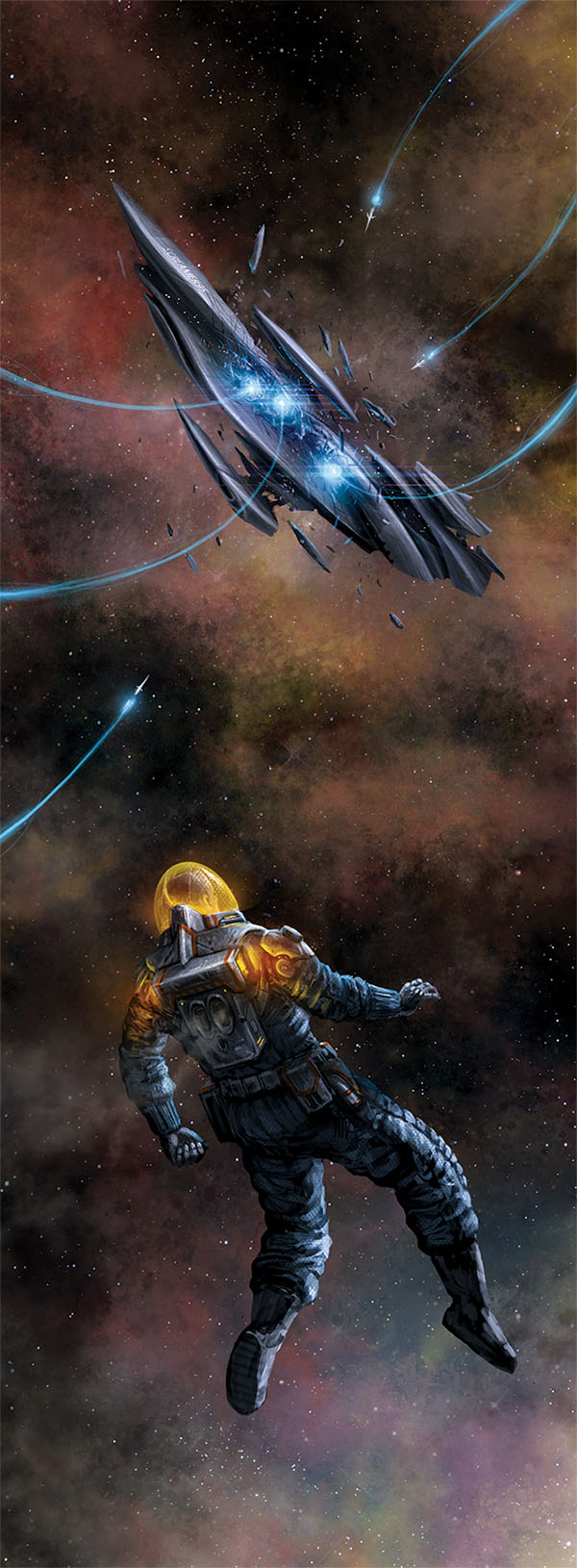 It oscillated randomly over several rounds of combat. (And if you’re thinking that this would be distressing for anyone in that compartment, you would be correct. Maybe you’re the character who carefully took the time to make the preparations to enter a vacuum only to be upstaged by someone else rushing into the compartment because the vacuum has vanished. Or maybe you’re the character suddenly exposed to the vacuum because you entered the compartment after being assured that everything was fine now until the GM suddenly remembered that the vacuum was supposed to be there. Either way, everything else about the game will quickly become blotted out by your palpable frustration.)
I think it can be argued that maintaining the integrity of the game world is, in fact, the GM’s most fundamental task. Everything else flows from that singular, unifying vision. And without that integrity meaningful choice (the defining characteristic of the roleplaying game) becomes impossible.
Perhaps the most common form of morphing reality is geographic: Distances that double or quadruple in size. Ogres who can somehow simultaneously be standing right next to two characters who are nowhere near each other. Hallways that appear and disappear from the floorplan. But it’s a problem which can be found in any aspect of the game world: NPCs who change their appearance. Organizations that flip-flop between panopticon omniscience and bumbling cluelessness. Spells that vary in efficacy depending on the GM’s mood.
On that last note, it’s also important to note that, in addition to descriptive consistency, the GM should also strive to achieve mechanical consistency. As Ben Robbins’ elegantly states in “Same Description, Same Rule”:
The game world is imaginary. It does not exist except in the minds of the participants. Each person has their own mind and their own imagination, which makes it all the more important to make sure there is a consensus, that you are all operating in the _same_ fictitious world and in agreement about how things work. Consistency makes that easier, inconsistency makes it harder.
To use an example from M&M, the players encounter one machine gun that uses a normal attack roll, and then later they encounter another machine gun that uses an Area attack instead (automatic hit, Reflex save to reduce damage). Conceptually the two machine guns are identical — one is bigger but otherwise the same.
A player sees the second machine gun before it fires and says “a ha, I will dodge to increase my Defense, which will make me harder to hit!” Logical but completely incorrect, because that player doesn’t know that the second machine gun uses a rule mechanic that has nothing to do with Defense.
(…)
There’s a simple fix for this:
The same description should never be modeled with two different rules. If you want to use a different rule, there should be a different description.
IMPROVING YOUR VISION
RPGs are the theater of the mind. They’re improvisational radio drama. Achieving consistency means holding complex pictures of the game world in your mind while simultaneously juggling all of the other things the GM needs to be doing at the gaming table.
That’s not easy.
The degree of complexity in that mental image that can be successfully managed will vary a lot between GMs. (This is also a skill, of course, and you’ll generally find that you’ll improve at it over time.) So the first thing a GM needs to do is know their limits. And once they know those limits, they can find ways to push beyond them.
For example, I know that I, personally, can’t handle fights with simultaneous action resolution if there are more than 8-12 characters involved. Beyond that limit, I can’t keep all of the disparate actions in my head at the same time and figure out how things would play out. So when that situation began cropping up frequently in my OD&D open table campaign, I responded by creating a mechanical structure that split the round into multiple resolution phases so that I was handling smaller groups of characters at any given moment.
If you struggle with keeping the geography of a locale consistent, sketch out a quick map. (This doesn’t have to be a hyper-accurate blueprint: It just needs to cement the idea that the kitchen is here and the bedroom is over there.) Jot down notes on your NPCs to keep their appearance and characterization consistent. Keep a campaign journal so that you can track continuity between sessions.
IMPROVING YOUR CONVERSATION
Once you’ve got things straight in your own mind, you can work on improving communication with your players. Start by making a mental (or physical) note of moments when your players become confused by your descriptions. Review those moments: How could you have phrased things differently – or what details could you have added – in order to make things clearer? Over time you’ll figure out which phrases (like “at the end of the hallway”) are too vague and how you can make them more precise.
(Note that precision does not necessarily equate to greater length.)
Creating clarity might also mean using visual references: Drawing diagrams, handing out photographic references for major NPCs, hanging a map of the city on the wall, and the like.
TRIAGE AT THE GAME TABLE
While you’re working on all of that, keep in mind that no matter how skilled you become mistakes and misunderstandings will still happen. So give some thought about how you’ll handle that confusion when it happens.
First, be alert for signs that a misunderstanding has occurred. Usually a dead giveaway is if the players are proposing actions which don’t make sense to you. I’ve talked about this at length before and proposed a general principle:
If you don’t understand what the players are trying to achieve with a given action, find out before adjudicating the action.
Second, give the benefit of the doubt to your players. Your vision of the game world is not precise and the situation of the game world is dynamic (even if your mechanics are breaking it down into sequential turns).
For example, there’s an ogre fighting in the middle of a room and one of the players declares that he’s going to run past the ogre. Clearly in their vision of the situation there’s enough room for them to safely do that. Maybe in your vision of the room things aren’t so clear-cut. But if you just have the ogre take a step to the left as he swings his club at Athena, then you could easily imagine Horatio  rushing past him. So let it happen.
Third, find ways to compromise between your vision and what they want to accomplish.
Maybe it really is impossible for Horatio to just run past the ogre: It’s a small room or maybe the ogre is specifically trying to prevent people from getting past it. Instead of just declaring it impossible, however, look at what the player is trying to accomplish (get past the ogre) and then offer them a way to do that which is consistent with your vision of the room: Maybe they can make a Tumble check to get past it. Or maybe Athena could deliberately bait it out of the way.
This process of compromise isn’t just a specific application of the “Yes, but…” principle of GM rulings (although it is), it also smooths the players’ correction of their mental picture. These mental pictures, after all, are built up from an aggregate of detail. By offering options for accomplishing their goals, you’re encouraging them to focus on the additional details you’re adding (the room is smaller than you thought) instead of on the rejection of their previous vision. (It’s a subtle distinction, but in my experience it’s significant.)
Finally, when the wheels come completely off the bus don’t be afraid of allowing minor retcons to resolve the discordance.
If I’m following the advice above, I find this most often occurs when the consequence for the misunderstanding doesn’t immediately manifest itself. For example, “If I’d known the ogres were close enough to get here before my next turn, I never would have stopped to pick up the idol!”
Even with the passing of some short span of time, it’s usually still not too difficult to just back things up a step, correct the action taken under a misapprehension, and then move forward. But as chains of cause-and-effect become more complicated you do have to balance the potential discordance of the retcon against the discordance of the player’s disconnection from the game world. (Also bear in mind that there is a difference between “the character didn’t know” and “the player didn’t understand”: If the player thought the ogres were several hundred feet away when they were actually only a few dozen feet away, that’s one thing. But if Horatio didn’t realize that the ogres could traverse several hundred feet in a single round because of the cheetah totems they’re wearing, that’s a completely different thing.)
Once again, it can be useful to consider the compromise of a negotiated retcon: When Horatio grabbed the idol he was granted a brief vision, so you’re not going to allow a retcon that wipes that moment out completely. But maybe you’ll allow Horatio to avoid getting cut off by the ogres if he drops the idol and makes a run for it with a successful Athletics check.
Go to Part 2
THE GM DON’T LIST
#2: Rolling to Failure
#3: Resolution Dithering
#4: Thou Shalt Not Hack
#5: Not Knowing the Rules
#6: Choose Your Own Adventure
#7: Preempting Investigation
#8: Mysteries With No Clues
#9: Fudging
#10: Idea Rolls
#11: Description-on-Demand
#12: Mail Carrier Scenario Hooks
#13 Boxed Text Pitfalls
#14: Fearing the Silence
#15: The Railroader’s Fallacy
#16: Not Writing Down Initiative
#17: Too Many Players
#18: Too Precious Encounters
#19: Ignoring Character Backstories
#20: Always Say Yes

 the violet spiral to force the Strange to read the wrong “memory location” and write Rukian reality into the prime world.) This would be specifically advantageous to the Karum because it would allow them to construct a backpack-size particle accelerator, which would be used, in turn, to “ping” the Strange energy network and provide a path for a planetovore to reach (and destroy) Earth.