
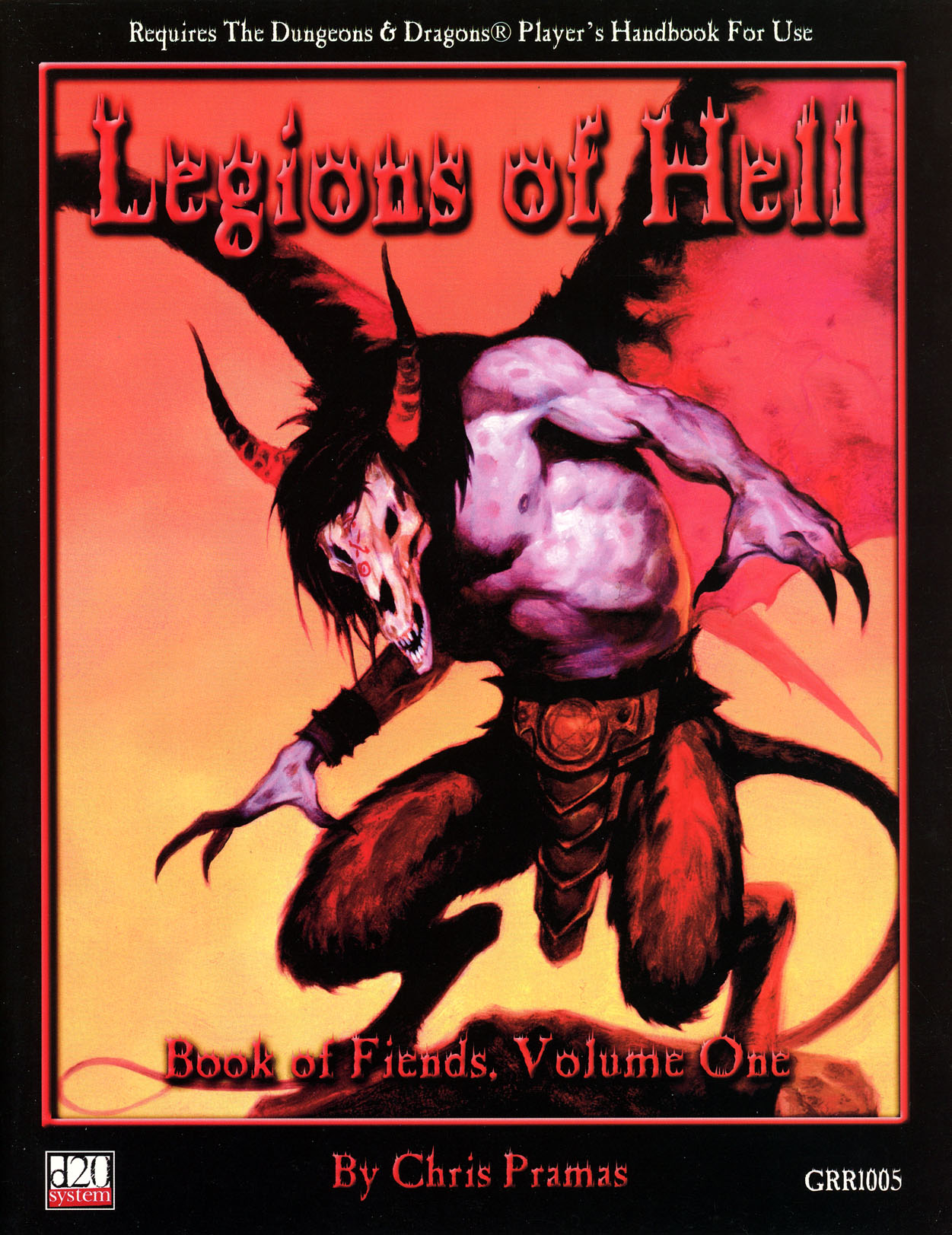
In a word: Excellent. Easily one of the Top 10 D20 supplements released to date.
Review Originally Published October 13th, 2001
Let’s face it: When we look at the shelf in our game shop and see yet another D20 monster manual variant, our eyes begin to glaze over. “For the love of God,” we think, “How many cheesy fantasy monsters can these people crank out? Oh, look! It’s a geezlehopper. It just like an orc, except it’s neon pink! Ooooo! Wow!”
We’ve so thoroughly “been there, done that” that it makes the endless Energizer Bunny commercials look fresh and innovative. (Do you realize that there are children in sixth grade who have never seen the original Energizer Bunny commercials? One is forced to wonder what, exactly, they think of this inexplicable pink bunny – who, as far as they can tell, has always starred in some of the worst commercials imaginable. But I digress.)
That’s why I’m writing this review: To send up a bright signal beacon to the gaming world at large, while jumping up and down and screaming:
HEY! OVER HERE! THERE’S AN INCREDIBLY AMAZING, HIGH QUALITY CREATURE CATALOG OVER HERE!
It’s called Legions of Hell, and it’s published by Green Ronin (famed in the D20 market for their Freeport modules).
THE LEGIONS OF HELL
As the title should suggest, Legions of Hell delves deeply into the nine circles of the Pit, exploring the servants of Asmodeus, the King of Hell. The core of the book consists of roughly forty-five monster entries, detailing a wide-range of hellish creatures.
At one end of the scale, Legions of Hell contains the foot soldiers of hell: The Akop (an entire race tricked into servitude and transformed into shadows); the Bonedreg (constructs created by the Leviathan from the remains of his victims he is unable to digest); the Chamagon (gaunt, quick-footed infiltrators and magical saboteurs); the Darksphinx (corrupted gynosphinxes); the Distender (foul devils with the appearance of a bloated stomach, capable of attacking using the four classic humors); the Faceless (assassins who signal their success by wearing the face of their latest victim as their own); the Hellwardens (living scarecrows who act as guardians); the Spinders (monstrous-sized creatures who travel in swarm – a bane even to the devils of hell); the Soulsniffer (creatures capable of tracking escaped souls across the planes); and many others.
At the other end of the scale, Legions of Hell also presents a variety of unique creatures – primarily various Princes and Dukes of Hell. These include such notables as Balan, Master of the Infernal Hunt; Furcas, Duke of Rhetoric; Hadriel, Duchess of Domination; Iblis, Duke of Pride (a Fallen Solar); the Lich Fiend; Krotep, Pharoh of Axor and Nekhet, Prophet of Set (who believe themselves to be the son and daughter of Set); and others.
In addition to this core of material, Legions of Hell presents a number of prestige classes designed for the servants of Hell; templates for Fallen Celestials; information regarding the Angelic Choirs; and an overview of Hell itself.
STRENGTHS
Legions of Hell distinguishes itself in a number of ways:
1. There is a lot of material crammed into it. Not only does it present a plethora of material which can be put to immediate use, every page seems to have some new idea or adventure seed waiting for exploration.
2. Chris Pramas, the chief author of Legions of Hell, was also the author of Guide to Hell, the definitive AD&D reference for the infernal plane. (He is also known for the Origins Award-winning Death in Freeport.) He puts this experience to good use, exploring the complete spectrum of Hell – rather than just focusing on one or two features. Legions of Hell is made notable because it isn’t the same old stuff we’ve seen before – a lot of creativity and research has gone into making this product distinct and valuable.
3. The artwork is simply stunning. It includes work by Brom, Sam Wood, Raven Mimura, and Toren Atkinson (those of you who keep an eye on artist credits in this industry should recognize all of those names). There is, literally, not a single weak piece of art in the entire book.
WEAKNESSES
So, moving onto an actual weakness of Legions of Hell…
Oh, wait. That’s right. It doesn’t have any weaknesses.
CONCLUSION
Legions of Hell is just plain good. It’s subject matter is rich; the ideas it brings to the table are original and creative; the development of those ideas is solid and imminently useful; the lay-out and production values are exemplary.
There is, literally, nothing negative that I can say about this product. If you have even the slightest interest in having a demonic presence in your D20 campaign, this product is absolutely essential.
In short: You will never regret the money you spend on Legions of Hell. There can be no higher recommendation.
Style: 5
Substance: 5
Author: Chris Pramas (with Jim Bishop, Brian Kirby, and Erik Mona)
Publisher: Green Ronin Publishing
Line: D20
Price: $14.95
ISBN: 0-9701048-4-7
Product Code: GRR1005
Pages: 64
The Book of Fiends series was completed, then revised into a single hardback collection for D&D 3.5 and then again for D&D 5E. I’ve never stopped singing its praises. It greatly enhanced the Avernus Remix. I used it extensively for my In the Shadow of the Spire campaign, from whence its influence can be easily seen in the Chaos Lorebooks series. I’ve adapted its monsters to Mothership, Numenera, and other systems.
If you asked me what my favorite RPG bestiary of all time was, it would be a toss-up between The Book of Fiends and the AD&D 2nd Edition Monstrous Manual.
For an explanation of where these reviews came from and why you can no longer find them at RPGNet, click here.









Hi Alexander, why did you never review the Golden Vault or Infinite Staircase for 5e? Just seems strange to have missed out two of the last books published for 5e when I think they have really good value, compared to the likes of Candlekeep and Radiant Citadel which felt more misses and hits.