
Where’s the dwarven beef?
Review Originally Published October 9th, 2001
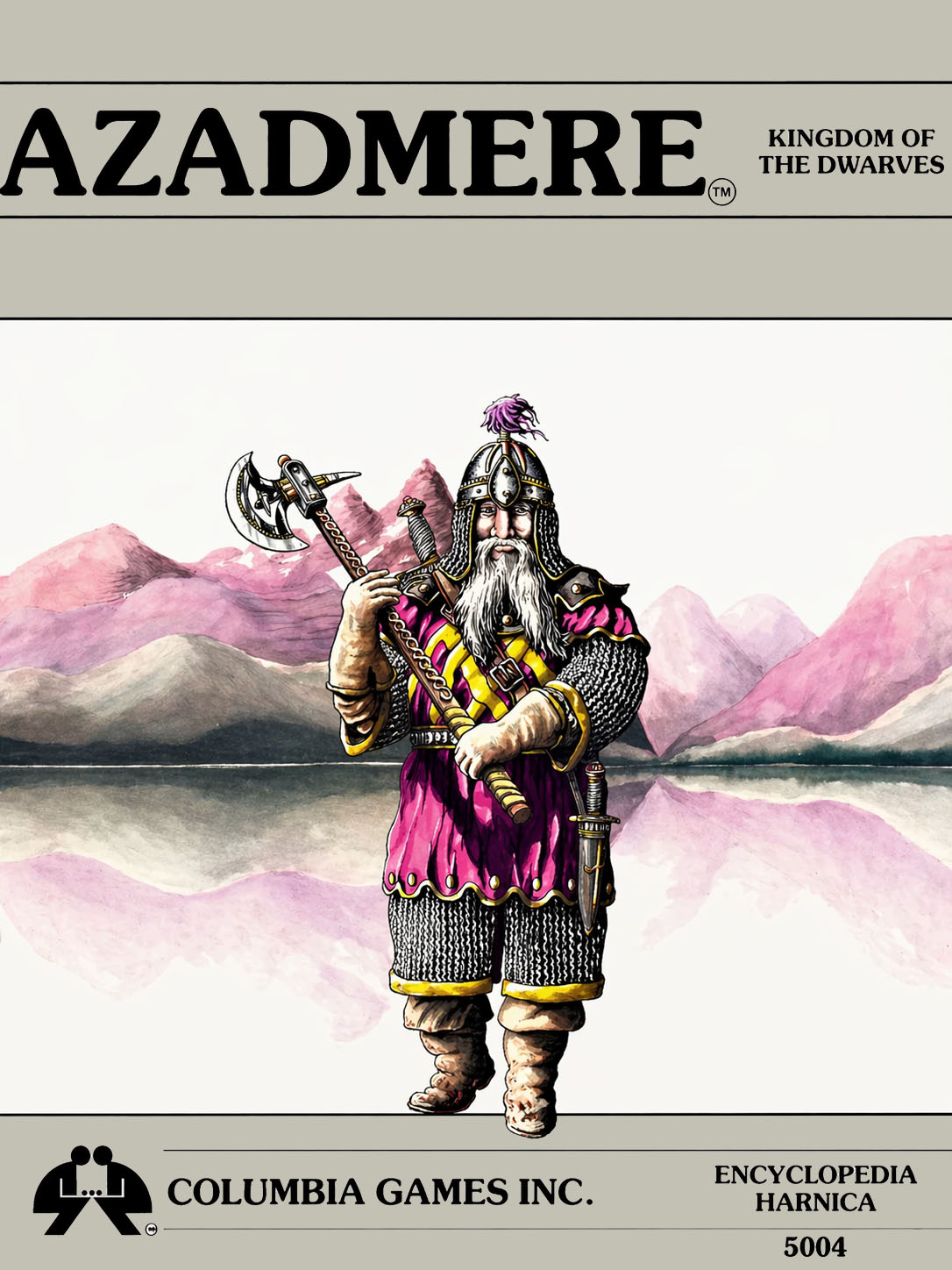
Azadmere is a HârnWorld supplement, containing four Encyclopedia Hârnica articles: Azadmere (10 pages), Khuzdul (4 pages), Habe (6 pages), and Zerhun (10 pages). It also includes full-page Player Maps (black and white, unlabelled) and Common Maps (full-color, labelled) for Azadmere (the kingdom), Habe, Zerhun, and Azadmere (the town).
AZADMERE
The titular subject of the supplement, the article on Azadmere devotes one page to discussing the history, government, economics, and religion of the Kingdom of Azadmere. In short: Azadmere is ancient, predating human civilization on Hârn by several millennia. When the first humans (the Jarin) reached Hârn, a symbiotic relationship grew up between the two cultures – with the dwarves increasingly focusing on their mining and craft, while the humans farmed the surrounding land for food. Eventually some human families were adopted into the dwarven clan structure. This caused some problems, however, because the original city of Azadmere was forbidden to humans. To solve this, the Outer City was constructed outside of the mountain (while the original city, within the mountain, became known as the Inner City).
Following this extremely brief summary (figure it out – if less than a page is spent in the book itself on this material, there can’t be that much information left out of my summary of the summary) we are given a full page map of the Outer City. The next two pages give a key for every single building in the outer city (naturally, almost all of these descriptions are extremely brief).
From there we get an even briefer look at the Inner City: Four pages of maps reveal the three primary levels of the Inner City (in relation to the Outer City and with detailed maps of Levels 1 and 2). The description of these maps is summarily squeezed into a single page, leaving room for a one page chart showing the clans of Azadmere and their primary assets.
And that’s it.
All right, I’ll be totally up front with you: My primary reason for buying the book was for the dwarven city. I’ve got a major dwarven city adventure looming on the horizon in my campaign, and so I went looking for extant dwarven city resources to draw upon.
But I’ve got to believe that I would be underwhelmed by this even if it hadn’t been my primary interest in the book.
I mean, the maps are fantastic. No doubt about it. Not only are they gorgeous in the execution, the Outer and Inner Cities are just plain well-designed from the look of it: They make sense, as so many fantasy cities do not.
But I have to admit that I want more description: I want to know what these rooms on the map look like. I want to know more about the people who live here. I want to know more about the politics. I want to know—
You know what? I just want to know more, period. And it’s not that “wow, you’ve told me so much and I’m still hungry for more” feeling (which is a great feeling) – it’s that “uh, did you forget to print something?” feeling (which is a bad feeling).
KHUZDUL
The four page Khuzdul article which follows the Azadmere article didn’t do much to alleviate my trepidations. Again, we are given the lightest coverage seemingly possible for dwarven history, culture, religion, and economics (and at least some of this is repeated from the Azadmere article).
To put this in perspective: The article on the Khuzdul in the Harndex (one of the books which comes as part of the second edition of HârnWorld) is nearly a page long. I would guess that the amount of information has only been expanded by approximately a factor of 5. Maybe.
Actually, the Khuzdul article as it stands in this book would make more sense as the Harndex entry. Or, at best, the outline for a Khuzdul supplement.
HABE & ZERHUN
The last two articles in the book are slightly better. Zerhun, in particular, seems to give a fairly complete picture of its subject matter (a dwarven fort guarding the southern reaches of the kingdom). But this actually serves as a major tip-off to the larger problems this supplement faces: If you need 10 pages to adequately describe a fort and the small town which supports it, what on earth makes you believe that 10 pages will be adequate to describe an entire dwarven city (which is 30 times larger in population alone)?
Habe is a small town, the oldest Jarin settlement in Azadmere. This article is still a little lighter than it probably should be, but doesn’t fare too badly. The maps of the keep in Habe, in particular, are a valuable resource. The maps of the Inn, in my opinion, less so.
CONCLUSION
The problem Azadmere has as a supplement can be summed up simply:
Where’s the dwarven beef?
If this book did nothing except describe the dwarven city of Azadmere, it could most likely do justice to its subject of choice. Similarly, if this book did nothing except describe dwarven culture and history, it could almost certainly do justice to its subject of choice.
Instead, Azadmere chooses to spread its focus too wide – and ends up failing to do justice to any of the material it chooses to present.
What’s in the book is of high quality. But the book remains deeply flawed because of what isn’t to be found here.
I, for one, am disappointed.
Style: 3
Substance: 3
Author: N.R. Crossby, Tom Dalgliesh, and Edwin King
Publisher: Columbia Games, Inc.
Line: Hârn
Price: $15.98
ISBN: 0-920711-09-X
Product Code: 5004
Pages: 40
Does, “Where’s the beef?” still have any cultural cachet?
I was, in fact, hunting for a great dwarven city supplement that I could plug into my ongoing D&D 3rd Edition campaign. Azadmere was not, as I recall, my only disappointment. (I believe there was also a Moria supplement I sampled and rejected, among others.) If I could go back in time and offer a guiding light to my younger self, I’d point him in the direction of DL4: Dragons of Desolation by Tracy Hickman and Michael Dobson, which includes an incredible set of dwarven city geomorphs.
Looking back, I’m realizing that my younger self had, in fact, read that module, but only in a used copy of the DLC1 reprint collection which, vitally, was missing all the geomorphs.
For an explanation of where these reviews came from and why you can no longer find them at RPGNet, click here.










Seems like this complaint may have been heard; the recently-Kickstarted hardcover print of Kingdom of Azadmere is up to 134 pages.
[…] The Alexandrian publishes a review of HârnWorld – Azadmere. […]