
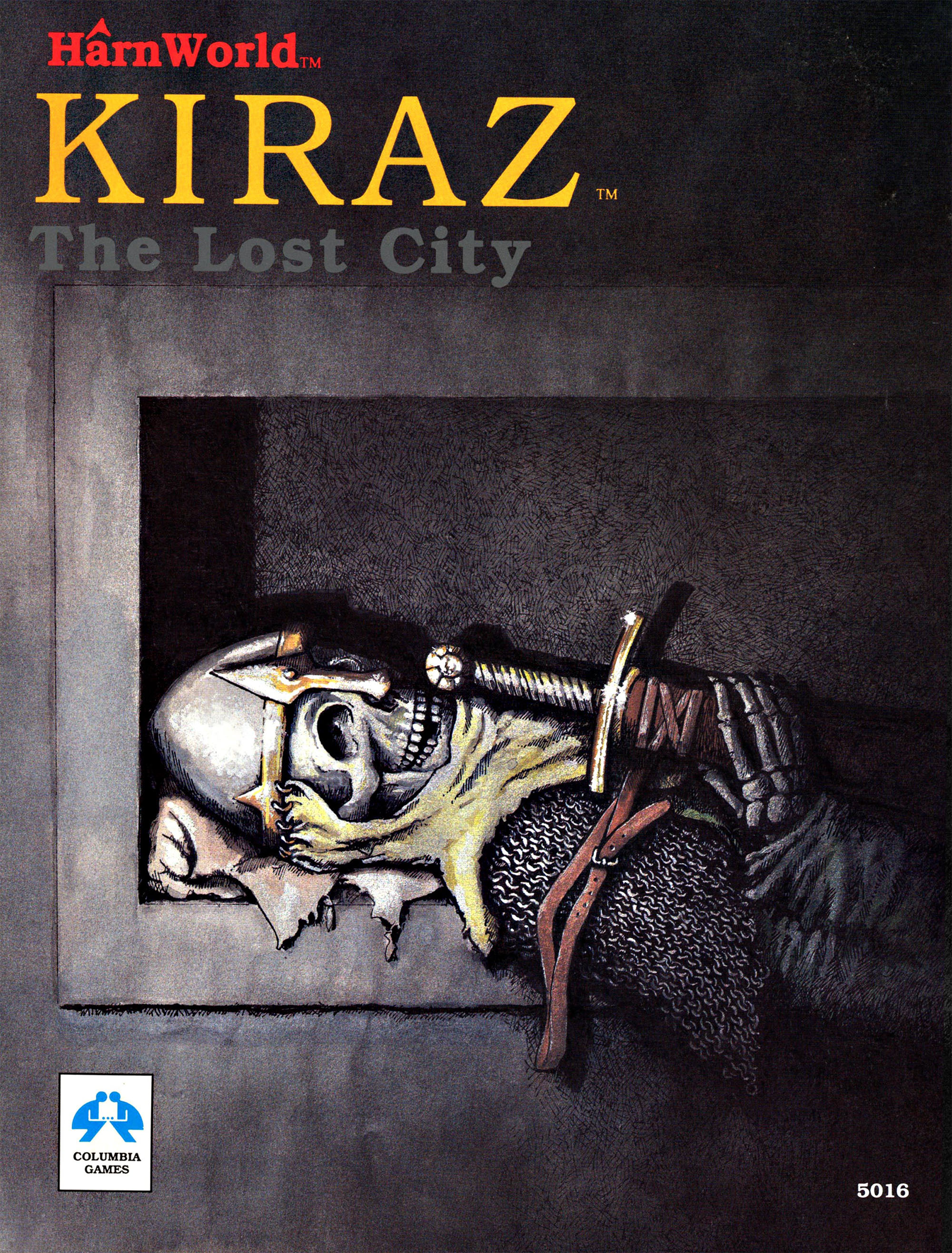
It’s like starving yourself for three days, and then eating a pecan. Kiraz makes you hungry for information, but leaves you unsatisfied when all is said and done.
Review Originally Published October 10th, 2001
Kiraz: The Lost City is the second adventure in the In Search of Panaga trilogy of modules. However, it is also a sourcebook for the lost dwarven city of Kiraz. As Crossby writes in his preface:
It was like this: Columbia wanted me to do Kiraz, and I wanted to complete the next volume of In Search of Panaga. Both modules were late. So, I thought, why not set the Horns of Ikarus in the Lost City?
I am largely unqualified to review the adventure portion of this product: I do not own either the first or third parts of the trilogy. However, I don’t feel this is a major impediment, because the bulk of the book is the sourcebook for Kiraz. And, in fact, the reason I bought the book to begin with was for the Kiraz source material.
Kiraz: The Lost City is comprised of three articles/modules: Kiraz (14 pages), Ushet (4 pages), and Horns of Ikaras (5 pages). There are also two pages of full-color illustrations (maps of the areas surrounding Ushet and Kiraz, as well as visuals of the entrances to each of them which can be shown to the players). There are also two blank pages labelled “GM Notes”.
KIRAZ
Kiraz is the oldest dwarven citadel in Hârn. A massive complex, it was once the pinnacle of dwarven civilization. Roughly six hundred years ago, however, Lothrim the Foulspawner laid siege to the city with his army of orcs. Kiraz fell.
Although the dwarves had their final vengeance upon Lothrim, the halls of Kiraz were sealed away forever – a grim reminder of the dark memories which were forged there. Today most of the halls stand deserted, although some of the lower levels have been broken into by orcs.
This section is really the core of the book: Brief detail is given of Kiraz’ history and the current area around the ancient city (3 pages). A cut-away map of the entire complex is given, along with a one-page summary of the major features of the city (2 more pages). After this one page summaries and maps are presented for several major areas of the city:
The High Halls: The Great Hall of Kiraz, the Royal Apartments, the Council Chamber – the High Halls once housed the royal family and government of the city.
Gallreda Complex: A residence for officers of the royal government. This includes the Hall of Galreda and the Hall of Zelanthu.
West Gate: The primary point of entrance to the city.
Ranzad Complex: The largest cavern in Kiraz, this was the marketplace and social center of the city.
Minehead: As the name might suggest, this was the point from which the mines were reached. Workshops, ore storage, and the like are all found here.
The Catacombs: Not only the communal graves of Kiraz, but also the Royal Tombs. The Hall of the Godstone (an ancient earthmaster site predating dwarven civilization) can also be found here – it is generally considered to be “the birthplace of the Hârnic Khuzdul [dwarves]”.
An additional page discusses ways in which the GM can develop the material presented here. Finally, two more pages give several artifacts and special locations which can be placed by the GM in whatever locations seem most appropriate.
Before I continue, let me make one point abundantly clear: All of the material which is found here is excellent. Beyond par. The maps are beautiful and superbly executed. The logic and detail of the city is meticulous: Crossby refuses to simply wave his hands in the construction of this city; instead insisting that the city make sense. By the time you are done reading through this article, you will have the sense that a place like Kiraz really could exist. This is, by no means, a small or unvaluable accomplishment.
The problem with this supplement is not the quality of what is present, but the vast amounts of information which is – quite literally – missing. This is, apparently, keeping in line with the intended design methodology – which is described as such:
In keeping with our long term policy, there is lots of room for the GM to customize his own version of the Golden City – even if a player should get hold of a copy of this module, it won’t help him much.
Folks, this just doesn’t cut it for me. The whole point of buying a supplement is so that I don’t have to do design work. Certainly keeping snoopy players on their toes is a laudable goal – but if I want to do that, I am quite capable of changing information. In fact, changing and rearranging information is vastly easier than being forced to create material out of wholecloth.
USHET
This is a four page article discussing the Rock of Ushet. Ushet was once a hunting lodge, connected to Kiraz via a series of spent mining tunnels. Following the Carnage of Kiraz, the Ushet entrance was sealed. In recent years, however, orcs have broken through those seals and taken up residence in the former hunting lodge.
The material presented here serves two purposes:
First, Ushet serves as the point of entry to Kiraz for characters playing through The Horns of Ikaras (see below).
Second, there are many former dwarven hunting lodges spread throughout the area around Kiraz. They are sites of conflict between the barbarian tribes (both orcs and humans) who remain in the area. Ushet serves as a generic template which the GM can use for any of these hunting lodges.
There’s nothing phenomenal in this section – but it’s all solid material, and very useful as either a specific or generic resource.
HORNS OF IKARAS
As I noted above, I am not familiar with the first part of the trilogy of which the Horns of Ikaras is the second part. With that being said, I am thoroughly unimpressed by what I see here.
Essentially what Crossby presents is a four-page outline of an adventure, rather than an adventure. A summary is given of what took place in the first adventure (1 page), the NPC who gives them the hook into this adventure is described at length (1 page), player handouts are provided (1 page), and the adventure is briefly summarized (1 page).
In short, the material presented here can be summed up with extreme accuracy by saying: “Several months have passed since the last adventure. The PCs should have heard some rumors about the Big Bad Guy’s activities (kidnapping three beautiful women, stealing some rare animals, and burning town officials in Aleath). They go to Kiraz – most likely gaining entrance via Ushet – where they need to find a key to gain access to the room where the Horn is kept.”
CONCLUSION
As I write this I currently have a D20 module in development: I have a general outline of events written down; about half of the maps completed; and rough notes quickly jotted to remind me what the keys on those maps mean. That’s what Kiraz looks like.
By the time I finish developing that D20 module I will have a text which presents the adventure in full to the GM, a complete set of maps, and a fully developed and descriptive key for all of those maps. That’s what Kiraz should look like.
Reading Kiraz feels like starving yourself for three days and then eating a pecan.
Having said that, however, let me go on to say that Kiraz comes with my recommendation: Although I take issue with the fact that so many things are simply left undeveloped, what is developed here is – quite simply – superb. For $15 this presents a solid value for your money, and anyone thinking of including a dwarven citadel in their own campaign could only hope to benefit from this book. Certainly anyone interested in Kiraz in and of itself as part of the world of Hârn should snatch up a copy of this book without a second thought.
Style: 4
Substance: 4
Author: N. Robin Crossby
Publisher: Columbia Games, Inc.
Line: Hârn
Price: $14.98
ISBN: 0-920711-28-6
Product Code: 5016
Pages: 28
Year Published: 1989
Rereading this review, I was somewhat surprised to discover that I’d given it a rating of 4 in Substance. Flipping through my copy of the book, though, I understand where I was coming from: It was a little on the pricey side for 30 pages of material, but there’s a lot of great stuff in here and the maps are truly spectacular. The problems aren’t what’s on the page; it’s the mismatch between the scope of the product and the scope needed by the subject matter.
For an explanation of where these reviews came from and why you can no longer find them at RPGNet, click here.










Bro PLEASE make that d20 module. I felt the exact same after reading the module and couldn’t put it into words until I had read your post. I’m running a game currently and players don’t know it yet but they are on the path to delving Kiraz and like you said the current content they have is woefully underdeveloped for actual play.
You should see the recent versions of this. It has been updated with color maps, much more art and a lot more information, really fleshing this all out.
The New Azadmere and Kiraz are wildly expanded upon. Made much more playable. You should have a look and re-review.