The Alexandrian

Posts tagged ‘games unplugged’

Heavy Gear: Tactical Space Support (Dream Pod 9)

Tactical Space Support is filled with a plethora of high-quality material – including two complete tactical systems – providing a breadth and depth of coverage that make this an invaluable resource for any campaign that gets within spitting distance of orbital velocity.

Review Originally Published in Games Unplugged Webzine – June 16th, 2000
Republished at RPGnet – May 22nd, 2001

The title is Tactical Space Support, but make no mistake: This book provides as much support, if not more, for a roleplayer as it does for a tactical Heavy Gear player.

In the fashion which their fans have become quite accustomed to, the Podsters have crammed more material into this slim, 96-page volume than most publishers include in massively oversized tomes. The short list: A history of space travel in the Heavy Gear universe; campaign background material; coverage of hardware, spacecraft, outposts, and space life; along with a vehicle compendium of specific vehicles – all discussed with a depth of understanding and breadth of coverage that makes this book absolutely invaluable for a Heavy Gear campaign which gets within even spitting distance of orbital velocity.

In addition to all this, roleplayers will find adventure seeds and NPC archetypes, plus expanded rules covering common space hazards — such as lack of atmosphere, effects of gravity, and exposure to radiation. In constructing these rules Vézina, the author, demonstrates what good game design is all about: A wealth of scientific research is boiled down to a set of formulas simple enough to be used at the gaming table, while still bringing with them all the reality you need.

The tactical player, on the other hand, will find two complete tactical systems, along with expansions for the VDS (Vehicle Design System) and additions to the standard Heavy Gear tactical game. Both of the new tactical systems use the core of the Silhouette system, but in a radically different way than a standard tactical game. The first, and primary, space tactical system abstracts the entire process – eliminating hex maps and miniatures altogether. This is due to the nature of space combat in the Heavy Gear universe, where secrecy, stealth, and first strike capability are of key importance. The second system is optimized for simulating a lightning strike combat situation – where two fleets pass each other at extremely high velocities and the entire combat lasts for a few fractions of a second.

Unfortunately, a couple of problems with recent Dream Pod 9 releases also crops up here: Specifically, a continuing fight with typos and copy-editing errors and the decreasing size of the average Pod release (from 112 or 128 pages down to 96 pages over the past year). In the former case, I am happy to report, the battle is obviously being won – Tactical Space Support is (almost) typo-free. The latter, however, makes its presence keenly felt in the total absence of tactical scenarios, and the shallowness of some of the other game-oriented resources (only four adventure seeds and NPC archetypes, for example). These slimmer books are still high quality products, and well worth the price of admission, but those dozen or two dozen pages make all the difference between a product being sublime and merely excellent.

While bearing some reservations in mind, there can still be only one verdict where Tactical Space Support is concerned: This is a fantastic book. If you have any intention of taking your Heavy Gear campaign to the stars, then you’d be making a serious mistake to pass this one up.

Grade: A-

Writers: Marc-Alexandre Vézina
Publisher: Dream Pod 9
Price: $18.95
Page Count: 96
ISBN: 1-896776-68-X

In 2001, I used RPGnet to archive a review which was no longer available on Games Unplugged’s website. Now here I am, finding new ways to archive it and make it available. It seems that much of a writer’s life — and perhaps any artist’s life — is finding new ways to enshrine and distribute their work.

I think I was a little too kind with my grading on this one. Or, rather, I was grading on a curve reflective of the other reviews appearing in Games Unplugged at the time. Proper scenario support feels really essential for novel mechanics/structures like this, and its absence here probably drops the book down to a B in my own grading scheme.

For an explanation of where these reviews came from and why you can no longer find them at RPGNet, click here.

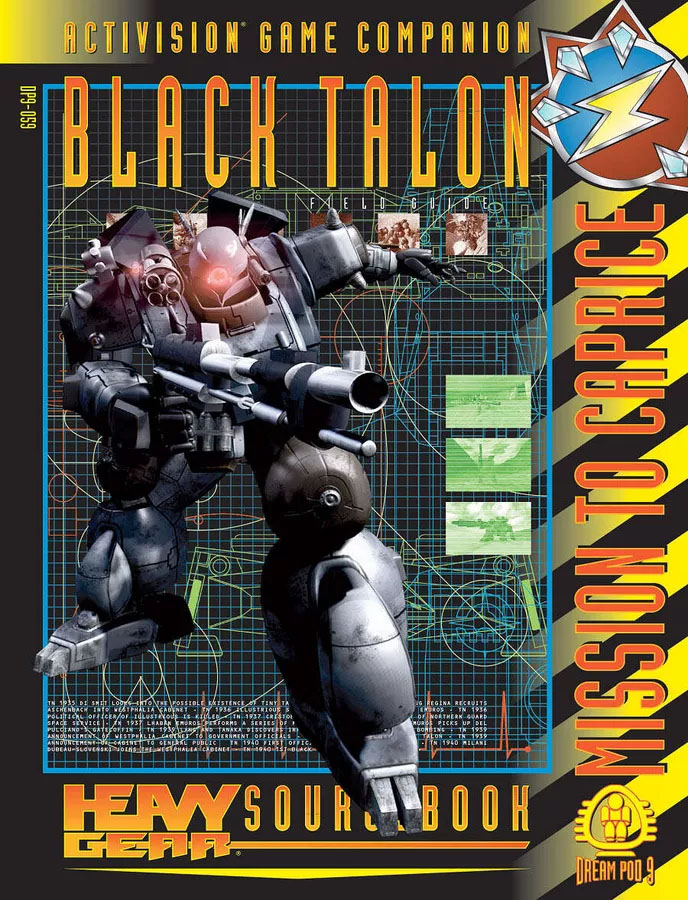
Heavy Gear - Black Talon: Mission to Caprice

Review Originally Published in Games Unplugged (July 2000)
Republished at RPGNet – May 22nd, 2001

Heavy Gear is headed for the stars.

Activision’s Heavy Gear II computer game focuses upon the trial by fire of the 1st Black Talons, the inaugural squadron of a new Terranovan fighting force designed to take the fight against the Terran aggressors back to Caprice. The Black Talon Field Guide, designed as a companion to this game, serves as a massive campaign resource for setting your own Heavy Gear games within the auspices of the expanding Black Talon program, or the wider struggle against Earth as a whole. The book is more than capable of standing on its own, but will be strengthened for some campaigns with the use of Tactical Space Support (detailing specialized rules for space combat) and Life on Caprice (the core sourcebook describing the planet of primary operations for the Black Talon program).

The only serious weakness of this book is a slight confusion over the time period when the material is set – the book is primarily presented as taking place after the events of the Heavy Gear II computer game, but some sections of the book instead seem to slip back to a time period just before the first Black Talon mission was launched. This is combined with numerous instances of copyediting errors and typos, which continue to make their debilitating presence felt in Dream Pod 9 products.

But these minor flaws are far outweighed by the sheer wealth of material which is present here. Some sections of the text will be familiar to veteran Heavy Gear players (but this is to be expected since the book is designed for new players brought to Heavy Gear by the computer game), but even they will be able to wade hip-deep in this one. When you can turn the page of a roleplaying supplement and say, “My god, there’s more?!” you know you’ve got a winner. This one’s a winner.

Grade: A

Writers: Marc-Alexandre Vezina
Publisher: Dream Pod 9
Price: $20.95
Page Count: 128
ISBN: 1-896776-63-9

This review is shorter than my typical reviews because it was written as a non-featured review for Games Unplugged magazine and I was writing for a very specific word count. One of the interesting things about GU reviews is that they would publish short recap versions of the review in subsequent issues, providing a much larger wealth of information in each issue. These recaps were written by the original review authors. Here’s the one I wrote for this review:

Recap: Heavy Gear is headed for the stars. The Black Talon Field Guide, serving as a companion to Activision’s Heavy Gear II computer game, serves as a massive campaign resource for setting your own Heavy Gear campaign within the auspices of the expanding Black Talon program. A sheer wealth of material makes this a highly desirable book for neophytes and veteran players alike.

I found that the recaps were an art in themselves: How to capture the key points in a VERY limited space, while still being a comprehensible to new readers.

Revisiting these older reviews really makes me want to run all the Heavy Gear campaigns I never got a chance to when I was younger.

For an explanation of where these reviews came from and why you can no longer find them at RPGNet, click here.

Blue Planet: Player's Guide (2nd Edition)

Welcome to the world Blue Planet – one of the smartest games you’ll ever come across.

Review Originally Published in Games Unplugged (February 2001)
Republished on RPGNet May 22nd, 2001

The year is 2199. Natural and manmade disasters have torn Earth apart. Incorporated city-states dominate the political scene. Civilization has barely survived a post-modern dark age. But there is hope: A wormhole at the edge of the solar system leads to a blue, oceanic world… Poseidon.

Welcome to the world Blue Planet.

With the Player’s Guide (being reviewed here), and its companion volume (the Moderator’s Guide), the Blue Planet game is moving into its second edition, with these two core rulebooks covering the same material which the first edition rulebook and Archipelago supplement did. Although the Player’s Guide contains a solid set of introductory setting material, in general the contents of the two books can be broken down very simply: The Player’s Guide contains all the rules. The Moderator’s Guide contains the world.

From the first moment you encounter the world of Blue Planet (in a first person narrative introduction which not only introduces you to the planet Poseidon, but also gives you a firm grasp of what the life of your character is like) you begin to appreciate the impressive creativity and thought which have gone into it.

For starters, this is a smart game: The science and technology which provides the foundation for Blue Planet’s science fiction is not only well researched, but acts as a powerful element in the logical historical extrapolation which gives rise to the future history presented in the game.

Unsatisfied with merely giving the grognards a rich supply of technical detail, the designers of Blue Planet have given you a setting rich with themes and elements from across the scope of the science fiction field: High adventure, cyberpunk, post-cyberpunk, hard SF, and space opera all find their place here. You can choose what you want to emphasize in your own campaign, or take the rich synthesis of the entire gestalt to heart. This multi-layered approach – which adds depth, believability, and utility to the setting – also gives rise to a number of small touches which are packed full of dynamic possibility: For example, the handling of non-humanoid intelligence (and the allowance given in playing non-humanoid PCs) is refreshing and well done.

As a natural result of all this, the Blue Planet setting gives rise to a number of different campaign structures: GEO Marshals, Incorporate agents, illegal poachers, native activists, treasure hunters, and dozens of other possibilities lie nascent within this world.

Easily overlooked in this second edition is the brand new Synergy System, which replaces the rule system of the first edition. A limited dice pool system, with a standard combat extension, and a simple, realistic wound system that gets the job done. But where the system really shines is character creation – which is accessible, yet dynamic. Accessible because the process is kept open and simple through the use of varying power levels, character packages, and other shortcuts. Dynamic because underneath this simple exterior is a system capable of handling a wide variety of needs and wants. Perhaps the most interesting part of this entire system is the unique Attribute/Aptitude/Skill dynamic – in which characters not only have the traditional split between their natural talents (Attributes) and learned abilities (Skills), but also have a representation of what areas their character tends to excel in (Aptitudes). Aptitudes serve to focus a character’s role in a campaign in a very realistic and flexible fashion. There all sorts of elements throughout the character creation system which can be described in the same manner: They aid, but they do not restrict.

Grade: A-

Title: Blue Planet: Player’s Guide
Writers: Jeffrey Barber, Greg Benage, Allan Grohe, John Snead, Jason Werner
Publisher: Biohazard Games (Fantasy Flight Games)
Price: $27.95
Page Count: 255
ISBN: 1-887911-40-7
Product Code: BP02

Blue Planet is another of my great white whales (pun intended). I fell in love with this setting when I read the first edition, but I’ve never been able to run a game there. I haven’t sailed those cerulean seas for many years, but for a decade or more I frequently revisited them and dreamed. (One idea I had was as Blue Planet/Transhuman Space mashup.) I was even hired to write a supplement for FFG’s edition of the game, but that, too, never came to pass.

FASA released a revised version of the 2nd Edition, which I don’t own but have been given to understand is basically just a cleaned up version of the edition reviewed here. A third edition of the game, Blue Planet: Recontact, was crowdfunded in 2021, missed its intended 2022 release date, but appears to be on the verge of finally becoming reality. Perhaps the third time will be the charm for me!

BLUE PLANET REVIEWS
Moderator’s Guide
Fluid Mechanics
First Colony
Frontier Justice

For an explanation of where these reviews came from and why you can no longer find them at RPGNet, click here.

This review originally appeared in the October 2000 issue of Games Unplugged.

Enchanted Worlds Starter Kit - New World GamingWhere’s the beef?

I hate to sound so flip, but that’s the question that was bouncing back and forth through my brain as I finished reading through my copy of the Enchanted Worlds: Starter Kit boxed set.

What you get: A slim booklet containing rules and setting information, a half-size booklet with an introductory adventure, a reference sheet, two eight-sided dice, a handful of character sheets, and a full color map.

The system is a standard Attribute + Skill deal, rolled against on 2d8. Character creation involves picking a race and then distribution roughly 250 points across your attributes and skills. Combat is handled using the standard resolution system (contested actions are handled by subtracting the defender’s skill from the attacker’s roll), with damage determined by weapon type and severity (the latter is determined randomly). Magic also relies on the standard resolution mechanic. It’s a simple, clean system – but nothing you haven’t seen a dozen times before. That’s not necessarily a bad thing, but those other systems you’ve seen probably came with more extensive equipment, spell, and skill lists (in other words, more depth and breadth).

The World of Unlond is a standard Tolkienesque fantasy – you’ve got your Dwarves (Earth and Stone), your Elves (Dawn, Twilight, Sun, and Moon), and your humanoids (Goblins and Hobgoblins). You’ve also two or three paragraph descriptions of the various geographical locations of the world (for example, the Eastern Marshes or the Thengold Empire). The “official backdrop” for the game is the Andarian Baronies – for which you are given a column of historical info, two columns of info on the government and society, and a three page overview of the Town of Greenway. The main book wraps itself up with a six page Bestiary (with all your standard fantasy fare – Giant Rats to Goblin Warriors).

The other major component of the boxed set is “Autumn Harvest”, a short introductory adventure. The adventure consists of a farmer asking the PCs for help because a terrible monster (a Giant Spider) has infested his farmhouse and hurt his little girl. Although the cover of the adventure seems to promise some political intrigue (“On the borders of Darkon Andar, a little girl is attacked. Now, you must find out why she was hurt and who or what is protecting the secrets of the past.”), in truth it is just a simplistic and mundane dungeon crawl: You go to the farmhouse, kill some monsters, find a hidden underground complex (consisting of six rooms), and kill some more monsters.

The color map and reference card are both well done – certainly within expectations.

So I ask again: Where’s the beef?

The material found here would make a really good pitch for a fantasy RPG: “We’ve got this good idea for an RPG… here are some rough ideas of the direction we’re thinking of taking.” But it’s not enough. Simply put, there’s no motivation for me to pick up this package.

I live in a world where I can pick up a Hogshead New Style game (and get a comparable number of pages, although of much higher quality and content) for six bucks. I also live in a world where I can pick up the two hundred page Player’s Handbook for D&D (and get a far more complete and well supported fantasy RPG) for twenty bucks. So why am I going to pick up a generic fantasy game which gives me neither a thorough set of rules nor a well-developed background for $14.95?

And I’m afraid the answer is: I’m not.

Grade: D

Writers: Matthew Rodgers and Daniel Price
Publisher: New Worlds Gaming
Price: $14.95
Page Count: 40
Product Code: EWRSK1

After the initial appearance of a review, Games Unplugged would run a short recap of the review in subsequent issues.

Recap: Where’s the beef? I hate to sound so flip, but that’s the question that was bouncing back and forth through my brain as I finished reading my copy of the Enchanted Worlds boxed set. You get a fairly standard system (which doesn’t really go very far beyond the most basic requirements) and an under-developed Tolkienesque fantasy setting.

I live in a world where I can pick up a Hogshead New Style game (and get a comparable number of pages, although of much higher quality and content) for six bucks. I also live in a world where I can pick up the two hundred page Player’s Handbook for D&D (and get a far more complete and well supported fantasy RPG) for twenty bucks. So why am I going to pick up a generic fantasy game which gives me neither a thorough set of rules nor a well-developed background for $14.95?

And I’m afraid the answer is: I’m not.

As I mentioned last week, after unexpectedly receiving review copies of this game I ended up writing two different reviews of it: The one for Games Unplugged that you just read and another for Gaming Outpost, which you can find over here.

Tony Lee, the editor of Games Unplugged, was not happy with the review. He didn’t want to publish a review which was as negative as this one and he asked me to rewrite it. I declined: It was a mediocre game sold in a dress shirt box with an inkjet-printed 8.5 x 11 cover taped on top. I gave it the shitty grade that it deserved. (And to give you some idea of how doomed this game was: The 3rd Edition D&D Player’s Handbook was reviewed in the exact same issue of Games Unplugged.)

The version of the review that was published in the magazine was heavily edited, although my letter grade remained intact.


Tagline: Edgy humor, industry news, and high-gloss production values. The new kid on the magazine block, Games Unplugged shows a lot of potential.

Games Unplugged #1I’ve been looking at the cover of the first issue of Games Unplugged for several months now (it’s been posted on their website). It’s a picture of a Scotsman, in his kilt, wielding a two-handed sword. It’s fairly well executed (although the guy is not particularly convincing as a threat – he’s terribly unbalanced), but it instilled in me great reservations concerning a magazine I was otherwise fairly excited about laying my hands on.

I know, I know. One shouldn’t judge a book by its cover, but this image was so ineffective as a cover it raised some serious reservations about just how much effort and capital was being invested in making this magazine a success.

And that’s all the bad news you’re going to get in this review, because any lingering fears or paranoia I may have had were more than unjustified. Games Unplugged is well worth your time.

The magazine has three primary focuses, and all of them are delivered upon en force: Industry News, Reviews, and Insight. All of these, of course, feed into the core of GU’s primary goal: Serving as an industry newsletter, by hyping not only products but people.

INDUSTRY NEWS: Perhaps the most surprising thing about GU’s industry news features (including “Da Buzzzzzzz” and “Gameorandum”, along with feature-length articles), is the fact they have actually managed to report on things with which I was not previously familiar in the industry. For example: The second edition of Blue Planet. The return of Cosmic Encounter (woo-hoo!). The second edition of Big Eyes, Small Mouth (the fact I missed this one is particularly noteworthy). The Sovereign Stone revised hardcover (high hopes here). I consider myself to be fairly well plugged in to various industry channels, so the fact that GU is trumping me not only proves the magazine’s worth – but also demonstrates that they’re really on top of their ball where this is concerned.

REVIEWS: I love reviews. I write ‘em. I read ‘em. I love ‘em. And Games Unplugged is chock full of them. This issue had over twenty pages of them (ranging from full page, in-depth pieces to snippet previews), covering dozens of products. (There’s a negative side to this, of course: My “To Buy” list swelled prodigiously as I read through them.)

INSIGHT: Here’s where the magazine really shines for me, though: Not only do GU’s staffers discuss various facets of the creative personalities behind the products we all know and love, Games Unplugged is also providing a forum for those creators to speak out in their own right. This first issue, for example, has Robin D. Laws discussing the design principles of Hero Wars, Shane Hensley describing the development process of Lost Colony, and Gary Gygax talking about the early days of TSR (in a recurring feature which will discuss the earliest days of the major game companies).

Beyond all of this (which has already, in my opinion, justified the $4 cover charge), is there any other reason you should pick up Games Unplugged?

Wellllll…. How about all new SnarfQuest strips? That’s right. Elmore is back, and although I wasn’t terribly impressed with the inaugural strip (too much recapping for new audience members, leading to some poor pacing throughout the piece) I have high hopes.

I also enjoyed the “Local Retailer Order Form” – basically a list of products which were mentioned in this issue of Games Unplugged, letting you easily check off what you’re interested in. Then you give the form to your local retailer, as an easy way of letting them know of products you’d like to see on the shelves (or are willing to special order). In a market where too many local retailers aren’t carrying products, it’s nice to see this encouraging feature.

CONCLUSION

At the end of the day, do I think you should get a subscription? Absolutely! Do I think you should at least give it a look? Positively! If nothing else, should you at least look at their webzine? Why the heck wouldn’t you?

[ Note: This is a review of a PDF version of the magazine provided by Dynasty Presentations specifically for preview purposes. Potential Sources for Bias: I intend to write reviews for Games Unplugged in the future. Plus, they give a really nice review of Dream Pod 9’s Jovian Planet Sourcebook for their Jovian Chronicles, a book which I helped write. ]

Style: 4
Substance: 5

Author: Various
Company/Publisher: Dynasty Presentations, Inc.
Cost: $3.00
Page Count: 64
ISBN: n/a

Originally Posted: 2000/05/09

One thing I’ve learned is that this industry is intensely hostile to disclaimers of potential bias from reviewers. Particularly the revelation that a review copy was provided. Stuff that is just bog standard procedure for reviewers in every other industry is viewed by a certain segment of the gamer community as some sort of dark heresy. There were at least a half dozen people who were outraged — outraged! — that Games Unplugged had given my book a good review in exchange for a good review of their magazine. (You’ll note that this is not what actually happened.)

In any case, at this point in my life I was a huge grog-head for reviews and RPG industry news: Games Unplugged was basically a magazine designed specifically for me. Of course, it’s totally unsurprising that it was out of business less than two years later. It was exactly the type of magazine that the internet rendered totally obsolete and it was premiering at exactly the wrong moment in history.

For an explanation of where these reviews came from and why you can no longer find them at RPGNet, click here.

Archives

Recent Posts

Recent Comments

Copyright © The Alexandrian. All rights reserved.