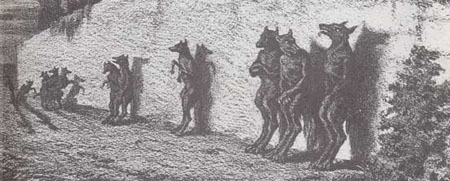
Lithographie de la Legende rustique de George Sand, 1858, Paris
Figthing with HTML code has chewed up some of the time I was planning to spend on lycanthropic templates, so I’m a day behind on my lycanthropes, but we’ll get to all of them before we’re done. Today we’re looking at the grand-daddy of them all: Werewolves.
As a reminder, these templates are designed to streamline and simplify the process of creating lycanthropes for 3.5:
(1) Create a stat block for the base creature.
(2) Apply the lycanthrope template in order to create the stat block for the humanoid form.
(3) Apply the hybrid template to the humanoid form in order to create the stat block for the hybrid form.
(4) Apply the animal form template to the humanoid form in order to create the stat block for the animal form.
WEREWOLF TEMPLATES
WEREWOLF TEMPLATE
Apply this template to the base creature to create the werewolf’s humanoid form. This template can be added to any humanoid or giant.
Size and Type: Creature gains the “shapechanger” subtype.
Hit Dice and Hit Points: Add 2d8 hit die to the base creature.
Armor Class: +2 bonus to natural armor.
Base Attack: +1 BAB
Special Qualities: alternate form, lycanthropic empathy, low-light vision, scent
Base Save Bonuses: Fort +3, Ref +3
Abilities: Wis +2, may gain an ability score increase due to additional hit dice
Skills: Gains (2 + Int modifier) skill points, treating Hide, Listen, Move Silently, Spot, and Survival as class skills.
Feats: Track, Weapon Focus (bite)
Challenge Rating: +2
WEREWOLF HYBRID TEMPLATE
Apply this template to the werewolf’s humanoid form to create the stat block for its hybrid form.
Size and Type: Medium or the size of the base creature, whichever is larger.
Armor Class: +4 natural armor (if better than the humanoid form’s natural armor)
Attacks: Gains 2 claw attacks and 1 bite as a secondary attack (-5 penalty).
| Hybrid Size | Claw | Bite |
| Small | 1d3 | 1d4 |
| Medium | 1d4 | 1d6 |
| Large | 1d6 | 2d6 |
| Huge | 2d4 | 2d6 |
Special Attacks: curse of lycanthropy (Fort DC 15); cannot cast spells with verbal components
Special Qualities: DR 5/silver for afflicted lycanthropes; DR 10/silver for natural lycanthropes
Abilities: Str +2, Dex +4, Con +4
WEREWOLF ANIMAL FORM TEMPLATE
Apply this template to the werewolf’s humanoid form to create the stat block for its animal form.
Size and Type: Medium
Speed: 50 ft.
Armor Class: +4 natural armor
Attacks: Replace all attacks with a bite attack (1d6 and lycanthropy)
Special Attacks: Replace base creature’s special attacks with trip and curse of lycanthropy (Fort DC 15); cannot cast spells with verbal, somatic, or material components
Special Qualities: DR 5/silver for afflicted lycanthropes; DR 10/silver for natural lycanthropes
Abilities: Str +2, Dex +4, Con +4
Skills: +4 racial bonus on Survival checks when tracking by scent.
THE SPIDER WEIRD OF HOLLOW’S DEEP
Werewolves are a dime a dozen, so I wanted to do something truly unusual to showcase the templates. In doing so I’ve technically broken the rules by applying a lycanthropic template to a magical beast. But if you don’t tell anybody, I won’t.
The Spider Weird is a horrific creature which haunts the dark woods around the village of Hollow’s Deep. It usually leaves the villagers alone, preferring to hunt the game animals of the forest. But upon occasion — when the villagers rile its anger or perhaps when the blood moon rises — the Spider Weird will inflict a reign of terror.
The Spider Weird is an aranea which was infected with lycanthropy while in its spider-humanoid form. The mixture of its natural shapechanging abilities and the lycanthropic curse allow it to assume four shapes: A monstrous spider, a black-eyed elf, a spider-wolf hybrid, and a wolf.
SPIDER WEIRD – MONSTROUS SPIDER (CR 6) – N Medium Magical Beast (Shapechanger)
DETECTION – darkvision 60 ft., low-light vision, Listen +7, Spot +7; Init +7; Languages Common, Sylvan
DEFENSES – AC 16 (+3 Dex, +3 natural), touch 13, flat-footed 13; hp 35 (3d10+2d8+10)
ACTIONS – Spd 50 ft., climb 25 ft.; Melee bite +8 (1d6 and poison); Ranged web +7; Space 5 ft.; Reach 5 ft.; Base Atk +4; Grapple +4; SA poison, spells, web
SQ change shape, darkvision 60 ft., low-light vision, lycanthropic empathy, scent
STR 11, DEX 16, CON 14, INT 14, WIS 15, CHA 14
FORT +8, REF +9, WILL +5
FEATS: Improved Initiative, Iron Will*, Track, Weapon Finesse, Weapon Focus (bite)
SKILLS: Climb +14, Concentration +8, Escape Artist +5, Hide +11, Jump +13*, Listen +7*, Spot +7*
SPIDER WEIRD – ELF FORM (CR 6) – N Medium Magical Beast (Shapechanger)
DETECTION – darkvision 60 ft., low-light vision, Listen +7, Spot +7; Init +7; Languages Common, Sylvan
DEFENSES – AC 20 (+3 Dex, +3 natural, +4 masterwork chain shirt), touch 13, flat-footed 17; hp 35 (3d10+2d8+10)
ACTIONS – Spd 50 ft., climb 25 ft.; Melee +1 rapier +7 (1d6 and poison, 18-20/x2); Ranged +7; Space 5 ft.; Reach 5 ft.; Base Atk +4; Grapple +4; SA spells
SQ change shape, darkvision 60 ft., low-light vision, lycanthropic empathy, scent
STR 11, DEX 16, CON 14, INT 14, WIS 15, CHA 14
FORT +8, REF +9, WILL +5
FEATS: Improved Initiative, Iron Will*, Track, Weapon Finesse, Weapon Focus (bite)
SKILLS: Climb +13, Concentration +8, Escape Artist +4, Hide +11, Jump +12*, Listen +7*, Spot +7*
POSSESSIONS: +1 rapier, masterwork chain shirt
SPIDER WEIRD – SPIDER-WOLF HYBRID (CR 6) – N Medium Magical Beast (Shapechanger)
DETECTION – darkvision 60 ft., low-light vision, Listen +7, Spot +7; Init +9; Languages Common, Sylvan
DEFENSES – AC 23 (+5 Dex, +4 natural, +4 masterwork chain shirt), touch 15, flat-footed 18; hp 45 (3d10+2d8+20); DR 5/silver
ACTIONS – Spd 50 ft., climb 25 ft.; Melee 2 claws +9 (1d4+1) or +1 rapier +9 (1d6+1, 18-20/x2) and bite +10 (1d6+1 and lycanthropy, poison); Ranged web +9; Space 5 ft.; Reach 5 ft.; Base Atk +4; Grapple +5; SA curse of lycanthropy, poison, spells, web
SQ change shape, darkvision 60 ft., low-light vision, lycanthropic empathy, scent
STR 13, DEX 20, CON 18, INT 14, WIS 15, CHA 14
FORT +10, REF +11, WILL +5
FEATS: Improved Initiative, Iron Will*, Track, Weapon Finesse, Weapon Focus (bite)
SKILLS: Climb +14, Concentration +10, Escape Artist +6, Hide +12, Jump +13*, Listen +7*, Spot +7*
POSSESSIONS: +1 rapier, masterwork chain shirt
SPIDER WEIRD – WOLF FORM (CR 6) – N Medium Magical Beast (Shapechanger)
DETECTION – darkvision 60 ft., low-light vision, Listen +7, Spot +7; Init +9; Languages Common, Sylvan
DEFENSES – AC 19 (+5 Dex, +4 natural), touch 15, flat-footed 14; hp 45 (3d10+2d8+20); DR 5/silver
ACTIONS – Spd 50 ft; Melee bite +10 (1d6+1 and lycanthropy); Ranged +9; Space 5 ft.; Reach 5 ft.; Base Atk +4; Grapple +5; SA curse of lycanthropy, trip
SQ change shape, darkvision 60 ft., low-light vision, lycanthropic empathy, scent
STR 13, DEX 20, CON 18, INT 14, WIS 15, CHA 14
FORT +10, REF +11, WILL +5
FEATS: Improved Initiative, Iron Will*, Track, Weapon Finesse, Weapon Focus (bite)
SKILLS: Climb +15, Concentration +10, Escape Artist +7, Hide +13, Jump +14*, Listen +7*, Spot +7*
Sorcerer Spells Known (CL 3)
1st (6/day, DC 13)—mage armor, silent image, sleep
0th (6/day, DC 12)—daze, detect magic, ghost sound, light, resistance
Change Shape (Su): Switch forms as a standard action.
Curse of Lycanthropy (Su): Fort DC 15
Lycanthropic Empathy (Ex): Communicate with wolves and dire wolves; +4 bonus on Charisma-based checks against them.
Poison – Spider or Elf (Ex): Injury, Fort DC 14, 1d6 Str/2d6 Str
Poison – Hybrid (Ex): Injury, Fort DC 16, 1d6 Str/2d6 Str
Scent (Ex): Detect presence within 30 feet (60 feet upwind, 15 feet downwind). Strong scents at double that range; overpowering at triple. Detect direction as move action. Pinpoint within 5 feet.
Web (Ex): 6/day, range 50 ft., range increment 10 ft. cts like net, anchors target in place. Effective against Large or smaller creatures.
*Skills: Can always choose to take 10 on Climb checks. In wolf form, gain +4 bonus to Survival checks made while tracking with scent.
In order to create the stat blocks for these forms, I:
(1) Prepped stat blocks of a normal aranea’s monstrous spider and humanoid forms. (I added armor and weapons to the latter.)
(2) To create the Spider Weird’s monstrous spider form, I applied the base werewolf template to the aranea’s monstrous spider stat block.
(3) To create the Spider Weird’s elf form, I applied the base werewolf template to the aranea’s humanoid stat block.
(4) To create the Spider Weird’s spider-wolf hybrid form, I applied the werewolf hybrid template to the Spider Weird’s monstrous spider form and then added the weapons and armor from its humanoid stat block.
(5) Finally, to create the Spider Weird’s wolf form I applied the werewolf animal form template to the Spider Weird’s monstrous spider stat block.
Without these werewolf templates I honestly would have never even considered trying to create the Spider Weird. Way too complicated. With the templates it took about 30 minutes to put the four stat blocks together. (I spent more time fussing with the HTML and CSS to make this page look half-way decent.)
This material is covered by the Open Gaming License.