Originally Published in Pyramid Magazine – September 15th, 2000
In 1988 the anime feature film Makai Toshi Shinjuku was released in Japan. Based on a novel by Hideyuki Kikuchi (the Japanese SF/Horror author), Shinjuku told the story of Kyoya, a young student of the mystic combat art of Nempo.
Ten years before the film begins, Kyoya’s father (a Nempo master himself) attempted to prevent Levih Rah (a Nempo master who had turned to evil) from summoning demonic powers to conquer the Earth. He died in the attempt, but not before he disrupted Levih Rah’s spell. Instead of conquering all of humanity in a single blow, Rah is only able to summon his demonic horde to a localized area: the Shinjuku district of downtown Tokyo. A massive earthquake wreaks devastation across dozens of city blocks, and Rah begins to prepare for the day when his dreams of conquest will reach true fruition. Now, a decade later, Kyoya must venture into this modern city of the damned, and finish what his father started…
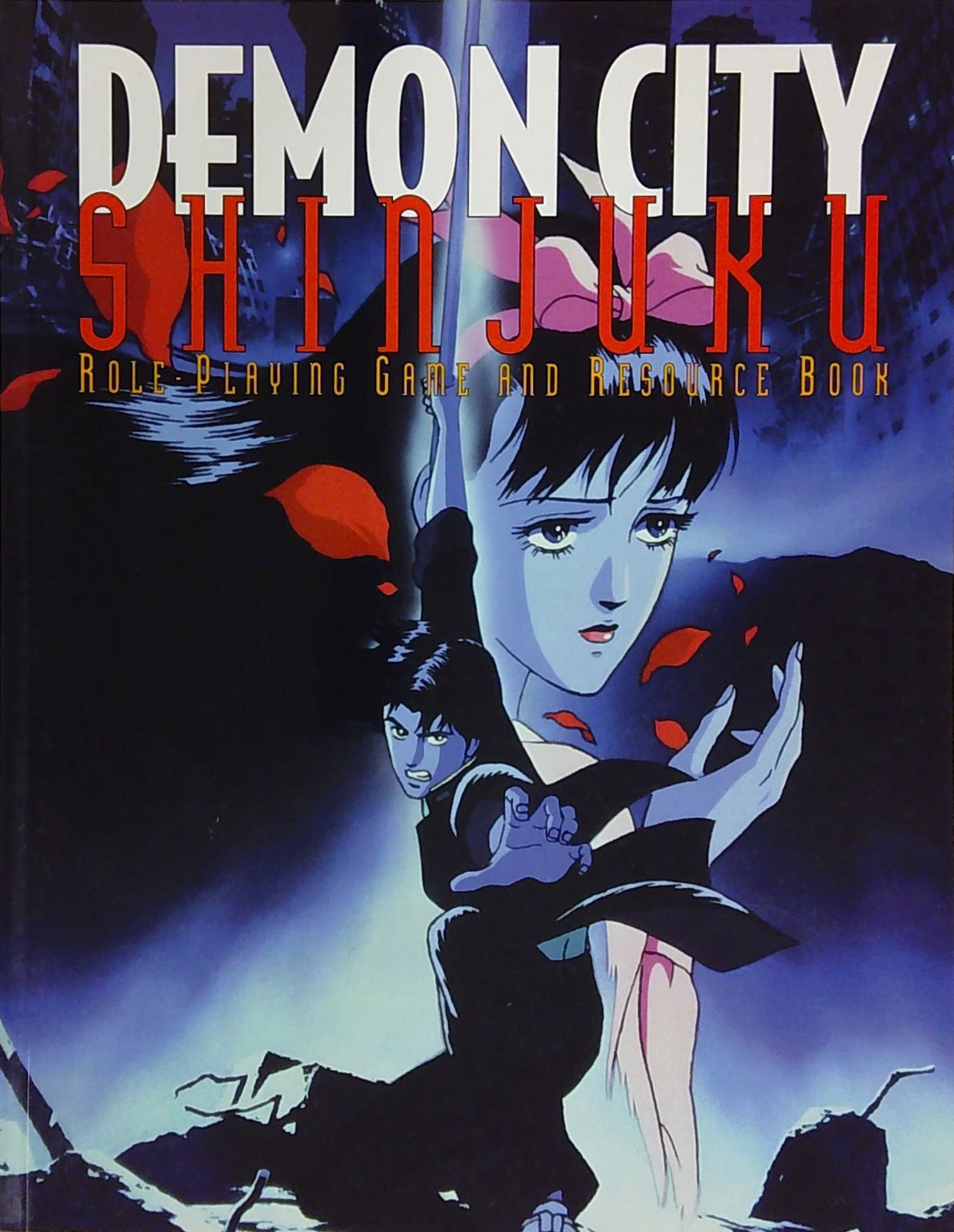
Several years after the film’s original release, Central Park Media translated it into English as Demon City Shinjuku. In America, as in Japan before it, Shinjuku quickly became a classic of both its medium and genre. And now, twelve years later, Guardians of Order has presented us with the Demon City Shinjuku Roleplaying Game and Resource Book.
Demon City Shinjuku is not the first, nor will it be the last, of GoO’s licensed anime games (it was preceded by Sailor Moon and Dominion: Tank Police, and has been followed by Tenchi Muyo!). Like these other games, Demon City Shinjuku uses the Tri-Stat System which first appeared in the critically acclaimed Big Eyes, Small Mouth.
Action resolution is handled in a fairly standard and straight-forward manner: A roll of 2d6 is modified by a difficulty and compared to the appropriate Stat or Skill. Combat uses the same basic mechanic to determine the relative effectiveness of attack and defense. Damage is determined through the combination of a secondary attribute and the weapon’s damage rating. One nice touch throughout the game are two simple flowcharts (one for combat and one for character creation) which clearly and concisely summarize the rules for easy reference during gameplay.
Character creation is based primarily on three things: Three character Stats (Body, Mind, and Soul – hence the name “Tri-Stat”), Character Attributes, and Skills. Each of these systems is point-based, with fairly broad and open-ended definitions. For example, your character might have a Level 3 in Massive Damage – allowing you increase your damage in combat by 15 points because you know precisely where to land a blow to cause the maximum possible amount of damage. However, precisely how your character knows how to land such a blow is left open-ended – they might have trained in the martial arts; or perhaps they receive mystic insight into where to place each strike.
This system is mechanically very precise while, simultaneously, modeling a wide variety of phenomena in the Demon City Shinjuku universe in a simple and easy-to-use manner. In addition, a great amount of care has been taken so that the elements of the game system will interact in exactly the manner shown in the movie – if doing X and Y in the movie allowed a character to achieve Z, then doing X and Y with the game system will also result in Z.
As impressive as the system is, though, the Demon City Shinjuku Roleplaying Game really begins to shine when we reach the second part of its title: Resource Book.
In addition to simply presenting a roleplaying game for their licensed products, Guardians of Order also present their books as generic resources for fans of the source material. In addition to creating a higher potential for the development of a crossover market of anime fans interested in purchasing the book, this also lends to the book a true depth of source material which is often lacking in licensed products. Instead of simply covering the material found in the movie, GoO has taken the next logical step of supporting the movie with a wide variety of supporting details – exactly the type of details which a GM craves when running an adventure.
While doing this, however, they have very carefully not imposed a vision of Demon City Shinjuku beyond the confines of the movie. Instead they have presented a wide-open toolbox with which a GM can create their own version of the Demon City Shinjuku universe. By doing so they don’t lock the property into their own vision of “how things are supposed to be,” instead opening it up to a multitude of visions limited only by the extent of your own imagination and desire. Want a campaign where Shinjuku was only one of many cities struck by Levih Rah’s spell? You’ll find support for it here. Want a campaign set in the years between Levih Rah’s spell and Kyoya’s success? You’ll find support for it here. Want a campaign where Kyoya failed? You’ll find support for it here. And so forth.
Moving beyond this toolbox, they have provided a wealth of real world information on Japan and Tokyo. This is, essentially, the foundation on which the movie is built – and by stripping away the surface of the movie, and revealing the pylons on which it was constructed, GoO is giving you the same firm base with which to build your own campaign.
By doing this, GoO has proven – once again – that they are capable of looking at things with the eye of a master game designer: Finding the basic elements which make up an experience, and laying them bare for you to use in the easiest fashion possible. The result is a high quality product which is, above all else, useful as a gaming resource.
So, at the end of the day, what is Demon City Shinjuku? It’s a tried and proven rule system which has been expertly adapted into a near perfect adaptation of a licensed property. It’s a property which is, in turn, rich with gaming opportunities — demons on the loose in a mystic post-Armageddon setting with gothic horror themes. It’s presented in a dynamic and open-ended fashion – remaining true to the source material, while simultaneously facilitating a diverse set of visions.
It is, in one hundred and fifty pages, a rich and worthy addition to your library of gaming experiences.
Style: 5
Substance: 5
Writers: David L. Pulver (with Mark C. MacKinnon, Jeff Mackintosh, Karen A. McLarney)
Publisher: Guardians of Order
Price: $19.95
Page Count: 150
ISBN: 0-9682431-9-3
Product Code: 05-001
This review, at long last, concludes the archiving of my older reviews from Pyramid Magazine, Games Unplugged, RPGNet, and others. (One final review, of Gary Gygax’s Lejendary Adventure: Lejend Master’s Lore, unfortunately seems to have been lost to the mists of time. I know it appeared in the June 1st, 2000 Games Unplugged webzine, but I’ve somehow lost the original digital file and the published version wasn’t archived.)
It’s been interesting looking back at where both I and the RPG hobby were at the turn of the millennium. I’ve been reminded of a few old favorites and been inspired in new ways by old “friends.” But I’m also glad this particular project has reached its conclusion. It’s surprisingly time-consuming to do the archival work of reclaiming, reediting, and commenting. (Which is, of course, why it’s taken more than a decade to finish archiving all 200+ reviews.)