The Alexandrian

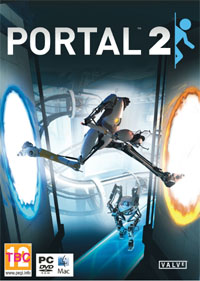
Review: Portal 2

April 20th, 2011

Portal 2 - ValveDespite Steam’s DRM and Valve’s demonstrable anti-consumer values, I found it impossible to resist picking up a copy of Portal 2. I have no decent excuse for this; Valve just seems to be the only company that can get me to routinely disregard my own self-interest in this regard.

The original Portal, of course, was a gem of a game. It took a single, innovative mechanic and fully explored it in almost every way imaginable. And it wedded that experience to an environment and a plot that were similarly laser-sharp in their focus.

When I saw the previews for Portal 2, I was concerned by what appeared to be a grabbag of new mechanics: Several different gels, launching pads, bombs, and a selection of energy fields. I thought it likely that the game was going to lose focus in an effort to find “the next portal gun” by throwing mechanics at the wall and waiting to see what would stick.

I was pleasantly surprised, however, to discover that this was not the case: Instead of distracting from the portal gun, the new puzzle mechanics feel like they’re unlocking the portal gun’s potential. They’re extending gameplay while keeping the focus firmly on the portal gun itself. If there’s any quibble to be had here, it’s that the puzzle designs don’t feel quite as crisp or complete. Unlike the original, Portal 2 feels like its left something on the table. (On the other hand, I haven’t played the cooperative campaign yet, so maybe things will be pushed farther there.)

Unfortunately, however, I was still right about the game losing focus: The story, world-building, and characters are all over the place. Instead of the original game’s intensity, Portal 2 diffuses itself across a hodgepodge of elements.

I probably should have been more suspicious going in. I know that when they rewrote the ending of Portal I was skeptical. (In my experience, the biggest mistake a sequel can make is trying to reset the clock. Pulling a Lucas and rewriting your original game in order to set things up for the sequel to reset the clock almost certainly isn’t a good idea.) But this really felt more like Portal fanfiction than anything else: Portal was amazing because it gave us something unique; Portal 2 too often feels like people consciously trying to recapture the magic of the original by aping its characteristics.

The story was also far too predictable, in my opinion. In Portal I was frequently surprised. In Portal 2 I was almost always three steps ahead of the story. And about half way through the game, the whole thing jumps the shark pretty severely, in my opinion. (I’ll come back later today and post a spoiler-filled explanation of what I’m talking about in the comments.)

Reflecting upon the game, I am also struck by something else. About midway through the original Portal, the nature of the game suddenly changes radically and something magical happens: You actually feel as if you’re pulling a fast one on the designers. You feel as if you’ve slipped off the rollercoaster and are charting your own course. It’s an illusion, of course, but it works. And since the designers are being personified in the game by GlaDOS, the result is not only incredibly invigorating, but also incredibly immersive.

The scenario in Portal 2 almost universally puts you in the same sort of “behind the carnival doors” sequence… but the effect isn’t the same. Even with the AI screaming on and on about how you’ve thrown a wrench into their plans, you can nevertheless see the hand of the designer all too clearly in every level: Even when you’re off the map, the puzzles are too trite; too predictable; too perfectly constructed to feel as if you’re charting your own course through a natural environment.

Ultimately I feel this was the thing that really pushed Portal over the top into being an all-time classic. And Portal 2 doesn’t get there.

So, what’s my verdict? Portal 2 may not be nearly as good as Portal, but it’s still a lot of fun. I recommend waiting until the price comes down to a more reasonable range, though. I don’t think it’s worth the $40-$50 it’s currently being retailed for.
Go to Part 1

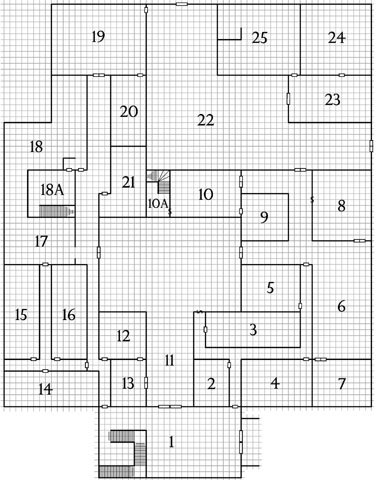
Let’s step aside from the map itself for a moment and spend a moment talking about how the map is actually used at the gaming table. For reference I’m going to use this redrawn version of the map from G1 Steading of the Hill Giant Chief:

G1 Steading of the Hill Giant Chief

(The only substantial difference is that I haven’t included the fireplaces that appear on the original map.)

Imagine, for a moment, that your PCs have just entered area 22 on this map. You flip to page 5 of the module and check the key:

22. OPEN COMPOUND: 14 dire wolves run free here (HP 25, 23, 22, 2 x 10, 19, 3 x 18, 2 x 17, 15, 13, 12), and they will immediately attack any non-giant or non-ogre entering their area. Note that if they see the whip (room 19), however, they cower and make no sound, but otherwise they howl and bite!

Easy enough. What else might you want to know once the dire wolves start howling and biting?

We can probably start with, “Who might hear this?”

So we’d take a quick peek at neighboring rooms: 8, 10, 10A, 19, 20, 21, 23, and 25. Crap. Now I’m trying to look at multiple pages of the module simultaneously to figure out how, at a fundamental level, this compound “works”. In a lot of modules you can actually find yourself trying to look at a half dozen pages just to figure out everything that the PCs can actually see from a particular area.

The problem, of course, is that the map itself is largely a cipher: It’s a bunch of rooms, some doors, and some keyed numbers.

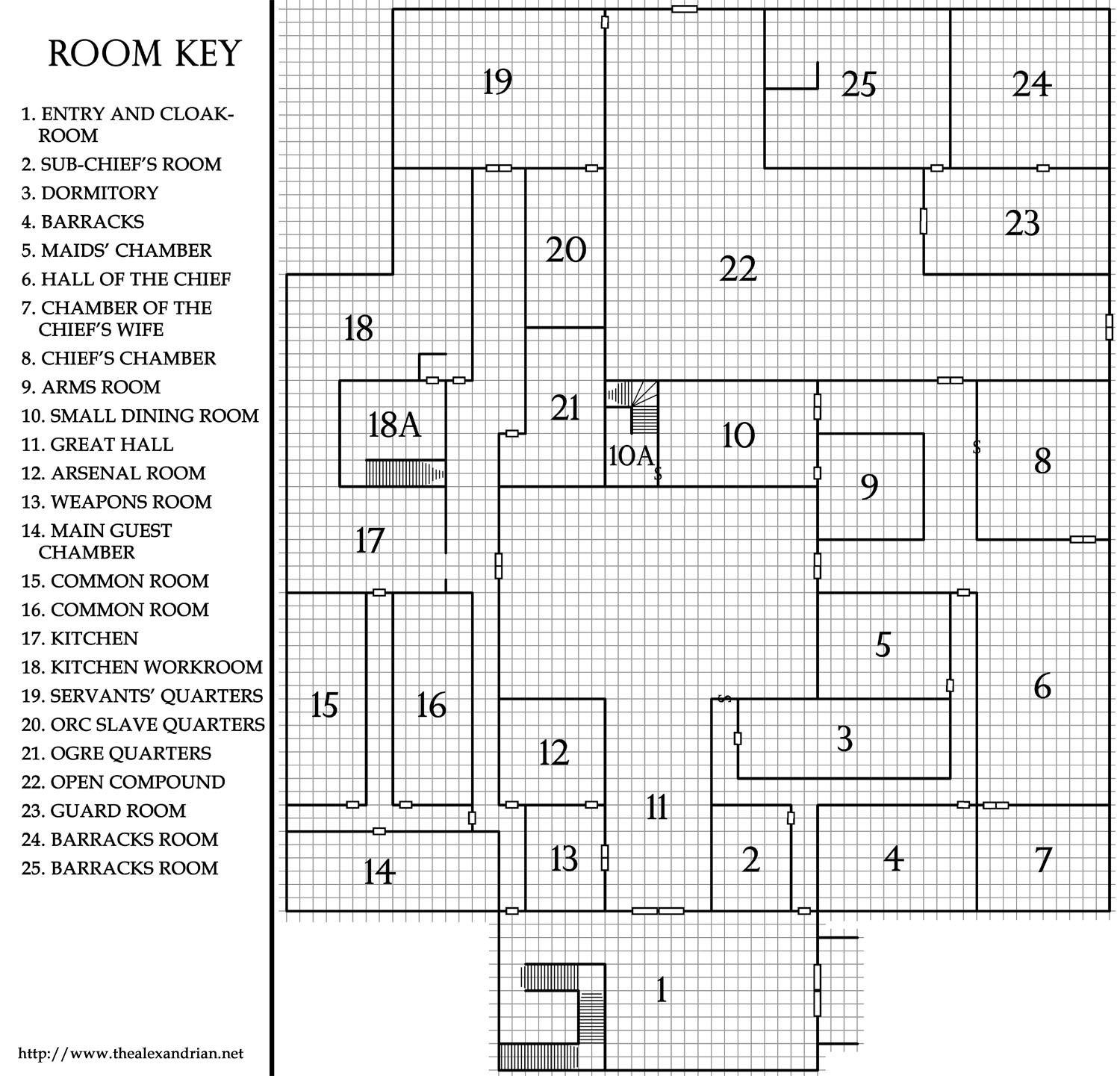
There are a lot of ways we could make it easier to figure out what we’re looking at. An easy one is to simply list a room key:

G1 Steading of the Hill Giant Chief - Room Key

(click for a larger version)

Now I can tell in a glance that area 23 is the Guard Room (I’m guessing the dire wolves will attract some attention from there). Area 19 is a servants’ quarters (they’re unlikely to come out, but might flee out the other exit and down the hall looking for help; or maybe they’ll need to keep the orc slaves from area 20 in line if they start panicking).

And  so forth.

Obviously this doesn’t entirely eliminate the need to reference the map key. But it does let us eliminate a lot of key references, cutting down on the page-flipping and allowing us to stay focused on the keyed information that’s most immediately important. This is particularly important when it comes to referencing important, non-localized information (the type of information we want about a location even when the PCs aren’t in that location).

What other non-localized information could be usefully pulled up onto the map?

More on that in Part 7.RPG Blog Carnival

Go to Part 7: The Monster Roster

This post is part of the RPG Blog Carnival for Cartography.

While poking around caving websites doing research for the Better Dungeon Maps series, I stumbled across a thread at CaveChat.org of “caving lies”, many of which seemed to have a great deal of pertinence to fantasy dungeoncrawling:

  • “You pretty much can’t get lost.”
  • “The trip can’t take more than 4 hours.”
  • “I’m just going to poke my head in and see where it goes.”
  • “It’s dry.”
  • “We’ve got plenty of rope.”
  • “You can fit through there. No problem.”
  • “Trust me.”
  • “Leave your pack behind, you won’t be needing it.”
  • “I know exactly where I’m at!”
  • “The cave map is accurate.”
  • “I don’t know how those rocks got in your pack.”
  • “I only scooped a hundred feet.”

Tangentially, the idea of “scooping” an area (i.e., being the first to explore it) has recently come up quite a bit in my hexcrawl campaign. Should have more on that later this week or next.

Go to Part 1

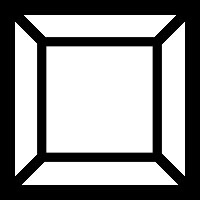
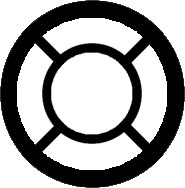
Pit traps are as old as the game itself, and their iconography is familiar to anyone who’s spent time gazing at dungeon maps. A little less familiar, perhaps, is the symbol for an open pit, but it’s not exactly a stranger to the dungeon, either.

Symbol - Pit Trap Symbol - Open Pit

If you’re in need of a circular pit, it’s pretty easy to modify these familiar symbols to suit:

Symbol - Circular Pit Symbol - Open Circular Pit

This leads us pretty comfortably to a discussion of trapdoors which are designed to be traversed (usually taking you to another level of the complex). These, too, have an established iconography:

Symbol - Trapdoor in Ceiling Symbol - Trapdoor in Floor

With “C” indicating a trapdoor in the ceiling and “F” indicating a trapdoor in the floor.

But here things get a little confused, because you will also find some maps keying the “C” to mean “concealed trapdoor”. (Which matches the use of “C” to indicate concealed doors in general.) This matches the use of an “S” to consistently mean both “secret trapdoor” and “secret door”:

Symbol - Secret Trapdoor

So what I’m going to suggest is that our map symbols for trapdoors instead look like this:

Symbol - Trapdoor Down Symbol - Trapdoor Up

And it’s now relatively simple to use “S+”, for example, to indicate a secret trapdoor going up. Or even a +/- to indicate trapdoors in both the floor and ceiling at the same spot.

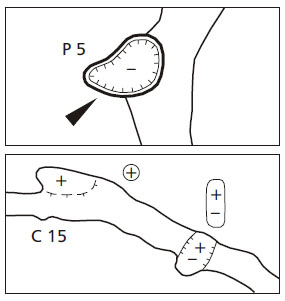
The other argument for this is that it conveniently matches the UIS’s key for indicating the difference between pits in the floor and chimneys in the ceiling:

UIS Pits and Chimneys

Which looks pretty useful to me.

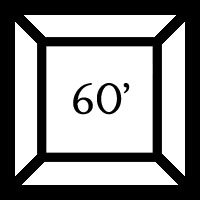
Final thought: Would it be useful to indicate the depth of a pit?

Symbol - Pit with Depth

The meaning seems fairly clear, but it might be muddier if we were dealing with a closed pit. What if we invert our symbol for ceiling height and use it to indicate depth?

Symbol - Open Pit with Depth Symbol - Closed Pit with Depth

It looks perhaps a trifle redundant on the open pit, but I’m guessing the consistency of iconography is worth it. Particularly since this same design can be used for pits and chimneys as desired.

And as a bonus, here’s a thought on indicating a spiked pit:

Symbol - Spiked Pit

What other common features do pits have that it might be useful to include on the map?RPG Blog Carnival

Go to Part 6: The Room Key

This post is part of the RPG Blog Carnival for Cartography.

This is a book trailer I produced for The Bishop’s Tale by Margaret Frazer. I also provide the (brief) voice of Sir Clement Sharpe near the top of the trailer.

Since I know most of the readers here are gamers, I’ll also recommend Frazer’s A Medieval Year in England: It provides a “day by day” insight into what medieval life was like. Lot of good inspiration to be found there for making your fantasy settings flavorful and distinctly “non-modern” without becoming overwhelmed in detail.

Archives

Recent Posts

Recent Comments

Copyright © The Alexandrian. All rights reserved.