
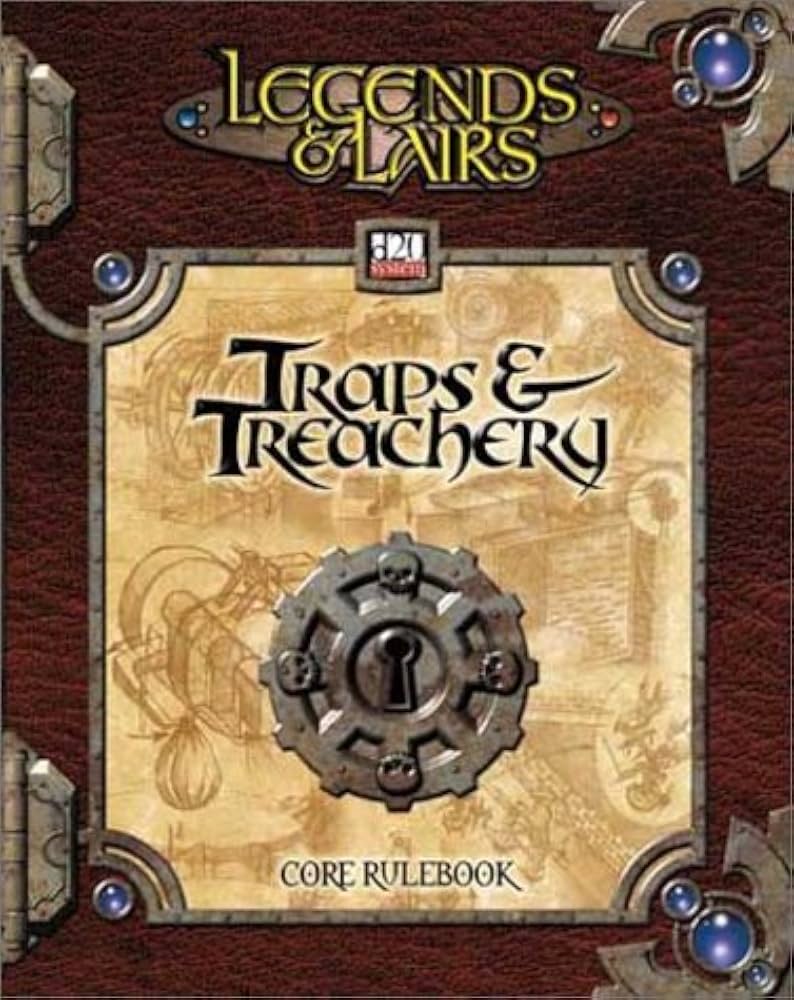
Traps & Treachery has received more use in my D&D games than any book outside of the core rules.
Originally Published March 14th, 2002
If a publisher walked up to me and said, “Justin, I want to produce a D20 sourcebook. What should I do first?”
Then I would say: “Buy a copy of Traps & Treachery so you can see how to do it right.”
CONTENTS
Traps & Treachery is a 172-page, hardback D20 supplement which retails for $24.95. Although printed in black and white, this makes it roughly equivalent to the Monster Manual in terms of content. So the simplest question to ask is: Will this book prove to be as useful a reference as the Monster Manual?
In my opinion, the answer to that is a definitive yes.
Warning: This review will contain spoilers for Traps & Treachery. Players who may find themselves pitted against these fiendish traps should read no further.
Traps: Undoubtedly the centerprise of Traps & Treachery are the traps. There are seventy pages of these – including basic mechanical traps and magical traps. A few examples:
Blackstone’s Clever Cage is designed to imprison trespassers, rather than killing them. Simple traps like these can provide a welcome change of pace, particularly at lower levels – where abandoned traps of this variety can serve as minor encounters, without actually draining any significant resources from the party.
Devilish Dungeon Double Slide is designed to split parties up while moving them to deeper and more dangerous areas of a dungeon. This can cause problems if you’re not prepared to run two groups simultaneously, but can pay big dividends if you are.
One Last Coin… sometimes even the simplest of temptations can carry large consequences. In this case, a single coin is being used to seal away a demon.
Blackstone’s Confining Conundrum shrinks the character as they fall down a shaft which diminishes in size right along with them. At the bottom, however, they are returned to full size – essentially trapping them in the room they come to rest in.
Deep Dwarf Darknetter is triggered by the presence of light, making it a perfect trap for all those underground races which do without it.
Puzzles: This section is short, but shouldn’t be undervalued. Logic puzzles, math puzzles, word puzzles, and chess puzzles are all given – along with some unique challenges and tests.
Trap Design: Several people I know have disparaged this chapter as “worthless.” I, on the other hand, consider it one of the high points of the book. This chapter not only covers some basic elements of trap design (expanding vastly on the guidelines provided in the DMG), it also discusses the different ways that traps can be implemented during the course of an adventure. This chapter is also very useful if you’ve ever wondered exactly what it means to “detect” a trap; let alone “disable” it.
Way of the Rogue: And now, kicking sand in the face of Logic, I close my summary with a discussion of the first chapter in the book. This chapter opens with a discussion of trap lore (which is also a valuable resource when it comes to describing the detection and disabling of traps), moves onto the “business of thievery” (guilds, extortion, smuggling, and a half dozen other types of rackets), tosses out a handful of prestige classes (Discreet Companion, Guildmaster, Roofrunner, and Trapmaster), a new NPC class (Thug), new skills, new feats, new equipment, and more.
This chapter is something of a catch-all at times, providing some of the raw tools necessary for the traps which follow it: A couple new arcane spells; several new divine spells; a thievery domain for clerics; etc.
For me, the highlight here (in terms of crunchy stuff) are the new skills, feats, and equipment. The rules for making and using poisons, along with new poisons, are also very valuable.
GOOD STUFF
All the good stuff about Traps & Treachery can be summed up very simply: Information. Lots and lots of information. Accompanied by lots and lots of crunchy stuff just waiting to be dropped into your campaign.
If you’re a DM with any predilection towards spicing scenarios with fiendish traps, then Traps & Treachery definitely deserves a place on your reference shelf. Nor should you be fooled into thinking this book worthless if you don’t run dungeon crawls: The very first use I put this book to was swapping out a trap in Terror in Freeport that I felt was far too absurd. (The concrete mixer became Blackstone’s Killer Kennel.)
If you’re the player of a rogue, then you’ll definitely want to take a peek at all the material in the front of the book (but keep out of the back, you snoop!).
In short, it doesn’t matter who you are: You’re going to find useful material in this book.
One thing I touched on briefly, above, but want to mention again, is the attention to detail. For example, every single trap in the book not only describes the effects it has, but also goes into detail on what it means to detect and disable the trap. This is the type of thing which is invaluable to me as a DM, because it saves me a ton of work.
BAD STUFF
I would have liked to see a narrower focus for Traps & Treachery: I would have preferred to see 172 pages of traps or 172 pages of thief-oriented information. Not half-and-half.
The reason for this is simple: As a DM I would want the traps. As a player I would want the class-oriented information. There’s very little crossover there. And, to make matters worse, as a DM I don’t want my players looking at the trap information.
The other thing you should consider is your tolerance for elaborately engineered and/or over-the-top traps. I, personally, have a very low tolerance for that type of thing – so I will not be using the trap which turns the victim into a mouse and releases house cats to eat them. Or the treadmill which feeds you into a spinning blades. Or the corridor which shoots buzzsaws at you. For me, such things are atmosphere killers and deflators of suspension of disbelief. (This is the same reason why you will never see a tinker gnome in my campaigns. Ever.)
On the flipside, the frequency of these types of traps is rare in T&T. And, in fact, if you – like I – thought Grimtooth’s trap books were great ideas but threw up your hands in disgust at how absolutely ludicrous and ridiculous the content was, then Traps & Treachery is like a dream come true.
CONCLUSION
If the first time you read through a supplement like Traps & Treachery you are constantly stopping to jot down notes of different ways in which you want to use the material, then the book is a success. If the book then earns a place in your gaming bag (so that it comes along with you to every gaming session) because you’re using the material in it in every single game session, then the book is something really special.
Traps & Treachery sits right next to my PHB, DMG, and MM every single time I sit down to the gaming table.
‘Nuff said.
Note: The reviewer has worked on a number of projects for Fantasy Flight Games, including five adventure modules and Mythic Races. The reviewer did not work on Traps & Treachery.
Style: 5
Substance: 5
Author: Greg Benage, Kurt Brown, Mark Chance, Brian Ferrenz, Lizard, David Lyons, Brian Patterson
Publisher: Fantasy Flight Games
Line: D20
Price: $24.95
ISBN: 158994020-2
Product Code: DD17
Pages: 172
For an explanation of where these reviews came from and why you can no longer find them at RPGNet, click here.











Man, I remember this book. It was great. Sadly in a move several years ago I got rid of all my RPG books (mostly D&D 3.x stuff like this). I hadn’t played in several years and my Girlfriend wasn’t interested at the time. Now I wish I had it all back.
Ooooh, a traps resource? This one might be worth finding secondhand or as a republished PDF for converting to 5.x. I like traps, especially nonlethal/nuisance traps, so extra tools to make interesting ones is really nice.
@MissMisinformation
FWIW it seems it is available on DriveThru for a steal.
https://legacy.drivethrurpg.com/product/482/Legends–Lairs-Traps–Treachery