
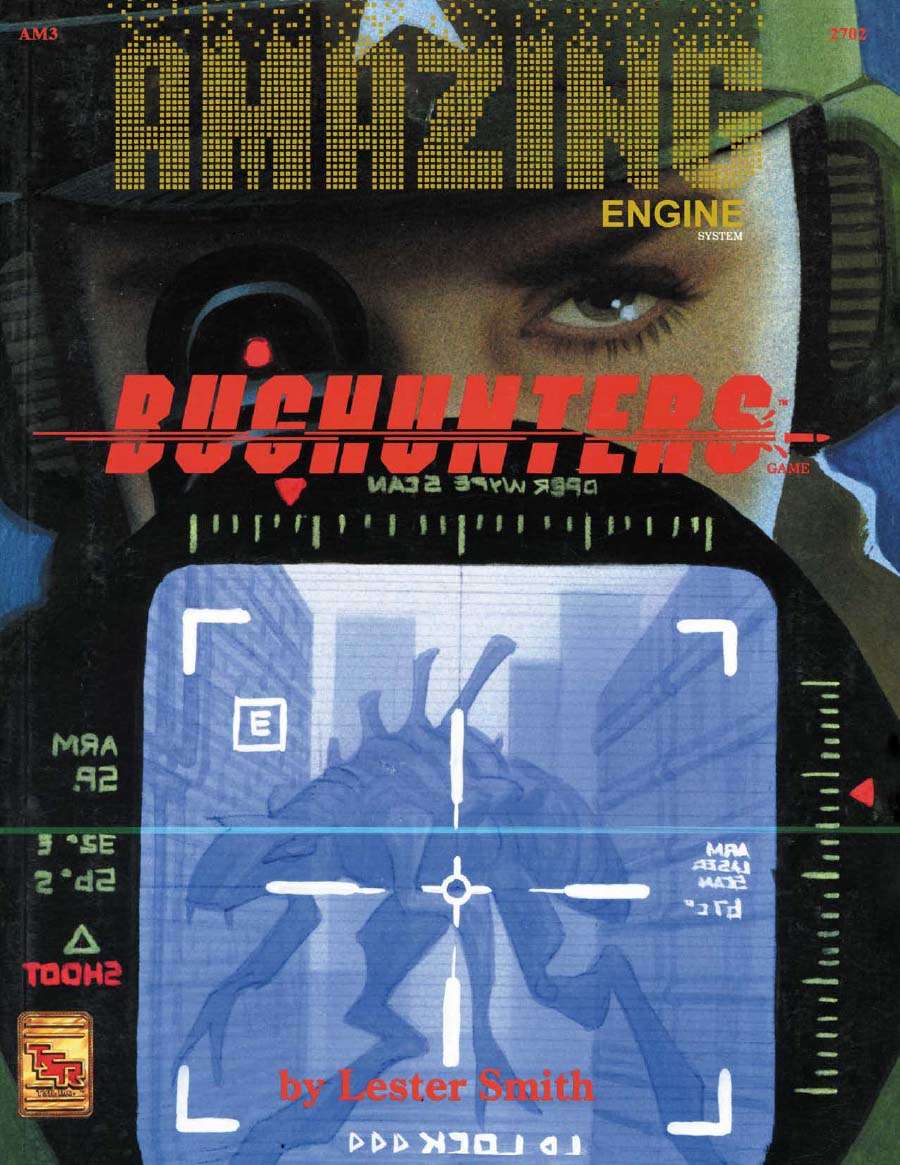
Bughunters can be mined for ideas, but – like most of TSR’s output in the ‘90s – is padded with too much fluff and empty space to present a truly high quality package.
Originally Published March 16th, 2002
WHY BUGHUNTERS?
Bughunters was a supplement for TSR’s Amazing Engine game – which hasn’t been in print for more than half a decade.
So why review it?
Well, first off, because a lot of RPG fans are bargain hunters: They’ll see this book in a remainder bin or on a clearance table and begin wondering whether or not its worth snapping up. And that’s what a review is all about.
Plus, I want to. ‘Nuff said.
WHAT YOU GET
Bughunters is essentially an unlicensed Aliens RPG: The PCs are ground-pounders in the United Terra Reconnaissance and Peacekeeping Force (UTRPF). As such they are charged with keeping Mother Earth safe from hostile aliens… And if there’s anything humanity has learned, it’s that every single alien in existence is hostile.
Bughunters mixes things up a little more by casting the PCs as Synners – synthetic humans. Synners originally became necessary because normal humans become debilitatingly ill if they go through an Isler jump (the FTL device of the setting) outside of cryogenic sleep. Once the law allowed the government to use synners in the military, however, it was inevitable that the genetic modifications would be extended to create super-soldiers. Once that happened, however, society no longer wanted synners living among them – so laws were pushed through that prevented the synners from ever mustering out of the UTRPF: Once created, they were in the military for life. And once that was true, the pressure from constant alien threats quickly allowed the military to generate their super-soldiers more quickly by using a braintaping technology to duplicate civilian personalities: The civilians had the consolation that some “part” of them was out in space having adventures, while the military got a pre-grown personality to insert into their rapid-growth clones.
So as a PC you are not only forced to fight a vicious alien menace for the rest of your natural lives (i.e., until one of the vicious aliens kills you), but most of your memories and your entire identity actually belong to someone else. That’s not only a solid premise for a game, it’s also a great source of characterization and drama: Character is not only what you are in the dark; it’s what you are when your back is pressed to the wall.
As a sourcebook, Bughunters provides all the usual suspects: In the player’s section you’ve got a future history of the universe; character generation rules; details on the life of a synner; combat rules; military equipment; details on ships; and a mini-sourcebook on Stargate, an L-5 space station where most synners start their careers (and, thus, a good starting point for most Bughunters campaigns).
The GM’s section contains some additional background information, including – of course – the stats for a number of vicious aliens for the PCs to hunt down and kill: Essentially, most of the intelligent life in the universe was created, modified, or enslaved by two Ancient races to serve in their centuries-old war. These races – referred to by many of the minor races as the Shapers (a psychic race featuring biological technology) and the Artificers (an insectoid race featuring advanced “hard” technology) – are completely exhausted by their long war, but the continued hostility is the reason why everyone humanity happens to meet in space is immediately a threat: They’ve been conditioned to assume that, if they don’t know a race, it’s probably serving the other side.
The book is wrapped up with some very helpful charts and tables, most notably a full-color, pull-out map of the local section of the Milky Way – complete with an accompanying table of stellar distances.
WHERE IT FALLS DOWN
Bughunters falls down by not going far enough: There’s fancy military equipment, but there’s not a lot of it. You get a few alien threats, but not enough to sustain a true “let’s hunt the new bugs this week” campaign. And so forth.
Perhaps the most unfortunate lack here is in setting details. Bughunters was always intended to be a stand-alone product, yet the creator has simply failed to deliver all that much in the way of real meat when it comes to the Bughunters universe.
Part of the problem here is that this was a TSR product circa-1993. Those of you who were in the hobby back then already know that the only thing TSR could be relied on to produce in those days were books with excessive whitespace, large fonts, and text with too much leading between lines: In short, products which employed every means possible to keep their actual word count and content to an absolute minimum while (literally) pumping up the margins.
But even taking that into account, there’s a lot of fluff here that doesn’t need to be here. Most of it (such as the introductory adventure) was probably also caused by corporate guidelines, so I’m not going to blame the authors or creators here. But it is an unfortunate reality of the book.
WHAT IT’S GOOD FOR
As a result, Bughunters is going to be primarily useful as something you tear apart for ideas and put back together in your own image. For example, I could easily see using some of the material and background material here for a bughunting campaign set about 25 years in the future of the Transhuman Space universe.
Looked at through this lens, Bughunters is a rich resource: There are a lot of very compelling pieces here which can be conveniently ripped out, turned around, and slammed into another game. Or used to create an entirely new setting to your heart’s content. Plus, there’s nothing really wrong with the material here – most of it can serve as a very reliable foundation on which you can simply continue building.
On aspect of particular note here is the ship design system: To design a ship in Bughunters all you need to do is slam together various modules – instantly creating your own, customized ship. I would have liked to see more modules to choose from, and more detailed floorplans of the modules, but this is another area where the foundation is very solid. The basic mechanic and floorplans are also completely system independent, so the whole thing is very easily portable.
The full-color map and stellar distance charts are also well done, and provide a resource for any science fiction campaign set galactically near Earth.
A Note on Amazing Engine: For those unfamiliar with the Amazing Engine product line, it was an attempt to produce a generic game (a la GURPS) by TSR. The engine itself has many strengths (which I may dwell on if I ever review the actual game system), but the game’s supplements suffered because of a methodology which required a complete set of character creation rules and (frequently) large chunks of the combat rules to be redesigned and reprinted. This helps contribute to Bughunters’ fluff problem. It also means you cannot play Bughunters as is without the Amazing Engine rulebook.
Style: 3
Substance: 3
Author: Lester Smith
Additional Design: Tim Brown, Karen Boomgarden, Newton Ewell, Tim Beach, Colin McComb of the Clan McComb
Line: Amazing Engine
Price: $18.95
ISBN: 1-56076-623-9
Product Code: TSR2702
Pages: 128
Year Published: 1993
Flipping through my copies of Bughunters, I’m going to be honest: I was overstating its usefulness as a resource. Except for the poster map of star systems near Sol. That’s pretty great.
For an explanation of where these reviews came from and why you can no longer find them at RPGNet, click here.











“I’m going to be honest: I was overstating its usefulness as a resource.”
Can I at least rip the introductory adventure or monsters for a Traveller or Aliens: The Roleplaying Game campaign?