
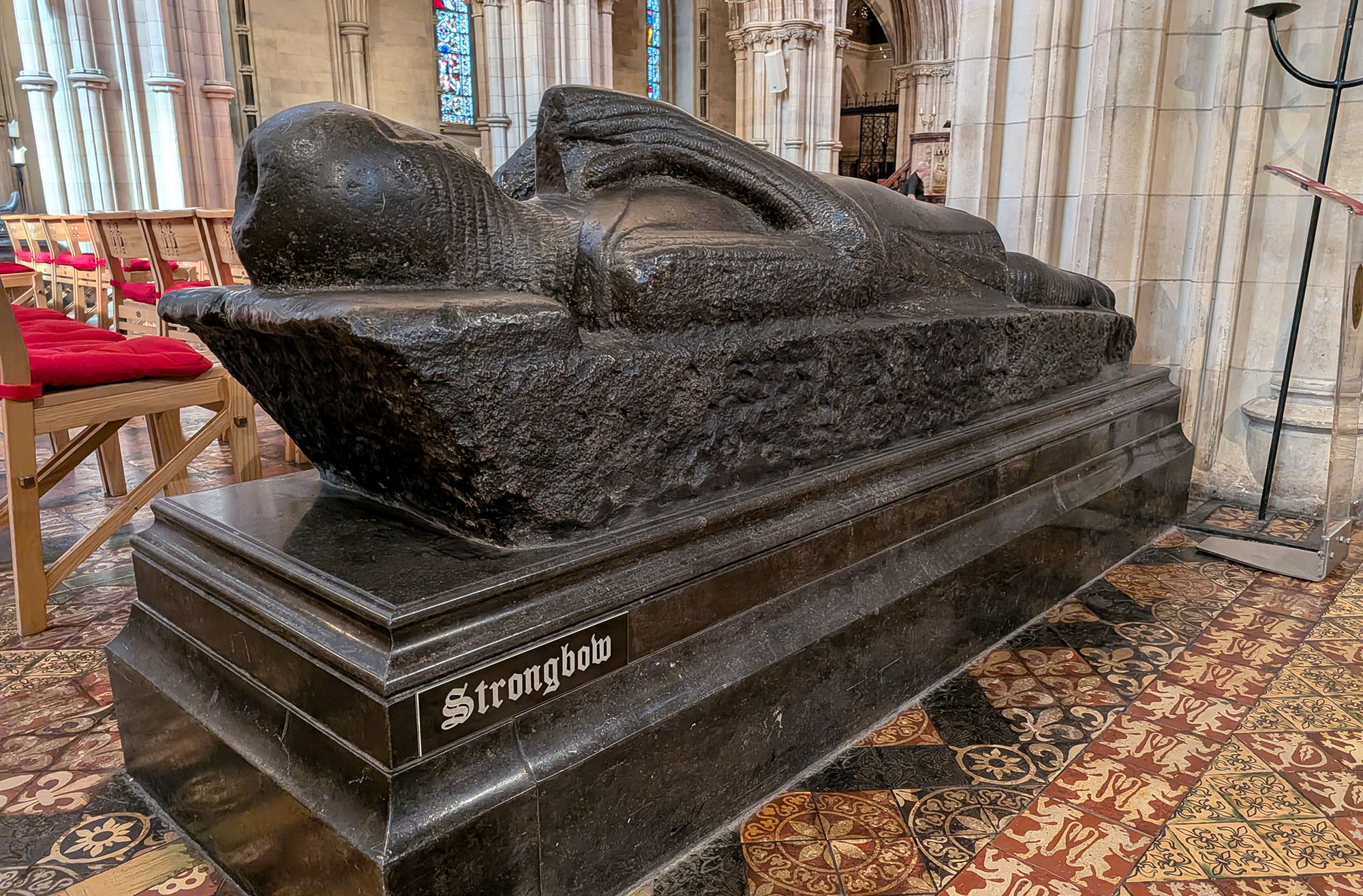
This is the tomb of Strongbow, aka Earl Richard de Clare, in Christ Church Cathedral in Dublin. Richard was an English nobleman who, through a complicated series of treaties, wars, and arranged marriages, was instrumental in making the Kingdom of Leinster subject to the English King Henry II. This fascinating history – and the many terrible and tragic events it begat – is not our primary focus here, but rather the tomb itself.
If you take a closer look at the effigy atop the tomb, you can see a rather noticeable dent atop its head:
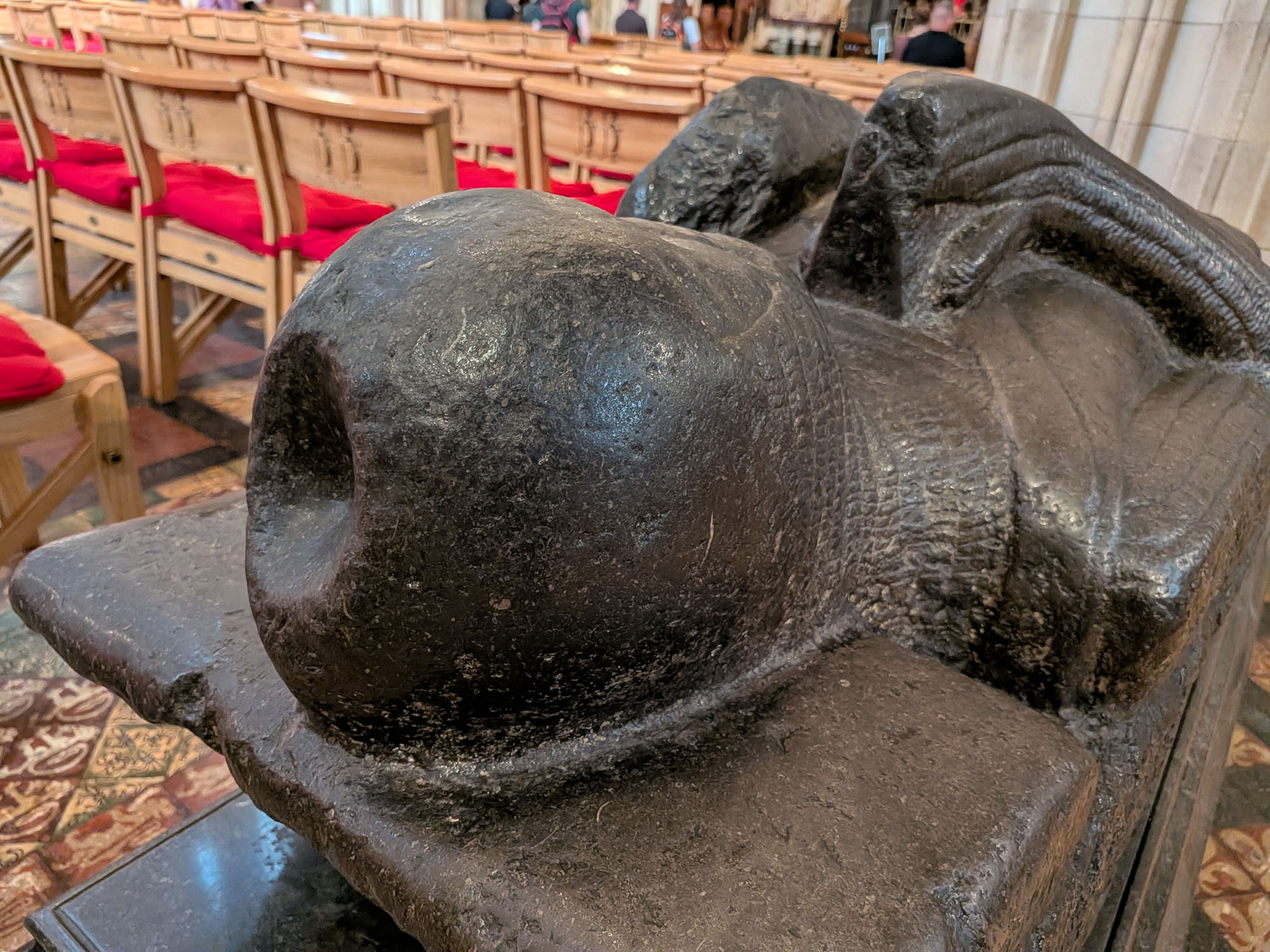
This is not, as I first surmised, a cold-hearted allusion to Strongbow being killed by a strong blow to the head. It is not, in fact, an original feature of the effigy at all.
Instead, for several hundred years, it became customary in Dublin for business contracts, debt payments, and other business to be formally witnessed at Strongbow’s tomb. At the conclusion of each deal, a coin would be scraped across the head of the effigy for good luck. The original reason for this practice is variously disputed (possibly having something to do with checking whether a coin was a forgery by scraping it across hard stone), but the end result of such use after centuries was wearing a hole in the statue’s head.
This is a fun bit of history. It’s also exactly the sort of detail that can make your campaign world come alive: Whether the PCs are signing a contract or shadowing a banker doing business, it gives a bit of vibrant life to an otherwise forgettable interaction. It turns the generic into the specific. It draws you deeper into the world.
To add these kinds of details to your own campaign world (assuming you’re not pulling them directly from history), look for the use beyond use.
There will be plenty of stuff in your world that has a simple, straightforward, utilitarian purpose. Just choose one of these, and then—
FIRST: ADD A SECOND USE. Ideally one discordant or at least orthogonal from the original use. So, for example, the tomb (primary) is also a place for moneychanging. (Or, conversely, you start with a place for ratifying contracts and decide that it could be the tomb of an important king. Our real world example can work either way.) Other examples could include:
- The blacksmiths of Maernath are also innkeepers for fire elemental traders, who book “rooms” in their forges.
- Contracts and treaties with the elves are “signed” by magically carving their initials into a tree in Dryads’ Grove. The ritual embodies the tree with a fey spirit, creating the dryad who protects the tree and adjudicates the agreement. Important agreements may have a single, dedicated tree. Less important agreements may share a tree, with a single dryad perhaps serving as adjudicator for dozens or hundreds of contracts. (The agreements, of course, are only considered binding for as long as the tree stands. And, vice versa, a broken agreement may cause a tree to die.)
- The altar of Kingsbury Cathedral is also where mothers are taken during labor so that their children might be born in a state of blessing.
SECOND: ADD A DETAIL. This should, like the hole scooped out of Strongbow’s skull, evoke the second use, making it manifest in the game world. Often these will be quite obvious, but the important thing is that the detail serves as a curious point of interest – something that will make a player ask, “Hey. What’s going on here?”
- The forges of Maernath having “viewing ports,” often accessible from the outside of the building, where visitors can call upon and chat with the elemental visitors.
- An elf lad seeking vengeance for the death of a contract tree that ruined his mother carries a stake of the tree’s wood, intent on plunging it into the heart of those he holds responsible.
- The Kingsbury altar has a contoured top. Some say it has been worn away through countless births; others that it was made that way when the altar was replaced in 1219 so that the mothers could be more comfortable. One tale claims the stone was burnt away by the buttocks of goddess who reputedly gave birth to a demigod on the altar.
You can, of course, add additional details as appropriate, but often less is more, and the important thing is weaving these elements into the life of your campaign.









This first and second use idea is extremely good and I’ll be using that from now on. Thanks for sharing it