The Alexandrian

Posts tagged ‘harn’

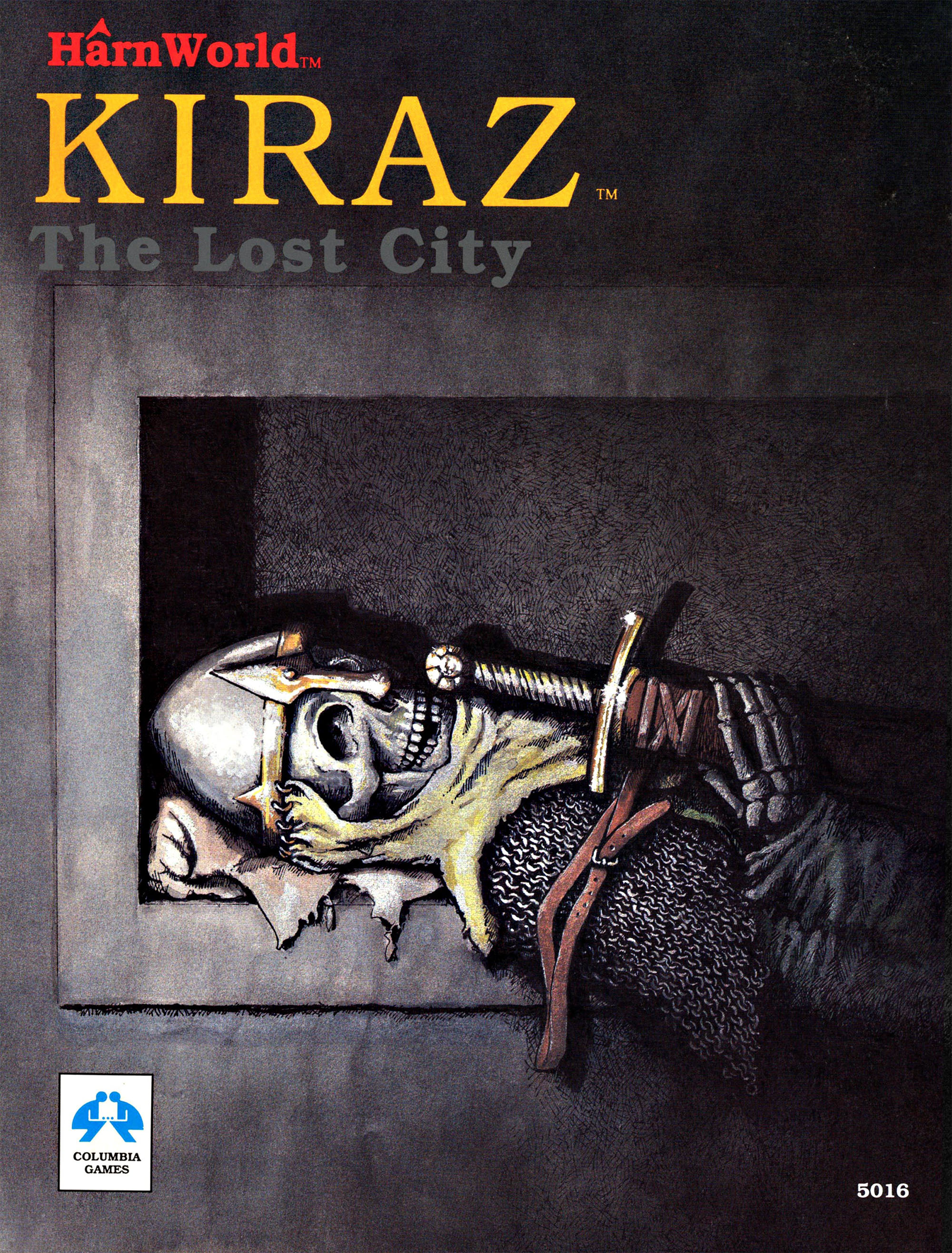
HarnWorld: Kiraz - Columbia Games

It’s like starving yourself for three days, and then eating a pecan. Kiraz makes you hungry for information, but leaves you unsatisfied when all is said and done.

Review Originally Published October 10th, 2001

Kiraz: The Lost City is the second adventure in the In Search of Panaga trilogy of modules. However, it is also a sourcebook for the lost dwarven city of Kiraz. As Crossby writes in his preface:

It was like this: Columbia wanted me to do Kiraz, and I wanted to complete the next volume of In Search of Panaga. Both modules were late. So, I thought, why not set the Horns of Ikarus in the Lost City?

I am largely unqualified to review the adventure portion of this product: I do not own either the first or third parts of the trilogy. However, I don’t feel this is a major impediment, because the bulk of the book is the sourcebook for Kiraz. And, in fact, the reason I bought the book to begin with was for the Kiraz source material.

Kiraz: The Lost City is comprised of three articles/modules: Kiraz (14 pages), Ushet (4 pages), and Horns of Ikaras (5 pages). There are also two pages of full-color illustrations (maps of the areas surrounding Ushet and Kiraz, as well as visuals of the entrances to each of them which can be shown to the players). There are also two blank pages labelled “GM Notes”.

KIRAZ

Kiraz is the oldest dwarven citadel in Hârn. A massive complex, it was once the pinnacle of dwarven civilization. Roughly six hundred years ago, however, Lothrim the Foulspawner laid siege to the city with his army of orcs. Kiraz fell.

Although the dwarves had their final vengeance upon Lothrim, the halls of Kiraz were sealed away forever – a grim reminder of the dark memories which were forged there. Today most of the halls stand deserted, although some of the lower levels have been broken into by orcs.

This section is really the core of the book: Brief detail is given of Kiraz’ history and the current area around the ancient city (3 pages). A cut-away map of the entire complex is given, along with a one-page summary of the major features of the city (2 more pages). After this one page summaries and maps are presented for several major areas of the city:

The High Halls: The Great Hall of Kiraz, the Royal Apartments, the Council Chamber – the High Halls once housed the royal family and government of the city.

Gallreda Complex: A residence for officers of the royal government. This includes the Hall of Galreda and the Hall of Zelanthu.

West Gate: The primary point of entrance to the city.

Ranzad Complex: The largest cavern in Kiraz, this was the marketplace and social center of the city.

Minehead: As the name might suggest, this was the point from which the mines were reached. Workshops, ore storage, and the like are all found here.

The Catacombs: Not only the communal graves of Kiraz, but also the Royal Tombs. The Hall of the Godstone (an ancient earthmaster site predating dwarven civilization) can also be found here – it is generally considered to be “the birthplace of the Hârnic Khuzdul [dwarves]”.

An additional page discusses ways in which the GM can develop the material presented here. Finally, two more pages give several artifacts and special locations which can be placed by the GM in whatever locations seem most appropriate.

Before I continue, let me make one point abundantly clear: All of the material which is found here is excellent. Beyond par. The maps are beautiful and superbly executed. The logic and detail of the city is meticulous: Crossby refuses to simply wave his hands in the construction of this city; instead insisting that the city make sense. By the time you are done reading through this article, you will have the sense that a place like Kiraz really could exist. This is, by no means, a small or unvaluable accomplishment.

The problem with this supplement is not the quality of what is present, but the vast amounts of information which is – quite literally – missing. This is, apparently, keeping in line with the intended design methodology – which is described as such:

In keeping with our long term policy, there is lots of room for the GM to customize his own version of the Golden City – even if a player should get hold of a copy of this module, it won’t help him much.

Folks, this just doesn’t cut it for me. The whole point of buying a supplement is so that I don’t have to do design work. Certainly keeping snoopy players on their toes is a laudable goal – but if I want to do that, I am quite capable of changing information. In fact, changing and rearranging information is vastly easier than being forced to create material out of wholecloth.

USHET

This is a four page article discussing the Rock of Ushet. Ushet was once a hunting lodge, connected to Kiraz via a series of spent mining tunnels. Following the Carnage of Kiraz, the Ushet entrance was sealed. In recent years, however, orcs have broken through those seals and taken up residence in the former hunting lodge.

The material presented here serves two purposes:

First, Ushet serves as the point of entry to Kiraz for characters playing through The Horns of Ikaras (see below).

Second, there are many former dwarven hunting lodges spread throughout the area around Kiraz. They are sites of conflict between the barbarian tribes (both orcs and humans) who remain in the area. Ushet serves as a generic template which the GM can use for any of these hunting lodges.

There’s nothing phenomenal in this section – but it’s all solid material, and very useful as either a specific or generic resource.

HORNS OF IKARAS

As I noted above, I am not familiar with the first part of the trilogy of which the Horns of Ikaras is the second part. With that being said, I am thoroughly unimpressed by what I see here.

Essentially what Crossby presents is a four-page outline of an adventure, rather than an adventure. A summary is given of what took place in the first adventure (1 page), the NPC who gives them the hook into this adventure is described at length (1 page), player handouts are provided (1 page), and the adventure is briefly summarized (1 page).

In short, the material presented here can be summed up with extreme accuracy by saying: “Several months have passed since the last adventure. The PCs should have heard some rumors about the Big Bad Guy’s activities (kidnapping three beautiful women, stealing some rare animals, and burning town officials in Aleath). They go to Kiraz – most likely gaining entrance via Ushet – where they need to find a key to gain access to the room where the Horn is kept.”

CONCLUSION

As I write this I currently have a D20 module in development: I have a general outline of events written down; about half of the maps completed; and rough notes quickly jotted to remind me what the keys on those maps mean. That’s what Kiraz looks like.

By the time I finish developing that D20 module I will have a text which presents the adventure in full to the GM, a complete set of maps, and a fully developed and descriptive key for all of those maps. That’s what Kiraz should look like.

Reading Kiraz feels like starving yourself for three days and then eating a pecan.

Having said that, however, let me go on to say that Kiraz comes with my recommendation: Although I take issue with the fact that so many things are simply left undeveloped, what is developed here is – quite simply – superb. For $15 this presents a solid value for your money, and anyone thinking of including a dwarven citadel in their own campaign could only hope to benefit from this book. Certainly anyone interested in Kiraz in and of itself as part of the world of Hârn should snatch up a copy of this book without a second thought.

Style: 4
Substance: 4

Author: N. Robin Crossby
Publisher: Columbia Games, Inc.
Line: Hârn
Price: $14.98
ISBN: 0-920711-28-6
Product Code: 5016
Pages: 28
Year Published: 1989

Rereading this review, I was somewhat surprised to discover that I’d given it a rating of 4 in Substance. Flipping through my copy of the book, though, I understand where I was coming from: It was a little on the pricey side for 30 pages of material, but there’s a lot of great stuff in here and the maps are truly spectacular. The problems aren’t what’s on the page; it’s the mismatch between the scope of the product and the scope needed by the subject matter.

For an explanation of where these reviews came from and why you can no longer find them at RPGNet, click here.
HarnWorld - Azadmere

Where’s the dwarven beef?

Review Originally Published October 9th, 2001

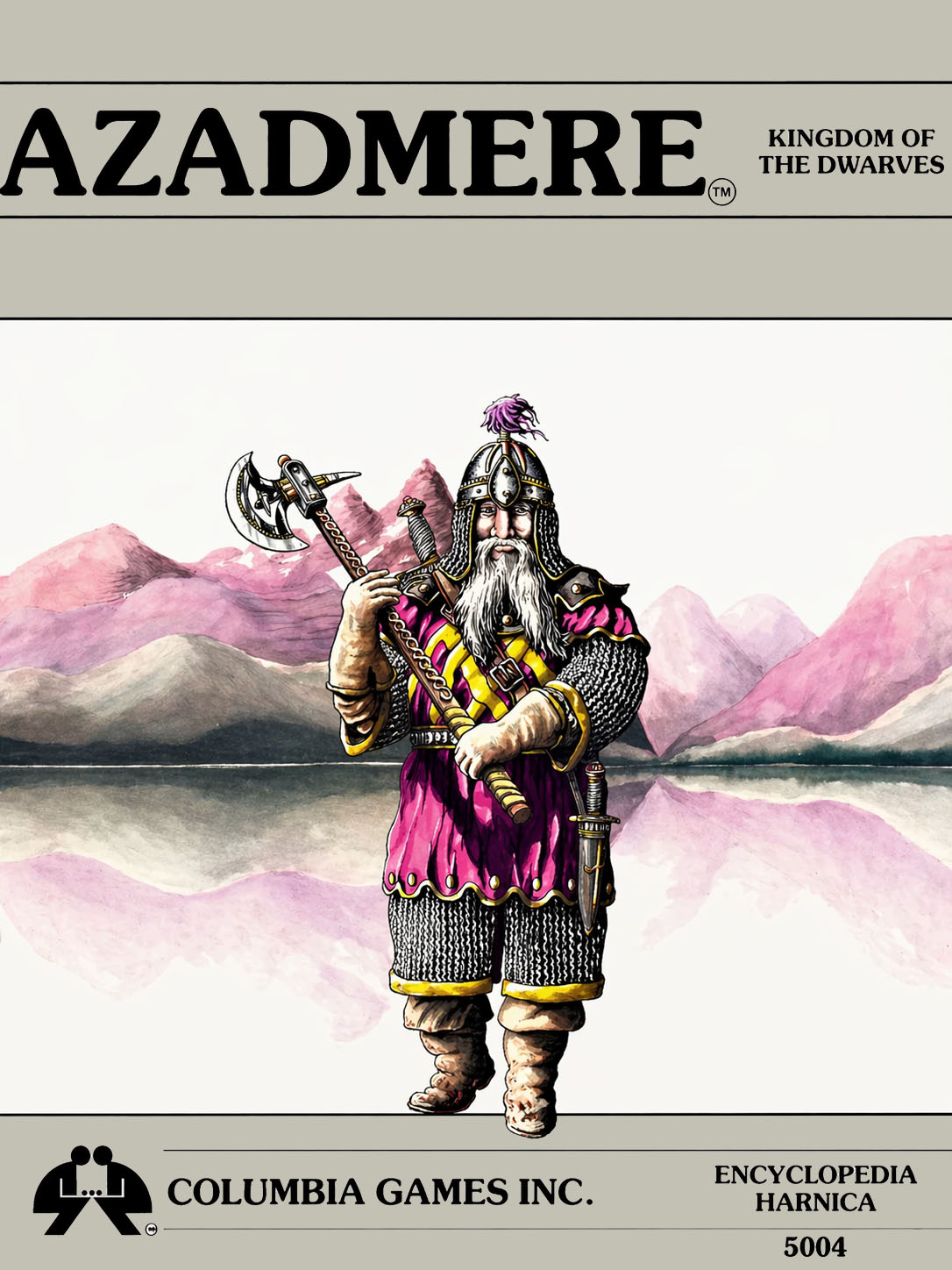
Azadmere is a HârnWorld supplement, containing four Encyclopedia Hârnica articles: Azadmere (10 pages), Khuzdul (4 pages), Habe (6 pages), and Zerhun (10 pages). It also includes full-page Player Maps (black and white, unlabelled) and Common Maps (full-color, labelled) for Azadmere (the kingdom), Habe, Zerhun, and Azadmere (the town).

AZADMERE

The titular subject of the supplement, the article on Azadmere devotes one page to discussing the history, government, economics, and religion of the Kingdom of Azadmere. In short: Azadmere is ancient, predating human civilization on Hârn by several millennia. When the first humans (the Jarin) reached Hârn, a symbiotic relationship grew up between the two cultures – with the dwarves increasingly focusing on their mining and craft, while the humans farmed the surrounding land for food. Eventually some human families were adopted into the dwarven clan structure. This caused some problems, however, because the original city of Azadmere was forbidden to humans. To solve this, the Outer City was constructed outside of the mountain (while the original city, within the mountain, became known as the Inner City).

Following this extremely brief summary (figure it out – if less than a page is spent in the book itself on this material, there can’t be that much information left out of my summary of the summary) we are given a full page map of the Outer City. The next two pages give a key for every single building in the outer city (naturally, almost all of these descriptions are extremely brief).

From there we get an even briefer look at the Inner City: Four pages of maps reveal the three primary levels of the Inner City (in relation to the Outer City and with detailed maps of Levels 1 and 2). The description of these maps is summarily squeezed into a single page, leaving room for a one page chart showing the clans of Azadmere and their primary assets.

And that’s it.

All right, I’ll be totally up front with you: My primary reason for buying the book was for the dwarven city. I’ve got a major dwarven city adventure looming on the horizon in my campaign, and so I went looking for extant dwarven city resources to draw upon.

But I’ve got to believe that I would be underwhelmed by this even if it hadn’t been my primary interest in the book.

I mean, the maps are fantastic. No doubt about it. Not only are they gorgeous in the execution, the Outer and Inner Cities are just plain well-designed from the look of it: They make sense, as so many fantasy cities do not.

But I have to admit that I want more description: I want to know what these rooms on the map look like. I want to know more about the people who live here. I want to know more about the politics. I want to know—

You know what? I just want to know more, period. And it’s not that “wow, you’ve told me so much and I’m still hungry for more” feeling (which is a great feeling) – it’s that “uh, did you forget to print something?” feeling (which is a bad feeling).

KHUZDUL

The four page Khuzdul article which follows the Azadmere article didn’t do much to alleviate my trepidations. Again, we are given the lightest coverage seemingly possible for dwarven history, culture, religion, and economics (and at least some of this is repeated from the Azadmere article).

To put this in perspective: The article on the Khuzdul in the Harndex (one of the books which comes as part of the second edition of HârnWorld) is nearly a page long. I would guess that the amount of information has only been expanded by approximately a factor of 5. Maybe.

Actually, the Khuzdul article as it stands in this book would make more sense as the Harndex entry. Or, at best, the outline for a Khuzdul supplement.

HABE & ZERHUN

The last two articles in the book are slightly better. Zerhun, in particular, seems to give a fairly complete picture of its subject matter (a dwarven fort guarding the southern reaches of the kingdom). But this actually serves as a major tip-off to the larger problems this supplement faces: If you need 10 pages to adequately describe a fort and the small town which supports it, what on earth makes you believe that 10 pages will be adequate to describe an entire dwarven city (which is 30 times larger in population alone)?

Habe is a small town, the oldest Jarin settlement in Azadmere. This article is still a little lighter than it probably should be, but doesn’t fare too badly. The maps of the keep in Habe, in particular, are a valuable resource. The maps of the Inn, in my opinion, less so.

CONCLUSION

The problem Azadmere has as a supplement can be summed up simply:

Where’s the dwarven beef?

If this book did nothing except describe the dwarven city of Azadmere, it could most likely do justice to its subject of choice. Similarly, if this book did nothing except describe dwarven culture and history, it could almost certainly do justice to its subject of choice.

Instead, Azadmere chooses to spread its focus too wide – and ends up failing to do justice to any of the material it chooses to present.

What’s in the book is of high quality. But the book remains deeply flawed because of what isn’t to be found here.

I, for one, am disappointed.

Style: 3
Substance: 3

Author: N.R. Crossby, Tom Dalgliesh, and Edwin King
Publisher: Columbia Games, Inc.
Line: Hârn
Price: $15.98
ISBN: 0-920711-09-X
Product Code: 5004
Pages: 40

Does, “Where’s the beef?” still have any cultural cachet?

I was, in fact, hunting for a great dwarven city supplement that I could plug into my ongoing D&D 3rd Edition campaign. Azadmere was not, as I recall, my only disappointment. (I believe there was also a Moria supplement I sampled and rejected, among others.) If I could go back in time and offer a guiding light to my younger self, I’d point him in the direction of DL4: Dragons of Desolation by Tracy Hickman and Michael Dobson, which includes an incredible set of dwarven city geomorphs.

Looking back, I’m realizing that my younger self had, in fact, read that module, but only in a used copy of the DLC1 reprint collection which, vitally, was missing all the geomorphs.

For an explanation of where these reviews came from and why you can no longer find them at RPGNet, click here.

HarnWorld (2nd Edition)

A classic fantasy world, Hârn continues to distinguish itself as a setting of unique detail, depth, and excellence.

Review Originally Published October 9th, 2001

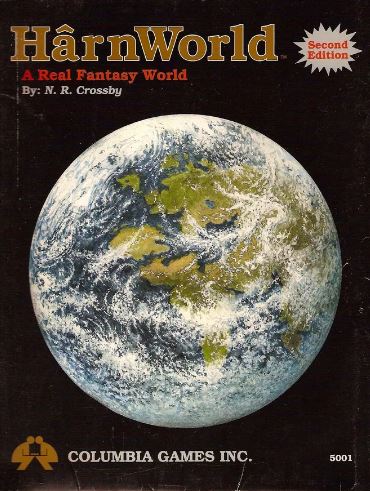
Hârn is a fantasy world created by N.R. Crossby and first published in 1983 by Columbia Games. In 1990, a second edition of HârnWorld (which is being reviewed here) was released, including:

HârnWorld: A 64-page booklet – including the articles Hârn, Kethira, and Lythia — serving as a general introduction to the campaign setting.

Harndex: The “Master Index for Hârn”, an 80-page booklet serving as the specific source material for the campaign setting. (Although referred to as an “index”, it is probably easier to describe it as an “abridged” encyclopedia. Entries are arranged alphabetically, with short articles discussing each entry.)

Map: A full-color poster map of the campaign setting.

Since then, Hârn has been supported with a variety of supplements (all of which are kept in print by Columbia) and its own rule system (HarnMaster, also currently in its second edition). In general, however, the source material is kept separate from the rules.

The Hârn product line, as a whole, is organized into a series of modular articles. For example, as mentioned above, the HârnWorld booklet which comes as part of the second addition HârnWorld product is actually comprised of three articles: Hârn (describing the island of Hârn), Kethira (the world on which Hârn is located), and Lythia (the continent which Hârn is part of).

Each of these articles has its pages numbered individually, and are specifically designed so that you can cut the book apart and separate the articles from one another and place them in a binder. As you purchase other Hârn products (which contain their own articles) you can organize the articles in any order you want (or pull specific articles to take with you to a particular game session). The concept/conceit is that each of these articles is part of an ever-expanding Encyclopedia Hârnica, with each GM assembling their own Encyclopedia as they assemble official material and create their own material over time. I don’t know that I’ll ever take advantage of this design myself, but it’s a nice option to have available.

SETTING DETAILS

Hârn approaches fantasy with a light touch. For example: Humans, elves, dwarves, and orcs are the only significant races to be found here. Other intelligent races do exist, including the Ivashu (a sterile race of diverse magical creatures who are perpetually created anew by the god Ilvir from the limited number of souls available to him) and the mere-dragons (a distant cousin of the true dragons) – but their rarity gives them a special significance. Hârn succeeds at making the magical elements of its fantasy effective and special because those elements are rare, not despite it.

Hârn itself is a large island, just northwest of the continent Lythia on the world of Kethira. As the name on the front cover would suggest, Hârn itself is the primary center of focus for HârnWorld — although Lythia also receives enough attention that you can easily use it as part of your campaign without too many problems (although I, for one, would really like to see additional support material released for the non-Hârn areas of the world). The other two continents on Kethira are briefly described in a couple of paragraphs each.

One of the first things I do when looking at a new campaign setting is to look at the map. Not only does a good map give you insight into what type of world you’re looking at, it can also serve as a sort of alternative “Table of Contents” for the setting – providing a structure by which you can understand the campaign material in context. Although this is generally a good piece of advice, I found it to be literally true in the case of HârnWorld — the various maps found in the product, essentially, serve as the Table of Contents for the various indexes via which the bulk of information is conveyed. In other words, you look at a map, see something you want to know more about, and then look it up in the appropriate index and cross-reference from there.

What immediately caught my attention about the poster map of Hârn is that, unlike the usual fantasy campaign map, this one did not feature continuous strings of nations from one end of the map to another. What I discovered was that there were only nine civilized states on the island of Hârn, with vast swaths of territory between them being settled only be eighteen barbarian “nations” (read: largely nomadic, decentralized tribes).

This does two things: First, it helps carry Hârn away from the pseudo-Renaissance period which haunts so many fantasy worlds (historically Hârn is similar to Britain somewhere between the 9th and 14th centuries – although several unique cultures also exist). Secondly, it establishes a large frontier in which adventuring can take place.

In this same vein, Harn’s history is an alternation between sumptuous detail (dating back to roughly the first appearance of humans on the island) and ancient mystery (everything before that). This not only gives you a plethora of solid roots in which to plant your stories; it also gives you a plethora of mysteries with which to spice your campaign. Best of both worlds.

The major highlights:

The Feudal Kingdoms. Most of the human kingdoms on Hârn are feudal in the most classical sense of the term. This includes Kanday and Rethem in the east; as well as Chybisa and Kaldor in the west. As noted above, these kingdoms are strongly reminiscent of 9th- to 14th-century Britain. One of Harn’s primary strengths is the realism with which these feudal societies are imbued – both in terms of their present day composition, and the history which believably leads to their composition. There is a truly organic feeling to the world, insofar as its current state of existence seems to flow naturally and believably from past events. Hârn’s history may not be the most dramatic fantasy history you will ever read; but, in my opinion, it is possessed of incredible power because it rings with such incredible truth.

Azadmere. The last dwarven kingdom. There’s really not much more which can be said here.

Evael. The last remnant of the elven kingdom which once covered all of Hârn. Finally unable to withstand the human migrations from Lythia approximately fourteen centuries ago, the elves renounced claim to Harnic sovereignty and retired to the Shavan Forest – where they have remained ever since. (Both the elves and the dwarves are, essentially, dying cultures. There is definitely a sense of influence from Tolkien’s Lord of the Rings, insofar as both of these races seem poised on the edge of being wiped from the face of history by the growing strength of humanity.)

Orbaal. Orbaal was founded by the Ivinians, more recent human invaders from Lythia. The Ivinians are essentially a Norse culture, and I see strong parallels between Orbaal and the Norse invasion of Britain.

Melderyn. Another human realm, but one with strong mystical overtones. It exists primarily in a smaller island just southeast of Hârn itself – but its influence and domain extends onto the main island as well. It is rumored that Melderyn’s civilization is a descendant of the ancient civilizations which populated the world in long-forgotten days.

STRENGTHS

Hârn’s primary claim to fame it’s meticulous detail – particularly in the area of culture, society, and history. It has a truly medieval feel which is absent from every other fantasy RPG setting I’ve seen on the market.

Indeed, Hârn’s attention to detail is scrupulous enough that HârnWorld actually ends up distinguishing itself as an excellent reference for medieval societies – regardless of whether you use Hârn as your campaign setting or not. If you’re not familiar with true feudalism, Hârn will open your eyes to a wealth of information.

WEAKNESSES

The first thing you’ll notice about Hârn is the bland production values which run through the product line. Essentially, the “look and feel” of HârnWorld and its supplements was set back in 1983 – and nothing has changed much since then. It’s clear that an emphasis is being placed on information over the presentation of that information. (The exception to this is the full-color poster map. That’s gorgeous. Easily one of the most beautiful fantasy maps ever produced.)

Note, however, that “bland production values” does not mean “poor production values”. The paper is stiff and durable. The editing is faultless. The layout is clean and easily comprehensible. This is a product designed to be used.

Another problem I had with HârnWorld was that, despite the generally exemplary organization of information, the wealth of detail combined with the disjointed nature of the articles means that – eventually – some information just plain ends up getting lost. For example, it took me quite a while to figure out where to look for the calendar/timekeeping information.

HârnWorld’s largest pitfall, however, is this: Sometimes the real world parallels become just a little too… parallel. In general, the historical parallels Hârn chooses to draw do exactly what Crossby says they should be doing: Giving the audience a point of reference so that they can draw on historical resources in expanding and detailing the campaign setting.

But occasionally the line gets crossed and Hârn ends up looking like 7th Sea: A pseudo-clone of the real world, lacking both the significance of reality and the joy of creativity. The worst of both worlds.

Fortunately, this problem seems to be contained mostly to the distant lands of Lythia (I noticed it particularly in the Ivinian culture) – while Hârn itself manages to maintain the best of both worlds (offering the familiarity of real-world analogues; while still sustaining a creative freshness).

CONCLUSION

The world of Hârn is a classic campaign setting, which has built its reputation through nearly two decades of consistency and a scrupulous commitment to quality and detail. It succeeds at giving you a depth and reality which is rarely matched.

At the same time, Hârn delivers because it succeeds at offering something different and unique from the rest of the market – while still being almost definitionally “traditional fantasy”. Here you will find your fantasy favorites (dwarven kingdoms, elven forests, ancient ruins, strange magic, kings, princesses, knights, and adventure) – but you’ll find them in a distinctly different flavor of world. Ironically, Hârn finds this “distinctly different flavor of world” by adhering closely to the real world – simply choosing to embrace the medieval roots so many fantasy settings claim (while, in actuality, treading around in a pseudo-Renaissance).

In short: Hârn is excellent.

Style: 3
Substance: 5

Author: N.R. Crossby, Tom Dalgliesh, and Edwin King
Additional Contributions: Brad Carter, Brian Clemens, Rob Duff, Mike Dwyer, John Frazer, Doug Gillanders, John Greer, Stephen Hinchcliffe, David Kowan, Sharon MacLeod, Simon Matthews, Brad Murray, Gene Siegal, and Garry Steinhilber
Publisher: Columbia Games, Inc.
Line: Hârn
Price: $29.98
Product Code: 5001
Pages: 134

ADDITIONAL HARN REVIEWS

HârnWorld: Azadmere
HârnWorld: Kiraz

For an explanation of where these reviews came from and why you can no longer find them at RPGNet, click here.

Archives

Recent Posts

Recent Comments

Copyright © The Alexandrian. All rights reserved.