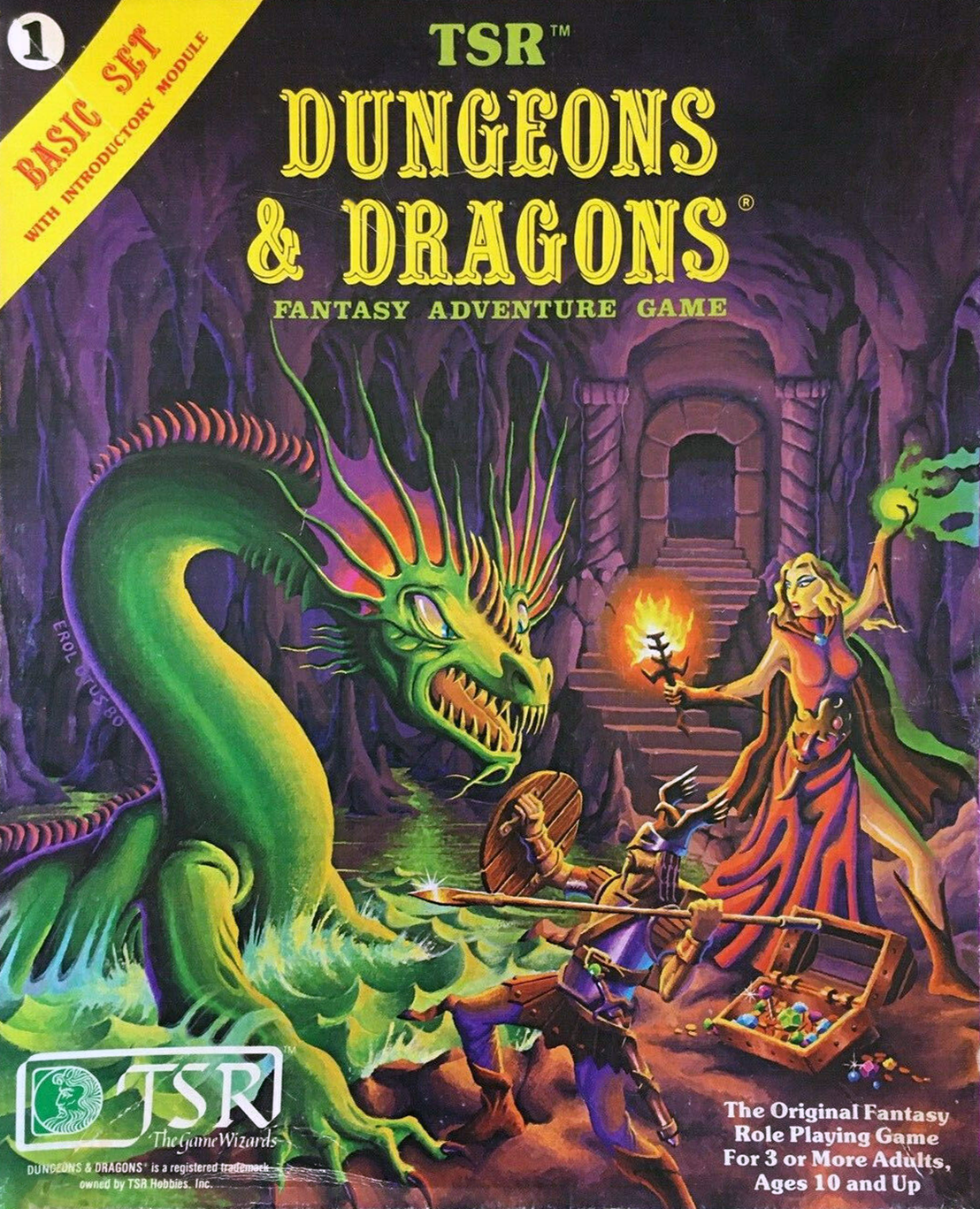
James Maliszewski at Grognardia has spoken at various times about the Moldvay morale rules. (Tom Moldvay being the TSR designer responsible for the 1981 edition of the D&D Basic Set.) James even went so far as to say that “D&D combat only makes sense if you assume the use of morale”.
This is an interesting thought. It was one that I initially rebelled against when I first read it, but it’s been kind of churning around in my head for a few weeks now. It’s been one of those memes that just refuses to let go.
I think the reason I mentally rebel against it is that it impinges into my “zone of GM control”. When I GM, I make a point of roleplaying the monsters. Hurt a wild animal badly enough and it’ll give up… unless it’s rabid. Get a one-shot kill on the goblin chieftain and at least some of the goblins are likely to rout.
A morale mechanic has always seemed like a fairly crude way of modeling this behavior.
On the other hand, I understand James’ point: If you don’t take morale into consideration, D&D combat — particularly the classic D&D combat he’s talking about (when 0 hit points meant dead) — always ends in a slaughter. No quarter is ever given; no prisoners are ever taken. Once you start fighting, everyone keeps fighting until they’re dead.
For those who don’t have access to the 1981 Basic Set, these were Moldvay’s morale rules:
Any creature in battle may try to run away or surrender. Characters are never forced to do this; a character always reacts in the way the player wishes. NPCs and monsters, however, may decide to run away or surrender. To handle this situation, each monster is given a morale score. Good morale (a high morale score) indicates a willingness to fight on, regardless of the odds. Bad morale (a low morale score) means the monster will tend to panic and desire to withdraw from combat.
MORALE SCORES: A monster’s morale score is given in each monster description. The score is a number from 2-12. The higher the morale score, the better the morale. A score of 6-8 is average. A score of 2 means the monster will not fight. A score of 12 means the monster will fight to the death without checking morale. Creatures with a morale score between 2 and 12 will need to “check morale” at some time during a battle, as explained below.
HOW TO CHECK MORALE: During combat it is often necessary to check monsters’ morale to see if they will continue to fight. To check morale, roll 2d6. If the result is greater than the monsters’ morale score, the monsters will try to retreat or use a fighting withdrawal. If the result is less than or equal to the morale score, the monsters will continue to fight.
WHEN TO CHECK MORALE: In general, morale is checked in critical combat situations. Two recommended times for morale checks are:
1. After a side’s first death in combat (either monsters or characters).
2. When 1/2 the monsters have been incapacitated (killed, asleep due to magic, so forth).
Monsters that successfully check morale twice will fight to the death.
ADJUSTMENTS TO MORALE: Morale can be changed by situations (unless the morale score is 2 or 12). Adjustments to morale may be permanent or temporary. The exact adjustments are left to the DM. A maxmium of +2 or -2 is recommended; for example, if monsters are losing a battle, their morale score may be temporarily adjusted by -1. If they are winning, the monsters’ morale score may be temporarily adjusted by +1.
RETAINER MORALE: The morale score of a retainer is based on the Charisma score of the player hiring him (or her). Retainers must check morale after each adventure. If the morale check is failed, they will not adventure with their employer again. Retainers do not need to check morale in combat unless the danger is greater than might be reasonably expected. If a retainer is given a full share of treasure for several adventures, his or her morale score might permanently become 1 higher than the original morale score.
SURRENDER: A character or creature may offer to surrender at any time; however, the opponent need not accept the offer, nor even stop fighting long enough to listen! The DM will handle any talks about surrendering that occur between monsters and characters. Even non-intelligent creatures will usually act reasonably and try to run from hopeless battles. Surrender will usually occur when a morale check is failed, if the defender cannot safely escape. If an intelligent creature surrenders, it will usually offer treasure (from its lair or friends) as payment for its life.
(There’s one obvious error in these rules: A score of 2 actually means that a monster might continue to fight. Morale scores should be one a 1-12 scale if you actually want to design monsters that will automatically run at the first critical juncture in combat.)
There are a few things these rules make me think about:
(1) How simple they are. Part of my objection to morale systems is, as I mentioned before, the crudity of them. But in some ways, if I were to use a morale system, I would prefer this kind of streamlined approach: As a DM it gives me a dollop of information (are they staying or are they going?), but lets me figure out what the information means. (Are they fleeing madly? Making a fighting retreat? Dropping their swords? Staying on guard while trying to negotiate?)
Adding more complexity to this system probably won’t make it any more faithful to reality. In many ways, it might actually make it less faithful and believable.
(2) Retainer morale. I have always been fascinated at the use of retainers in classic D&D gameplay. Despite that, I’ve only played in a single (very short-lived) campaign in which hirelings were ever a significant part of gameplay. If I ever did end up with retainers in play, I think a morale system for them makes a lot of sense: They’re sort of the players’ purview and they’re sort of the DMs’ purview, so it makes sense to use the completely impartial arbiter of the dice determine their outlook.
(3) While I’m still loathe to turn over sentient NPCs to a morale system (because roleplaying them is one of the things I enjoy about DMing), I think it would be interesting to use a morale system for certain types of opponents: Animals for example. And even petty thugs and mooks.
I’ve mentioned in the past that one of things I really love about GMing is being surprised by the actions of my players. (I probably despise railroading more as a GM than I do as a player, actually.) I enjoy seeing events unfold in unexpected ways at the game table. It seems like morale rules would help make that happen.
(4) Is there any easy way to implement a morale system in 3rd Edition? Many efforts I’ve seen in the past start by looking at some sort of mechanic based around Will saves. This has the advantage of using an existing statistic (so that you don’t have to add a morale score to every stat block that you use), but has the disadvantage that the bonus to Will saves increases with level.
Because the Will save bonus increases, you’re left with two options: Either you can complicate the rules in order to vary the DC (which, as I’ve noted, make the rules seem far less appealing to me). Or you’ve effectively introduced another save-or-die effect into the game — one which is pervasive and constant (insofar as it happens every combat).
For example, Heroes of Battle introduced a morale check which was simply a DC 20 Will save. (It was specifically designed for mass combat, but also included an optional variant for “Morale in the Dungeon”.) It kind of split the difference: It had a handful of modifiers that could effectively vary the DC of the check from 15 to 32 (thus adding complexity to the check), but for the most part it was just a flat DC 20 check.
Moldvay sidesteps this issue by using a flat scale. To mix-and-match edition terminology, a CR 1 creature can have morales from 2 to 12 and so can CR 20 creatures.
But the interesting thing about Moldvay’s rules is that, although they look like a flat scale at first glance, they aren’t in practice. Why? Because the triggering conditions are based on the toughness of the monsters. A CR 1 creature with a morale score of 8 and a CR 20 creature with a morale score of 8 might appear to have the same morale… but it’s actually much more difficult to score a “first kill” against CR 20 opponents than against CR 1 opponents.
Moldvay’s system breaks down a bit when it comes to monsters keeping mixed company — does it really make sense for the ancient red dragon to panic because the heroes have killed one of the hundreds of goblin goons he keeps around? — but that type of issue can probably be glossed over through the use of DM discretion.
And maybe that’s the solution for morale mechanics: Use a Moldvay-style flat rating system, but don’t bother specifying the “critical combat conditions” that trigger a check. The DM simply makes a check whenever it seems appropriate. Ultimately, you’re giving the DM the final discretion in how and when… but then, at the crucial moment of decision, he gives up his control and lets the dice decide.
So that, in the end, even the DM can be surprised by the result.
(I’ve also noticed that Moldvay’s doesn’t seem to play well with solo monsters. This probably has a lot to do with the fact that encounters with solo monsters were comparatively rare in previous editions, but nonetheless it would definitely be something to look at if you were planning on using Moldvay’s rules.)
Whether you use a morale system or not, I think it’s important to remember that many (if not most) opponents won’t fight to the death unless they’re forced to.
But also remember that routed opponents can also regroup, go for help, or otherwise return to the field of battle… either during the same confrontation, or later after they’ve had a chance to recover.