IN THE SHADOW OF THE SPIRE
PRELUDE 2B: THE AWAKENING – DOMINIC
PBeM – March 5th thru 9th, 2007
The 15th Day of Amseyl in the 790th Year of the Seyrunian Dynasty

IN THE SHADOW OF THE SPIRE
PRELUDE 2B: THE AWAKENING – DOMINIC
PBeM – March 5th thru 9th, 2007
The 15th Day of Amseyl in the 790th Year of the Seyrunian Dynasty
IN THE SHADOW OF THE SPIRE
Prelude 2B: The Awakening – Dominic
In this installment of the campaign journal, you’ll find some custom-made, Latin-esque spell names and a prayer to Vehthyl, the God of Magic. Both of these were created by Dominic’s player, who simply spun them out of wholecloth during our PBeM sessions.
I really appreciated him doing this.
I know from personal experience that releasing some of your control over the game world can be difficult for a GM to do. But this type of player-initiated world-building should be encouraged for a number of reasons.
First, getting the players to care about the game world is actually quite difficult. Lectures rarely get processed. And even the focused world-briefings I hand out before a campaign rarely make much of an impression. (In the case of Ptolus, I have — on multiple occasions — been able to treat information from the pre-campaign handouts as mysteries that the PCs have to track down information about. The players haven’t noticed. In another instance, events in the same handouts were effecively retconned when I realized it would be more interesting for the PCs to play through those events. At this point, I would actually prefer it if the players didn’t read this and try to track down their copies of those handouts.)
But if the player creates the information themselves? That’s something that they’ll remember. That’s a thread that you can weave into the wider tapestry — and if they follow that thread that they’ve created, then they’ll have a chance to see part of the bigger picture.
Second, you can use this material as a pretty solid indicator of what the player cares about. If he’s designing rituals and heraldry for the order of knighthood his character has joined, you can pretty quickly identify the order as being important. That means that hooks and scenarios involving the order will be effective.
Third, no GM has an infinite amount of time on their hands. If your players are willing to be a resource, you should be willing to take advantage of that. Someone has mapped out the floorplan for their liege lord’s castle? Awesome. When assassins break into the castle, the player has already designed the scenario maps for you.
And won’t he be surprised to discover that there’s a secret passage in that castle that neither he nor his character ever knew about!
Which leads me to my next point: In most roleplaying games, it’s still the GM’s world. And for a large variety of reasons, the GM still needs to be able to exert some control over it. Which means that some ideas may need to be vetoed.
But I’d recommend using a “soft veto” if at all possible. If someone cares enough to put the time and the effort into creating something original and unique, then I think it’s worth your time to try to figure out how you can make it work for them. I have two varieties of soft veto:
THE SOFT VETO: “This looks good, but can we change X and Y?” For example, I remember a campaign from years ago where a player wanted to run a Scottish highlander. Now, my D&D campaign world at the time didn’t feature anything even remotely resembling the Scottish highlands. We took an underdeveloped kingdom on another continent and worked it over until it gave her what she wanted. She didn’t get the kilt that she wanted, but she was able to play the character that she wanted to play.
THE SOFTEST VETO: Sometimes I allow a “questionable” element into one campaign only to drop it from the game world after the campaign has been completed. This is for stuff that doesn’t quite mesh with my vision of what the game world looks like, but isn’t so problematic that there’s any good reason to reject it for a player who wants it.
But the truth is that player-created content is often pretty awesome. At some point I’m going to be able to properly utilize the element-worshipping Talbarites — a religious sect given its genesis entirely by a PC named Talbar (who, in a different campaign, was played by the creator of Agnarr the Barbarian).
First Principle: Any story you can tell in any other genre can be told in speculative fiction.
Second Principle: … and a whole bunch more.
Let’s take Spider-Man, for example. You can probably find other ways to explore the central theme of “with great power comes great responsibility”, but it would be comparatively difficult to invest that great power into the hands of a teenage boy with whom your audience can so readily identify. (See, also, Ender’s Game.)
Similarly, love stories are ubiquitous… but it takes speculative fiction to create the specific type of dynamic that exists between a 17-year-old Vampire Slayer and a 400-year-old vampire (particularly when the vampire loses his soul as a direct result of experiencing true happiness with the Slayer). Which isn’t, of course, to say that there isn’t clear metaphoric content there that can be applied to mortal relationships.
Or take a look at the absolutely brilliant exploration of character in the new version of Battlestar Galactica. The clone-like, resurrecting cylons are a Pandora’s Box of sociological, cultural, and psychological problems that simply do not exist in the real world… and thus make possible compelling and powerful stories that you won’t find anywhere else.
Conceptually, look at a work like the original Foundation Trilogy. Or Vinge’s exploration of perverse ethical structures in A Deepness in the Sky.
None of which is to say that other forms of fiction need to pack up their bags and go home. There is clearly a power in the historical narrative of Roots, for example, that cannot be captured by any fantastical restructuring of slavery and racism. Contemporary romances can feature a closer identification between protagonist and reader than a novel starring someone from the 31st century. And so forth.
Nor is it to say that all SF is innately awesome. Sturgeon’s Law (“90% of everything is crap”) naturally still applies.
But it is to say that SF removes the walls.
Which brings us to our conclusion: SF is awesome because it has women wearing brass bras and spandex.
… wait, no. I seem to have gone astray somewhere.
 I’ve written about dissociated mechanics before. But it’s notable that WotC’s designers began unleashing these immersion-shattering monstrosities before the release of 4th Edition. The latter days of 3rd Edition are riddled with them, as well.
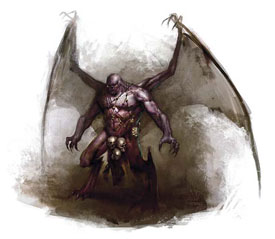
For example, I was trolling my way through Monster Manual V this afternoon when I came across the gadacro demon. These creepy little customers “relish their victims’ eyes, preferably plucked from the skull of a victim that sill lives”.
A little demonic creature that plucks the eyes from your head sounds pretty horrifying. Just the type of thing that can really instill a true sense of demonic terror in the hearts of your players. So I took a peek at the mechanics they’d given us for modeling this…
Eyethief (Ex): A gadacro can forgo its sneak attack damage or extra damage on a confirmed critical hit to instead blind its opponent for 5 rounds. A creature that has been blinded in this way cannot be affected again until it has recovered from the current effect. Creatures that lack eyes are immune.
Yup. They’ll steal the eyes right out of your head and then, 30 seconds later, your eyes will miraculously regenerate and you’ll be just fine.
Wait… what?
A mechanic that allows for the true theft of an eye needs to be carefully balanced because it can be so devastating, but this ain’t the way to do it.
Here’s a better way, one that’s actually associated with the game world:
Eyethief (Su): When scoring a critical hit, a gadacro can be choose to forego all damage from the attack and instead attempt to pluck out the eye of its opponent. The victim may make an immediate Fortitude save (DC 10, based on Strength). If the save is successful, the gadacro’s attempt has failed.
If the save is failed, the gadacro has seized the eye. The eye is immediately damaged, imposing a -2 penalty on Spot checks and ranged attacks. If all of a victim’s eyes are damaged in this way, the victim is blinded. (This damage is permanent, but can be repaired with a remove blindness spell.)
If the gadacro suffers any damage or if the victim succeeds on an opposed grapple check before the gadacro’s next turn, the gadacro’s attempt comes to an end.
However, if the gadacro is undisturbed, on its next turn it can attempt to complete the theft of the eye as a full action. The victim must make another Fortitude save (DC 10). If the save is successful, the gadacro’s attempt has failed.
If the save is failed, the gadacro has plucked out the character’s eye. (The damage to the eye can no longer be repaired with a remove blindness spell. It requires regeneration or a similar ability to correct.)
It should be noted that there’s nothing mechanically wrong with the ability as presented in the rulebook. The only problem is that the mechanics are, in no way, a faithful represenation of what they’re supposed to be representing. A demon that can mystically steal the power of sight from your eyes is otherworldy, strange, and evocative.
(Although I’d probably be tempted to go one step further and allow the demon to actually see through the sightless eyes of its victim. Such a demon would feast on its experiential theft.)
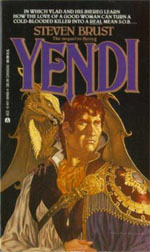 Coming off of Jhereg, I had very high expectations for Yendi, the second book in the Adventures of Vlad Taltos. In fact, having finished Jhereg in a late night bout of reading (inspired entirely by the fact that I could not put the book down), I promptly went out the next day to track down the next book in the series.
This actually proved surprisingly difficult. The early books in the series apparently went out of print a few years ago and were recently released in a series of trade paperback omnibus editions, starting with The Book of Jhereg (which actually collects the first three Vlad Taltos books — Jhereg, Yendi, and Teckla). But I’m not a big fan of trade paperbacks (which lack the durability of hardcovers and the convenient size of paperbacks), and it didn’t make much sense to spend $16 on a collection when I already owned a third of it. (My decision was also being heavily influenced because I already had a used copy of Teckla for $2.50 in my other hand.)
So I ended up picking up the third and fifth books in the series from Uncle Hugo’s (the local used SF bookshop), and then hit up Amazon for used copies of Yendi and Phoenix (the second and fourth books in the series).
Long story short, I was pumped up and ready to go by the time Yendi arrived in my mailbox.
In terms of the actual book itself, however, I ended up being somewhat disappointed. Not hugely disappointed, but somewhat disappointed.
Most of my disappointment, I suspect, stems from the fact that the plot of Yendi is not terribly dissimilar from that of Jhereg: Vlad Taltos gets a case at street level that leaves him perplexed and fearing for his life. He bums around with his friends in high society for a bit and hears some interesting gossip about world-shattering events and historical trivia that appears to be inconsequential… until it turns out that his case, the world-shattering events, and the historical trivia are all intimately connected!
It’s a solid formula, but it ends up being like the magician who performs the same trick twice in a row: The second time he does it, it’s pretty easy to figure out how you’re being fooled.
In Jhereg, Brust had me fooled: The high-society gossip and historical trivia all looked like the type of background world-building detail that you find strewn around the better fantasy novels. My brain promptly filed them as such and, as a result, I was completely surprised when Brust pulled back the curtain and showed how everything was interconnected.
When he tries to pull the exact same trick in Yendi, however, I can spot it coming from a mile away. And since I can clearly see the information he doesn’t want me paying attention to, it’s far too easy to figure out what’s coming long before it arrives.
One of the mistakes Brust makes is in his conservation of characters. In most fiction, you don’t want any spare characters just wandering around filling up space. Those spare characters just become needless bloat.
But in a mystery, those “spare characters” have another name: Suspects.
If you’re reading a mystery and you can clearly see why all the characters are in the story… except for this one lady who just wanders through and says “Hello” every so often. Well, it doesn’t exactly take a genius to figure out whose guilty.
(The better mystery authors will avoid the “spare character” problem by making sure that all of their characters have at least one legitimate and obvious reason for being in the story. That way you don’t just have faceless names wandering around, but you’re also not tipping your hand.)
In Brust’s case he kind of ends up with the worst of both worlds: He has lots of spare characters wandering around in a perpetual state of name-bloat… but they’re all part of Taltos’ criminal organization. In the circles of high society, on the other hand, Brust has an austere conservation of characters… except for the guilty party, who really does just wander by and say “Hello” every few dozen pages.
The other shortcoming of Yendi, in my opinion, is Brust’s failure to raise the stakes. Jhereg gave us a really nifty and multi-layered setting with lots of interesting and original characters. And the unique magical physics of the Dragaeran setting let Brust create entirely unique methods for conducting both crime and politics. There’s a definite sensawunda at work.
Yendi gives us a second dose of the same stuff… but not much notably new or different. The first time you show me a rocketship? Awesome. The second time you show me a rocketship? Nifty. Now, what are you going to do with it?
In that sense, the part of the book I enjoyed the most was probably the first few chapters: A young Taltos is running a small gang in the slums of Adrilankha when another crime boss decides to make a play for his territory. The evolving battle of sorcerous gang warfare, which lasts for several chapters, is frankly enthralling. Brust does a really slick job of taking a familiar archetype (“gang war”) and running it through the unique characteristics of his fantasy world to give something refreshingly unique and entertaining.
(In fact, I would have been perfectly happy if the entire book had stayed at that level of petty gang politics. But once the story moves into high society, the gang war pretty much disappears from the narrative and the cloning of Jhereg’s plot begins.)
With all these negative things being said, I think it’s important to make this point: I still had a rapacious appetite for this book. I would frequently find myself fighting off sleep in order to squeeze in a few more pages.
That’s the unmistakable sign of a book that, despite it’s shortcomings, is still extremely entertaining.
I should also note that Yendi takes place before Jhereg, telling the story of a younger Vlad Taltos at the beginning of his career. I find Brust’s decision to tell these stories out of chronological order very intriguing. It appears to be a very deliberate choice, and not one structured in quite the traditional roles of “prequel” and “sequel”. Just off of these two books, I’m left with the impression of listening to an old warrior telling tales of his youth in whatever order strikes his fancy at the moment. (An impression somewhat spoilt by the last few paragraphs of this book, but more strongly supported by the opening of Jhereg.)
I’m looking forward to seeing what happens next.
GRADE: B-
Steven Brust
Published: 1984
Publisher: Ace
Cover Price: $7.99
ISBN: 0441944566
Buy Now!