Tagline: Wick has created something original, creative, and breathtakingly alien in Orkworld. Buy this game. Buy it now.
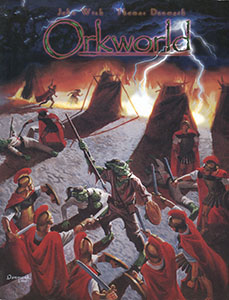 When I bought my copy of Orkworld at its GenCon release this year, John Wick immediately recognized me via my nametag. For those of you not in the know, Wick and I have been involved in some rather raucous on-line debates – both here on RPGNet and over on Gaming Outpost, among other places – concerning the validity of the review process. A small example of this would be my infamous review of Wick’s “Official Review Policy” here on RPGNet, which became part of a larger firestorm elsewhere.
In any case, long story short, Wick recognized me and signed my copy, inscribing it:
”Hi Justin —
If you review this, I’ll break your legs.
🙂 John Wick
You there, in the back, huffing up your chest to jump all over Wick: Stop it right now. It was a joke. Note the smiley face. He laughed. I laughed. Personally, I get a little grin on my face every time I look at that silly inscription. He made my day.
So Wick had his joke… and now I get mine. (Feel free to insert a sinister laugh here at your discretion.)
I’ve going to write five reviews of his game.
Yes, you read that right. I’m going to write five reviews of Orkworld. Collect the whole set. The next three, if all goes the way I hope, will appear elsewhere, and then I’ll come back here (when all is said and done) to post the fifth – wrapping the whole thing up.
Is this a funny joke? I don’t know. I tend to snicker whenever I think about it, but your mileage may vary. I suppose it depends on just how much irony you can find in the situation.
Is this an elaborate joke? Absolutely. Just to dispel any confusion: Each of these reviews will have the exact same conclusion as this one (“buy this book”) – I’m not trying to be disingenuous. Nor will any of these reviews leave any information out (“And this time around I’ll be taking a look at that zany character system! Tune in next week to find out about combat resolution!”). These are going to be complete, honest reviews, each of which will function just fine all by itself.
But none of these reviews will repeat one another, either: Each will approach the task of reviewing in a very different, but hopefully equally effective, manner. In this sense the project is a little bit of a mental exercise for me – a chance to see just how flexible the idea of a “review” really is without sacrificing the quality of the review.
Do you care? Probably not. But rest easy: You’ve only had to waste 400 words of your valuable reading time on this clap-trap, and from this point on out you can pretend that this is just another RPGNet review. Relax, sit back, and enjoy.
(And lest he feel forgotten, Thomas Denmark – the highly talented illustrator who provides the pictures for Orkworld — also signed my copy, complete with a wonderful sketch of an ork. Thank you, Mr. Denmark.)
ORKS
My decision to purchase Orkworld can be boiled down to two simple facts: First, nearly 200 pages of cultural information on Orks. Second, more than fifty pages detailing the World of Ghurtha.
Orkworld is a 300 page book.
Wick opens his work with The Caius Journals — the diary of a young soldier serving in the armies of the Solarian Empire who, through a series of encounters, learns a certain level of appreciation for orkish culture. His journey of discovery is shared fully with the reader, and we learn – with him – of the beauties of this alien society living alongside mankind on the world of Ghurtha.
If you can’t make up your mind over whether or not to pick up Orkworld, then I encourage you to pick the book up off the rack of your local game store and read through this opening section: Through it you will see a pertinent and well-crafted glimpse of the careful and intricate construction of orkish life which lies at the heart of this marvelous game.
Following the Journals comes a chapter simply entitled Ork, which is broken into five sections:
Thaloo. “Thaloo” is the orkish word for “belief” – or, more precisely, philosophy. Here we learn, in short, about how orks view the world: What is Ghurtha like? Who are the Gods? How do they worship them? Why do they worship them? What are the guiding principles of their life? What do they think of birth? How do they organize their societies? And why?
It is here that you’ll being to realize the great richness of the material which has been laid out before you. There is so much offered in just this one small segment of the work, that I cannot begin to adequately summarize it – but I will offer a few highlights:
Orks believe that there are two sides to the world. One side, the Wakingside, is where we all live. The Otherside is home to the gods. Likewise the sky, which revolves around the world, is split into two halves – the Day-sky and the Night-sky. When those of us on the Wakingside of the world are beneath the Day-sky, the gods sleep beneath the Night-sky; and vice versa.
The orks believe in four gods: Keethdowmga, the Great Mother; Bashthraka the Thunderer (a god of war); Gowthduka, the Silent God (a god of knowledge); and Pugg, the Trickster (the ork’s favorite). Orks do not “pray, build shrines or make sacrifices” – after all, the gods are on the other side of the world: They can’t hear the prayers, see the shrines, or receive the sacrifices. (Orks are a practical sort of people.) Instead, if communication is desired (and if you’re a smart ork you realize that you very rarely want to have chats with a god) it is carried out through a bodalay – a shaman who can interpret the Omens of the Otherside.
An important concept in orkish life is that of Trouble. Orks believe that they each carry with them a certain amount of Trouble – or, more accurately, “fortunate misfortune”. They think of Trouble (“fortunate misfortune”) as a testing ground – a place for honing the talents of worthy orks and weeding out those orks who would be a burden to those around them. The intricate concepts of Trouble within orkish life are far more complicated than this, but I cannot do them justice in this space. Suffice it to say that I am extremely impressed with what Wick has put together for the backbone of his fictional culture.
Another important concept in orkish philosophy is that of Fana – an ork word which means, literally, “hand”, but also can be translated as “’strategy’, ‘standing’, ‘position’, ‘favor’, and ‘advantage’”. To fanu (“have hand”) in orkish life is to have advantage in a situation – basically it can be thought of as the worth of a particular ork or situation.
Finally, we’ll take a quick look at the concept of Thwak. It is the idea of outsmarting someone – to trick them, defeat them cleverly, or take something from them. This concept of testing yourself craftily against your fellows is highly honored among the orks, and is (in many ways) the guiding principle of the way they approach life and deal with their Trouble.
There’s a lot more here that I’m not even going to touch on (or I’ll be here all day): Domdha, Keerisboon, Shusha, Motherhood, the spiritual beliefs surrounding orkish cannibalism, Noodeema, Dracha, Black Magic, and Dreaming. Beginning to get the idea? Orkworld is chock full of great ideas!
One nice element to mention here is that, throughout the book, Wick leaves open the question of whether or not the myths which the orks believe in are true or false. Are the gods real? Is there a true afterlife? If there is, is it really on the other side of the planet – or is that just a conceptual fantasy? At the same time he gives a wide array of tools so that, whether you decide these myths are true or false, you’ll have plenty of support from the game. The ambiguity – and the support – are nice touches.
Chochum. “Chochum is the ork verb ‘to live’.” And in this section of the book we learn a good deal about just that: How orks live.
Orks organize themselves into Households which are, in turn, parts of larger Tribes. They are migratory – moving from one eetalday (village site) to another during the course of the year (generally going to where food can be found). One specific eetalday will be specified as the dooladay – the “winter home” where the tribe spends eight months of the year.
In this section we also learn about what orks eat (and when they eat it),
Ganala. This section of the chapter basically deals with the structure of orkish society. A great amount of detail is given to orkish law (including the specific punishments for the crimes in orkish sociey), orkish politics, the orkish calendar, and orkish power struggles.
In addition we learn of Doona and Noona (the former meaning sex; the latter referring to the orkish love – neither of which quite fits our own understanding of those concepts); orkish hygience; orkish art (there’s a bit in here where Wick discusses a startlingly beautiful image of sculptures carved out of living wood); orkish riddles; orkish games; healing techniques; as well as common orkish diseases (and their treatments).
Zhoon. Here we are treated to a discussion of orkish principles of war. Wick has clearly done a marvelous job of researching a variety of traditional tactical manuals (such as Sun Tzu’s Art of War) and constructed an original gestalt of them, giving orks their own personalized – and yet extremely legitimate and intelligent – philosophy regarding war.
A couple of important concepts introduced here: The Five Virtues (Zho: Strength; Bha: Courage; Thrun: Prowess; Wan: Cunning; and Shoon: Endurance) form the core of how orks judge the worth and talent of one and enother.
Mowgd – meaning, literally, “yellow” – is an interesting orkish concept. It refers to cowardice and it refers to weakness. It can have both a literal and a figurative meaning. For example, someone with “mowgd feet” might have been crippled in some way; or, more likely, they have run away from a fight.
Anatomy. Finally, Wick wraps the whole thing up with a quick look around the orkish anatomy.
Leaving Ork we come to Stories. As if the plethora of information he has already given us was not enough, Wick proceeds to provide more than fifty pages of stories drawn straight from orkish culture: These are the stories that orks tell each other around the campfire at night. Included are the Boondahtel (the Three Brother Stories – the core of the stories dealing with Bashthraka, Gowthduka, and Pugg) and the Puggthwaku (the Pugg Trick stories, in which Pugg tricks the gods of the other races out of their part of the Afterlife). Brilliant stuff here (and I use the word advisedly), giving you invaluable insight into orkish life and belief.
Which leads to my next point. One common problem I have with many roleplaying games is that they overlook something of key importance: People need to understand the roles they are supposed to be playing.
Far too often I have run into games which include unique cultures for which I have no understanding (because they have been created specifically for the game), but for which the game neglects to give me any sort of understanding. How am I supposed to play, for example, a citizen of the Planet Galumph’alot when I’m not told how people on the Planet Galumph’alot live their lives?
Suffice it to say that Wick has done more than enough to avoid this problem. By blending the themes and cultures of a wide variety of primitive societies with the rich soil of his own imagination, Wick has created something original, creative, and breathtakingly alien.
Yet, at the same time, he has described every pertinent intricacy of orkish life in a way which makes them come alive. No vagueness. No cheats. You’ve never seen John Wick’s orks before – but by the time you’re done with Orkworld, you’ll feel as if you’ve lived among them for years.
Bravo.
THE WORLD OF GHURTHA
If the description of the world of Ghurtha (in which the default Orkworld game takes place) had been as richly detailed as that given to orkish culture and life then I wouldn’t have to tell you that this is where I was most disappointed with the game.
Unfortunately, I have to tell you that this is where I was most disappointed with the game.
I could feel a spot of trouble coming on when I turned to the first two pages of the Ghurtha chapter (which comes at the end of the book) and was shown three maps: One covering terrain features, one covering areas of climate, and one entitled “Caribou Migration Routs [sic]”.
I’ve got three problems:
1. None of these maps are labeled. Later on in this same chapter we are given some vivid descriptions of thirty-three locations on the face of Ghurtha (and there are other generalized locations like “the blackened plains of the elves” and the “dwarves’ rocky kingdoms” and “the Solarian Empire” which are also included throughout the text). None of them are actually placed on this map. To be fair, you can piece out the locations of some of them based on their descriptions (for example, the elves live on a “blackened plain” surrounded by “tall mountains” – hence I can sorta figure out where they must live on this map)… but I really shouldn’t have to.
2. That climate map would be a really nice touch… too bad the key for it was apparently meant to be reproduced in color. Hence Desert, Wet Equatorial, Dry Equatorial, Humid Subtropical, Mediterranean, Humid Midlatitude, Boreal Forest, Subarctic Semi-Arid, Tundra, and Ice Cap regions are all varying shades of gray of the exact same pattern (and several of those shades of gray are, for all intents and purposes, identical).
3. Caribou Migration Routes? I may have missed something, but I’m pretty sure that caribou are never mentioned anywhere else in this book. On pg. 73, though, I noticed a reference to “the Migratory Map (found in the World chapter)”. So I’m pretty sure this map isn’t supposed to be of caribou migrations, but of the migrations for the orkish tribes. That being said, though, the map still has problems: It is far too simplistic in its representation to actually be useful as a game tool. And it also doesn’t seem to quite match up with the description of the ork’s migratory movements found in the Ork chapter.
The other major problem I have with this chapter is that the majority of the world simply isn’t described in the level of detail necessary to run a game on Ghurtha. I know, for example, that the major center for human culture on the planet is the Solarian Empire – located on the southern edge of the continent. What’s the capital of this Empire? Whose the Emperor? Are there any other human societies?
On the other hand, perhaps some of this is intentional: The other races are presented as “monsters”, in the same way that orcs are typically represented as “monsters” in traditional fantasy games like Dungeons and Dragons. (Where the D&D Monster Manual traditionally gives a single page write-up to monsters, though, Wick gives them several pages of description – including culture, philosophy, lifestyles, etc.)
Intentional or not, it means that the responsibility for big, important chunks of Ghurtha have been left sitting in the hands of the GM.
Moving away from the negative elements to be found here, let’s dwell for a moment on the positives: For example, Wick gives use a plethora of interesting information on the cultures of man, dwarf, and elf – giving each a unique outlook, lifestyle, and philosophy. You aren’t left with the feeling that elves are just men with pointy ears who live in trees – elves, dwarves, and men are fundamentally different from one another.
The other thing I like about Orkworld is that it is an affirmation of what I’ve been saying for a very long time: You can take elves, dwarves, men, and (yes) orks; and you can put them into a fantasy world; and, yet, that fantasy world doesn’t have to look anything like Tolkien.
And it can work.
In fact, it can work even more effectively because people – being familiar with elves, dwarves, orks, and men – will give you some extra rope to play around with. Make no mistake: John Wick’s elves are not the elves of Tolkien; they are not the elves of ElfQuest; they are not the elves of D&D. But they are still elves. Damn good elves. Scary elves. Elves like you’ve never seen elves before.
And the same is true for dwarves. In fact, it’s so true that I’m really hoping that someone will convince Wick to do Dwarfworld and Elfworld RPGs (or at least sourcebooks). And I’ll take a Solarian Empire game, too. Throw me on the pyre if you must, but I want to know as much about the elves of Ghurtha as I now know about the orks of Ghurtha.
Moving on: Earlier in this section of the review I mentioned that there were thirty-three really nifty places described in this section. Places like the Singing Forest (the wind in the trees creates susurations of music which lures the unwary to sleep… at which point the trees eat them); Broken Spear Pass (where three orkish heroes have had their spears break in the heat of battle); and the Forest of Black Beasts (home to the monstrous creatures who look like the other humanoids of Ghurtha… but whose eyes glow in the dark, and who don’t walk like any other creature on the planet).
Each of these places can be home a dozen different adventures, easily. John Wick helps pave the way by giving you an adventure seed with each and every one of them. Coincidentally, these small, extremely useful and creative gestures, are liberally spread throughout the entire book. John Wick describes a place, there’s an adventure seed attached. An item? There’s another seed. I’d guess that there were at least one hundred adventure seeds (in various forms) to be found in the pages of Orkworld. At least.
CHARACTER CREATION
Here’s the way it works: You don’t create a character. Your gaming group creates a Household.
The basic concept has been done before (Pendragon and Ars Magica spring to my mind), but I still consider it a paradigm shift away from the norm – and it works really well for Orkworld.
Household creation takes five steps:
Step One: Questions. In which you decide upon the answers of a number of questions for both your household and your individual characters. And Wick makes you ask some really good questions – questions which will reveal not only what type of Household you’re creating, but also what type of game you want to be playing. The questions, like the entire creation process, serve not only to construct your characters, but also as a collaboration with your GM in order to make the game fun and accessible to everyone.
Step Two: Choose a Household Totem. I’ll let Wick handle this one: “The players choose a single animal to represent their household.”
Step Three: The Point Pool. Instead of individual characters receiving points to spend, the Household as a whole receives a pool of points. Specifically, twenty-five points per player in the group.
Step Four: Household Advantages. Here in Step Four you can spend those points to gain various advantages for your Household – reindeer, blacksmithing, additional thraka, a better Winter Home, etc. The more points you spend on the Household, the better the Household will be. However, the more points you spend on the Household, the fewer points you have to spend on your own characters. It’s an interesting balance act.
Step Five: Creating Thraka. Finally, you create your individual thraka. There’s still no need to split the points evenly – you can freely decide to power up one set of PCs, while leaving another set of PCs comparatively weak. You’ve got all sorts of options available to you.
Your character is quantified in five ways:
Zhoosha. This refers, basically, to your overall standing and ability. You might think of it as somewhat similar to “level” in D&D, but that’s not exactly the right analogy. A better label might be something like “heroic greatness”. Other games might call it “Luck” or “Fate”.
Virtues. Remember when I talked about the five virtues by which orks judge one another? They’re back. Courage, Cunning, Endurance, Prowess, and Strength. You get one at rank 3; three at rank 2; one a rank 1. You can increase them one rank for four character points, but you can’t increase any of them above rank 3 during character creation.
Skills. Skills are assigned to specific virtues, but Orkworld has no predefined skill list (except for five special skills – one for each virtue – which each ork starts with). Instead, you come up with the names and purviews for each skill you want. For example, if you want your ork to be skilled at riding a reindeer one-handed you would simply create and give them the “Ride Reindeer One-Handed” skill.
Trouble. Like the Five Virtues, the ork’s concept of Trouble is also represented mechanically. Everyone starts with one point of Trouble, although they can elect to take a second (and thus get some extra points to spend elsewhere) if they so choose.
Wounds. Finally, your Wound Rating is equal to your Endurance + Zhoosha. This will obviously become important during combat.
Wick wraps up the character creation section in an extremely clever manner: When orks come of age they go through a rite of initiation, known as the gooleeala. Like most rites of initiation, this is a frightening and semi-mystical experience. At the end of the gooleeala, the young orks lose their childhood names, and are given new names by the other orks which went through the gooleeala with them. Wick gives a sample of how GMs can describe the experience of the gooleeala to their players at the end of the character creation process… at which point everyone takes their character sheets, hands them to the person on their left, and lets them name their character.
You don’t have to do it if you don’t want to, by any stretch of the imagination. But I think it’s a nice finishing touch on the entire character creation experience that Wick has built into Orkworld.
CHARACTER ADVANCEMENT
Character advancement in Orkworld is handled through the use of Fana Points. Earlier in this review I discussed the concept of “fana” in orkish culture. For the purposes of Fana Points you can think of “fana” as meaning “fame”.
Basically it works like this: Fana Points are awarded to the PCs by the Household’s tala (bard). During the course of the game the bard (who may be either a PC or an NPC) keeps track of Fana rewards – instances where a PC does something particularly noteworthy (whether that’s something “courageous, cunning, stalwart, or even downright stupid” doesn’t matter – just so long as its noteworthy).
At the end of the game, the tala performs a Fana Check for each of these memorable feats by rolling number of dice equal to his Zhoosha. The highest roll (from all the checks for that game) becomes the character’s Fana Points.
The bard himself earns a number of Fana Points equal to his lowest Fana Check for the game (in other words, the bard is gaining Fana for the effectiveness of his stories – just as the thraka gain Fana for the effectiveness of their accomplishments).
From this point on out it becomes pretty standard: You can think of Fana Points as an exact analog for Experience Points (3 Fana per current rank of Virtue to increase a Virtue; 1 Fana per current rank of Skill; 7 Fana per current rank of Zhoosha).
I found this entire concept to be incredibly clever: You are playing a character out of legend, and the abilities of your character within the legends you are telling is dependent on how effectively the bard has passed down the story of the legend. It’s a little self-referential, but as abstractions go (and pretty much every advancement mechanic on the market is an abstraction) this one’s pretty neat. Plus I think the fact that the system is designed so that the party’s experience points can actually be handed out by one of the PCs is – mechanically – a really interesting and original idea.
BASIC RESOLUTION
John Wick writes that, “when it comes down to it, every game system resolves two things: 1) picking locks, and 2) hitting things.” I think that’s probably one of the best descriptions of what an RPG’s rules are for that I’ve ever heard.
The basic resolution mechanic for Orkworld works like this: Take a number of six-sided dice equal to your Virtue + Skill and roll vs. a Target Number set by the GM. Choose one of the dice you rolled – that’s your Success Total. If your Success Total is higher than the Target Number then, congratulations, you just succeeded at whatever it was you were trying to do.
The Obligatory Twist: When you roll doubles, for each additional die of the same type you rolled, add one to your total. (This creates an interesting dynamic whose effects I haven’t fully mapped out yet. If you roll 1,2,3,3,3,4 – for example – you’d actually want to keep the 3’s – because 3+1+1 is 5 (whereas 4 is just 4). It would be interesting to combine this idea with something like the Silhouette system, because it greatly increases the usefulness of a larger dice pool over the more traditional method of only counting double sixes as plus-ones. But I digress.)
Finishing it up: If you’re directly competing against someone else, then you both roll — the higher Success Total wins. If you tied, then you both check the next highest result to break the tie – repeat as needed. And you don’t necessarily need to count doubles while resolving ties. (Or, if you find this too confusing, you can just let the character with the lowest Trouble succeed.)
COMBAT
I found some of the explanations in the combat section of the rules to be somewhat confusing, but after I muddled my way through the text I found that the system works well in practice.
Step One: Determine Initiative. Roll your Courage score – result goes first. Thraka characters should roll a number of extra dice equal to their Zhoosha score. (Thraka get several combat-related bonuses due to their Zhoosha score. I would have liked to seen similar rules for non-Thraka characters, such as tala, to get Zhoosha bonuses for their areas of expertise.)
Step Two: Take Action. Roll your Prowess + Skill (whichever combat skill is most appropriate). Your opponent rolls his Prowess + Skill (whichever combat skill is most appropriate for blocking or dodging the blow). Highest roll succeeds, as usual.
Step Three: Resolve Action. Here’s where it gets a little complicated, and the explanation in the books gets a little muddy. If the attack was successful you take the difference between the attacker’s roll and the defender’s roll and add the Weapon Value to get the Wound Total.
Then you make a Wounding Roll (Strength + Weapon Value) and the defender makes a Resistance Roll (his Wound Dice – Zhoosha + Endurance). But the defender can’t count any of his dice that come up with a number which you rolled on your Weapon Value dice (so for the Wounding Roll you need to keep the dice rolled for Strength and the dice rolled for Weapon Value separate).
If the attacker succeeds, then it was a Lethal Blow and he does damage equal to the Wound Total. If the defender succeeds, then it was just a Glancing Blow and does only one point of damage.
Because of the way the whole thing is organized I had to read through this section a couple of times to have it make sense (hopefully this summary is fairly easy to understand). It’s also a little unclear whether or not the Resistance Roll is supposed to be your current wound rating, or your permanent maximum (although I’d say there’s a fairly good chance its the latter).
You die if you take damage equal to your wounds. While you’re in an injured condition you lose one die from all rolls for every two Wounds you’ve taken (Weapon Dice, Wounding Rolls, and dwarves are excepted from this for various reasons.)
There are the standard bells and whistles around the edges, and they work the way they’re supposed to. A couple notable things, though:
First, the counter-attack mechanic has a bit of a hole in it: You can counter-attack on any turn where you have an action left and the person attacking you has just missed you with one of their own attacks. If this is the case you automatically score a successful hit as if you hit with a difference of 0. The problem I have with this is that a successful hit always means that they’re going to take at least one point of damage. A beginning level character only has four Wounds – so, in other words, if your character misses someone else four times (while they still have an action left), then your character is dead.
The working together mechanics work really well – involving adding or subtracting dice from characters dice pools in a very intuitive fashion.
The mechanics for handling the reach of various weapons are also handled in a easy-to-manage fashion that lets you take into account the difference between a spear and a sword (which is important to the Orkworld setting because of the importance orks put on the advantages of spears over swords during combat), without losing the simple flow of combat.
There’s one last hole in the combat rules that needs to be addressed: As your characters advance they can obtain Legendary Virtues – Virtues above rank 6. A Virtue of 7 is a Legendary Virtue of 1; a Virtue of 8 a Legendary Virtue of 2; and so forth. The rule for handling these reads like this: “An ork who has a Legendary Virtue can no longer fail any roll involving that Virtue. Also, when he makes a roll involving that Virtue, any dice that roll equal to or lower than his Legend Rank count as Doubles.”
That translates to always getting successful hits – which means you’re always doing a minimum of one point of damage. Actually, “hole” may be too strong a term here – perhaps that’s exactly what’s intended. But it just doesn’t seem to work quite right within the confines of the system.
MAGIC
There are, supposedly, three magic systems in Orkworld: The Simple System, the Mythic System, and Elven Sorcery.
Neither the Simple or Mythic systems (which handle orkish magic) involve the casting of spells: Orkish magic is based not on arcane rituals, but upon the empowerment an item receives through its use. As an analogy, the orkish equivalent of Excalibur would not be magic because the Lady of the Lake enchanted it using her magical powers, but because it was the sword Arthur used in fighting back the barbarian hordes.
Elven sorcery, on the other hand, is about casting spells. I won’t go into much detail here, but I will say that John Wick has delightfully neglected to bother balancing the system. I say delightfully because the elves are meant to be vicious SOBs who put the fear of god into the bones of the players. As John Wick writes:
“Um, isn’t this a little too powerful?”
No. It’s a whole heapin’ helpin’ of “too powerful”. Elves are not something orks should ever be messing with. They are monsters.
A few notes on magic before I move on:
1. The simple magic system is really good – and very different from almost any other magic system on the market. The only weak point here is that it cheats on the Eating Stomach. Orks, you see, can gain mystical powers from eating the body parts of a deceased comrade. Specific powers are granted from the eating of spleen, brain, lungs, hands, and heart. But when you eat an ork’s stomach things suddenly become more than merely hazy, they become downright impenetrable. Allow me to quote the entire section, verbatim, from the rulebook:
Eating an ork’s stomach is a dangerous affair (you eat everything he ever ate). Game Masters should reward (heh, heh) orks with the courage to undertake such an epic task.
I have no problem with “exactly what happens is left to the GM’s discretion” – but I would have liked at least some indication of what, exactly, is being left to the GM’s discretion.
2. On a similar note, in the section on Elven Sorcery we are told that “sorcerors can also store [life force] in a special container (called a “aeldrondoo”) for use at a later time”. Unfortunately, that is all the information we are giving regarding the aeldrondoo – the mechanics of how an aeldrondoo works, how one is made or obtained, and other pertinent pieces of information are left entirely up in the air.
3. Finally, I have some issues with referring to the Mythic System as a system — it’s really just a listing of sample magic items (based off various myths of the orkish people). The section is very well done – giving even more insight into orkish culture, providing adventure seeds with every object, and more – but it’s not a system.
GRIPES AND NITPICKS
There’s so much more that I could discuss here (the wonderful give-and-take of the Trouble System and the great roleplaying ideas it generates; the Winter Season mini-system which is reminiscent of Pendragon and Ars Magica, accenting the game beautifully; the solid, useful, and insightful GMing advice; and on, and on, and on) – but since I just topped 5000 words I think I’ll cut the praises off for the moment, and move onto the various gripes and nitpicks I have regarding Orkworld:
The biggest nitpick I have is the printing error on pg. 49 which causes a largish chunk of text to be repeated. This error has a cascade effect throughout the product: Not only is the Table of Contents in error from that point forward, but the page headers (which otherwise do a really great job of summarizing the precise contents of each page) are misplaced throughout the rest of that chapter. I also suspect that several pictures have become misplaced throughout the book as a result of this error.
Moving beyond the big screw-up, we encounter a host of minor editorial concerns: The footnotes/endnotes get misnumbered in the Culture chapter; there is some atrocious proofreeding in the Game chapter; some organizational problems crop up from time to time (for example, why are the discussions of Wa and Magic subsections of Trouble?); there are lay-outs in the theme/plot (the various themes and plots, instead of being subsections of “theme” and “plot” are made of equal importance); the discussion of story GMs and diced GMs are reversed on pg. 247; etc.
Finally, with material of such depth and richness, Orkworld is in desperate need of an index. (Although its just as well it didn’t have one, since the printing error on pg. 49 would have almost certainly rendered it nonsensical.)
A particularly pervasive problem is the usage of two similar orkish words: tala and talda. According to the appendix summarizing the high points of orkish language,tala means “foolish heroism” and talda means “bard; one who remembers”. In the text, though, orkish bards are are routinely referred to as “tala”.
CONCLUSION
At some point in the past I have said that Wick had the potential for genius, and it was unfortunate that it had not yet been allowed to shine as brightly as it might. Welcome to the breakout.
Does Orkworld have problems? Yes. I would have liked to see a finer polish on the final product. I would have liked more details on the other races and the world in general. Some of the holes and oversights in the rules system are also unfortunate. And the editorial errors have a certain egregious quality to them.
But when Orkworld is one target – and its on target in all the right places – it leaves no doubt in your mind: Wick has created something original, creative, and breathtakingly alien in Orkworld.
Buy this game. Buy it now.
Style: 4
Substance: 4
Author: John Wick
Company/Publisher: Wicked Press
Cost: $25.00
Page Count: 304
ISBN: 0-9703013-0-8
Originally Posted: 2000/11/02
I did not end up writing five reviews of Orkworld. The project stalled out, largely because it became so controversial that many of the venues I had intended to publish the reviews through demurred. (Ultimately, the only other review that was published was the review for Games Unplugged.) What I found interesting about the project was the opportunity to explore the different ways that a reviewer can present their opinions and recommendations concerning a particular piece of media: Many thought I was going to write different opinions or conclusions in each of my reviews, that was never the point. My grade for the book (and my heartfelt recommendation for its merits) never shifted. The point was to explore how reviews fundamentally work. And despite the overall failure of the project, I still consider it a success because it taught me a lot about reviewing.
For those interested, my original notes for the approach of each review were:
RPGNet Biggie
Games Unplugged Glitzy (L5R, 7th Sea, and now this)
Orkworld as Sourcebook
Orkworld as Alternative Tolkienesque Fantasy
RPGNet Wrap-Up (Best Game of the Year?)
I would personally visit Orkworld with Fanal the Swordbearer.
For an explanation of where these reviews came from and why you can no longer find them at RPGNet, click here.