LABORATORY #20: MAZE OF FOCUS
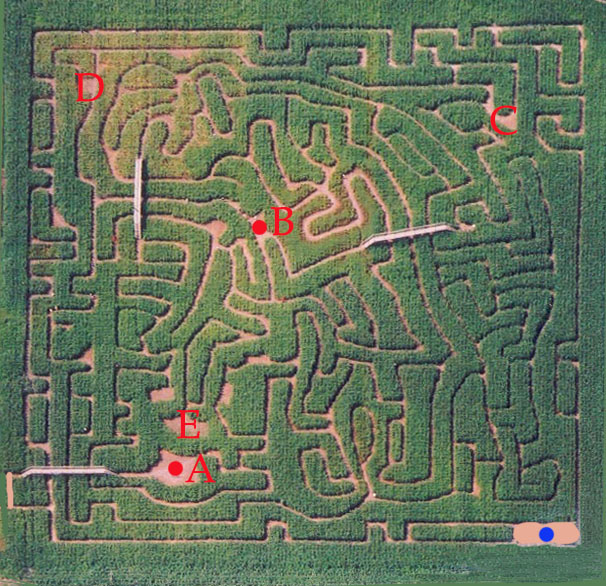
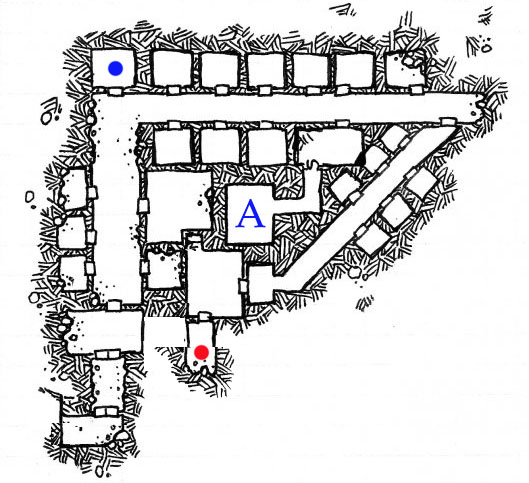
ARCANE RUNES: The walls of this maze are covered in arcane runes.
- Arcana w/read magic (DC 22): The runes on the wall focus the entangling of the teleportal network; or, more accurately, keeps the energy of the teleportal network from entangling into a collapsed state (by sympathetically channeling its complexity into the structure of the maze).
POINT A: Teleportal to Laboratory #19.
POINT B: Teleportal to Laboratory #16.
BLUE POINT: Teleportal to Laboratory #21.
POINT C: Bronze Tablet #4.
POINT D: A large sheet of oil-cloth is draped over a bulky mass. Throwing back the cloth reveals a wooden wagon, fitted for a dray creature.
- Animal Handling (DC 12): The wagon’s harness is not designed for a horse… or anything even remotely horse-like. It’s unclear what sort of creature would have fit into its points.
The wagon contains:
- Dozen bags of sugar
- Dozen bags of sea salt
- 6 large pots, each containing a pickled roc’s foot
- 6 large pots of salted crab meat
- A layer of boxes containing a variety of antique children’s toys
- Search (DC 15): Hidden compartment beneath all the packages, containing three masterwork swords.
POINT E: A long, flat chest of obsidian with a golden statue of a dryad embracing an oak tree atop it (worth 2,500 gp). The chest contains 23,350 sp. Atop the silver pieces lies a book with blank pages, between which have been pressed 101 leaves from different trees. (If the book is viewed with true seeing or similar abilities the pages remain blank… but the pressed leaves are revealed to be the Spellbook of Leaves.
- Search (DC 25): Secret compartment in the bottom of the chest contains a box of cherry wood containing six leaf-shaped broaches of platinum (black ash, elm, gray birch, hemlock, sequoia, and oak) each worth 500 gp.
SANDS OF TIME
Necromancy
Level: Sorcerer/Wizard 3
Components: V, S
Casting Time: 1 minute
Range: Touch
Target: One creature or object
Duration: 10 minutes/level or instantaneous (see text)
Saving Throw: None
Spell Resistance: YesThis spell accelerates a creature’s aging, rendering them temporarily withered and haggard, applying a 1d6 penalty to Strength, Dexterity, and Constitution. This penalty can’t reduce any of these scores below 1. This penalty lasts for 10 minutes per level.
When the spell ends, the target returns to its normal age and vigor. Immortal creatures (including most elementals, fey, outsiders, and incorporeal creatures) are immune to this spell. If you cast this on an object, construct, or undead creature, the spell weathers and corrodes it, inflicting 3d6 points of damage +1 per caster level (maximum +15). This version of the spell has an instantaneous duration.
SPELLBOOK OF LEAVES
This spellbook has 101 rare leaves pressed between its pages. The spells can only be read using a true seeing spell or similar methods of viewing invisible text.
1-level spells – acidic grasp, animate rope, change self, charm person, chill touch, comprehend language, cetect secret doors, enlarge, erase, grease, identify, jump, message, undetectable aura, ray of enfeeblement, shield, silent image, tenser’s floating disk, unseen servant
2-level spells – absorb dead flesh, alarm (ethereal), blur, darkvision, flaming sphere, fog cloud, invisibility, knock, acid arrow, minor image, protection from arrows, spectral hand, hideous laughter
3-level spells – blade of shade and agony, blink, fireball, tiny hut, phantom steed, sleet storm
4-level spells – bestow curse, dispel magic field, emotion, illusory wall, phantasmal killer
5-level spells – interposing hand, secret chest, passwall, permanency, transmute rock to mud
6-level spells – mass suggestion, lucubration, freezing sphere, planar binding
7-level spells – grasping hand, delayed blast fireball, power word stun, simulacrum
8-level spells – antipathy, clenched fist, dispel magic field (greater), etherealness, incendiary cloud, maze, summon monster VIII, temporal slam
9-level spells – dominate monster, energy drain, horde of hell, meteor swarm, power word, kill, refuge, soul bind
ABSORB DEAD FLESH
Necromancy (Evil)
Level: Sorcerer/Wizard 2
Components: S, M
Casting Time: 1 action
Range: Touch
Target: Caster
Duration: Instantaneous
Saving Throw: None
Spell Resistance: NoBy playing a hand upon a corpse (a dead, and not undead, body) the caster absorbs the flesh of the corpse, healing himself for 1d6 points plus 1 point per level of the caster.
Once cast on a corpse, the corpse shrivels and decomposes rapidly, leaving only a bare skeleton. This spell may only be used once on any corpse.
Absorb dead flesh does not work on any corpse that does not have some rotten meat hanging from its bones.
Material Component: A corpse.
ACIDIC GRASP
Conjuration (Creation) [Acid]
Level: Sorcerer/Wizard 1
Components: V, S
Casting Time: 1 standard action
Range: Touch
Targets: Creatures touched
Duration: Instantaneous
Saving Throw: None
Spell Resistance: YesThe caster’s hand becomes coated with a sickly, greenish secretion. This allows for a touch attack that causes 1d8 acid damage, which can be used once per caster level. The damage can also be dealt as extra damage when making an unarmed strike, attacking with a natural weapon, or dealing damage with a successful grapple check.
ALARM, ETHEREAL
Abjuration
Level: Bard 2, Ranger 2, Sorcerer/Wizard 2
Components: V, S, F
Duration: 4 hours/level (D)This spell functions like alarm, but can also be triggered by creatures passing through the affected area on planes which are coterminous with the Material Plane (including ethereal and astral creatures, as well as creatures on the Plane of Shadows).
Focus: A bell made of carved crystal and a very fine piece of mithril wire.
BLADE OF SHADE AND AGONY
Evocation
Level: Assassin 2, Blackguard 2, Cleric 3, Sorcerer/Wizard 3
Components: V, S, DF
Casting Time: 1 standard action
Range: 0 ft.
Effect: Dagger-like blade of black flame in the palm
Duration: 1 round/level (D)
Saving Throw: Will partial
Spell Resistance: YesThe blade of shade and agony can be used to make melee touch attacks that deal 1d6 damage + 1 per two caster levels (maximum of +10). A creature struck by the blade must succeed on a Will saving throw or become shaken for 1d6 rounds.
DISPEL MAGIC FIELD
Abjuration
Level: Cleric 5, Sorcerer/Wizard 5
Components: V, S, DF
Casting Time: 1 standard action
Range: Close (25 ft. + 5 ft./2 levels)
Effect: A contiguous area up to one 10 ft. square/level
Duration: 1 minute/level
Saving Throw: None
Spell Resistance: NoA dispel magic field is invisible and can be passed through. Anyone or anything entering it, however, become the target of a dispel magic effect at the caster’s level.
DISPEL MAGIC FIELD, GREATER
Abjuration
Level: Cleric 8, Sorcerer/Wizard 8This spell functions like dispel magic field except that the effect is that of greater dispel magic.
HORDE OF HELL
Conjuration (Summoning) [Evil, Lawful]
Level: Cleric 9, Sorcerer/Wizard 9
Components: V, S
Casting Time: 10-30 minutes (see text)
Range: Medium (100 ft. + 10 ft./level)
Effect: One or more summoned creatures, no two of which are more than 30 ft. apart
Duration: 10 minutes/level (D)
Saving Throw: None
Spell Resistance: NoTen minutes after this ritual begins, 1d4 hellcats appear. Ten minutes later, 1d4 chain devils appear. Ten minutes later (at the completion of casting), one bone devil appears. If the casting is interrupted (or if the caster chooses to cease casting), any creatures which have already been summoned remain but no additional creatures will appear.
The summoned creatures obey the caster for the duration of the spell (which is calculated from the point where the casting came to an end). The caster can dismiss them individually, in groups, or in totality at any time.
SUMMON SHADOW RAVEN
Conjuration (Summoning) [Evil]
Level: Clr 3, Sor/Wiz 3
Components: V, S, F/DF
Casting Time: 1 full round
Range: Close (25 ft. +5 ft./2 levels)
Effect: Summons shadow raven.
Duration: 1 round/level of caster
Saving Throw: None
Spell Resistance: NoThis spell summons a shadow raven from the Demi-Plane of Shadow. Once the raven in on the spellcaster’s plane, the spellcaster may attempt to bind it as a familiar.
The shadow raven enters this world through any shadow within range of the spell, so the spell won’t work in total darkness or total light. The shadow raven serves faithfully for the spell’s duration. If the spellcaster has the proper tribute, the shadow raven may serve as a familiar. The GM is the final arbiter for what tribute is appropriate.
Arcane Foci: A small, shiny object and a shadow.
TEMPORAL SLAM
Transmutation
Level: Sorcerer/Wizard 8
Components: V, S
Casting Time: 1 full round
Range: Close (25 ft. + 2 ft./level)
Target: 1 creature or object
Duration: 1 hour/level
Saving Throw: Will negates (harmless, object)
Spell Resistance: Yes (harmless, object)For whatever duration he desires up to the spell’s maximum, the caster pushes that target creature and its carried gear (or any one object of medium-size or smaller) out of time. The target vanishes immediately and it no longer exists in the world’s normal time stream while the spell lasts. If the target is a caster, any spells or effects the target was maintaining are affected as though the target just died.
During the period in which it is outside time, the target cannot be located with scrying or similar divinations. Not even a wish or miracle can bring the target back earlier or dispel the temporal slam, since no magic remains within the normal flow of time to dispel.
When the spell ends, the target returns to the same location from which it disappeared. If some other object occupies that space, the target is harmlessly shunted into the nearest open space. For the target, no time has elapsed. A target creature will have effectively transported into the future from its perspective. When the target returns, any timed phenomenon such as poison onset or the duration of abjuration spells will pick up from the point when the target vanished.
SHADOW RAVEN (CR 2) – CE Small Undead Animal (Incorporeal)
DETECTION – Listen +5, Spot +5; Init +3; Languages Common
DEFENSES – AC 15 (+3 Dex, +1 size, +1 deflection), touch 15, flat-footed 12; hp 11 (2d8+2); Miss 50% (incorporeal); Immune undead immunities (ability damage/drain, critical hits, death effects, energy drain, fatigue, mind-affecting, nonlethal damage, paralysis, poison, sleep, stunning, any effect requiring Fort save)
ACTIONS – Spd fly 60 ft. (good); Melee incorporeal claw +4 (1d2 Str); Ranged +4; Base Atk +1; Grapple -3; Combat Feats Flyby Attack
SQ incorporeal
STR -, DEX 16, CON -, INT 2, WIS 11, CHA 12
FORT +1, REF +4, WILL +2
FEATS: Flyby Attack, Weapon Finesse
SKILLS: Hide +10, Listen +5, Spot +5
Incorporeal (Su): Immune to non-magical physical attacks. Ignore spells or magical weapons 50% of the time. Move through physical objects. Ignore any physical bonuses to AC (natural armor, armor, shields, etc.). Affected normally by positive energy, negative energy, or force effects.
LABORATORY #21: UNDEAD LABORATORY
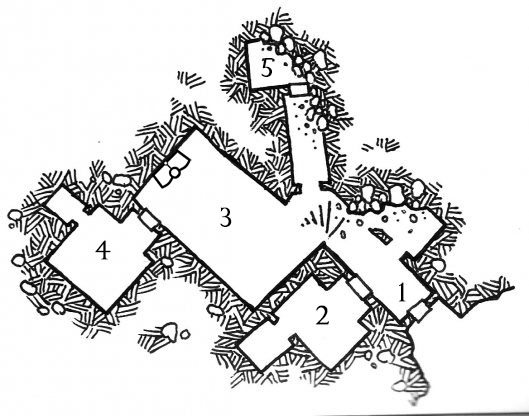
TELEPORTALS: In a small chamber outside the door leading to Area 1.
AREA 1 – SOUL NET: A spectral figure of umbral blue seems frozen in mid-air, surrounded by a broken lattice of blue energy.
- Frozen Shade: This shade is caught in the soul net. If the soul net is dispelled or otherwise removed the frozen shade is released.)
The soul net is spread across the entire entrance here. If someone passes through the soul net:
- Undead: Undead other than soul shades cannot pass through a soul net. If forced through a soul net, their animating force will be stripped from their body (which turns to dust).
- Living: Living creatures suffer 8d6 points of damage as their soul is shredded by the net. Their shredded soul becomes a soul shade with a number of hit points equal to those lost. (Going through the soul net multiple times will further shred the living soul, creating more soul shades.)
- Shredded Souls: Shredded souls can only be repaired (and the lost hit points restored) through the use of a modified raise dead spell after the soul shade has been destroyed. (Soul shades are compelled to seek out and destroy the original sour; abhorring it.)
AREA 2 – ZOMBIE MASTER: The zombie master (who ensconces himself in the rear chamber of this area) and 8 bugbear zombies.
AREA 3 – CYCLOPEAN MUMMY: The far end of this chamber appears to be a massive, 15′ tall bas relief of a king. The floor is a mosaic of orange and blue tiles in a spiraling, hexagonal pattern.
- Sarcophagus: The bas relief is actually the lid of a massive sarcophagus sunk into the wall. Within is the Cyclopean Mummy. If offered a tribute worth at least 1,000 gp it will not attack and will instead act as an augury, answering three questions.
AREA 4 – THE LICH BRAIN: A pulsing, purplish brain lies in the middle of an arcane circle in the middle of the floor, surrounded by a pile of dust outlining the rough shape of a corpse.
- Arcana/Spellcraft (DC 28): To identify the ritual as an attempt to create a lich.
- Arcana/Spellcraft (DC 35): To spot the errors in the ritual that resulted in the caster’s body being annhilated.
- Lich Brain: The brain is undead (and hostile).
- Corpse Dust: Within the corpse dust surrounding the brain is a BLUE KEY scarred with several burn marks. (It was damaged during the ritual. Using the key inflicts 4d6 points of damage and has a 25% chance of returning the user to their original location.)
- Ruined Phylactery: The would-be phylactery of the lich was ruined useless by the failed ritual, but the silver and jewels encrusting it are still worth 10,000 gp.
- Side Chamber: A blackened and charred barrel sits in the corner of the room, a tall staff protruding from it and topped with the antlers of a young stag. (The staff is made of mahogany, with a central grip of cold iron.)
AREA 5 – COLLAPSED CHAMBER: Contains shattered shards of pottery. Amidst the shattered pottery are Bronze Tablet #7 and Bronze Tablet #8.
FROZEN SHADE (CR 9-1*) – 109 hp (13d8+50), AC 21, claws +16/+16 (2d8+5), Save +12, Ability DC 18
Str -, Dex 13, Con -, Int 6, Wis 12, Cha 13
Skills: Intimidate +17, Perception +17, Search +17
Aura of Fear (Su): 30 ft. radius, Will save or become panicked for 3d6 rounds
Incorporeal (Su): Immune to non-magical physical attacks. Ignore spells or magical weapons 50% of the time. Move through physical objects. Ignore any physical bonuses to AC (natural armor, armor, shields, etc.). Affected normally by positive energy, negative energy, or force effects.
Turn Resistance +6
* Undead
ZOMBIE MASTER (CR 9-1*) – 109 hp (13d8+50), AC 21, claws +16/+16 (2d8+5), Save +12, Ability DC 18
Str 16, Dex 12, Con -, Int 14, Wis 9, Cha 12
Skills: Diplomacy +17, Perception +15
Enthralling Pipes (Su): Standard action; enemies within 30 ft.; Will save or dazed.
Fast Healing 3
Zombie Regeneration (Su): Zombies within 120 ft. gain regeneration 10.
* Undead
CYCLOPEAN MUMMY (CR 12) – LE Huge Undead
DETECTION – darkvision 60 ft., Listen +8, Spot +8; Init +0; Aura despair
DEFENSES – AC 23 (-2 size, +15 natural), touch 8, flat-footed 23; hp 240 (32d12+32); DR 5/-; Immune undead immunities (ability damage/drain, critical hits, death effects, energy drain, fatigue, mind-affecting, nonlethal damage, paralysis, poison, sleep, stunning, any effect requiring Fort save); Vulnerable fire
ACTIONS – Spd 20 ft.; Melee slam +31 (3d8+18 plus mummy rot); Ranged +16; Space 15 ft.; Reach 15 ft.; Base Atk +16; Grapple +39; Combat Feats Awesome Blow, Improved Bull Rush, Power Attack
SQ darkvision 60 ft., undead traits
STR 40, DEX 10, CON -, INT 6, WIS 14, CHA 18
FORT +12, REF +10 WILL +20
FEATS: Ability Focus (despair), Awesome Blow, Alertness, Great Fortitude, Improved Bull Rush, Improved Natural Attack, Improved Toughness, Power Attack
SKILLS: Hide +12, Listen +13, Move Silently +12, Spot +13Despair (Su): Those seeing mummy make Will save (DC 20) or paralyzed with fear for 1d4 rounds.
Mummy Rot (Su): Supernatural disease – Fort DC 16, 1 minute, 1d6 Con and 1d6 Cha. Cannot be cured without first casting break enchantment or remove curse; requires caster level check (DC 20) to apply those spells or any healing spells to victim.
Awesome Blow: -4 to melee attack roll. A smaller corporeal creature is knocked flying 10 feet and falls prone (1d6 damage if they strike obstacle). Reflex save (DC = damage dealt) negates.
LICH BRAIN (CR 6+3*): 60 hp (8d8+24), AC 19, Save +9, Ability DC 16, Tiny
Str -, Dex 10, Con -, Int 22, Wis 16, Cha 16
Skills: Spellcraft +15
DR 15/bludgeoning and magic
Immobile (can levitate in place)
Immune mind-affecting
Turn Resistance +8
*11th level wizard (+4), undead (-1)Wizard Spells Prepared (CL 11)
6th (DC 22)—chain lightning, globe of invulnerability
5th (DC 21)—dominate person, feeblemind, wall of force
4th (DC 20)—greater invisibility, ice storm, summon monster IV, wall of ice
3rd (DC 19)—dispel magic, fireball, haste, lightning bolt, summon monster III
2nd (DC 18)—darkness, detect thoughts, hypnotic pattern, magic mouth, rope trick, see invisibility
1st (DC 17)—grease, magic missile (x3), mage armor, shield
0th (DC 16)—dancing lights, detect magic, mage hand, prestidigitation
Go to Part 7: Laboratories 22-23
Any material in this post not indicated as Product Identity in the Open Gaming License is released by Creative Common Attribution-Share Alike 3.0.