The Alexandrian

Archive for the ‘Roleplaying Games’ category

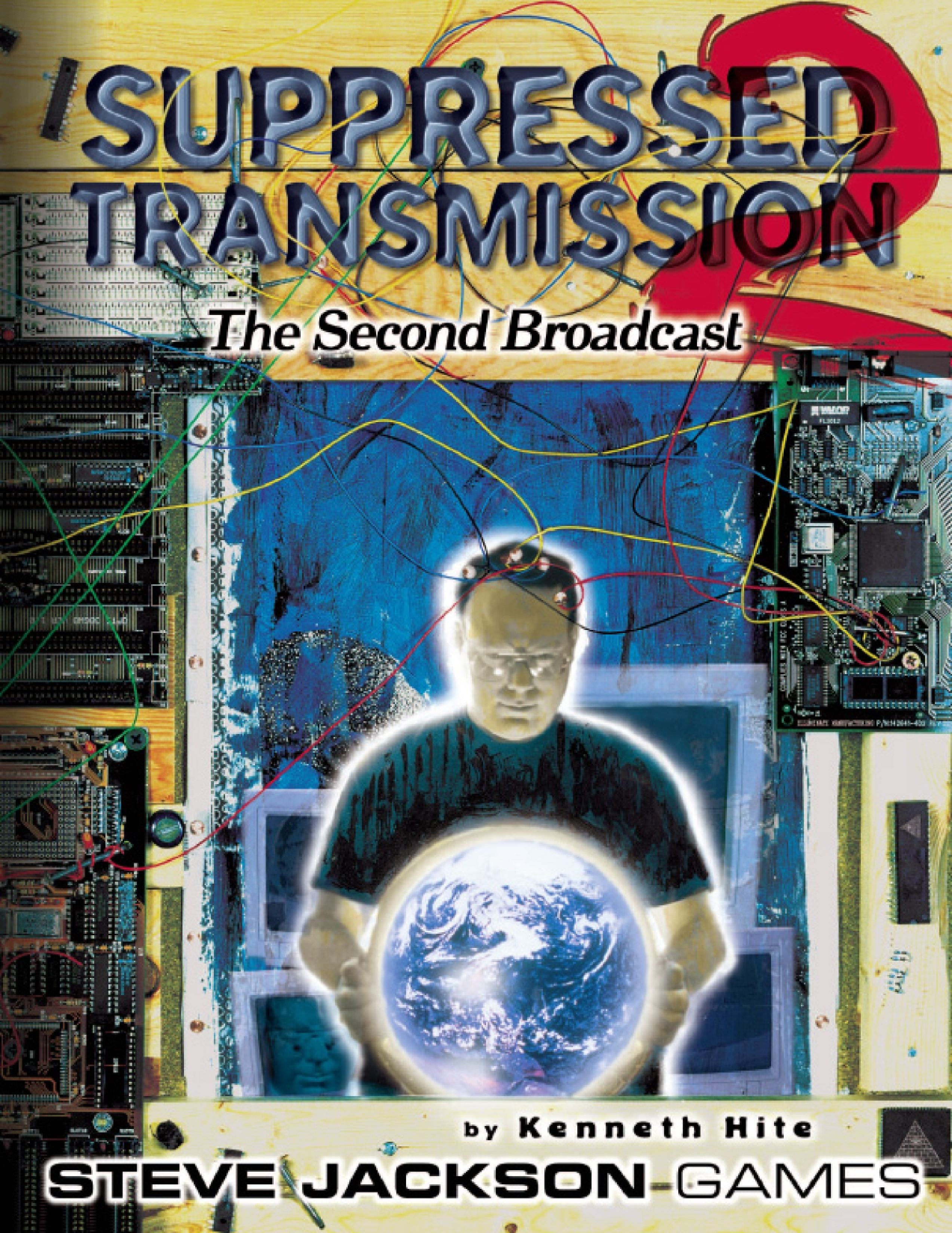
Suppressed Transmissions 2: The Second Broadcast

Originally Written July 2001

For nearly three years now, Kenneth Hite has been writing Suppressed Transmissions – a column which can be found, each and every week, in the digital pages of Pyramid Magazine.

For those of you unfamiliar with the column, I find it almost impossible to explain the experience: Hite takes a plethora of historical fact, teases it out with imaginative alternatives, spices it with every possible nuance of conspiracy, stirs in a bit of secret history, adds a touch of horror, and creates a potent brew. Each and every one of these columns – grouped about a particular idea (Jack the Ripper, Joan of Arc, the Knights Templer, Crystal Skuills, etc.) – contains half a dozen ideas. Each of these ideas could provide weeks of campaigning, and are possessed of a singular stamp of quality.

But that description alone does not do justice to the true brilliance which is churned out – week after week – by this remarkable man. Hite is not only preeminently creative, he is steeped in knowledge which boggles the mind – and the interstice between the two which is Suppressed Transmissions – defies any expectation I could hope to create in your minds.

In short: A better wellspring of ideas you will not find.

The book being reviewed here is the second collection of these superb columns – covering the period from April 1999 to March 2000, with columns grouped together by common theme (Alternate History; Enigmatic Explanations; Men, Myths, and Monsters; Peculiar Places; and Clashing Symbols). However, as many of you probably already know, all of these columns can already be accessed (along with the rest of Pyramid’s archive) by subscribing to the magazine for $15 a year. So why would you spend $20 buying this collection (or the first one)?

Because Ken Hite is even smarter than I thought. Suppressed Transmissions 2 uses the standard SJG format – main text supplemented by a sidebar on every page. And each and every sidebar – on each and every page – is crammed to the gills with copious footnotes. For this collection, Hite has copiously gone back into each and every column and supplemented it with additional research, interesting digressions, and interconnections.

This material is invaluable, and represents an incredible value.

So, by all means, subscribe to Pyramid and check the column out first. But if you are as captivated with it as everyone else who has ever read it, then you’re going to want to track down these collected volumes as soon as possible.

In short, again: Suppressed Transmissions is essential for any GM’s library.

Grade: A+

Like my review of Hera & Zeus, this was originally written for Games Unplugged magazine, but I can’t find any record of it actually being published despite, if I recall correctly, having a review copy supplied by the magazine. Based on its length, I believe this review would have been originally intended for Games Unplugged‘s webzine rather than the print magazine.

I had completely forgotten writing this review when I wrote a new review of both Suppressed Transmission volumes back in 2023. Unsurprisingly, neither my opinion of the book nor my superlatives were much altered, but it’s still interesting comparing both reviews, written with more than decades between them.

Path of candlelight

In my Mothership open table, a character named Manny Vasquez recently died. One of the other PCs, Dürmig Ableton, decided to use one of his downtime actions to arrange a memorial service for Manny — a chance for everyone who had worked with him to share their memories and commend him to the wisdom of the stars.

I loved this idea, but it was also problematic.

Sure, we could play through the memorial service with the four players who were currently at the table, but what about the other twenty players who are currently active in the campaign and their characters? In fact, even Manny’s player wasn’t at this session! (Dürmig had heard the news of Manny’s death from one of the other PCs in the session, who had been working with Manny when he died.)

What Dürmig was really proposing was a communal event that, ideally, everyone playing in the open table could choose to participate in.

The problem is that I’ve tried organizing community events like this before — where a bunch of open table players all get together — and they’re pretty antithetical to what makes an open table work: The whole point of the open table, after all, is flexible scheduling so that you’re NOT trying to coordinate everyone’s schedules. Therefore, not only have I found that events like this often never come together at all, I’ve seen the efforts to coordinate real-world and game-world schedules actually wreck the entire open table and end the campaign.

(This may be difficult to understand unless you’ve seen it in practice. Basically, characters and/or players got put on hold waiting for the communal event to happen. When the event inevitably got delayed because of the logistical issues, people went into a “holding pattern” where they were waiting for the event to happen. Attendance dropped at the other sessions, which killed the forward momentum of the table and even caused whole sessions to be canceled. This caused players’ commitment to the game to flag, which increased the attendance problems while also making it harder for everyone to come together for the now much-delayed communal event, and the whole thing slipped into a death spiral.)

So with these practical and existential problems in mind, how did we handle Manny’s memorial service?

RUNNING THE EVENT

For context, here’s a few key facts about how this open table is being run:

  • We have a dedicated Discord server where events are scheduled. The players’ also have channels for chatting with each other between sessions.
  • This is supplemented with an e-mail list, which I use to let people who aren’t habitually checking Discord know when new sessions have been scheduled.
  • Time is synced between the real world and the game world, generally at a rate of 1 week in the real world being equal to 1 cycle in the Tempest Cluster.
  • There’s a system of downtime actions which we resolve at the beginning of each session. Among other things, this allows PCs to “catch up” to the game clock.
  • In my campaign status document, in addition to tracking open table headlines, I’ve also found it useful to track Major Events and the date they’re occurring. It then becomes relatively easy to see, during downtime resolution, which characters are “passing through” a major event and make sure to insert it into their narrative.

With these structures in place, I then did four things to run the memorial event.

First, as I mentioned, Dürmig spent a downtime action getting the event set up. This was during a session, so we played through this and established the broad details.

Second, I asked Dürmig’s player to make a post to the campaign Discord detailing the invent and inviting others to join and (in this case) share their memories of Manny. I also promoted the event to all of the players in the campaign via our e-mail list.

Third, I included the memorial service on my Major Events timeline. It’s very different from the other sorts of events I’ve tracked there (e.g., a major terrorist attack on the station where everyone lives), but the key thing is that it’s getting “triggered” for each PC as they pass through that moment in time. This gives us a chance to play through (and likely add to) the event, making it a living part of the campaign experience.

Fourth, I encouraged those players — if they hadn’t already — to go to the Discord and share what their character does at the memorial service. (This can be a little wobbly if you ask them to do it after the session, so you may find it most effective to take a “break” so that everyone can hop on their phones and roleplay the moment immediately.)

The result is an event that plays out multiple times over multiple weeks (or even months) of real time. It naturally results in the event being revealed/created/built in a nonlinear fashion, but with each pass through the event the group is collectively adding layers of detail and interaction to it. Meanwhile, no one is left waiting for the event to happen, nor is anyone forced to skip the event unless they want to.

FINAL THOUGHTS

To date, I’ve only used this technique to resolve what you might refer to as “low stakes” events: Attending Manny’s memorial service, for example, is a communal event, but its outcome is not going to fundamentally shift the forward trajectory of the campaign. Things might be different if there was, say, a bomb hidden in Manny’s coffin or if the big, shared event was something like the evacuation of the station.

If/when such events arise in the future, I’ll probably use similar techniques of mixing nonlinear Discord resolution, but will need to experiment with other techniques to make it work right. A few things I’ve considered include:

  • Special Event Session! I’d use this if the PCs can/should be positioned to affect the outcome of the event. The goal here would not be the futile hope of getting everyone in the campaign to show up on the same day, but rather to run a specially flagged session where the PCs who show up are the ones at the tip of the spear. (Other PCs may still be able to participate in the session’s “pregame” via the event’s Discord thread.)
  • Default anyone not participating in the event by such-and-such a date as having been away from the action. (In the Tempest Cluster campaign, for example, we would just assume that they took a low-paying job off-station when the event happens.)
  • Alternatively, with the canonical timeline/outcome determined (by a special event session or otherwise), we can now transition the non-linear resolution techniques described above as everyone else figures out how their character was affected by what happened during the special event.
  • Multiple special event sessions. This can work if the event is designed in such a way that its outcome is being affected by actions taking place in significantly different places at the same time. For example, maybe every session in March is resolving a different facet of a crisis, with the outcome from all tables being synthesized at the end of the event

As I say, these are currently just thought experiments. But they do open up some really fascinating opportunities I’m looking forward to exploring.

FURTHER READING

Open Table Manifesto
Open Table Headlines
Tempest Cluster

Akop - Book of Fiends (modified)

And from those teeming places of shadow and virulent beds of life and seething pits of chaos, the Natharl’nacna bent the substance of the world unto their will. From the work came the least of their servants, a swarming brood of anarchy and despite.

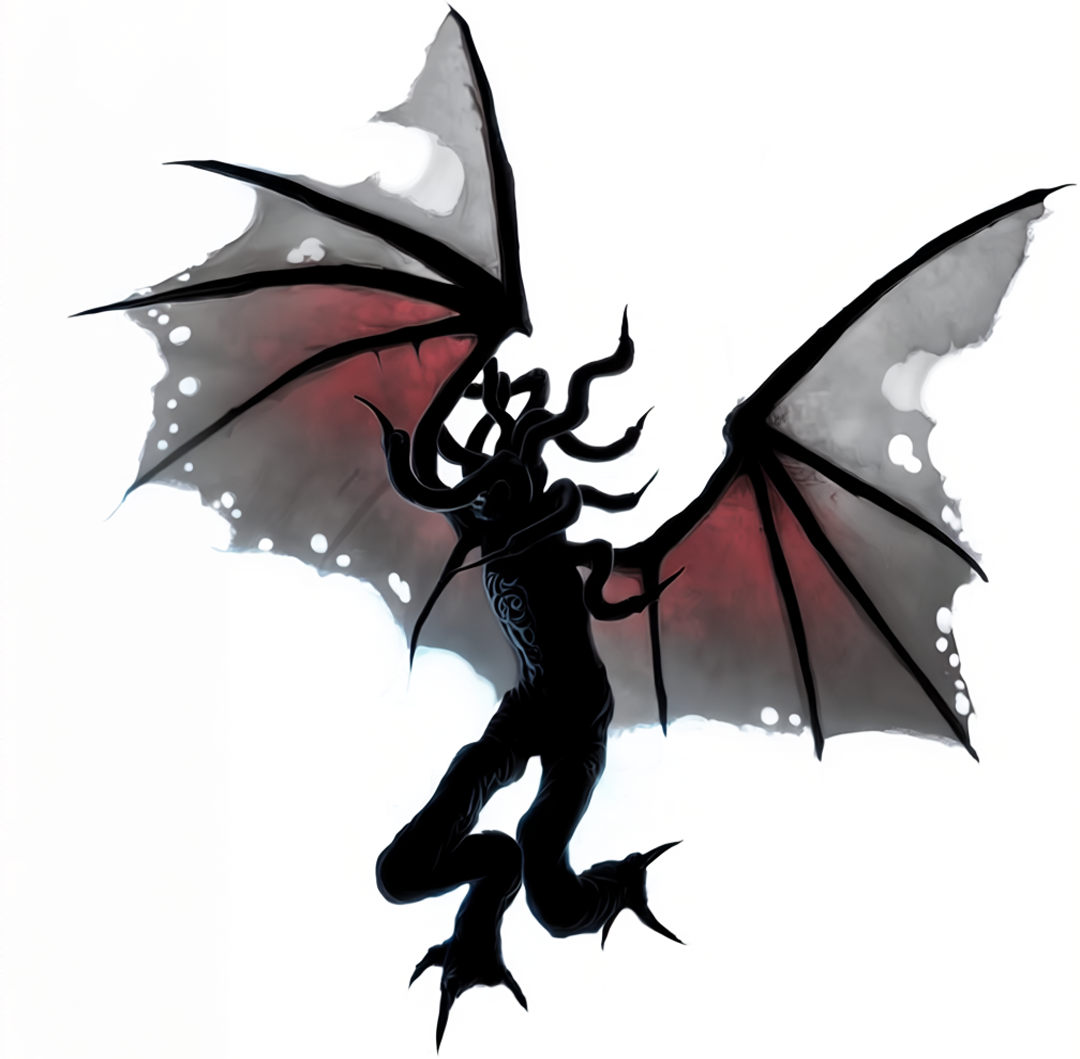
This slim folder of supple hide, clasped shut with a length of emerald green ribbon, contains a dozen or so individual sheets of parchment. Written in an archaic – almost alien – form of the Common tongue, they tell a sad and cautionary tale.

In a time of great strife and a war, a race of high sorcerers fled the mortal world and took refuge within “a spired realm of the Dreaming.” For long years without count this race dominated their new home – they were masters of magic and builders of wonder; they lived in peace and glory.

They were called the Akop and the years of their golden age seemed without end.

But there came a time when this proud race faced a problem they could not overcome: “Although they lived within the halls of Dreaming, yet their arts had never mastered the dream-craft. They worked marvels within dreams, but were not of the Dream themselves.”

Their world was dying. And in its slow decay, it had become severed from the mortal realm from which the Akop had first come. “From the fraught-prison of their own creation, there was no flight.”

In their desperation they turned to a creature referred to in the text only as the Kindred. The Kindred had the power to free them from their self-inflicted prison, but he demanded a high price: “Through his gates they would pass, but once passed they would blood-bind their hearts to serve him for unto a generation of their race.”

Faced with obliteration, the Akop agreed. But the Kindred was treacherous: The gates which took the Akop from their world were foully enchanted. As they emerged into the “deep eurl-realms of chaos”, the Akop were transformed into insubstantial creatures of living shadow, bereft of mortal form. “Of the flesh, they could not be harmed. But nor could they breed of the flesh. There would be no passing of their generations and upon their oath the Kindred had bound them for all eternity. And so the Kindred became the Enslaver of Races.”

In their new form, the akop became members of the Elder Brood – a foul mixture of twisted races that are described as “servitors of the Kindred and the kindred of the Kindred”. There they “took their place among the essyat and gadacro; the nintha and the obaan”. Over the years that followed, the akop degenerated – losing first their magic and then their sanity.

“In their madness, the Kindred found he could not command them; could not control them; could not rule them. But yet, in madness, they ever-serve the mad-mind of the Kindred and work unto his ends.”

THE NAUGHT-FLESH OF THE AKOP

The akop are incorporeal beings of shadow. “And they loathe those luck-fated to still wear their flesh. They blood-boil to battle-lust and long to bring all those of their former kindred into their Akop - Book of Fiends (Green Ronin)madness of the cur-kin. But in this the curse of the Kindred tightens, for with each akop who passes in the battle-fraught, their race-pride is brought one step closer to its end-utter.”

THE TOUCH OF THE AKOP: “Fear the shadow-flesh which is not, for in its touch the madness of a dying race shall seep through pore and blood into the bone and brain. Those afflicted by the touch of the akop shall be driven to their Dream of madness.”

It seems that those driven insane by the akop are thrust into dreams of apocalyptic vision. There seems to be a shared quality to these dreams (among those whose shattered minds have recovered enough to communicate), and it is believed that they are the race memories of the Realm in which the akop once lived – twisted through the memory of its destruction and their own madness.

At this point, in a separate hand, there is a report of many such visions collated from various sources. Some are not given any textual authority, but seem to have been gathered first-hand (and perhaps deliberately so). They conjure strange visions of ruptured towers of obsidian; cascades of shattered stone glittering with chaos-tossed magicks; of great forests ripping apart in silent desolation; of rivers plunging into ourobouric self-destruction.

SUMMONING THE AKOP

A final selection of papers details the particular details of the summoning ritual necessary to “summon a brood-swarm of akop to give the truest service of chaos”.

Using these notes, a summon fiend spell can be modified in one of two ways.

First, it can be cast using a 1st-level spell slot, in which case it will temporarily call forth an akop for 1 hour. Due to the madness of the akop, however, the control of the spell is not perfect. The akop is allowed to make a Wisdom saving throw when summoned. On a success, the control of the spell is broken and the akop is free to act in whatever manner their madness dictates. (When in doubt, have them act as if under the effects of a confusion spell.) On a failure, the akop is controlled normally, but may retry the Wisdom saving throw once every 10 minutes.

Second, it can be cast using a 6th-level spell slot to permanently bring a swarm of 1d6+2 akops to the caster’s location. These are not summoned creatures, but have been brought from the Elder Brood into the mortal plane. These akop, too, are difficult to control, although the rites involved in summoning them give them disadvantage on their saving throws. If these akop fail their saving throw, they can reattempt it once per day.

DESIGN NOTES

Although the elder brood are described as being teemless in their variety, only three varieties can be found in the Chaositech sourcebook. So I cracked open one of my favorite bestiaries — Green Ronin’s The Book of Fiends — and started scavenging some of those fantastic monsters, like the akop, to fill out the ranks of the elder brood. The Book of Fiends has been updated for D&D 5th Edition, so it’s quite easy to add these to your own Ptolus campaign, regardless of which edition you’re using.

Back to Chaos Lorebooks

D&D - Forgotten Realms: Into the Dragon's Lair (Wizards of the Coast)

Originally Published in Games Unplugged Webzine – May 1st, 2001

Warning: This review will contain spoilers for Into the Dragon’s Lair. Players who may end up playing in this module are encouraged to stop reading now. Proceed at your own risk.

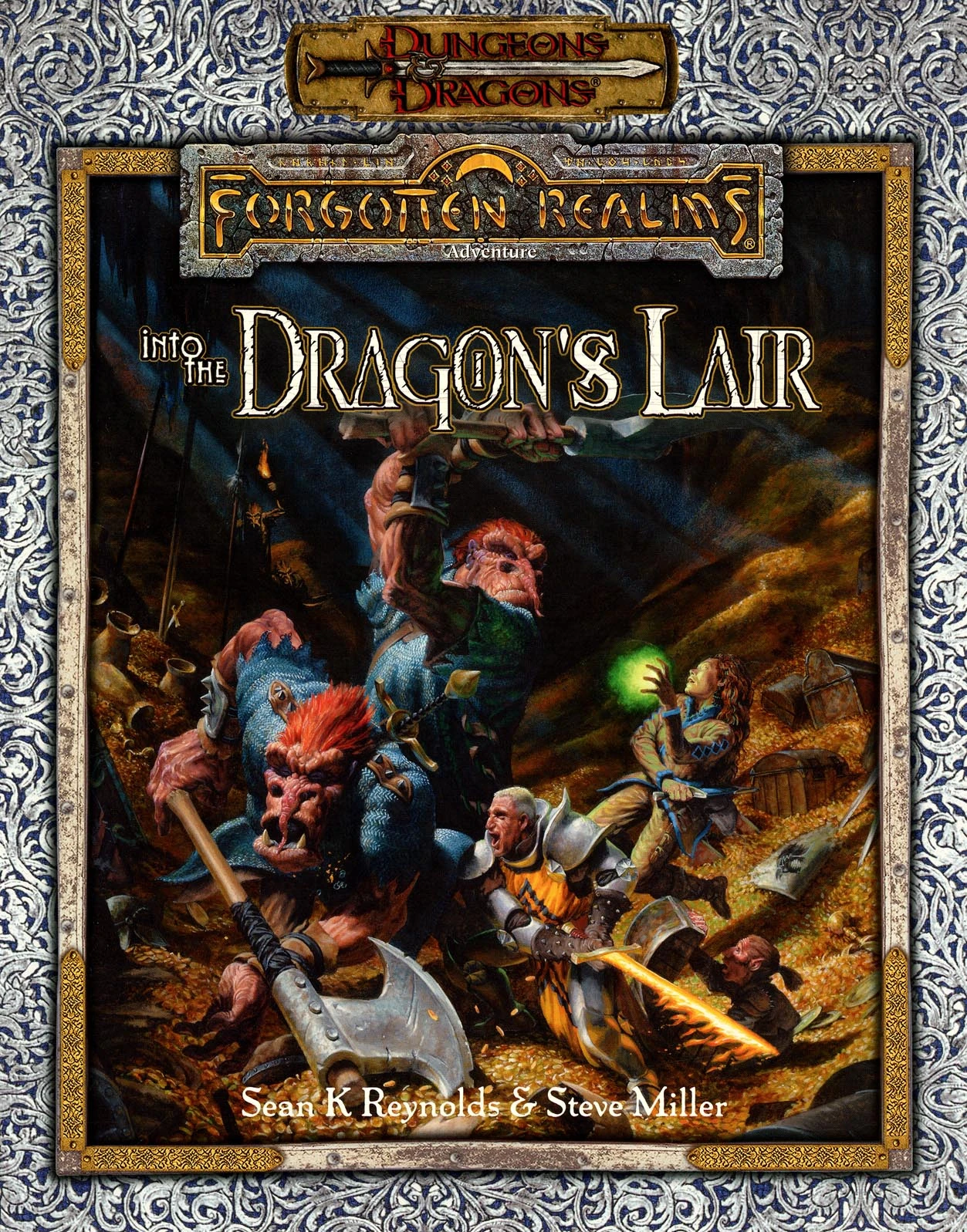
Into the Dragon’s Lair is a 96-page module, written by Sean K. Reynolds and Steve Miller, inspired by and designed around the events detailed in the Forgotten Realms novel Death of the Dragon by Ed Greenwood and Troy Denning.

The plot goes something like this: Cormyr was laid waste and her king slain by a dragon who has an ancient blood grudge against the royal line. During the fighting which followed the dragon was killed. (That’s what happened in the novel – and it’s all summarized for the DM at the front of the module.) The PCs are asked to track down the dragon’s lair and liberate the treasure to be found there for the good of Cormyr. (I would have liked to see a few alternate adventure hooks, including the self-obvious: “We’re adventurers, we’ve heard about abandoned treasure, and we’re off to get it.”) Of course, the PCs are not alone in their hunt for the treasure – they’re in a race against time against a half dozen other adventurers and adventuring parties (although it would have been nice if the adventure had been designed so that they could actually lose the race).

The adventure basically breaks into three major sections at this point: First, the PCs need to travel cross country to the dragon’s lair. When they penetrate the lair they will discover its secret: The dragon’s orcish thralls are actually the inhabitants of a demi-plane and the dragon herself exists in a pocket dimension outside of that pocket dimension. The PCs need to work or fight their way through the demi-plane of orcs in order to find the entrance to the dragon’s pocket dimension. The dragon’s pocket dimension is inhabited by evil elves who had sworn loyalty to the dragon. Once they’ve liberated the treasure (if they can do successfully), they have to find some way to transport it back to Cormyr.

There are a couple of really nice features to this product: First, Reynolds and Miller have made sure that it remains accessible – even for those Forgotten Realms players who aren’t familiar with the novel which provides the background out of which this adventure is constructed. (Including me.) Second, the whole structure of competing with other adventuring parties for the deserted dragon’s horde is really cool – and carried out with relatively few flaws. Finally, the entire adventure has an epic quality – which is not only nice to see, but surprising given that the adventure has a novel as its basis for existence: All too often, novel-based adventures are just linear railroads where the players are forced to pantomime the actions of the original protagonists.

There are also some rather unfortunate flaws in this product: First, the map on page 26 (which shows how the PCs get to the dragon’s lair) has misplaced the location of the ambush so that it doesn’t match the description in the text. Second, there are quite a few elements in Into the Dragon’s Lair which are brought up and then never capitalized on – orcish politics, a mysterious valley of fog, some of the interactions with the other parties. In other areas, plot threads are simply left dangling without resolution or explanation. Executing on these would have made the difference between a good module and an excellent one.

If the premise of Into the Dragon’s Lair has you interested, you should definitely check it out – it delivers. If the only reason you’ve been holding back on it is because you’re (understandably) leery of novel tie-ins, then definitely check it out because they’ve avoided all the pitfalls with this one.

But there’s nothing here which is going to make this a “must-have, instant classic”. It’s a good idea, with above average execution, and its definitely worth the cover charge. Beyond that, your own judgment must reign.

Grade: B

Writers: Sean K. Reynolds and Steve Miller
Publisher: Wizards of the Coast
Price: $17.95
Page Count: 96
ISBN: 0-7869-1634-6
Product Code: TSR11634

This is an oft-overlooked adventure from the very earliest days of D&D 3rd Edition. If I recall correctly, it was actually the second official adventure published by Wizards of the Coast, actually predating The Forge of Fury, but no one really paid any attention to it for some reason. I only ended up reading it because I got a review copy, and I’ve just discovered that it’s actually missing from the Wikipedia article listing all official D&D adventures (although I’m sure someone will fix that shortly).

Part of the problem was likely that it was a 10th-level adventure released within just a few weeks of D&D 3rd Edition being released, so it’s unlikely anyone had a group leveled up and ready to play this when it released.

In truth, though, I also have no memory of the adventure itself at this point. I wonder if, in light of of the Race to the Prize scenario structure, I would still be impressed by its handling of the rival adventuring teams?

Zaug (c) Monte Cook Games

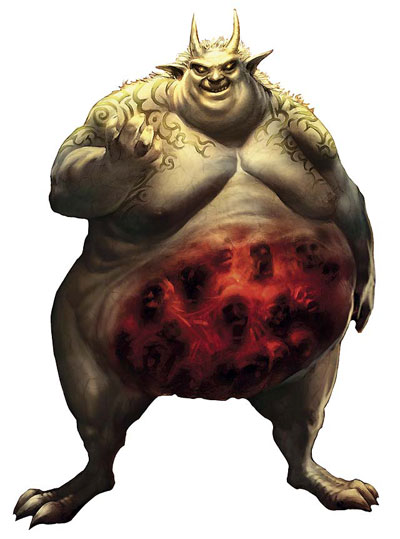
They were the least of those that served. They were corruption given flesh; a corpulence of festering death and decay. Rebellious in spirit, yet forever bound to the power of their masters.

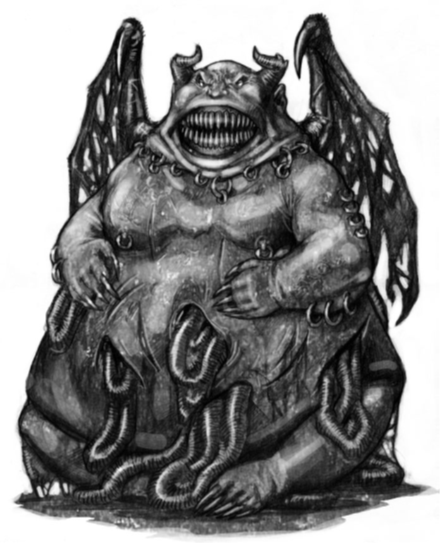
This tome describes the zaug – one of the “servitors of the Galchutt”. Physically the zaug were grossly obese humanoids with no hair. They had wide mouths full of teeth, claws for hands, and short horns on their heads. Some are described as possessing vestigial, rotting wings. A few passages describe their bodies as “corrupted receptacles”. Sores and oozing pus and bile covered their fat flesh. And much of their skin hung loose in rotting folds, pocked with holes from which intestines and other guts hung out – spurting vile fluids.

Several passages are given over to describing festering poisons and other vile alchemical substances that could be created from the “bile of the zaug”, although no true details of the required procedures are given.

The flesh of the zaug itself is ever-regenerating – allowing it to survive despite the diseases, poisons, and parasites that teem through its body. They are said to never eat or drink or breathe, and to speak only telepathically.

THE SOULHARVESTERS

Solamith - Monster Manual V (Wizards of the Coast)

Some among the zaug were transformed by the Galchutt and “turned to a new purpose”. As the zaug were made living receptacles for manifest corruption, the zaug soulharvesters became living prisoners for captured and tormented souls.

“Their very flesh burned with the fire of the souls which screamed within them.”

“Their hunger was without end, fed eternally by the torment of those who seared their flesh.”

Where the flesh of the zaug festered, the beruned and corpulent flesh of the soulharvesters was glistening and taut. And pressing out against the green-veined and pallid skin of their guts were the screaming faces of those imprisoned within them.

The “soulfire flesh” of the zaug soulharvesters is described as an immense, living power source.

THE LORE OF THE LATTER YEARS

And while their masters slept, the labors of the zaug were endless.

Later lore describes the zaug working with the “titans of the Purple City” in labors of “the technology of the taint” as they worked to “perfect the crafts gifted from beyond the Demonweb”.

Other passages refer to the zaug working in the laboratories of Ghul the Skull-King. “And their works turned to the binding and changing of the flesh, and the lesser races were turned into weapons of dark might.”

KASTRALATHAKASAL

And in the sleep of the Galchutt and the sealing of the Vaults of the Rhodintor, the zaug at last found their freedom. And in their caverns of the deep, their works turned inward.

Deep beneath the surface of the earth, it is said that Kastralathakasal – the City of the Zaug – “stands citadel upon the Throne of Darkness”. The city itself is described as a stronghold of alien metals and living, organic components.

DESIGN NOTES

The zaug originally appeared in the Chaositech sourcebook and play a significant role in Monte Cook’s Ptolus. The Soulharvesters, however, were originally Solamith demons created for the D&D 3rd Edition Monster Manual V. (They made the leap to 4th Edition, but there doesn’t appear to be an official adaptation for 5th Edition, which is unfortunate in my opinion.)

Given the great plentitude of monsters available for D&D, this is a technique I frequently use. It’s similar to The Campaign Stitch, but rather than melding adventures it takes monsters and asks: What if these are the same monster?

It’s kind of like palette shifting, but rather than taking one stat block and using it to model a multitude of creatures, this technique — monster melding — takes a bunch of different stat blocks and brings their lore together. I like it because it transforms a vast-but-shallow funhouse filled with an incomprehensibly huge variety of beasties and instead uses it for depth. The zaug and the solamith are both interesting in their own right; but their sum, in my opinion, is greater than the sum of their parts: By putting them into a relationship with each other, both of them become more interesting and versatile.

Back to Chaos Lorebooks

Archives

Recent Posts

Recent Comments

Copyright © The Alexandrian. All rights reserved.