They were the least of those that served. They were corruption given flesh; a corpulence of festering death and decay. Rebellious in spirit, yet forever bound to the power of their masters.
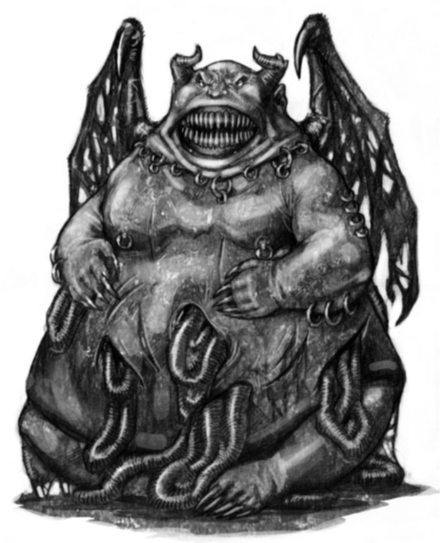
This tome describes the zaug – one of the “servitors of the Galchutt”. Physically the zaug were grossly obese humanoids with no hair. They had wide mouths full of teeth, claws for hands, and short horns on their heads. Some are described as possessing vestigial, rotting wings. A few passages describe their bodies as “corrupted receptacles”. Sores and oozing pus and bile covered their fat flesh. And much of their skin hung loose in rotting folds, pocked with holes from which intestines and other guts hung out – spurting vile fluids.
Several passages are given over to describing festering poisons and other vile alchemical substances that could be created from the “bile of the zaug”, although no true details of the required procedures are given.
The flesh of the zaug itself is ever-regenerating – allowing it to survive despite the diseases, poisons, and parasites that teem through its body. They are said to never eat or drink or breathe, and to speak only telepathically.
THE SOULHARVESTERS
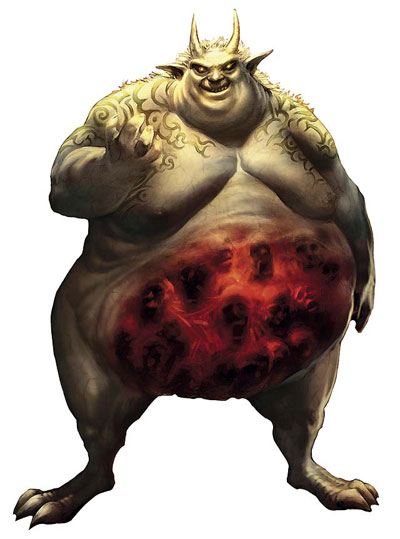
Some among the zaug were transformed by the Galchutt and “turned to a new purpose”. As the zaug were made living receptacles for manifest corruption, the zaug soulharvesters became living prisoners for captured and tormented souls.
“Their very flesh burned with the fire of the souls which screamed within them.”
“Their hunger was without end, fed eternally by the torment of those who seared their flesh.”
Where the flesh of the zaug festered, the beruned and corpulent flesh of the soulharvesters was glistening and taut. And pressing out against the green-veined and pallid skin of their guts were the screaming faces of those imprisoned within them.
The “soulfire flesh” of the zaug soulharvesters is described as an immense, living power source.
THE LORE OF THE LATTER YEARS
And while their masters slept, the labors of the zaug were endless.
Later lore describes the zaug working with the “titans of the Purple City” in labors of “the technology of the taint” as they worked to “perfect the crafts gifted from beyond the Demonweb”.
Other passages refer to the zaug working in the laboratories of Ghul the Skull-King. “And their works turned to the binding and changing of the flesh, and the lesser races were turned into weapons of dark might.”
KASTRALATHAKASAL
And in the sleep of the Galchutt and the sealing of the Vaults of the Rhodintor, the zaug at last found their freedom. And in their caverns of the deep, their works turned inward.
Deep beneath the surface of the earth, it is said that Kastralathakasal – the City of the Zaug – “stands citadel upon the Throne of Darkness”. The city itself is described as a stronghold of alien metals and living, organic components.
DESIGN NOTES
The zaug originally appeared in the Chaositech sourcebook and play a significant role in Monte Cook’s Ptolus. The Soulharvesters, however, were originally Solamith demons created for the D&D 3rd Edition Monster Manual V. (They made the leap to 4th Edition, but there doesn’t appear to be an official adaptation for 5th Edition, which is unfortunate in my opinion.)
Given the great plentitude of monsters available for D&D, this is a technique I frequently use. It’s similar to The Campaign Stitch, but rather than melding adventures it takes monsters and asks: What if these are the same monster?
It’s kind of like palette shifting, but rather than taking one stat block and using it to model a multitude of creatures, this technique — monster melding — takes a bunch of different stat blocks and brings their lore together. I like it because it transforms a vast-but-shallow funhouse filled with an incomprehensibly huge variety of beasties and instead uses it for depth. The zaug and the solamith are both interesting in their own right; but their sum, in my opinion, is greater than the sum of their parts: By putting them into a relationship with each other, both of them become more interesting and versatile.