 “Wolves Beyond the Border” is one of the original Conan stories written by Robert E. Howard. The action, however, does not feature Conan himself. Howard chose to skew his literary camera off to one side and look at the world around his protagonist from a different angle.
This is my first memory of being exposed to this particular technique. It creates a very interesting effect, although — ultimately — I think the story is a failure. In the years since then, I’ve seen the technique used in a variety of series, and the result is more often failure than not.
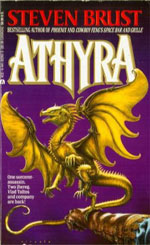
Which is why, when I realized that Athyra was going to be using this particular approach, I subconsciously bunkered down for a long and painful slog…
… only to be more-than-pleasantly surprised to discover that my fears were unfounded.
In fact, it didn’t take me very long to realize that Vlad Taltos lends himself particularly well to this particular approach. Part of it can simply be boiled down to the fact that the Taltos stories have been told from the POV of Taltos himself. So this is literally our first opportunity to see what he looks like to other people. (Whereas with Conan, for example, the stories are told from a third-person POV, so there’s already some distance from the character.)
But Taltos’ susceptibility to this kind of technique also has a lot to do with the nature of the character himself: Taltos likes to play his cards close to his vest. He plots and he plans, but he usually keeps those plans — and even the information those plans are based on — a closely kept secret. When you’re inside his head, though, he can’t keep any secrets from you. It’s like watching a poker tournament on TV: You can see all the cards.
In Athyra, on the other hand, we suddenly find ourselves on the outside looking in: The cards are hidden from us. And that, in itself, is interesting.
But what really makes it fun is that, at this point, we’ve gotten to know Vlad pretty pretty well. So we still have a pretty deep insight into the types of games he plays and the way he plays them. So, on the one hand, we can suddenly sympathize with the new protagonist who finds himself baffled by Vlad’s hidden strategies (a POV that suddenly gives us a fresh insight into the perspective of many supporting characters from the previous books), but on the other hand we can also appreciate the deeper structure of what Vlad is doing.
I think the other thing that makes Athyra work is the type of story Brust has chosen to tell: The main character is Savn, a young Dragaeran lad on the cusp of reaching adulthood. The novel, in short, falls into the familiar genre of “young boy/girl finds unique bond with exotic mentor while coming of age”. (My personal favorite in this category is probably Stephen King’s Hearts in Atlantis, although you’ll find examples of the genre cropping up everywhere.)
This type of story weds itself well to the enjoyment gleaned from knowing Vlad better than the main character does. In fact, the entire genre is largely driven by the fact that we — either as adults or as the genre-aware — can appreciate the “exotic mysteries” of the mentor figure. Part of the genre’s effectiveness is that it saddles both sides of the chasm which is “coming of age”. On the one hand, we remember the (relative) innocence of our youth. On the other, we know the wider world which is being revealed. In the interstice between the two, we remember what that coming of age was like… and thus become intimately sympathetic with the main character as they follow the same journey.
(When I was a kid, on the other hand, these stories operated on a very different level: The fictional mentor became my mentor as well, and I became intimately sympathetic with the main character because their journey was my journey.)
The other thing about this type of story is that, although it is not told from his POV, the mentor is a main character. When done properly, the story is as much the mentor’s as the student’s. So even though we’re pushed out of Vlad’s head, Vlad in some sense remains a main character (which I think helps make the technique work).
COMING OF IMMORTAL AGE
In my reaction to Yendi I discussed the genre-alteration of familiar tropes. Brust has a talent for taking existing archetypes, running them through the unique characteristics of his fantasy world, and creating something refreshingly unique and entertaining.
In the case of Athyra, Brust is telling a coming of age story for Savn… but Savn is 80+ years old.
Savn is a near-immortal Dragaeran with a lifespan of several hundred (possibly thousand) years. He is also a farmboy still serving in his apprenticeship to a physick. So in terms of social position (and even maturity), Savn is basically a teenager. A very old teenager.
Brust appears to be consciously attempting to explore what it would mean to be a near-immortal living in a society of other near-immortals. It’s a bold challenge. And, in the narrow case of Savn and the story of Athyra, Brust succeeds.
But, to a large extent, he only succeeds by “cheating” — and so, in a broader sense, he also fails.
By “cheating”, I mean that he has placed Savn in a rural community which is socially backwards and largely populated with ignorance. This allows Brust to get away with having Savn be relatively naive and culturally under-developed. In other words, it allows him to largely draw a line of equivalence between “human 16-year old” and “Dragaeran 80-year old”.
Which, as I say, works just fine for the story… but still disappoints on some level because it misses out on what could have been a much bolder and more dynamic challenge.
Let’s try to break this down. If you actually took human lifespans and started lengthening them, what would happen to the concepts of “childhood” and “adulthood”?
Well, to some extent we don’t have to imagine it: It’s been happening all around us for the past hundred years or so. The concept of “teenager”, for example, is a recent one. (The term itself wasn’t even coined until the 20th century.) It represents a rather radical departure from ages past, when people we now consider “kids” would have actually been seen as fully functional adults. And over the past decade or so, I have noted increasing trends to infantilize college students, with a growing expectation that colleges and universities should be acting as some sort of surrogate parents for their students.
And this social trend appears to be expanding even as recent physical trend lines indicate that the onset of puberty is happening at earlier ages.
Speaking in general terms, I see three reasons for this expansion of pre-adulthood:
First, the increase in average lifespan lessens the sense of urgency in reaching adulthood and pursuing adult goals.
Second, the amount of “basic knowledge” expected for someone to function as an adult in society has drastically increased. We’ve gone from the completion of high school being exceptionally rare to a college education being seen as a fairly standard expectation. The acquisition of more knowledge requires more time, and this naturally expands the amount of time it takes to become an adult in the eyes of society.
Third, the amount of leisure time and the economic structure of our society has fundamentally shifted. When it’s an economic necessity for your kids to help you in the field, you’ll get them out there as soon as they’re physically capable of helping you. But the vast majority of modern careers don’t have that kind of structure. This, again, reduces the sense of urgency in reaching the transition from childhood to adulthood.
But there’s an important proviso here: The 16-year old of today is not the functional equivalent of the 10-year old of yesteryear. And this is the mistake that Brust makes when he draws the line of equivalence between a modern 16-year old and a Dragaeran 80-year old. The expansion of childhood isn’t like taking the same chunk of butter and spreading it over a larger slice of bread.
Because, fundamentally, the 80-year old Dragaeran will still have 80 years of experience, even if they’re not functionally an adult in the eyes of their society. And you can kinda duck around that, as Brust does, by putting the character into a situation where they can easily hit a ceiling of knowledge and enter an endless cycle of dreary life.
But I think you’re ducking out of the really interesting question: Whether it’s a matter of physical maturation or social construct (or both), what does it really mean to be 80 years old and still be a child?
Athyra doesn’t try to answer that question. If it did, it might have been a great novel. As it is, it’s merely a fun one.
GRADE: B
Steven Brust
Published: 1993
Publisher: Ace
Cover Price: $7.99
ISBN: 0441033423
Buy Now!