 A lot of my contemporaries have fond memories of the boardgames Dungeon! and HeroQuest. I was never that enamored of them. I think this is largely because I came to the games via Dungeons & Dragons rather than vice versa — so it always seemed like the poor man’s version of a fuller and richer game. There are myriad limitations to the game, of course, but the largest lack I felt was that — although the contents of a room could change — the board was largely immutable. There was no true sense of exploration.
HeroQuest, in particular, was never a game I really warmed up to. The inclusion of a gamemaster allowed for dungeons with more flavor, but also emphasized the fact that — with the same play dynamic — I could be playing an actual RPG. (Perhaps Advanced HeroQuest or Warhammer Quest would have left a different impression on me, but I’ve never even seen a copy of those games.)
The completely randomized Dungeon!, on the other hand, at least served the niche of “I want to play D&D, but I don’t have a DM”. It just didn’t scratch it very well (at least for me).
Over the years I’ve occasionally dipped back into this particular sub-genre, usually to be met with disappointment. Most recently the Order of the Stick boardgame failed to be anything more than an unbalanced, colossal bore.
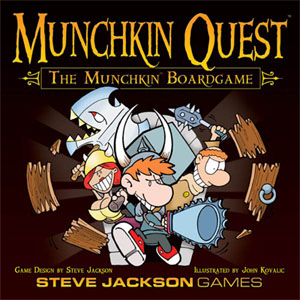
Which brings me to Munchkin Quest — which finally scratches the itch I first developed twenty years ago: DM-less dungeoncrawling. It has a variable board which you discover as you explore it,
Over the past few weeks, my little circle of friends have played Munchkin Quest almost a dozen times, more than any other game. That’s probably not a pattern of usage that will last forever, but it does speak to a dynamic and interesting game.
SLOW PACE
The only real complaint we had with the game was its slow pace. Allow me to explain…
Munchkin Quest is based on the popular Munchkin card game, which I played a lot 3-4 years ago before losing my regular playing group. In Munchkin, every turn stats by opening a Door — which generally means fighting a monster. And once that monster has been defeated, play proceeds to the next player.
In Munchkin Quest, in order to facilitate the exploration of the dungeon complex, players are instead given 3 movement points (which can be increased or decreased with various pieces of equipment or other abilities in the game). When players explore into a new room (generally by spending a single movement point), they encounter a monster and fight it.
Begin to see the problem?
In Munchkin a player’s turn usually consisted of a single combat. In Munchkin Quest, on the other hand, we were usually seeing 3 or 4 combats on every player’s turn.
The first time we played the game, it took 90 minutes before the fourth (and final) player finally got to take their first turn. Even with all the out-of-turn actions that can be taken in the game, this was still hugely problematic. The long breaks between turns not only tended to result in players disengaging from the game, it also had several knock-on effects that also degraded gameplay.
For example, because of the multiple combats per turn the players tend to level up faster in Munchkin Quest than they do in Munchkin (at least in terms of the number of turns — in actual playing time, Munchkin Quest is a little slower). In our experience, a game of Munchkin Quest was over in just 3-4 turns (which would take 3-5 hours). This had a direct impact on the flow of the game (unlike Munchkin it didn’t feel like you were in a race with other players — the pace was just too slow for that).
One of the more interesting elements of the game are the wandering monster mechanics — which allow undefeated monsters to move from one room to another. But the longer, slower turns significantly lessened this dynamic of the game. Monsters rarely moved and didn’t move very far.
The longer, slower turns also created poor gameplay in other ways. During our third game, for example, it took nearly two hours for the fourth player to get their first turn. At their beginning of that turn, the first three players were already levels 6th, 8th, and 7th. (The game is won at 10th level.) The fourth player was already 2nd level, but had ended up out of position as the others had all moved away from the entrance of the dungeon. She hadn’t been able to join in the combats or treasure hauls and was seriously disadvantaged.
HOUSE RULES
In order to fix this problem, we introduced a simple set of house rules:
(1) At the beginning of the game, all players roll a single d6. The player with the highest result becomes the Quest Master. (Re-roll ties.)
(2) At the beginning of a round of play, all players draw one (1) Deus ex Munchkin card.
(3) At the beginning of a round of play or at the end of any monster movement phase, the player with the most green feet (movement points) takes a turn. In the case of ties, start at the Quest Master and go clockwise.
(4) On their turn, in addition to all the other actions allow by the rules (playing cards, combat, etc.) a play can take any ONE action which requires the use of movement points.
(5) At the end of each player’s turn, there is a monster movement.
(6) If all of the movement points at the table have been spent at the end of a monster movement, then a new round begins. Flip all of the red feet back to green and continue play.
EFFECTS
These house rules have several effects:
(1) Play looks a little more like traditional Munchkin in that, on any given turn, a player will probably only fight a single combat (at most).
(2) Players don’t have such long lapses between their turns, which also means that there will be a more active churn of resources (which helps to keep the game fresh).
(3) Monsters become more active in their movement around the board, making the dungeon feel more dynamic.
(4) As far as we can tell, no meaningful strategies from the original game are eliminated. But we have discovered that all kinds of new strategies have been created. One major area of strategy became the manipulation of remaining movement tokens (allowing you to take more turns or affect the sequence of play). Another area of strategy rose up around how players traveled together. (In the original rules we all felt like we were basically soloing the game. But the house rules allowed people to either move off by themselves; move with small partnerships; or huddle up as one big group and stick together.)
Game balance appears to be completely unaffected by the modification.
I suspect that once we get the 6-player expansion for the game, the dynamics made possible with these house rules will become even more interesting. And, in my opinion, necessary: When it takes 45-75 minutes to get to the fourth player’s first turn in a four-player game, I can only imagine that it would take 90-120 minutes toget to the sixth player’s turn in a six-player game. And that would be outrageous.