

I scooped up a handful of Mothership trifolds today with an eye towards restocking the jobs board for my Mothership open table. I’m beginning to dive deeper into the vast sea of Mothership content, which may mean a few more misses, but also the opportunity to uncover hidden gems and a few diamonds in the rough.
RECLAIMER
The PCs has been hired to “scavenge usable resources from the Galloway Outpost, a long-abandoned mining and research facility on the desert moon Kara-9.” Coincidentally, despite this outpost being “long-abandoned,” another corporation has hired another team to scavenge the outpost at the exact same time. The PCs will need to compete with this other team to “secure and extract as many undamaged resources as possible.” Even more coincidentally, the whole place collapses two to three hours after the PCs arrive.
Despite the inexplicable string of coincidences, this is a pretty solid concept for a scenario that’s anchored to a pretty good map that’s well xandered and ready for potential conflicts to break out between the rival salvage crews. (Although for some reason the map depicts a space station with a docking bay instead of the land-based outpost from the scenario’s introduction, just one of a surprising multitude of continuity errors.)
Unfortunately, Reclaimer is senselessly hostile to any GM wanting to run it.
First, it’s designed for a custom micro-pamphlet format that requires you to print, cut, and then origami the PDF. The result is cute, but completely impractical: Among other things, it splits the map of Galloway Outpost across multiple spreads, making it painful to use.
The map also uses a number of custom symbols, all of which are unkeyed. You’ll probably be able to figure out most of them, but some remain complete mysteries to me.
Once you work your way past the unfriendly formatting, what you’ll discover is that the adventure is functionally unfinished:
- There are no stat blocks for the rival crew.
- Colored keycards are used to unlock various areas of the base, but the keycards not included in the key. Instead, the GM is instructed to “spread keycards around the outpost and allow crews to find them through exploration.”
- There’s a potentially interesting little mini-game where power has to be rerouted to different areas of the base… except it’s unclear why the PCs would need power restored to any of these rooms.
Perhaps most importantly, the central dynamic of the adventure is scavenging on a time limit: How much can you salvage before the competing team arrives (unless they got here first in yet another continuity error) and before the base collapses?
The collapse of the base is put on a specific time limit described in six stages from Minor Structural Damage to Total Collapse. Which would be great, except no guideline for the time required to salvage material is given. And although a list of salvage types is given (industrial fuel, raw minerals, rare electronics, etc.) these are keyed to the map in only vague, incomplete, and, yet again, contradictory ways. Also missing is any sort of value for this salvage.
Most of the adventure, therefore, simply isn’t here. If you want to run Reclaimer, you’ll need to be prepared to do most of the design work yourself.
GRADE: D
MEAT FARM
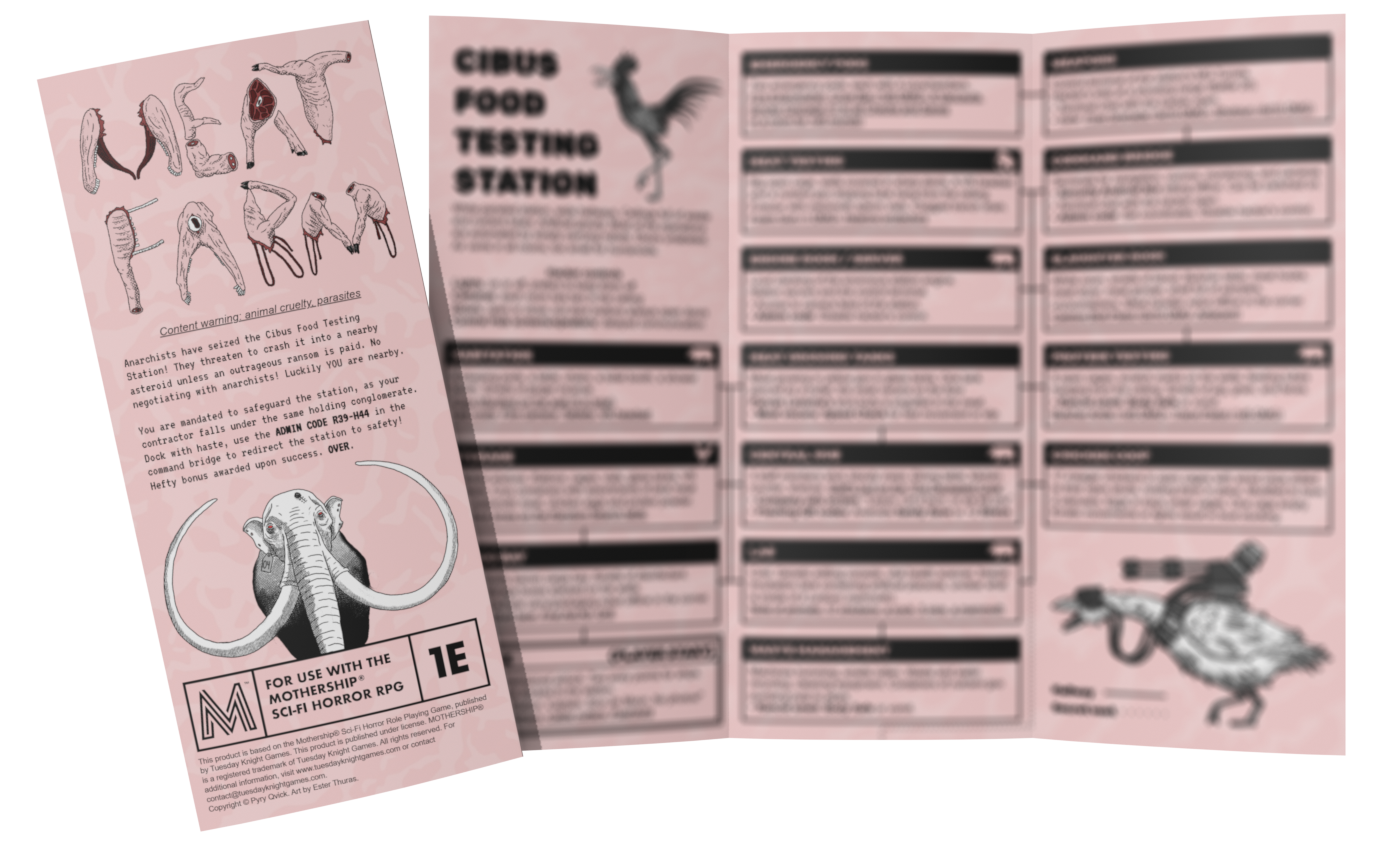
A lone hacker has suborned the computer systems of Cibus Station, a corporate research station. They’ve freed the experimental subjects, killed (almost) everyone onboard, and are demanding a ransom. The PCs’ corporate overlords want them to board the station and regain control.
Pyry Qvick’s Meat Farm is another adventure that does a great job of layering threats: The hacker will turn the station’s automated stations against the PCs; a suborned android has gone homicidal; and the station is overrun with dangerous/weird/disturbing experimental animals.
What will make or break a creature feature adventure like this are, of course, the monsters, and Qvick delivers a nifty combo pack, including turret gooses, parasite pigs, and albino mammoths, among others. These are stocked in minimal-but-vividly keyed rooms, which are both varied and interesting.
The only real problem I have with Meat Farm is the pointmap itself, which is maddeningly vague to the point of incoherence. I’ve had this problem with vague pointmaps in other Mothership adventures. The problem is that, yes, the pointmap is meant to be an abstract representation of the game world. But it still needs to represent the game world. If I look at your map and (a) I have no idea how to describe the game world to the players and/or (b) the connections between rooms appear nonsensical, that’s a problem.
So when I run Meat Farm, I’ll be taking the adventure’s room keys, but rearranging them into a coherent map.
GRADE: C
CARRION PROTOCOL

Here’s another adventure of experimental meat. (I’m tempted to connect them in some way.)
In this adventure by Stella Condrey, author of the Rimbound series, the PCs answer the distress call of the FUV Irene only to discover that the ship’s meat labs — designed to provide fresh food for the crew — have catastrophically malfunctioned. Multiple compartments have become overgrown by semi-sentient flesh and violent fleshhounds are wandering through the ship.
Carrion Protocol is short, creepy, and fun.
The only real problem with the adventure is the lack of a clear vision of what, exactly, happened on the ship before the PCs showed up. There are a bunch of “clues” thrown around (blood trails, corpses, etc.), but none of it seems to add up to a coherent narrative, which makes the scenario unnecessarily difficult to run. (If I, as the GM, don’t understand what happened, it becomes much harder to answer the questions the players are asking consistently.) Somewhat related to this is a continuity issue where “every 10 minutes a room adjacent to meat growth is overgrown.” But at that pace, the entire ship should have been overgrown long before the PCs could have answered the distress call.
Also, the adventure is presented a pamphlet, but every PDF is screwed up in a different way so that you can’t actually print any of them and get a functional pamphlet, which is rather frustrating.
These problems are not terribly difficult to fudge your away around, however, and as a pay-what-you-want title, this one is worth checking out.
GRADE: C
BURYING GROUNDS ON PAVEL THETA
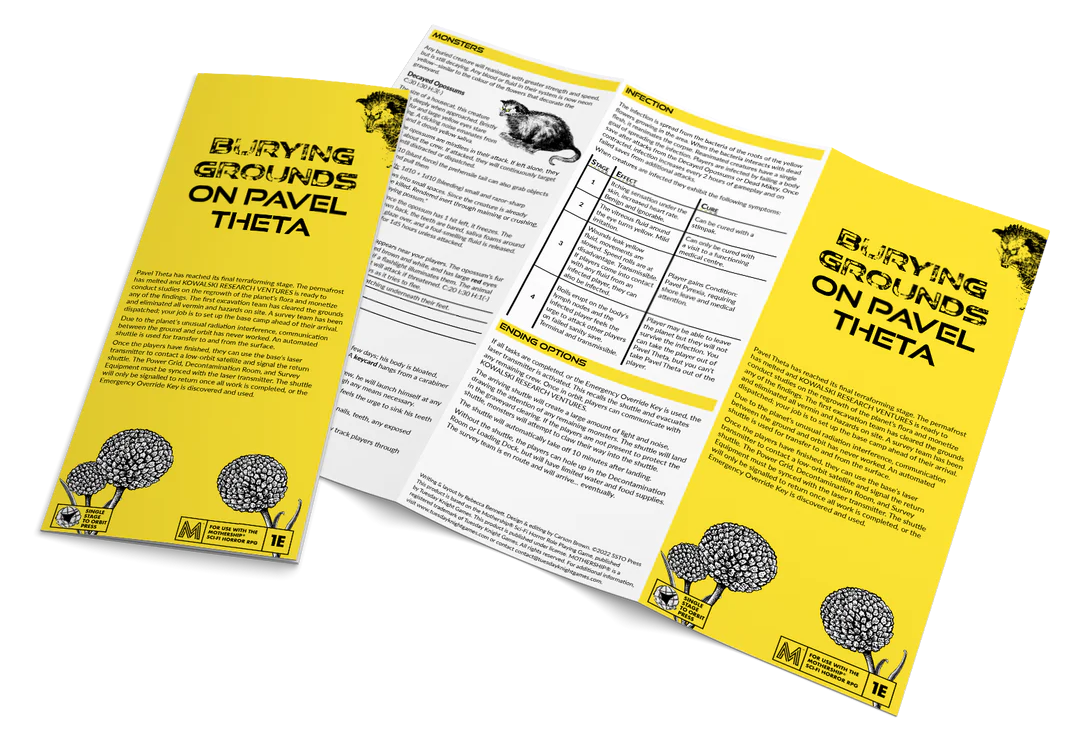
Rebecca Bennett’s Burying Grounds on Pavel Theta is a Pet Sematary riff: On a newly terraformed world, the corporation has lost contact with the team who was supposed to be establishing a base camp and the PCs are sent in as the backup team.
Unfortunately, it turns out that any corpses buried in the ground become reanimated undead. This includes Mikey, a member of the original team who died and was buried by his teammates, and a bunch of undead opossums.
Conceptually, I really like this adventure. The undead opossums are incredibly creepy and Bennett includes a great pacing mechanic for them.
Where it unfortunately falls apart is, once again, the details. Like Carrion Protocol, Burying Grounds desperately needs an authoritative background: The previous team is missing, but (other than Mikey) what happened to them? Where are they? Where did the opossums come from? How did they get buried?
It’s a lot of cool stuff, but it kind of all falls apart when you look at it… which, of course, the players will definitely do.
The adventure also includes three recorded audio logs you can share with your players, but they appear to be performed by voice generators with a flat intonation, so they’re probably not worth using.
GRADE: C-
QUANTUM CARGO
Researchers on the FMV Dirac have been attempting to perfect quantum duplication technology, allowing the Quantum Dynamics Corporation (QDC) to collapse multiple quantum states of an object simultaneously, functionally creating a perfect copy. Dr. Flora Ciama attempted to steal the prototype device, accidentally triggering a quantum collapse.
From the outside, the ship appeared to vanish only to reappear several weeks later broadcasting multiple distress signals. The PCs have been dispatched to retrieve the top secret research (although, of course, QDC doesn’t trust them enough to tell them what that research is). They arrive at the Dirac and find it trapped in a quantum flux: At ground zero, three different versions of Dr. Ciama carry out the heist against and again and again — one succeeding, one failing and triggering the quantum explosion, and one stuck in the quantum core chamber.
Quantum Cargo has a few issues — like Burying Grounds on Pavel Theta, for example, it could really benefit from a definitive crew list and a slightly more coherent explanation of what’s been happening on the ship — but the incredibly clever structure of its core premise, in which four different zones of random quantum effects dynamically combine with a location key filled with reality-bending set pieces, make this adventure something special. And despite a few lacunae, there’s also a lot of loving attention to detail here, which includes providing detailed player maps.
GRADE: B-











Do you think that the trifold pamphlet format is causing a lot of the issues with the missing information in a lot of these? As in, they ran out of space to explain or expand the adventure?
Hello there. I am the author of one of these pieces. Please do not speak about me or my work again. I consider you mealy and worm souled from the way you handled the legacy of Jennell Jaquays and would rather you keep my name out of your mouth.
Ps it’s a pocket mod not a pamphlet.
Nice! Love to see more Mothership reviews.
-J
(You should probably stop using “xandered” though, it just makes you look bad.)
Actual play update for Quantum Cargo: My grade remains unchanged, but you should take a close look at the tripartite quantum event at the center of the adventure and make sure you have a VERY clear understanding of what the room looks like and exactly how Dr. Ciama(s) interact with it.
If you’re looking for inspiration, check out the “We’ll Always Have Paris” episode of *Star Trek: The Next Generation*.