It’s pretty well understood that over the last forty years, the sales of comic books in America have shifted inexorably from “floppy” pamphlets to graphic novel collections.
To understand this shift, one must first know that it follows a thirty-year decline of comic book sales at newsstands as the medium became one of the last lingering vestiges of the pulp magazine market that had dominated fiction sales from the mid-19th century until being wiped out in the mid-20th century by television and paperback novels. With their distribution system collapsing, comic books only survived the 1970s because of the creation of the direct market.
The direct market not only allowed Marvel and DC to survive with much smaller sales than they’d enjoyed in their heyday, it let small publishers and solo creators effectively distribute their creations. The result was a renaissance in North American comic book storytelling which carried the medium to new creative heights.
The history of the direct market is a saga in its own right, including Marvel failing to monopolize it in the ‘90s and instead blowing up the entire industry through exclusivity deals with fallout which continues to impact not only the comics industry, but neighboring hobby industries, unto this day. (You can draw an almost direct line from there to Paizo’s current financial woes, for example.) But the most important effect of the direct market was to ghettoize comic books: New readers could no longer discover comics in the mainstream stores they were shopping at; they instead needed to seek out specialty shops.
Comic book pamphlets have never really emerged from that ghetto.
Graphic novel collections sold in book form, on the other hand, could and did. Unlike pamphlets, they could be stocked in bookstores alongside other books, where they could be discovered by the general public.
Marvel and DC, however, have not been able to translate their complete domination of the pamphlet market into a similar domination of the book market. Instead, they combine for less than 10% of the market, while Scholastic Books dominates with 40% of the market.
WHAT’S THE PROBLEM?
A key turning point in the history of comics came when Scholastic Books licensed Jeff Smith’s Bone (previously self-published through the direct market). Its success caused Scholastic to expand and publish more comics, which leads pretty directly to Raina Telgemeier being the bestselling comics creator in North America.
Now, let’s say that you’ve never heard of Bone before, but your friend recommends it or you see a copy on the shelf at your local bookstore and you think it looks cool. What should you read first?
Well, that’s pretty easy: You read Volume 1. Then Volume 2. Then Volume 3, and so on until you reach the end of the story in Volume 9. This is easy. It’s intuitive. It’s obvious just from looking at the books on the shelf which one you should read next.
The same will be true for virtually any manga series. One Piece might have more than a hundred volumes and countless spin-offs, but there’s no question where you should start: Volume 1.
Let’s compare this to someone hearing about Geoff Johns’ Green Lantern: Blackest Night. They look around and they spot the Blackest Night Saga, collecting Blackest Night #0-8. This must be it!
Except… no. That collection does include the full Blackest Night mini-series, but the story was originally written to weave between multiple titles. So we’ll have to take a step back and consider:
Blackest Night Saga
Blackest Night: Green Lantern
Blackest Night: Black Lantern Corps – Vol. 1
Blackest Night: Black Lantern Corps – Vol. 2
Blackest Night: Green Lantern Corps
Blackest Night: Tales of the Corps
Which of these should we read? Well, that depends on how essential you consider Peter J. Tomasi’s contributions to the story to be, but let’s assume we can ignore those and just pick up the comics written by Geoff Johns, so we grab Blackest Night Saga, Blackest Night: Green Lantern, and Blackest Night: Tales of the Corps.
Now… what order do we read these in? Well… that’s the trick, isn’t it? The original pamphlets included helpful blurbs that said, “The story continues in blah, blah, blah!” and you could just follow those from one issue to the next, but these have been removed from these collections. Your only real solution here is to search online for a reading order, and then skip back and forth between the collections trying to find the matching issues.
Okay, screw that. Can we just bypass this whole morass by grabbing the Blackest Night 10th Anniversary Omnibus? Sort of. This collection is 1700 pages, costs $150, and includes not only the Blackest Night story, but every single crossover comic.
It turns out that what you probably want to buy is none of these, but actually Green Lantern by Geoff Johns Omnibus – Volume 2. That includes a bunch of other Green Lantern stories by Geoff Johns, but seems to include the complete Blackest Night story. I think. It looks like this might still be missing some stuff, but at this point I’ve spent over an hour researching this in the hopes of getting an authoritative answer, and I don’t care anymore.
And this isn’t an isolated problem. If you make an effort to read Marvel and DC books — and it’s definitely an effort — you’ll repeatedly find yourself forced to look up reading lists, desperately hoping you can avoid spoilers, just to figure out what seemingly random assortment of books and/or issues you need to follow just to read the thing you already want to read.
There are a number of reasons why Marvel and DC struggle with this.
First, they both have a vast library of legacy continuity. While there are many advantages to having this huge back catalog (including many of the most notable stories of the 20th century), it also means that the answer to, “I like Batman, where should I start reading?” can’t be as simple, “Start with Volume 1!” Not only would it be impossible to publish the stories like that, but you don’t actually want people to have to struggle through decades of mediocre Batman comics before they can read Frank Miller’s Year One or Snyder’s Court of Owls or Grant Morrison’s iconic run.
Second, many of their stories — both old and new — are written to sell pamphlets. Crossover events, as we’ve seen, make sense when your goal is to make a kid bike back to the newsstand and buy another comic, but they can become labyrinthine puzzles that make the story impenetrable. On the flip side, these mega-crossover events also mean you’ll be happily reading a story and then — KABOOM! — it’s blown up by a completely different story that you likely don’t care about.
And it’s not just crossover events: Way back in 1968, for example, Stan Lee, Gene Colan, and Jack Kirby cooked up a story in which Doctor Doom would take control of Daredevil’s body in an attempt to ambush the Fantastic Four. The story started in Daredevil #37, continued through Daredevil #38, and wrapped up in Fantastic Four #73.
Although Fantastic Four #73 has been reprinted in at least six different Fantastic Four collections, the Daredevil issues have never been included. Out of five different Daredevil collections including the first two parts of the story, only one of them included the finale.
Finally, this isn’t just a problem caused by legacy issues. Marvel and DC still actively suck at this.
For example, arguably Marvel’s best superhero comic right now is Ryan North’s Fantastic Four. I simply can’t heap enough praise on the work North is doing — not only do I love it, but these are the comics that got my daughter excited about superheroes. In pamphlet form, this run has been published as:
- Fantastic Four 7 (2022) — #1-33
- One World Under Doom — #1-9
- Fantastic Four 8 (2025) — #1 thru ongoing
Even here, of course, we see the pain point of trying to track continuity across the ceaseless numbering reboots designed to sell pamphlets to collectors. But let’s go ahead and check out the reading order of the paperbacks:
- Fantastic Four – Vol. 1
- Fantastic Four – Vol. 2
- Fantastic Four – Vol. 3
- Fantastic Four – Vol. 4
- Fantastic Four – Vol. 6, pg. 113-136 (Giant-Size #1)
- Fantastic Four – Vol. 5
- One World Under Doom – Chapter 1
- Fantastic Four – Vol. 6, pg. 1-26 (also, there are no printed page numbers)
- One World Under Doom – Chapter 2
- Fantastic Four – Vol. 6, pg. 27-47
- One World Under Doom – Chapter 3
- Fantastic Four – Vol. 6, pg. 48-68
- One World Under Doom – Chapter 4
- Fantastic Four – Vol. 6, pg. 69-89
- One World Under Doom – Chapter 5
- Fantastic Four – Vol. 6, p. 90-112
- Fantastic Four – Vol. 1, p. 1-50
- One World Under Doom – Chapter 6
- One World Under Doom – Chapter 7
- Fantastic Four – Vol. 1, p. 51-72
- One World Under Doom – Chapter 8
- Fantastic Four – Vol. 1, p. 73 thru end of the book
- Fantastic Four – Vol. 2
Now, to be fair, I think one can quibble about whether or not Giant-Size Fantastic Four #1 needs to be read in its original publication order by jumping forward two volumes. But even if we ignore that, this is clearly batshit on multiple levels.
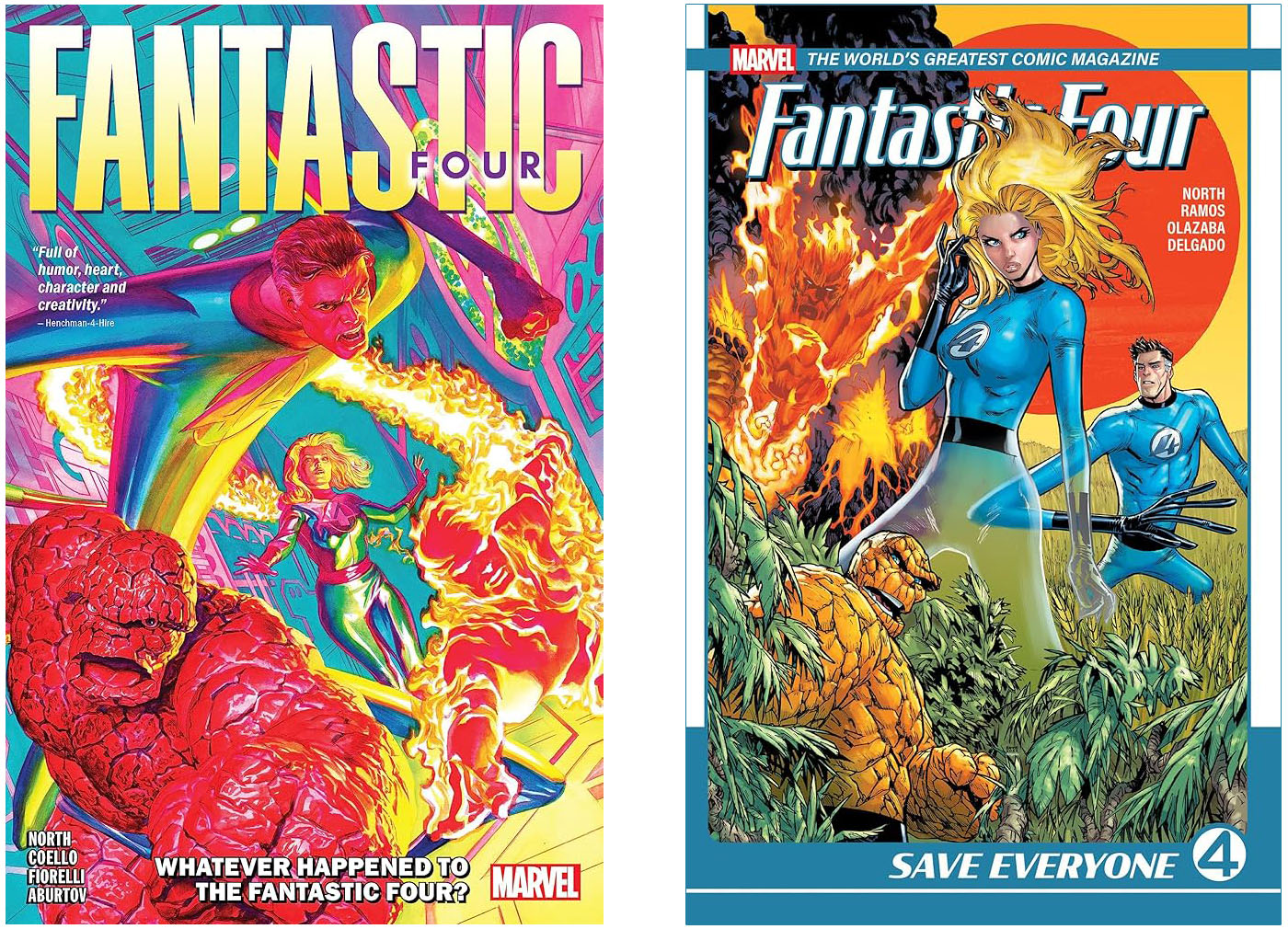
I particularly want to call your attention, though, to the decision to publish Volumes 1-6 of Ryan North’s Fantastic Four and then follow that up with a different Volume 1 of Ryan North’s Fantastic Four.
Didi: Hey, I’ve heard there are some really cool Fantastic Four comics I should read. Where should I start?
Gogo: Fantastic Four — Volume 1. But not Fantastic Four – Volume 1. Or Fantastic Four – Volume 1. Or Fantastic Four – Volume 1. Or Fantastic Four – Volume 1. Or Fantastic Four – Volume 1. Or Fantastic Four – Volume 1. Or Fantastic Four – Volume 1.
Didi: Ah. I see. I want Ultimate Fantastic Four – Volume 1.
Gogo: Don’t be silly. That’s completely different.
Didi: Uh… which Fantastic Four – Volume 1 do I want, then?
Gogo: Fantastic Four – Volume 1 by Ryan North.
Didi: Great!
Gogo: But not Fantastic Four – Volume 1 by Ryan North. You want Fantastic Four – Volume 1 by Ryan North.
Didi: For fuck’s sake.
This confusion doesn’t just affect readers. It also affects the retailers and distributors who are ostensibly trying to keep these products in stock and on the shelves. For example, the current listing for Fantastic Four – Vol. 1 (2023) at Amazon has been updated to show the cover for Fantastic Four – Vol. 1 (2026).
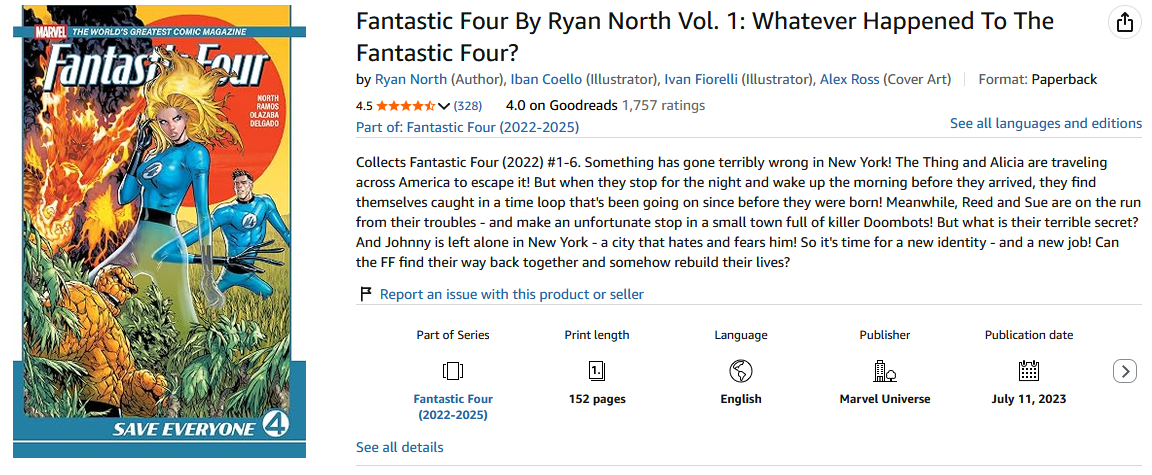
Which means, of course, if you do a search for “Ryan North Fantastic Four Vol 1,” what you’ll see are two listings for Fantastic Four – Volume 1 by Ryan North with, seemingly, the exact same cover. (I also wonder how many stocking errors are being made, resulting in the wrong book being shipped out even if a new reader does order the right one.)
It gets even sillier, though: If you grab Fantastiv Four Vol. 1 (no, not that one, the other one) and open it to the inside front cover, you’ll find This Guide Will Show You Were to Begin to Follow the Adventures of the Fantastic Four!, accompanied by pictures of the graphic novels you need to follow the series! This is incredibly useful! Exactly what…
… hang on. This is actually a completely different set of Fantastic Four graphic novels (including a different Fantastic Four Vol. 1) that has nothing to do with the reading order of the Fantastic Four graphic novel you’re currently holding in your hands.
These problems, of course, don’t just afflict bookstores. Digital comics are of rising importance, currently making up a fifth of all comic book revenue in North America, but navigating this morass through Marvel’s and DC’s digital platforms is arguably even more complicated.
A SOLUTION
Ultimately, to solve this problem, Marvel and DC will have to stop creating content primarily for pamphlets. This doesn’t mean they should stop publishing the pamphlets, but it does mean understanding that their primary goal is producing the books that — instead of being sold for a single month — can be potentially sold for years or decades to come.
The first and most important thing will be creating unique arc titles. Frank Miller’s Batman: Year One would not be as well-known today if it had been instead sold as Batman – Volume 1 among a slurry of a dozen other Batman – Volume 1’s. Yes, it can be difficult to title a serialized work before you’ve written it, but Charles Dickens, Alexandre Dumas, and Rumiko Takahashi were able to pull it off, so I’m sure you can figure it out.
Optionally, I would recommend embracing this title on the pamphlets, too. So when someone launches Fantastic Four: Family Matters, it’ll be Fantastic Four: Family Matters #1 on the cover. Create a legacy numbering badge and use it consistently to get the best of both worlds.
When collecting crossovers, you need to include the full story in every collection that includes part of the crossover. For mega-event crossovers, this won’t be possible, but you need to figure out (a) a consistent way of collecting them (most likely a core narrative collection and a every-single-crossover omnibus) that (b) includes come clear method for referencing the individual parts, so that you can (c) clearly tell people reading other collections where to go if they want to follow the event.
Importantly, you should retroactively create titles for your backlog. Collections like Fantastic Four by John Byrne, Green Lantern by Geoff Johns, and Batman by Scott Snyder & Greg Capullo have been a step in the right direction, but can be difficult to apply broadly across a medium where creative teams have often shifted rapidly. They also sound pretty dry and academic.
Collaborate with original creators to find these titles where appropriate, but I’m absolutely saying that it would be better for the earliest issues of Amazing Spider-Man (whether that’s thirty-eight issues, ninety-nine issues, or one hundred and twenty-two issues) to be published as Spider-Man: Origins than as anonymous volumes lost in the midst of generic archive collections labeled masterworks or showcases or epics.
You can absolutely keep an archival line for completionists, but that’s exactly what it should be: Archival.
For the general public, you want them to be able to clearly and uniquely identify and recommend different stories. This will never be as clear as One Piece or Spy x Family or Bone, where there’s a single story guided by a single creative vision that you can read from beginning to end. And that’s okay. The fact that there are so many different Spider-Man stories about so many different versions of Spider-Man or Batman or Superman can be a huge advantage… but only if you stop doing the equivalent of wrapping them in brown paper and randomly shuffling them around.
At the moment, for example, DC Comics is enjoying a huge amount of success with their Absolute titles. There are a lot of reasons for this — including, importantly, the high quality of the comics themselves — but I think a significant part of it is that, if I hear about how great Absolute Superman is, I know exactly what I need to do: I pick up Absolute Superman Vol. 1, read it, and then continue onto Absolute Superman Vol. 2.
By contrast, I picked up Ultimate Spider-Man Vol. 1 — not to be confused, of course, with Ultimate Spider-Man Vol. 1, Ultimate Spider-Man Vol. 1, Ultimate Spider-Man Vol. 1, Ultimate Comics Spider-Man Vol. 1, or Ultimate Spider-Man Vol. 1 — and started reading from one volume to the next… only to discover that for the story to make sense there’s a point where I just have to arbitrarily know that I need to stop reading Ultimate Spider-Man collections, go read something else, and then come back to Ultimate Spider-Man.
This is, fundamentally, a bad user experience. And it doesn’t have to be this way.









This hits the nail on the head for me. I’m a casual comic reader. My brother is an avid fan. He’s recommended various books/runs, which I usually enjoy. But whenever I think about getting into a series, the reading order issue you raise is immediately overwhelming. I’ve found that I instinctively gravitate towards constrained graphic novels – even those with DC/Marvel characters. This has been this way since I received Miller’s Batman collection for Christmas in 1989.
I read plenty of graphic novels, but I’ve never had much interest in superhero comics (unless you count Hellboy); I prefer consuming that genre in movie and TV form. And reading this makes me exceedingly glad for that.
Incidentally, a few months ago I wouldn’t have gotten the Didi and Gogo reference.
As part of the problem (an old veteran comic collector who has learned to navigate the wasteland of Marvel and DC collections), I only got back in to comics back in 2011-2012 when DC did the New 52….after being absent comics since the early heyday of Image in the 90s I had lost the plot on comcs, so to speak. New 52 gave me a clear jumping on point and it was great. Recently I did the same with Marvel, where I leaped on with the post-Krakoa X-Men titles, and then sort of spread out from there. The best and only way I found to enjoy comics these days is to A: find a fresh jumping on spot when it happens (which is hard to detect unless you’re already monitoring for it), and B: ignore as much of what came before that jumping on point as you possibly can.
Separately from that strategy, I also have this strategy: collect a specifc character(s) and just focus on finding as much of that character as you can stomach and/or want. So I have a robust collection of Batman, Wolverine, Moon Knight and various old Image/Wildstorm titles (which have the adventage of usually being series that are now “complete” usually in omnibus editions). This strategy requires embracing the specific character or series and also worrying less about the continuity of th esequence in which you read the books. But it is also, I feel, an adopted strategy of old collectors and maybe not reflective of a general reader’s desires.
TL:DR: totally agree, following Marvel and DC in trades is an utter nightmare!
Over on the Japanese side of things, three things that stand out to me are 1) the industry has a pipeline for finding and promoting new talents – the big publishers have contests for high schoolers to submit manga, and the winners get snatched up; 2) they aren’t trying to be all things for all people – there are magazines catering to nearly every demographic, and 3) manga is incredibly cheap, with a healthy secondary market – new tankoban (a tiny, ~180 page paperback with 6-10 chapters) run from $3-$5, and you can buy entire runs of old manga shrinkwrapped together for less than $1 a volume. (I picked up the first Grappler Baki run – 42 volumes – for about $30 a few years ago.)
I think that DC is taking steps to fix this with their compact comic format: manga sized, fairly self contained iconic stories with their bigger names characters. Their DC finest trades are also pretty decent for a big, self contained run.
I’ve noticed that Marvel is awful about this, however. They seem to print their Epic Collections (big collections of 15-20 sequential issues) both in a random order, and in very limited quantities. So, it’s hard to collect long runs because either the issues you want have never been collected, or are already out of print and only available in the secondary market for a massive upcharge (there are certain long oop books that go for three to four hundred dollars.)
I’ve also noticed that Marvel just doesn’t have as many “evergreen” collections or graphic novels. Dc has a ton of short run stuff like All Star Supes, Batman Year One, The Long Halloween, New Frontier,, Green Lantern and Flash Rebirth, Crisis Watchman, and Dark Knight Returns that can essentially be kept in print endlessly and it will still sell. Marvel has far fewer it seems like, the main few I can think of are Born Again, Days of Future Past, Weapon X, and Kravens Last Hunt. Just a weird difference I noticed between the big two.
[…] instead of being sold for a single month, can be potentially sold for years or decades to come.” Read the full article here, recently highlighted by industry guru Paul […]
Even if they solved this huge issue (which many comic fans tend to downplay) there still remains a lot of problems in the American comic industry, the most notable of this is the domination by the Superhero genre and undying characters.
Manga and Bandes dessinées have a variety of genres to accomdate all demographics with much more author control than comics. Oda will write and draw One Piece till its over or he dies. Comics change authors and artists every few months.
When Goku and Kenshiro’s adventures came to an end, there were Luffy and Ichigo to take on the mantle of being Manga’s top stars and so on, comics still relies on Batman and Spiderman to pay the bills.
This is what made reading comics on my iPad much better than it ever was on paper.
It was still frustrating to skip around using a reading order list, but at least I could just pay for a subscription and then have access to everything and use the search function.
Maybe it has improves since I was last into comics, but I really wondered why they didn’t just have built in reading lists for different arcs.
Man this makes me feel so vindicated as someone who like superhero comics but finds the main-continuity DC / Marvel stuff totally impenetrable. My favorite superhero comic is probably Invincible, which ran for 144 issues and wrapped very satisfyingly. I also quite liked Ultimate Spider-Man, which I think I must’ve had the good fortune to read before there were quite so many “Ultimate Spider-Man Vol. 1″s.
Yeah I feel this so much. I only started collecting comics in 2019 and I had to just dive in where they were and knew that there would be some details I just didn’t know. Some of the smaller publishers I was able to backfill with graphic novels but I still have holes in my DC collection because the books are out of print and at this point the story has moved past that point.
I really, really wanted to get into marvel comics when the MCU shat the bed, so I got the marvel app and spend some time browsing. Eventually, I figured “hey, iron man is a fun guy, maybe I can read an iron man story?” So I went googling and started reading a series by an author I can’t remember. I read like9 issues and really enjoyed it. But then, between issues, summarised a small box, was like an Avngers: Endgame level crossover event which heavily impacted Iron Man’s character in the series i was reading. At that point, I gave up. If I just had to assume that world-shaking events would ne dealt with “off-page” when only reading a single series, I figured this whole thing wasn’t worth it (though the Ultimates series that went on at that time does still linger in my mind.)