This will be the final installment in this essay series. My goal here will be to describe the actual process of what I do at the gaming table while running a session of my Thracian Hexcrawl. I’m not entirely sure how useful it will be, but I”m hoping it will provide some sort of insight.
This post is going to be an attempt to provide an abbreviated, annotated record of actual play from my hexcrawl campaign. The goal is to show what I was thinking, the decisions I made, the procedures I used, the tools I exploited, and so forth.
SETUP
An hour or so before the game is scheduled to start, I’ll set up the table.
I sit at one end of a long dining room table. I place a TV tray to the left of my chair and another TV tray to the right of my chair. Then I pull out the box that I keep all my Thracian hexcrawl material in.
On the TV tray to my right I place the Binder that contains the campaign key and the Folder which contains the documents detailing individual locations.
There’s a second folder which contains a DM screen, the four pages of reference tables that I paperclip to the DM screen, a copy of the campaign map, and several copies of the DM’s worksheet I designed for hexcrawling. I place the worksheet on the table in front of me. I place the DM screen on the TV tray to my left. And I conceal the campaign map behind the DM screen.
Next, the rulebooks: I have several copies of Volume 1: Men & Magic that I place in a stack on the table for the players. I take my copies of all three OD&D booklets and place them in a stack behind the DM screen to my left.
I also have a stack of graph and hex paper, including several “communal maps” that have been drawn by the players. These are placed on the table.
I also have a stack of three folders: One for blank character sheets, one for living characters in the campaign, and one for characters who have died. I place these folders on a counter off to one side of the room. (I rarely need to access them, so it’s easiest just to have them out of the way.)
I print out a copy of the Campaign Status sheet for the current session and also place it on the table in front of me.
I grab my dice bag and pull out the dice I need: 2d4, 6d6, 6d8, 2d10, 2d12, 6d20. 6d6 for fireball and lightning bolt damage. 6d8 because it means I can roll an entire day’s worth of encounter checks in a single go. 6d20 because I can simultaneously roll an entire mob’s attack rolls. (The 6d20’s are selected in three pairs of matching colors because it allows for easy grouping for mixed types.)
BEGINNING OF THE SESSION
As players arrive, I pull their character sheets out of the appropriate folder. Many players need to choose which of their active PCs they’re going to be playing.
Two things happen at this point:
- I make a rumor check for each primary PC (not for hirelings). There’s a 1 in 3 chance for each PC that they’ll receive a rumor. (The current rumor table is part of the Campaign Status document. It’s generated based on the activities of PCs in previous sessions and by randomly generating hex numbers and creating rumors based on the contents of the generated hex.)
- I make a morale check for each hireling employed by the active PCs. On a success, the hireling continues adventuring with their employer. On a failure I use a system based on the OD&D reaction table to determine the hireling’s action: They might automatically leave their PC’s service or demand an additional bonus of some variable amount. (Usually nothing happens because the players have learned to keep the morale of their hirelings high.)
I keep a master list of every hireling in the campaign — including their current loyalty and morale values — in the Campaign Status sheet.
While I’m doing this, the players are generally getting prepared for the adventure. This includes:
- Discussing what their expedition is going to be.
- Buying equipment.
- Hiring hirelings.
- Any other business they might need to attend to while in town.
If they go looking for hirelings, I have a simple system I use to determine how many hirelings are currently available for service in town; what classes they are; and what level they are.
STARTING OUT
While the players are wrapping things up, I’ll grab my 6d8 and roll them: Virtually all of my regions use a 1 in 8 encounter check. Each roll, therefore, represents a full day’s worth of encounter checks (since there are six watches in a day). By reading the dice left-to-right as they fall, I can very rapidly determine which watches in the day have an encounter. Since I don’t yet know where the PCs will be on those days, I can’t generate the specific encounters (which are region-dependent). But on my DM’s worksheet, I can write down the Day/Watch when encounters will be happening. By generating three or four days worth of encounter checks up front, I can simplify my workflow once the PCs hit the road.
(Note, however, that if I know at this point that the PCs are going to be heading in a direction which will almost certainly have them traveling through a given region for a lengthy period of time, I can also go ahead and generate full encounters at this point.)
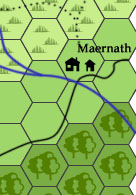 In this case, the PCs are in the city of Maernath, located in hex O6. Maernath is an old city-state in this setting. It was here long before the Duchy of Thracia began pushing east in recent years (establishing the Keep on the Borderlands and the logging village of Caerdheim to the south) and the City Fathers occasionally chaff against the “authority” of the newcomers. Although the early adventures of the PCs were based primarily out of Caerdheim (which was near the Caverns of Thracia), an increase of interest in the Palace of Red Death to the north led to an increased number of expeditions being mounted from Maernath. Those expeditions resulted in various PCs gaining a lot of lore about the area surrounding Maernath and that, in turn, spurred even more expeditions here.
The PCs leave town along the road heading south. They’re lightly encumbered (12″ movement) and they’re traveling along a road through open plains, so they can travel 12 miles per watch. Maernath’s position within hex O6 is biased, so it only takes 4 progress to exit the hex. They’re aiming for the river, which is on the road right on the border of the hex (so they obviously have no difficulty finding it).
Their goal is to follow the river into the Old Forest (in hex P7), so now I’m going to look ahead: Their course along the river takes them through the near side of the hex (6 miles away) into hex P6 and from there they will then pass through the near side of hex P7 (another 6 miles). Although they’ve left the road, they’re still traveling through open plains and the river provides enough of a track that they’re still traveling at 12 miles per watch. Total it up:
4 miles (Maernath to river) + 6 miles (O7 to P6) + 6 miles (P6 to P7) = 16 miles
Which means they’ll arrive at the edge of the Old Forest a little over an hour into their second watch. This is notable because, looking at my DM’s worksheet, I can see that the second watch of the day has an encounter. I can determine the time in the watch by rolling 1d8. The result I get is a 3, which basically means the encounter is scheduled to take place just as they’re reaching the edge of the Old Forest.
1. First, there’s a 50% chance that the encounter will be the location keyed to the hex. I roll the dice and it is not. (If it had been and they were traveling through open country, I would flip to the location key and they would have that encounter. In this case, however, they’re following the river: Unless the keyed encounter for this hex was on the river, they would not encounter it. That would either result in no encounter happening despite the check or they might experience an encounter connected to the keyed location. For example, the keyed location for P6 is Orkam’s Hole, which is inhabited by a family of basilisks, so they might spot basilisk footprints in the muddy banks of the river.)
2. If the PCs are in a hex bordering another region (and they are), there’s a 50% chance that they’ll get an encounter from the other region instead.
3. I roll a 13, so that’s exactly what’s going to happen.
4. I flip to the Old Forest encounter table and roll. The result I get is “Slimes”, which has a sub-table which generates Gray Ooze. The slimes don’t have any % chance of being a Lair or Tracks encounter, so I can skip that step.
Given the confluence of all the factors involved, I’m going to have the Gray Oozes appear just as the river passes beneath the boughs of the Old Forest. They’ll be draped down from the tree branches above the river like some kind of horrific spanish moss.
INTO THE OLD FOREST

After the PCs have dealt with (or avoided) the Gray Oozes, they’ll be able to continue along the river. It’s a medium forest and their speed is going to drop by 1/2. They had 8 miles of movement left in their second watch, so they’ll be able to gain 4 progress through hex P7.
Three miles along the river, however, they come to a tree on the south bank of the river with the Dwarven letter “mu” carved into its trunk. They’re familiar with it. In fact, one of the PCs left it here as a marker: Gordur, a powerful orc stronghold, lies several miles due south from this spot.
This, however, is not their goal. They continue along the river for another mile and then make camp for the night. The next day, they continue another two miles until they find a similar tree with the Dwarven letter “thod” carved into it. This marker was placed due north of the Crypt of Luan Phien. The crypt is their ultimate goal and so now they turn south, away from the clear navigational marker of the river and into the depths of the Old Forest.
At this point, they need to start making Navigation checks. Epicaste, a hireling rescued by the dwarf Aeng from the Caverns of Thracia, is the group’s best navigator, so she steps forward and takes point.
1. It’s a medium forest, so the Navigation DC is 16.
2. Epicaste blows the check. (Possibly because Delmhurst, another hireling, keeps second-guessing her.) I roll 1d10 to determine the group’s veer. With a roll of 8, I determine that they’re veering to the right. Instead of heading due south into hex P8 (which is where they want to go), they’re going to end up in hex O8.
When does that actually happen? Well, they entered hex P7 from due north. Whether they’re leaving into hex P8 or O8, they’re still exiting through the far side of the hex. So they need to rack up 12 progress to exit the hex. They’d gained 4 progress in the hex during their second watch; they’ll gain another 6 progress in their third watch of travel (the following day), and they’ll enter hex O8 about midway through the second watch of that day.
I’ve also generated an encounter for the second watch of the second day, so once again I generate a random time and determine that the encounter will be taking place after they’ve entered hex O8. This is particularly important because this time the encounter I generate is a location encounter, so I flip to the key for O8:
Me: “Towards the waning hours of the day, you enter a small clearing. Criss-crossing branches grow into what appear to be houses with walls of woven moss.”
Aeng: “I don’t remember this.”
Delmhurst: “I think the thousand-year dummy has gotten us lost again.”
It turns out the strange houses are empty and abandoned. It’s getting late in the day, so the PCs decide to make camp here for the night. They’ll try to backtrack their trail the next day and figure out where they made the wrong turn.
CONCLUDING THOUGHTS
And that’s basically all there is to it. With a strong key and a clean procedure, the hexcrawl will flow naturally in response to the explorations of the PCs, drawing them deeper and deeper in to the mysteries of the wilderness.
Although this is the final essay in this series — and the end of my thoughts on hexcrawls (at least for the moment) — there will be one final installment containing system cheat sheets for hexcrawling.
 face: A strange, mask-like biotech growth which extrudes into a faceless visage.