 Continuing my thoughts from yesterday, this time with a…
SPOILER WARNING!
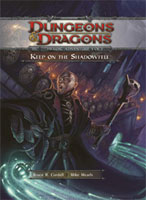
The following thoughts contain minor spoilers for Keep on the Shadowfell. If you don’t want to be spoiled, don’t read it. And if you’re in my gaming group then you definitely shouldn’t be reading it.
You have been fairly warned.
(10) The editing is atrocious. I can only hope they do a better job with the actual core rulebooks. For example, I’m pretty sure that the Empire of Nerath and the Empire of Nareth are actually the same thing.
(11) Unfortunately, these types of gratuitous errors aren’t limited to the fluff content. The rules are also riddled with errors. For example, the quick start rules define two types of cover: Normal Cover and Superior Cover. These are naturally referred to in various places throughout the adventure: A treeline or a boulder or a piece of furniture will either grant normal cover or it will grant superior cover.
Unfortunately, some obstacles will also grant “cover” — which is neither “normal cover” nor “superior cover”. I’m guessing that I’m supposed to interpret “cover” as being “normal cover”, but when you take the trouble to define a precise technical term then you should make the effort to actually use the precise technical terms you’ve defined.
(12) Other rules aren’t explained properly. For example, when describing the rules for handling a pit trap, the module states “if a bull rush forces a creature into the pit, it can immediately attempt a saving throw to avoid going over the edge”. Fair enough. But I’ve been led to understand from other sources that this is true for any type of forced movement that would cause a character to suffer falling damage. Almost all of the pregen PCs, in fact, have forced movement abilities. Why didn’t they include the complete rule?
(13) Another example: Upon first reading the Quick Start Rules, I was annoyed by the fact that a dying character was doomed to die unless someone helped them. According to the Quick Start Rules, a dying character must make a saving throw each round. If they succeed, their condition stays the same. If they fail three times, however, they die. Apparently, I thought, no one ever wakes up on their own after being knocked unconscious in 4th Edition Land.
I have since been led to understand that, in other preview material, the full rule has been revealed: If you roll a natural 20 on your saving throw, you wake up with one-quarter your hit points. Why on earth wasn’t that sentence included?
(14) Several NPCs in the adventure use rules (like the recharge rules and aura rules) which are never explained. This, frankly, is completely inexcusable in an introductory product.
(15) Making the rules even more confusing is the fact that there are actually two sets of Quick Start Rules: One for the players and another for the DM. At first I thought this was a practical piece of utilitarian design: The DM can have a copy of the rules for easy reference and so can the players.
But then I discovered that they were actually two different sets of Quick Start Rules. And for reasons beyond my comprehension, the player’s Quick Start Rules don’t include a lot of the rules the players will need to play their characters. (For example, they don’t even include all of the rules necessary to understand the abilities on the pregenerated character sheets.)
So, for me, the entire player’s Quick Start Rules packet is useless: I’ll be xeroxing the pregenerated characters out of it (so that they can actually be used) and I’ll be xeroxing the DM’s Quick Start Rules so that my players will actually have the rules they need to play the game.
(16) The first two encounters in the adventure use the exact same map and the exact same concept (kobolds ambush the party while they’re traveling on the road). The sense of deja vu was palpable even as I was reading it. I can only imagine the experience at the game table will be moreso.
What makes this design even more ridiculous is that the second ambush on the road doesn’t make sense. The first ambush happens while the PCs are on their way to the village of Winterhaven. The second is supposed to happen shortly after they leave it. But after leaving Winterhaven, the adventure assumes the PCs will go to one of two locations: Either a dragon burial site or the kobold lair.
Neither of these locations lie on the road. The most direct route from Winterhaven to either location is, in fact, directly through the wilderness. So why does the adventure assume you’ll be able to (essentially) reuse the ambush-on-the-road scenario when the PCs won’t be on a road?
(17) “The tall hobgoblin calls to the others in Common: ‘Don’t kill ’em. We can sell ’em to the Bloodreavers as slaves.'”
This is apparently a bit of foreshadowing for H2 Thunderspire Labyrinth. Pity they didn’t include any rules for dealing nonlethal damage.
(18) The skill challenges in this adventure are particularly lackluster. In particular, they continue to demonstrate the same railroading qualities that the sample posted to WotC’s website did. It’s possible that this is merely because this is an introductory adventure, but it certainly didn’t do much to convince me that the core rulebooks are going to resolve any of the problems I have with the mechanics WotC has shown us.
(19) Speaking of skill challenges, let’s talk about Sir Keegan. Sir Keegan was the last commander of the keep before being driven mad by the emanations of the Shadowfell Rift. In his madness he killed his wife and his closest friends before the garrison of the keep turned on him, drove him into the dungeons beneath the keep, and sealed the entrance behind him. In the dungeons, Sir Keegan regained his sanity and, overcome with remorse, poisoned himself. He somehow ended up as a sentient undead skeleton (the details here are vague), and dedicated himself to making sure that the Shadowfell Rift was never open.
Now, bearing that story in mind, consider how the PCs will encounter Sir Keegan for the first time:
The raised dais in this old crypt holds a single coffin. Carved on the lid of the coffin is a warrior in plate armor with a sword laid across his chest, the point toward his feet. The heavy coffin lid explodes in a flurry of dust. A humanoid skeleton girded in plate armor rises from the cloud. It holds aloft a longsword. “The rift must never be opened!” it croaks. “State your business, or prepare to die!”
Wow. Dramatic.
But let’s take a moment and analyze this: Who, exactly, built this crypt for him? Did he just decide to have one built for himself on the off-chance he might need it in the event that he would be driven insane, go on a murderous rampage, and then be trapped in the dungeons beneath the keep by his own men?
Well, perhaps Sir Keegan was a master stone-carver. And, after being trapped in the dungeons without any food, quickly chiseled out a crypt for himself before poisoning himself. And, naturally, after dedicating himself to making sure that the rift was never opened again he would just seal himself inside that crypt and never emerge… even while cultists set up shop next door and begin working to open the rift.
Makes perfect sense… right?
Okay, setting those problems aside, let’s turn our attention to the meat of this encounter: The social skill challenge that Sir Keegan triggers. A social skill challenge that will result in brilliant conversational gems like this one:
KEEGAN: You wear a fearsome demeanor. Are you really as formidable as you look?
PC: <makes an Intimidate check> Yup!
KEEGAN: Awesome. Well, in that case I totally believe that you’re here to stop the cultists. Would you like my magic sword?
… sound kinda cheesy? Well, perhaps you’ll prefer this one:
KEEGAN: If you trust your senses not to betray you, tell me what you see before you.
PC: <makes a Perception check> Umm… a dead guy standing in the remains of his crypt?
KEEGAN: Wow! You’ve got keen eyes! With eyes like those you must be here to stop the cultists. Would you like my magic sword?
Seriously. I’m not even kidding around. Keegan’s first bit of dialogue in each example is lifted straight from the module, as is the suggested skill check. In order to succeed at this social skill challenge, the PCs have to make four successful skill checks before failing at four skill checks, with each skill check representing a Q&A exchange. (The PCs can also decide to go with straight up Diplomacy and/or Bluff checks if they prefer.)
(20) They finally fixed the encounter format they pioneered in the waning days of 3rd Edition. They’re still using the useful and easy-to-access two-page spread for each encounter, but rather than splitting crucial information across two different locations (by having a keyed description in one place and the encounter information in another), they’re using the encounter format for each keyed area.
I note, however, that the format requires every last square inch of a dungeon to be covered by an encounter. I suspect they consider this a feature: “After all,” they’ll say, “An empty room is a boring room.”
But, of course, just because a room doesn’t have a monster or a trap in it doesn’t mean that it’s empty or boring. More importantly, if the PCs know that there’s going to be something exciting behind every single door that they kick in, it rather lessens the moment of anticipation.
The other thing I’ll note about the new format is that the designers made a big deal in their pre-release publicity about how 4th Edition would be featuring multi-room encounters. I guess this is sort of true, but the only thing that’s really changed is that they’re drawing their arbitrary “monsters won’t go past this point” lines in slightly different ways. I doubt I’ll be seeing any meaningful difference in play, since my 3rd Edition campaigns already feature multi-room running battles on a regular basis. This is another one of those areas where my experience seems to have been considerably at odds with the “common wisdom”.
But we’ll see what happens in actual gameplay. It would actually be pretty awesome if I was totally surprised.