The Alexandrian

Archive for the ‘Roleplaying Games’ category

Go to Part 1

Of course, it’s all well and good to say, “Prep Situations.” But one of the reasons people prefer the plotted approach is that it provides a meaningful structure: It tells you where you’re going and it gives you a way to get there.

Without that kind of structure, it’s really easy for a gaming session to derail. It’s certainly not impossible to simply turn the PCs loose, roll with the punches, and end up somewhere interesting. Similarly, it’s quite possible to jump in a car, drive aimlessly for a few hours, and have a really exciting time of it.

But it’s often useful to have a map of the territory.

This line of thought, however, often leads to a false dilemma. The logic goes something like this:

(1) I want my players to have meaningful choice.
(2) I need to have a structure for my adventure.
(3) Therefore, I need to prepare for each choice the players might make.

And the result is an exponentially expanding adventure path:
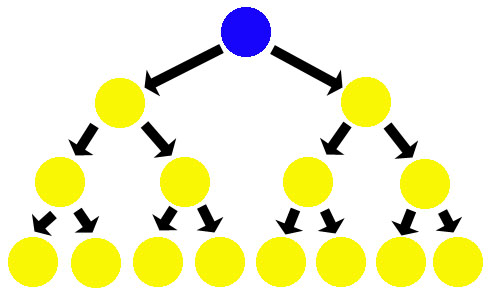
Node-Based Scenario Design - Exponentiall Expanding Adventure Path

The problem with this design should be self-evident: You’re preparing 5 times as much material to supply the same amount of playing time. And most of the material you’re preparing will never be seen by the players.

In some ways, of course, this is an extreme example. You could simplify your task by collapsing some of these forks into each other:
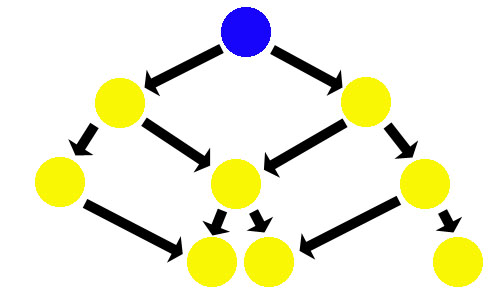
Node-Based Scenario Design - Collapsed Forks

But even here you’re designing eight steps worth of material in order to provide three steps of actual play. You’re still specifically designing material that you know will never be used.

And in other ways it’s actually not that extreme at all: The original example assumes that there are only two potential choices at any given point on the path. In reality, it’s quite possible for there to be three or four or even more – and each additional choice adds a whole new series of contingencies that you need to account for.

Ultimately, this sort of “Choose Your Own Adventure” prep is a dead end: No matter how much you try to predict ahead of time, your players will still find options you never considered — forcing you back into the position of artificially constraining their choices to keep your prep intact and leaving you with the exact same problem you were trying to solve in the first place. And even if that wasn’t true, you’re still burdening yourself with an overwrought preparation process filled with unnecessary work.

The solution to this problem is node-based scenario design. And the root of that solution lies in the inversion of the Three Clue Rule.


Go to Part 3: Inverting the Three Clue Rule

Most published adventures are designed around a structure that looks like this:

You start at the beginning (Blue), proceed through a series of linear scenes (Yellow), and eventually reach the end (Red).

Occasionally you may see someone get fancy and throw a pseudo-option into things:

But you’re still looking at an essentially linear path. Although the exact form of this linear path may vary depending on the adventure in question, ultimately this form of design is the plotted approach: A happens, then B happens, and then C happens.

The primary advantage of the plotted approach is its simplicity. It’s both easy to understand and easy to control. On the one hand, when you’re preparing the adventure it’s like putting together a scheduled to-do list or laying out the plot for a short story. While you’re running the adventure, on the other hand, you always know exactly where you are and exactly where you’re supposed to be going.

But the plotted approach has two major flaws:

First, it lacks flexibility. Every arrow on the plotted flow-chart is a chokepoint: If the players don’t follow that arrow (because they don’t want to or because they don’t realize they’re supposed to), then the adventure is going to grind to a painful halt.

The risk of this painful train wreck (or the necessity of railroading your players) can be mitigated by means of the Three Clue Rule. But when the Three Clue Rule is applied in a plotted structure, you run the risk of over-kill: Every yellow dot will contain three clues all pointing towards the next dot. If the players miss or misinterpret a couple of the clues, that’s fine. But if they find all of the clues in a smaller scene, they may feel as if you’re trying to spoon-feed them. (Which, ironically, may cause them to rebel against your best laid plans.)
Second, because it lacks flexibility, the plotted approach is inimical to meaningful player choice. In order for the plotted adventure to work, the PCs must follow the arrows. Choices which don’t follow the arrows will break the game.

This is why I say Don’t Prep Plots, Prep Situations.

Keep on the Shadowfell was the inaugural introductory product for 4th Edition. When it was released, I shared my initial impressions and eventually ended up writing a lengthy series of essays in which I remixed the entire adventure.

One of the major problems I had at the time was the sheer sloppiness of the module: There were continuity errors in the adventure scenario and numerous self-contradictions in the rules. Ignoring some of the larger creative and structural issues with the adventure, on a very basic level the product was a mess.

In April 2009, Wizards of the Coast released a revised version of the module as a free PDF on their website. I didn’t pay much attention to it because I had already sampled 4th Edition, found it lacking in everything I value in an RPG, and moved on. But I did think it was a rather nice gesture on WotC’s part to make a corrected version of the product available.

Recently, however, I decided to re-visit this material with an eye towards using my remixed version of the module as the basis for an OD&D one-shot. Remembering that the module had been revised, I tracked down the PDF. My plan was to re-read the revised version of the module, see what had been improved, and then adapt my remix notes as necessary if I thought incorporating the changes would be worthwhile.

Unfortunately, I couldn’t even get past the first paragraph of the first encounter before discovering that WotC’s revision was just as sloppy as the original product.

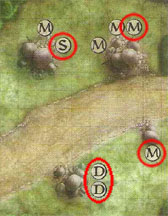
The original module describes the encounter like this (pg. 16): “The player characters are on the King’s Road traveling toward Winterhaven east to west (or right to left on the map).” They are then ambushed by kobolds, as shown on this map:

Kobold Ambush

The obvious problem, as I detailed in my original remix essay, is that the indicated kobolds are all standing in plain sight for characters traveling east to west along the road.

WotC’s keen-eyed revisers noticed the same thing, but they didn’t want to redo the cartography. So they opted to simply change the direction that the PCs are traveling (pg. 6): “The player characters are on the King’s Road traveling toward Winterhaven, west to east (or left to right on the map).”

Problem solved!

… except that’s completely impossible.

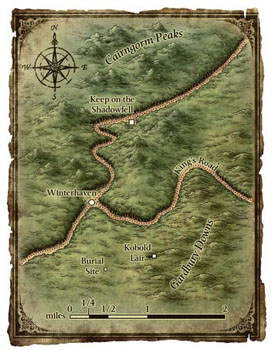
Because two pages earlier in the module we can see this map of the local area:

Winterhaven Area Map

And, as you can clearly see, Winterhaven is at the western end of the King’s Road. You cannot travel west-to-east anywhere on the King’s Road and end up at Winterhaven.

Mistakes, of course, get made. (For example, both the original and revised versions of the module refer multiple times to the Burial Site being southwest of town. You’ll note that it isn’t.) But what you have here is an acknowledgment that there is a problem that needs to be fixed; a decision being made (either deliberately or ignorantly) to not fix the root of the problem; and ending up with a half-assed effort that just creates an entirely different problem.

And it doesn’t even fix the original problem, because there are still kobolds standing in plain sight.

This is symptomatic of WotC’s general culture of not-fixing (or even anti-fixing).

VS.

(prompted by “Signs of Life” at the Society of Torch, Pole, and Rope)

The reason we look for verisimilitude in the rules of a roleplaying game and not in the rules of Monopoly is because we don’t play roleplaying games as if they were a round of Monopoly.

QED.

Personally, I look at the rules of a roleplaying game as the interface between me and the game world. I want those rules to be fun and interesting, but I also want them to be transparent: My primary interest is interacting with the game world. If I wanted to interact with the rules of a game, I’d play a boardgame like Monopoly or Arkham Horror.

So if the rules in a roleplaying game get in the way — either due to a lack of verisimilitude; or because they’re boring; or dissociated; or too complicated — then I’m going to be unhappy with those rules.

The Hall of the Mountain King

WORST. PLAN. EVAH.

Dwarves: Oh no! All the gold in our mountain has been cursed!

Dwarven God: That sounds sucky. Here’s a magical artifact to remove the curse.

Dwarf 1: Think we should use it?

Dwarf 2: Nope. Let’s lock all the dwarves afflicted by the curse into the lower vaults.

Dwarf 1: And then use it?

Dwarf 2: Nope. Let’s evacuate the mountain.

Dwarf 1: And then we’ll use it?

Dwarf 2: Nope. We’ll hide the magical artifact in the depths of the mountain.

Dwarf 1: And… then use it?

Dwarf 2: Nope. We’ll create clockwork bodies for ourselves and inscribe the secret of how to find the artifact on the gears and cogs.

Dwarf 1: And… wait, what?

Dwarf 2: Then we’ll go senile. And centuries from now the grandchildren of our disciples will “con” a small group of adventurers into retrieving and using the magical artifact.

Dwarf 1: What the hell are you talking about?

I guess this is what happens when you write adventure modules by committee. (I really wish I was exaggerating this, but I’m not. Although they technically didn’t plan to go senile, this is, in fact, the background used in the module.)

THE SIMPLE FIX

The artifact wasn’t ready-to-use out of the box. The Secret Masters of the dwarves collected the tears of the Hundred Widows who had lost their husbands to the corruption of the curse. The fist-sized teardrop of gold they forged from the cursed gold needed to bathe for a hundred years in the widows’ tears before it could cleanse the mountain itself.

Unfortunately, long before the teardrop was ready, the dwarves had been forced to abandon the fortress. Or perhaps the Secret Masters arranged for the evacuation, planning to return a century later. Whatever the case may be, things didn’t go according to plan: A hundred years passed and, deep in the bowels of the mountain, the Golden Teardrop was completed. But the dwarves were never able to return to the Golden Citadel, and so the teardrop lay forgotten…

Archives

Recent Posts

Recent Comments

Copyright © The Alexandrian. All rights reserved.