The Alexandrian

Archive for the ‘Roleplaying Games’ category

Tagline: Ghost Dancers details the Indian societies and tribal beliefs of the Weird West. An above-average supplement, it is highly recommended for any GM running a Deadlands game and will prove useful to anyone playing an Indian character.

If I recall correctly, Ghost Dancers was the first time I received a review copy of a book. (At the time, RPGNet maintained a Wish List function for people who had posted reviews on the site. They probably still do. Here’s a document somewhat contemporary to this review describing their review policy.) Getting that review copy was terribly exciting for me at the time. I kept meaning to go back and write a review of the core Deadlands game, but for one reason and another it never happened. The half-finished file still lurks on my hard drive as a poor derelict.

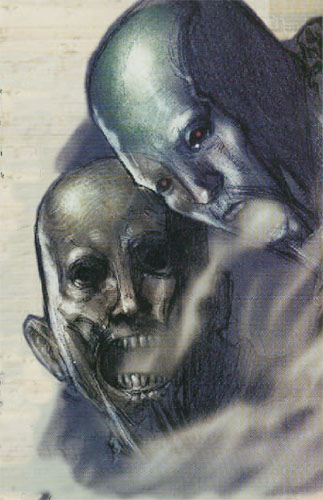
Deadlands: Ghost DancersGhost Dancers is the sourcebook for the Indians of the Weird West. It does it’s job well – giving a highly effective overview of Indian political, cultural, and religious life. Those of you familiar with the Deadlands game will know that many of the crucial events which lead to the development of the Weird West (instead of our historical Wild West) are the result of various Indian factions – as a result this book is a crucial key to understanding some of the background to the world itself. Since it also details the Hunting Grounds in great detail, this book is a must for any Deadlands GM.

I also suggest, but not quite so highly, this book for any player with an Indian character who feels that the main rulebook isn’t giving him enough flavor or options for his character. If you are generally unfamiliar with Indian belief and culture, this book will also give you a good one-point stopping place for learning more. (Of course you should beware of taking things in this book as absolute historical fact – the designer himself is careful to point out that not only is the book simplifying many things about Indian culture, the Weird West is not an historical place by any stretch of the imagination.)

The book follows the traditional (and extremely advantageous) breakdown of all Deadlands material: a section for the players (Posse Territory), material that the GM should know and reveal only to select players (No Man’s Land), and material for the GM’s eyes only (Marshal’s Handbook). In Ghost Dancers, however, this has been changed to The War Party, Sacred Grounds, and The Chief’s Words – because “those white guys at Pinnacle Entertainment mistitled the sections in the previous books.” (Any product with the ability to look at itself humorously earns high points with me.) This lay-out is very nice – too often source material is only useful for the GM or reveals world secrets to the players because it lumps all the information about organizations and locations together. Nor have I seen this lay-out lead to useless regurgitation of the same information in each section. Pinnacle always seems to be careful in giving the GM just the extra information, without restating what has been said 50 pages earlier.

STYLE AND LAYOUT

My one persistent problem with Deadlands products is that the graphical presentation of the books fails to do anything for me. It is clearly meant to be evocative, but it just sits like a lump of clay for me. The cover art of Ghost Dancers, like all Deadlands products I’ve seen is a high-quality, excellent piece of work. The interior art, on the other hand, varies wildly from just slightly above average to pathetically horrid. The special font they use for headings is supposed to be mood-setting I suppose, but I’m pretty much indifferent. They have, however, solved one of my big problems with the main Deadlands rulebook – the type font is a nicely readable size, as opposed to the unnecessarily huge size used earlier.

One last minor complaint. Deadlands products use a nice referencing system to take you from one section of the book to another (for example, if you’re reading a section on the Sioux Nations in the War Party section you might get a page reference indicating that more material on this subject can be found in the Chief’s Words section). For this referencing system they use three miniature pictures – a gun and hatchet for the War Party, a holy symbol for the Sacred Ground, and a chief’s head and headdress for the Chief’s Words. These three pictures are then repeated on the title pages of each of the three sections. The problem comes because they apparently created these images at the thumbnail size for the referencing system and then just blew them up for a full-page presentation on the title pages. Anyone who has done this will know that you end up with a fuzzy image at the larger scale – and that’s precisely what you get in Deadlands products. Suggestion: Compose the pictures at the larger scale and then shrink them down to the smaller scale.

None of these are serious problems in my opinion, they just don’t click with me properly. A quick flip-through of the book should be enough for you to judge whether or not you agree with me.

Indeed, these problems are inconsequential. The lay-out of the product is excellent. Material is laid out in an intuitive and consistent fashion and a detailed table of contents will make it easy to find what you’re looking for. You won’t find any weird placement of information – such as sticking a section on weapon damage in the equipment section rather than the combat section with the rest of the weapon damage information – that seems to be trendy with certain companies.

So, to sum up: Externally this product is visually fantastic. Internally, it is visually boring. The lay-out is useful, productive, and easy-to-use however – and that’s the most important thing. It is only my aesthetic sense which is offended.

THE WAR PARTY

The first section of the book serves both as a reference for players and as a general introduction to the book. The first chapter (“Welcome to the Lodge”), serves as that general introduction.

Chapter Two (“Indian Country”) gives a broad overview of Indian history, as well as comprehensive look at the major tribes and organization of Indian society. Chapter Three (“Making an Indian”) provides details on modifying the basic character creation rules found in the main rulebook for Indian characters – including your role in Indian society, the selection of your Guardian Spirit, and new aptitudes, edges, hindrances, knacks, and gear. The section of the book also contains new archetypes for use by the GM and players both.

Chapter Four (“Guardian Spirits”) details the workings of Guardian Spirits, while Chapter Five (“Strange Medicine”) expands and improves upon the medicine rules found in the main rulebook, providing more options and details.

SACRED GROUND

Chapter Six (“Objects Sacred and Profane”) detail the rules for creating and using ‘medicine objects’ (magical items). This is an exceptionally useful resource for the GM, as is the next chapter (Chapter Seven – “The Hunting Grounds”) which details the extradimensional realm of the Hunting Grounds.

If there is one reason above all others to buy this book it is the material found in Chapter Seven. With amazing grace the designers allow the Hunting Grounds to be not only something of significance and importance to Indians, but to all religious groups. In the Weird West the magical forces which have been interpreted through the faith and religion of humanity are all too real – and it was the release of those forces from what the Indians call the Hunting Grounds (and Christians would call Heaven, Purgatory, and Hell) during the Reckoning that created the alternate history which Deadlands details.

In my mind, therefore, understanding and being able to use the Hunting Grounds in a Deadlands campaign is extremely important – and this book is the key to allowing that. As a result, every Marshal/Chief/GM should own a copy of Ghost Dancers.

THE CHIEF’S WORDS

Chapter Eight (“The Chief’s Guide”) provides everything about the Indians of the Weird West that the players just aren’t supposed to know. I won’t go into details here, because there are probably several players reading this review, but some of the stuff you uncover here is truly exciting and made me want to go out and start writing adventures.

Chapter Nine (“Secret Societies”) details the Ghost Dance (from which the book gets its name) and the Raven Cult. The Ghost Dance is a ritual revealed to the Paiute tribe – it preaches of peace and tolerance, and foretells of a time when the white man will be driven from his lands and the red man shall return to power. A time which shall be prophesied in the birth of a pure white buffalo calf.

The Raven Cult — as anyone whose familiar with the Deadlands game knows – is responsible for the Reckoning. They, too, foretell a future where the white man has been driven from the lands of the Indians – but they see the way to this future as one paved in blood and violence.

The GM will learn everything he needs to know about these two secret societies. Once again this is important information and mandates buying this sourcebook. The information on the Raven Cult is important because of the role in the origins of the Weird West setting. The Ghost Dance is important because they are clearly going to become important in the future of the Weird West.

SUMMARY

This book is an excellent and required resource for the GM of a Deadlands game, but only of mild interest to a player (even if the player happens to have an Indian character). I suggest that only one copy is really necessary for any gaming group, but that one copy is necessary for any long-term campaigns set in the Weird West.

Style: 3
Substance: 4

Author: Paul Beakley
Company/Publisher: Pinnacle Entertainment Group
Cost: $20.00
Page count: 128
ISBN: 1-889546-20-8
Originally Posted: 1998/06/19

THIS

The Bard's TaleI am going to quote something at length from the CRPG Addict because I think it’s important:

The problem [in The Bard’s Tale] is, it costs a lot to resurrect a dead character, especially a high-level dead character. Resurrecting six dead characters cost way more than I had at this point. I had to create a dummy character just to exit the Guild. I was able to resurrect one character immediately, but to get the other five, I had to build up my savings. It took a good three hours before they were all happy and healthy again.

It sounds horrible, especially to modern gamers, but I actually really, really like this aspect of The Bard’s Tale. Death isn’t a game-killer the way it is in Wizardry, but boy does it have consequences. Since you can only save in the Guild of Adventurers, every dungeon foray is a risk, creating a palpable tension as you wander your way through the passages. And every once in a while, you stumble into an encounter like this one (there were actually two more on this same level, with a dragon and a high-powered wizard) that makes your stomach drop and an expletive escape your lips.

Modern games make it far too easy. In something like Baldur’s Gate, you would save every five or ten minutes. If you stumble on to a soul sucker, you might treat the first battle against him like a test run. If your characters die–or, heck, even just lose more hit points than you want to spare–no problem. Just reload and run the encounter again with the experience at your back…

Because of the frequent save points, modern games depend on the difficulty of individual battles to make the games challenging. In The Bard’s Tale, Wizardry, and other games of the era I’m playing, there are plenty of difficult individual battles, but it’s the totality of the expedition that brings the difficulty. You must constantly strategize. How much gold do I need to get from this encounter to make the “trap zap” spell worthwhile? What should I set as my bottom hit point threshold before I return to the surface? Do I want to expend 15 spell points on this group of wights, or take the risk that they’ll turn me into a crippling old man with one touch? I’ve only got 15 squares left to map on this level, but my characters only have 1/2 their hit points. Should I press on or go back?

Exhilarating. Fortunately, I have a lot of games like this left to play.

In computer games, this is a trend which extends beyond CRPGs. In FPS games, for example, Halo ushered in the era of rechargeable shields/stamina and ending an era in which players shepherded health packs and treated entire missions as strategic challenges (instead of a string of tactical encounters).

If this sounds familiar, it should. Tabletop RPGs have been embracing the same trends, starting with a My Precious Encounter(TM) design ethos for published adventures and then hard-coding that design ethos into the game system.

Allow me to emphasize this one last time with two key pull quotes:

Modern games depend on the difficulty of individual battles to make the games challenging.

In [older games] there are plenty of difficult individual battles, but it’s the totality of the expedition that brings the difficulty.

Obviously this is a design ethos which has been most strongly championed by WotC in the 4th Edition of D&D (and then pushed even farther in D&D Gamma World). But it can be seen cropping up in a lot of places.

The argument can, of course, be made that this tactical focus is “more fun”: You’ll never end up trapped in the lower levels of the dungeon (nor will you figure out a clever way to escape). You’ll never find yourself desperately low on health (nor feel the exhilaration of overcoming the cyber-demon between you and the next health pack). You’ll never need to make a tough choice about whether to use your spells now or later (nor experience the satisfaction of blowing away an opponent with your well-earned stockpile of powerful enchantments).

But, ultimately, I think there’s a reason why we refer to “strategy and tactics” as a matched pair: They go together hand-in-hand. They complement each other. They improve each other. Strategic decisions shape (and re-shape) the immediacy of tactical play, naturally resulting in varied and disparate tactical challenges that must be overcome.

Of course, there will still be a great deal of variance in My Precious Encounters(TM) scenario design. (That is, after all, the “precious” part of carefully crafting your “perfect” encounters.) But in my experience, the result still feels curiously bland. Maybe in this encounter you’re fighting a couple of big brutes and in the next encounter you’re surrounded by grunts. But the encounters still all seem to follow the same basic trajectory.

This is probably unsurprising, of course: By removing the strategic portion of the game, you’ve gutted a huge chunk of meaningful choice and consequence. In other words, you’ve crippled the gameplay.

Thought of the Day: Filthy Light

November 28th, 2011

At Home - Bill BrysonFrom At Home: A Short History of Private Life by Bill Bryson:

Tallow [candles], made from rendered animal fat, had the great advantage that they could be made at home from the fat of any slaughtered animal. […] Because it melted so swiftly, the candle was constantly guttering and therefore needed trimming up to forty times an hour. Tallow also burned with an uneven light, and stank. And because tallow was really just a shaft of decomposing organic matter, the older a tallow got, the more malodorous it grew.

First thought: I need to do a better job of emphasizing quality of light when I’m describing scenes.

Second thought: Could tallow rendered from magical beasts be possessed of special properties? For example, dragon candles could counter darkness spells due to the potency of the light created. Would the tallow from a basilisk counter petrification, aid it, or even cause it?

For those who could afford it, oil lamps were the most efficient option, but oil was expensive and oil lamps were dirty and needed cleaning daily. Even over the course of an evening, a lamp might lose 40 percent of its illuminating power as its chimney accumulated soot. If not properly attended to, they could be terribly filthy. In At Home: The American Family, 1750-1870, Elisabeth Donaghy Garrett records how one girl who had attended a party in New England where the lamps smoked reported afterward, “Our noses were all black, & our clothes were perfectly gray and … quite ruined.”

In running an urban campaign, I make it a point to keep track of when the heroes have been trekking through sewers and getting sprayed with ichor. But it sounds like even their lamps can give them a rather thorough smirching.

Of course, eventually they start using continual light or continual flame spells, and these have every indication of being even cleaner and safer than a modern light bulb. After all, they don’t actually consume anything, so they can’t giving off great quantities of smoke, right?

But here’s another possibility: Perhaps continual flame spells operate by drawing their fuel from the Ethereal Plane — they are literally burning ether (pun intended). A sheen of scintillant silver marks the greasy reside they leave behind on nearby objects, but this is quite harmless (unless it is allowed to accumulate in great quantities, in which case the nearby casting of spells may cause the residue to ignite and produce unexpected wild magic effects). In addition, the small vortexes produced by continual flame spells on the Ethereal Plane (as they draw raw ether from one plane to the next) are quite easy to detect. Continual flames, therefore, are sometimes used to form navigational beacons on the Ethereal Plane, but they may also attract the attention of the ethereal marauders and the like.

In Defense of System Mastery

November 25th, 2011

Monte Cook recently posted “A Different Way to Slice the Pie” at WotC’s website. In this essay, he argues that system mastery is a bad idea and makes the game more difficult to learn.

… has everyone swallowed crazy pills around here?

From the essay:

The problem with a newly codified rule is that it becomes one more thing to remember. Moreover, it becomes a component of the game that you have to learn even though it might never come up in play. As unlikely as it seems, it’s possible in 3rd Edition for one to read and understand the “Attacks of Opportunity” section and then never actually have the rule come into play. Why? Because attacks of opportunity are triggered actions that don’t happen on the player’s turn. They’re also situational and easy to forget.

So imagine slicing the pie a different way. Rather than calling out attacks of opportunity as an element of D&D combat, you simply add the rules where and when they are needed. So it would say, as in 1st Edition, that if you move away from a foe, or use a missile weapon next to him, the foe gets a free attack.

With this approach, rules appear only when you need them. There’s less codification and fewer (potentially far fewer) rules to master before you can start playing. The rules are revealed on a need-to-know basis, as distinguished from rules that are “unpacked” and individually categorized and described in a large chapter of a rulebook.

Okay. Let’s break that argument down:

  1. Take a rule which can be trivially memorized and referenced with needed.
  2. Delete that rule.
  3. Replace that rule with a bunch of new rules which are all similar to each other.
  4. This will result in there being fewer rules for you to master before you start playing.

So, increasing the number of rules will somehow result in there being fewer rules?

That’s gotta be crazy pills talking, right?

To be clear here, what Cook is simultaneously talking about here is the idea of organizing the rulebook so that rules you don’t need at 1st level are segregated. That way new players don’t need to spend time learning rules that they won’t use until weeks or months later. That makes perfect sense. That’s exactly how the old BECMI boxed sets were organized, and although it made things a little more difficult to reference sometimes, if you do the separation correctly it can be a net gain for the game.

But what that has to do with taking one rule, turning it into 90 different rules, and then smearing them across the rulebook I’m somewhat at a loss to explain.

SYSTEM MASTERY

What I’m seeing here is yet another manifestation of the inherent hostility that has inexplicably grown up against the concept of “system mastery” over the past 5-6 years.

For example, we saw a similar bit of insanity 4 years ago from David Noonan when he claimed that giving every monster unique powers was much easier than referencing unified rules from the PHB because you can list the unique powers in the monster’s stat block (i.e., “the rules only appear where you need them” as Cook says). I pointed out that this was a false dilemma: You can both reference the unified rule and include it in the monster’s stat block (making it easy to use on-the-spot and also rewarding a player’s system mastery).

In other words, Cook’s thesis that rules should “only appear where you need them” is fundamentally flawed. For maximum utility, rules should appear where you need them AND they should be based on universal mechanics which are easier to learn and master.

Why?

Well, for example, let’s imagine that Monster A has a special attack. In order to use Monster A, I’ll need to read the rules for that special attack and understand how to use it. Ideally, I’d find these rules in the monster’s stat block (so that they can be easily referenced when I use the monster). But if I use Monster A several times, I’ll probably remember how the special attack works. I will have mastered those rules and no longer need to read them before using Monster A.

Why anyone would think that’s a bad thing, I dunno. I’m assuming they’re masochists.

But let’s take this farther: Now I want to run Monster B. It, too, has a special attack. And as with Monster A, I’ll need to read the rules for that special attack and understand how to use it.

Unless, of course, Monster B uses the same rules for its special attack that Monster A uses for its special attack. Then I can use my mastery of the rules from Monster A to run Monster B without reading its rules. (Even better would be if this special attack were referred to by a common, unique name so that I could tell at a glance that this was the same ability.)

Legends & Labyrinths leverages the principles of system mastery through its Sidebar Reference System (SRS). (As I’ve discussed before.) I’m not saying that’s a universal solution that everyone should adopt (although I know that, personally, I wish all my RPG rulebooks used it). But I don’t understand why any game designer would want to run away from the principles of system mastery or make their games harder to learn and use.

Because, in reality, the power of system mastery extends beyond merely “I know that rule”. Memorizing the rule is only the first step; learning how to use the rule (and use it effectively) is the next one. For example, a Chess player doesn’t just memorize the rules for how a rook moves. They combine that knowledge with how the other pieces move and, from that, learn how force is projected on the board. And then they grow from there.

And the same is true in D&D or any other roleplaying game.

I’ve collected The Egyptian Incursion into a convenient PDF. You can download it here.

Egyptian Incursion PDF

The Egyptian Incursion is a quick scenario I threw together in a couple of hours for Gamma World. It was designed to serve as an introductory adventure for four 1st level characters. You can read it online here.

Archives

Recent Posts

Recent Comments

Copyright © The Alexandrian. All rights reserved.