The Alexandrian

Archive for the ‘Roleplaying Games’ category

Double Helix - Battletech Alterworld

This is one of the dumber things I’ve written. It’s a proposal I wrote to FASA for a Battletech novel at some point between 1996 and 1998. The reason it was dumb is that I was trying to carve out my own little niche of the Battletech universe when, with the benefit of age and hindsight, I can see that there was zero chance that FASA would be interested in doing that.

The reason I’m posting it here is because it was obliquely referenced last month when I talked about the AlterWorlds project that resulted in the creation of The Human Concordat. I mentioned that one of the subsequent AlterWorlds would have been “an insolated planet in the Mechwarrior universe”. My plan had been to repurpose the planet Callashan, described below, into an AlterWorlds setting.

SYNOPSIS

When General Kerensky performed his dramatic Exodus from the Inner Sphere, prompting the beginning of the Succession Wars, he was not alone in his horror at the fierce partisanship which had grown among the members of the Star League. A group of colonists from a conglomeration of worlds formed a coalition which headed into the Periphery in an attempt to escape the madness of the growing Succession Wars.

This group, unlike Kerensky, sought not to return in glorious triumph to reform the Star League, but rather merely to survive in peace far from the power mongers of the Inner Sphere.

In pursuit of this goal they settled a planet they would come to call Callashan, and for a long time the dreams of these colonists were met. Callashan was a world of peace. The memories of the War they had left behind slowly faded as the years passed, and the future looked to be a bright and hopeful time.

But as the memory of War faded, so too did the warning it provided. After nearly three hundred years of peace the world of Callashan began to politically fracture. Now three feudal kingdoms exist (the Houses of Alcrom, Gaos, and Ethaois), each vying for control of the world with the power of the BattleMech.

The story of The Double Helix focusses upon Kalen, the greatest hero — the “Helix” — of the House of Alcrom. In an attempt to form an alliance between the House of Alcrom and the House of Ethaois, Kalen has been betrothed to Natasha; the Helix of House Ethaois.

The marriage, however, will be anything but simple. The leaders of the two houses argue over where the marriage be held… and when… and how. The bride- and groom-to-be have not only never met each other, they have tried to kill each other dozens of times upon the battlefield. The House of Gaos will do anything to prevent the marriage from taking place, including killing and destroying anybody and anything involved.

And if the marriage is this much fun, just imagine what the honeymoon will be like.

CALLASHAN

The advantages of the world of Callashan are numerous, particularly if it were to ever be translated into a setting within the BattleTech or MechWarrior game systems. Because it is isolated and secluded (Callashan has lost the Dropship technology necessary to leave the planet) Callashan would make an excellent stand-alone product.

Callashan also has a potential as a “beginner’s intro” to the BattleTech system and universe: without becoming fully immersed in the history of the Succession Wars, the Exodus, the Clan Return, and all the other innunendo of the main BattleTech universe a player can become comfortably familiar with the ‘small’ world of Callashan before expanding.

Other possibilities of future expansion would include discovery of Callashan by the Explorer Corps project — possibly mistaking the world for one or more of the Clan homeworlds.

But what is Callashan?

Before delving deeper into the plot of The Double Helix I feel it’s important to explain a few things about the local politics, the important people, and the current social structure of the world of Callashan.

Callashan was formed as a Free Colony to escape the terrors of the Succession Wars — following the example of Kerensky, several small colony worlds near the Periphery picked up lock, stock, and barrel and rode out into the unknown in search of a new home under the leadership of a man called Callashan (hence the planet’s name).

Callashan ruled as the first king of this new world, but he died without heir, and a primitive feudal structure was left in his place — a struggle between the houses of Alcrom, Gaos, and Ethaois (the three planets which had first settled this world) for supremacy.

Callashan had not wanted to see war visited upon people who had struggled so long and hard to avoid it, and so he instituted a championship. Each house was to nominate its greatest BattleMech pilot — their Helix — to the Triple Helix, a round-robin competition held once every five years. The house whose Helix emerged victorious would claim the crown for the next five years, when a new Triple Helix would be held.

But kingships are not meant to be prizes, and so, inevitably, this system collapsed beneath petty feuding. The competition of the Triple Helix was moved onto the battlefield. Nonetheless, the position of the Helix still holds tremendous power and respect within the new governments.

Note: Over the years Callashan’s Mechs have developed away from the standards. Therefore, those Mechs whose names are still the same will often be ‘tweaked’ from those currently owned by the Inner Sphere powers. In addition many new Mechs are also present.

MAJOR CHARACTERS

Kalen – Kalen is the hero of our little tale. Kalen is one of the best Helixes in the history of Callashan. He is about 25, sandy-haired, well built and a generally likeable guy. He is also a demon in the cockpit. He feels great respect for, and has a paternal figure in, Lord J’hon (see below).

Natasha – The heroine of The Double Helix, and also the daughter of Lord Optun (see below). Natasha is the youngest to ever achieve the Helix rank. Only 18, her Mech skills are exceeded only by her firery temper. She has olive-skin and dark hair, and serves the House of Ethaois faithfully.

Kenneth – Our primary villain, the Helix of the House of Gaos. In the most classic of traditions where Kalen is “one of the best”, Kenneth is the best. This of course means that by the end of the story Kalen will have barbecued this guy in this cockpit. Ken is extremely talented and about 19 years old. But he’s also a jerk, impatient, and generally immature. He also whines too much. He’s coddled and favored by…

Lord Dysim – Current ruler of the House of Gaos. He puts up with Kenneth, because, on the whole, Kenneth is a superb Mech pilot. House Gaos is the most powerful of the three houses, due in large part to the secret technological programs initiated under Dysim’s reign of power. However, Dysim is also a cruel, corrupt, power-mongering individual. He’s married to…

Lady Eve – Lady Eve is not exactly a “sharp cookie”. She’s easily dominated by her husband, and he cares little for her — she has failed to produce an heir, and is therefore worthless to him. She plays an exceedingly minor role in this novel. In fact, so minor, she has managed to utterly slip off the synposis below.

Giles – Is Kalen’s engineer. Actually he works with the entire Alcrom Helix Guard, but he and Kalen are also the best of friends. He serves…

Lord J’hon – The current ruler of the House of Alcrom. J’hon has taken no wife, nor does it appear he is going to. However, he took Kalen under his wing after the youth’s father was killed in a Mech (his mother having died several years earlier in a cockpit as well), and Kalen is the current heir. He is the mastermind of the marriage which The Double Helix focusses upon, and he’s worked for months with…

Lord Optun – Current ruler of the House of Ethaois, to get the whole thing worked out. Optun, while originally hesitant about the plan, has now welcomed it with open arms. Natasha is his daughter, and with Kalen as the sole heir of the House of Alcrom the two houses will be united under a common rule within a generation. Lord Optun is about ten years younger than Lord J’hon (mid-40s) and is married to:

Lady Julia – Who is generally optimistic about everything… even if the world is about to come to an end. Natasha can’t stand talking to her, usually with good reason. Finally we come to her son,

Prince Andrew – Who is pretty much exactly where he wants to be. He’s slightly younger than Natasha, but still acts kinda like a “big brother” to her.

CHAPTER BREAKDOWN

Chapter One: Kalen is on the field, commanding his Alcrom Helix Guard against a raid of a supply depot by the forces of the House of Ehaois. The battle goes very well for Kalen and his unit, but as final pursuit for destruction of the incursion is about to commence he is ordered back to base. Upon returning to base he demands an explanation for why he was not allowed to finish his assault, particularly as he was about to confront the Ethaios Helix. By way of his explanation he is told of the engagement to Natasha for the first time. Although the truce is “official” both powers have yet to inform commanders, which is why the encounter happened at all. He has just enough time to ask something to the effect of, “Wait, go over that again…” before Chapter One Ends.

Chapter Two: “WHAT?!” Natasha is a little less calm when confronted with the news from her father and mother. They argue for several minutes (this gives us ample time to introduce several political elements of the planet). Natasha then goes off to seek counsel from her brother, Andrew, and they talk for several minutes. At this point we’re no longer totally certain if Kalen is ever going to come back again, so…

Chapter Three: Kalen goes to Giles, his best friend and mechanic, and tells him the as-yet unreleased news of his engagement. They talk for awhile while Giles conducts repairs on Kalen’s mech (or at least some of the Mech’s in Kalen’s group). Also introduced during this time period is Giles’ assistant, David, who becomes crucial later on in the plot.

We now cut to House Gaos, where Kenneth is speaking to Dysim. He’s somehow discovered the marrriage alliance (through a spy — who is actually David, but that isn’t revealed until later to the reader).

Chapter Four: Natasha is onboard the transport shuttle taking herself, her father, her mother, and Andrew to meet Kalen on a border outpost between the areas controlled by the two houses. She’s sullen, and nobody’s attempts to cheer her up succeed. After a couple pages of sullenness a bomb goes off crippling the shuttle which proceeds to crash.

Cut to Kalen and J’hon waiting at the outpost. News comes in of the shuttle’s crash… plus Gaos Mechs are on their way towards the area. Kalen clambers into a mech himself and is off to the rescue.

Cut back to Natasha in the wreckage. Well, it’s not really much of a wreck. Everybody’s shook up, and the shutttle is defenseless and certainly not going anywhere, but no one’s dead (as we quickly ascertain). She takes instant control, organizing everybody and calming people down.

Back to Kalen, who lumbers over the hill and down to the shuttle. He loads up the four people in the shuttle (Natasha, Optun, Julia, and the pilot) into his own cockpit as best as possible. He completes this just as the Gaos mechs come plowing into sight. What follows is an action-packed, multi-page sequence of a running chase betwen Kalen (who is drastically outnumbered) and the Gaos mechs. Kalen is little aided by Natasha’s constant exclamations of advice.

Of course he is eventually successful at getting within range of a sufficient back-up force to scare the Gaos Mechs off, and the chapter ends on a happy note.

Chapter Five: The official “first” meeting of the betrothed couple takes place as planned. Afterwards, everybody gets together and talks for awhile about the mutual future of the two houses, the stunning rescue by Kalen, and other pieces of stupid trivia which is absolutely boring Natasha (from whose perspective this section is told) to tears. She doesn’t like what she sees in Kalen, which is just as well because…

Kalen thinks pretty much the same as she does, as we switch to his perspective for the remainder of the session. He and Natasha are never left alone, and barely speak to each other. In the end, after much argument a plan is laid for the official announcement ceremony, and farewells are spoken.

Finally we cut to House Gaos where we are treated to Kenneth carefully weaseling his way out of responsibility for the failure to successfully complete the sabotage the House Ethaois transport.

Chapter Six: This story switches POV between Kalen and Natasha rapidly, telling of a dual raid by the Gaos on both House Alcrom and House Ethaois. The chapter begins with Kalen talking to Giles, then receiving word of the raid. Our first contact with Natasha is in the cockpit of her Mech shortly after that as she attacks the Gaos forces. This is basically a straight-out battle chapter. The gaos forces are pushing towards two security compounds (one for each House). Natasha successfully prevents the breach of her compound, but Kalen fails to protect his.

Chapter Seven: The official ceremony of the betrothed couple is committed — it is broadcast across the territories held by the two houses. Afterwards Natasha and Kalen have their first real opportunity to speak to each other in length and alone…. it doesn’t exactly take well. They’re at each other’s throats. They control their tempers quickly, however, when their Lords enter, but they aren’t thrilled to hear the next piece of news: Kalen is to accompany Optun, Natasha, and the rest of the Ethaois diplomatic party back and tour their security measures.

When they arrive in Ethaois, however, the tour is cut short by news of a second Gaos attack along the border — again the intended target appears to be the security compound. Kalen suits up with Natasha and they’re off again. (Although this looks awfully close to the last combat sequence, there’s a lot of actual character development between the two.) In addition to their viewpoint, we also follow the Gaos Elemental Leader as he leads his strikeforce into the security compound and withdraws the files needed before blasting out. Although Kalen and Natasha (and Natasha’s Guard) fight hard, they’re too late to stop the extraction (although they take out a good number of Gaos Mechs).

During the end of the fight, however, Natasha’s Mech is seriously damaged and she is forced to eject — Kalen saves her life by attacking a mech preparing to destroy her ejection seat. At this point Kalen begins to analyze how he really feels about her.

Chapter Eight: In the aftermath of the battle Kalen and Natasha begin discussing what the purpose of the raid was. Kalen knows his security compound was also harboring secret research into a next generation of mech, and Natasha also knows that her compound was being used to test new satellite spy equipment. After a bit of brainstorming they realize the only common element between the two compounds was the fact they were security compounds: Meaning the probable target of extraction was the area battle sheets used by the two houses.

Kalen needs to get back to Alcrom and warn his people, and Natasha warns her father.

Chapter Nine: Now the fun starts and the plot starts speeding up. When Kalen tries to board his shuttle, he is denied access by a guard. He is forced to knock out the guard and forcibly take off from the Ethaois compound.

Meanwhile, Natasha has reached her father who is in an uproar about Kalen’s “escape”. Natasha is confused.

It turns out that Optun had no intention of actually going through with the marriage. Instead the entire purpose was to lure Kalen to the Ethaois compound, trap him, and then ransom him for a considerable gain of power and territory from the House of Alcrom. Natasha is disgusted… if nothing else, Kalen saved her life, and now she discovers that she has been utterly deceived by her own parents.

Kalen, for his part, is madly flying towards the Alcrom border. He is being pursued by Ethaois aerofighters, but — after several tense moments of aerial acrobatics — he manages to cross his border and be joined by Alcrom aerofighters who force the Ethaois fliers off. When Kalen arrives at the main Alcrom compound he is greeted by the news that Gaos has begun a full scale assault upon the Alcrom border. J’onn has sent to Optun for assistance, but has been refused. Kalen decides he must have been mistaken about Natasha after all, and that the whole situation was a part of some sick ruse.

The situation on the front is bleak — Gaos has used the battle sheet tactics stolen from the security compound to breach the normal patrols, and they are striking deeply into Alcrom territory — their apparent target being the Alcrom central compound. Kalen is heading out into the thick of things.

Chapter Ten: Kalen leads his men into the battle, and over the course of the chapter they are slowly decimated by the Gaos forces. The chapter ends with Kalen in a nearly hopeless position with his men dropping around him like fleas.

Chapter Eleven: The cavalry rides in — taking the form, in this case, of Natasha and the Ethaois Helix Guard. She’s rallied her loyal soldiers, ignored her father’s orders, and come out to aid House Alcrom. The battle rages on, now switching POV between Natasha and Kalen. They become separated as things begin to look worse and worse for House Alcrom. Kalen is eventually faced off by Kenneth and two other Mechs of House Gaos. Kalen fights a slowly losing battle, destroying one of Kenneth’s supporting mechs, but Natasha (again) shows up in the nick of time to wipe out the second supporting mech. They win the day, signalling a turning point in the battle of House Alcrom.

Chapter Twelve: House Alcrom emerges victorious. Kalen and Natasha return to House Alcrom. Natasha has been disowned by her father, her Helix status cancelled, and the other warriors in her guard decommissioned. Kalen and Natasha face their true feelings for each other, and the book concludes in a glorious ceremony which names Natasha an Honorary Helix of House Alcrom (another first for her) and recommissions her warriors as House Alcrom soldiers.

FUTURE PLANS

The Double Helix ends in such a way that no sequels are necessary. If such sequels are requested, however, they are easily provided. Kalen and Natasha do go on to unify Callashan, but shortly after their reign begins new trouble looms: The Explorer Corps have found the planet; the Inner Sphere has returned.

Go to Part 2: An Untold Novel’s Beginning

Go to Part 1

Now we have a basic framework for the urbancrawl: A map divided into districts. Content keyed to each district.

What we need now is a default action that will allow the PCs to engage with that keyed content. In dungeoncrawls and hexcrawls, that action is geographic movement. In the urbancrawl, it’s the investigation action.

In my discussion of hexcrawls, I advocated for the “hidden hex”: The hex is an abstraction that’s useful to the GM for keying and managing content, but which has no meaning for the PCs. In the urbancrawl, however, I believe that you will generally be keying content to districts that are meaningful to the PCs: They know where that ward or neighborhood or landmark or street is located.

So the basic investigation action ends up being pretty simple and very transparent: The player points to a neighborhood and says, “I want to investigate there.” The GM looks at their key and tells them what they’ve found. (If the GM is using multiple urbancrawl layers, then they can randomize which layer has been discovered with this investigation action.)

GENERIC vs. SPECIFIC INVESTIGATION

In actual practice, though, you’re quickly going to want to add additional utility to this basic action.

The first thing you’ll need is the ability to distinguish between generic investigations and specific investigations.

In a generic investigation, the PCs are just looking for anything interesting without any particular agenda. This generic investigation is identical to our basic interaction above.

Weird Tales - February 1937In a specific investigation, on the other hand, the PCs are poking around with a particular goal in mind. This is where the urbancrawl layers become significant: They’re not just looking for anything of interest, they’re specifically looking for a patron. So instead of randomly selecting content from your available layers, you’ll key the specific content tied to the patron level of your urbancrawl.

(You might also include a chance of them finding something other than what they were looking for. For example, you might roll 1d6 and on a roll of 1 they get information from an urbancrawl layer other than the one they intended.)

I’ll also argue that this is the point where you should start hiding the abstraction again: You’ve arranged the content of your city into urbancrawl layers because that’s a convenient way of organizing it and interacting with it as a GM, but those layers don’t really have “meaning” in the game world. The players shouldn’t be saying things like, “I’d like some content from the Heist urbancrawl layer, please.” You want them to be saying, “We need another big score real bad. I’m going to go hit up my contacts in Oldtown and see if I can find something lucrative.”

(At that point you might look at your key and note not only the Tablets of Shandrala that are being held by the local Sheriff of Taxes (as keyed to the Heist layer of your urbancrawl), but also that Count Ormu on the Vampire layer of your urbancrawl in the same district holds the onyx crown jewels of the Lich Queen of Rasang.)

At this point, you might also be thinking about prepping a random table for selecting specific districts if the PCs attempt city-wide investigations. That’s certainly an option and I’m not going to say thee nay, but I suspect you’ll lose some feeling of the ‘crawl if you do that: Instead of crawling to a specific part of town and poking around (exploring the town and everything it has to offer as they do so), the players are just kind of generically asking for a content handout.

(For similar reasons, I wouldn’t run a dungeoncrawl by randomizing which room they explored next. This is why I think making the district structure of the urbancrawl explicit is the right way to go: It encourages that specific engagement with the geography of the city and requires that meaningful exploration choices are being made. On the other hand, I could certainly be completely wrong about this.)

MECHANICS OF THE INVESTIGATION ACTION

Instead of having the investigation action result in an automatic success, you might want to resolve it mechanically. Obviously the exact nature of the mechanic will depend on the system you’re using, but for the sake of argument let’s assume we’re using D&D 3.5.

Weird Tales - Volume 38, Issue 3The most obvious mechanic here would be a Gather Information check. You could set a universal DC for the check (DC 15 to perform an urbancrawl investigation); or you could vary it by city (DC 15 in the City-State of the Invincible Overlord, but DC 20 in the more tight-lipped City-State of the World Emperor); or you could vary it by urbancrawl layer (DC 10 for the Random Encounter layer, DC 20 for the Vampire layer); or you could define it for each key entry (DC 15 to find the blood den in Midtown, but DC 22 to find the den in the Nobles’ Quarter).

You could also allow for exceptional successes to generate additional information. If you were using a One Roll Engine system like Better Angels or Reign, for example, you might generate “soft rumors” for each additional set after the first. These soft rumors wouldn’t give the PCs a specific hook, but they would tell them about general areas of interest that are available in the local urbancrawl. (For example, you might tell them about rumors circulating through the Temple District about people showing up with puncture marks on their necks. They won’t find a specific blood den that way, but it might prompt them to go looking for it.)

You could similarly use the height of an ORE set to determine if the PCs get additional pieces of actionable intelligence. For example, any simple success tells them where the vampire blood den is. But if they score additional dice in the set you might tell them how many vampires are nesting there or give them a floorplan. (This could also just translate into additional rolls on an old school rumor table about the location.)

CONTEXTUALIZING

Starting off with generic Gather Information checks is probably a good starting point, but I’m guessing it won’t take long for the PCs to start attempting investigatory actions that would be handled better through alternative skill checks.

If we think back to our survey of old school city supplements, we might recall that Pavis had some interesting guidelines for PCs researching information in the city.

Gather Information checks can be used to handle the collection of gossips and rumors from taverns and markets.

Knowledge skills could be used when searching through records and the like. Pavis suggests the records of cults and guilds (diaries, receipts, letters, ledgers). It might also represent tax records or newssheets or libraries or any number of other things depending on the particular setting. Gaining access to these records might require Bluff, Diplomacy, and/or the paying of a fee or bribe.

Knowledge (Local) could be used to generate “soft rumors” like the ones discussed above (suggesting potential avenues of investigation).

Specific types of urbancrawl layers might also suggest other skills. For example, maybe an Appraise check would make the best fit for the hypothetical Heist layer I keep using for examples. Players are also likely to suggest all kinds of specific hijinks that could trigger other skill checks (like a Forgery check to gain access to property records or a Decipher Script check to figure out the graffiti patterns the local gangs are using).

The point here is that, like any action resolution, you want to contextualize the investigation action and you also want to respond to the contextualization provided by your players: Don’t just tell them “the vampire den is on Highborn Street”, tell them how they learned that piece of information.

A good technique for this is to make the skill check and then (assuming success) frame the scene just before the information is acquired. For example, if they make a Gather Information check to figure out where Don Carlo is holed up don’t just tell them, “You talk to Don Carlo’s driver and he tells you that he’s got safehouse on the east side.” Instead, cut to the point where they walk into a seedy bar and find the driver half drunk. That lets you play through the moment, which can set the mood, allow for memorable roleplaying opportunities, or lead the investigation in unexpected directions.

Go to Part 12: Exploring the Advanced Urbancrawl

Town Generator - Last Gasp

Since we’re talking about urbancrawls lately, my attention was immediately arrested when I saw a couple of pretty amazing city generators over at Last Gasp.

Both of them are dice-drop generators, which reminds me of the fun you can have with Vornheim, but they’re integrated with prodigious random tables. The first is a generator for small, Lovecraftian-style fantasy towns: The dice drop generates a layout for the buildings and the faces of the dice are used iteratively to form factions, feuds, leadership… It’s fantastic. Check it out here.

In Cörpathium - Last Gasp

The other generator creates a particular iteration of the ever-shifting magical city of Cörpathium, which draws its inspiration from M. John Harrison’s Viriconium. The dice drop in this generator determines the relative locations of city districts and then (this is the cool part) generates a whole bunch of conditionals based on which districts are present and how they relate to each other. You can find it here.

Go to Part 1

The pair of questions I keep coming back to are: Why are the PCs urbancrawling? And what are they actually doing when they “crawl”?

And I think the reason I’m struggling with those questions is because, in an urban environment, their answers are very dependent on the specific context of the PCs’ actions.

This dependence is the result of the city being an extremely dynamic place: In a dungeon there’s generally just one interesting thing happening in a room. In the wilderness the interesting thing is separated from other interesting things by miles or leagues of scenery. But in the city there’s so much activity so densely packed that any given block (or even building) will often have dozens of different things happening in it. The question of which of those things you’ll end up engaging with is highly dependent on the experiences that you choose to seek out.

Having recognized this Gordian knot, we now have to seek the sword that can slice through it. And I think the key here is to stop thinking of the city as a monolithic entity and start thinking of it as being made up of diverse parts. We need to manage the dynamic nature of the city by breaking it apart into distinct layers. The city is not a single urbancrawl, but rather a multitude of urbancrawls that lie on top of each other in a simultaneous coexistence.

LAYER 0: THE GAZETTEER AND THE MAP

Dweredell - Dream Machine Productions

Let’s start with the base of the city: The gazetteer. This is the Baedaeker’s travel guide version of the city. It’s the list of useful shops, taverns, inns, and Important Public Locations.

The gazetteer isn’t an urbancrawl. Although it might be interesting to build some of this stuff into an “Explore the City” urbancrawl layer for those completely new to the city, the stuff in the gazetteer constitutes the elements of the city that will generally be visited through targeted travel. For ease of reference, putting these locations in a gazetteer format makes the most sense.

The other thing you’re going to want forming the foundation of your city is the map. And you’re going to want to split that map up into naturalistic divisions. For ease of reference, I’ll refer to them as districts, but in the game world they could be anything: Neighborhoods, wards, sectors, gang territory, streets, or whatever. You’re aiming for districts that make sense to the characters actually living in the city (they’re labels or divisions that they would recognize and talk about). But you’re also aiming for a districting concept that scales to the amount of material you’re planning to include in each layer of the urbancrawl. (This is just like a hexcrawl: If you find yourself frequently keying multiple entries into a single district, your scale is probably too large. If you find yourself with a lot of empty districts, your scale is probably too small.)

THE URBANCRAWL LAYERS

Over the top of this foundation – the gazetteer and the map – you’re going to layer in your urbancrawls.

Unlike a dungeoncrawl, the goal of an urbancrawl doesn’t default to treasure hunting. It defaults to finding something interesting. If the PCs are fairly ignorant of what the city has to offer (or are simply looking for new opportunities), then this idea of “finding something interesting” can remain fairly generic. But as the PCs learn more about the city, the action will inevitably become contextualized: Instead of saying, “Let’s see what’s going on in the Longbotttom neighborhood.” they’ll start saying things like, “We need to find out if there’s a blood den near Powderhorn Park.” or “Maybe we can figure out what the Halfling Mafia has been up to.”

Each urbancrawl layer basically boils down to one way in which the content of the city can be contextualized. In a given city, for example, you might have separate urbancrawl levels for:

  • Vampire blood dens.
  • Patrons who can give them jobs.
  • The activities of a criminal gang.
  • Potential targets for lucrative heists.
  • Purely random encounters that provide “color”.

Each of these urbancrawls would (ideally) have interesting material keyed in every district of the city. So if the PCs go poking around the Longbottom neighborhood they might find the local vampire den. Or get contacted by agents of Lord Melbourne. Or run into mafiosos hassling local businesses. Or discover that a local merchant family currently holds the Neferelli Diamond. Or get their pockets picked by goblin urchins.

(Having five full layers like this would probably represent a really dense urbancrawl. It would require a lot of prep, but it would also deliver hundreds of hours of play. My guess, though, is that you probably only need 2 or 3 layers to get a really dynamic urbancrawl started.)

THE THIRD DIMENSION

This basic structure of urbancrawl layers is probably sufficient for running a simple urbancrawl. But I’m going to propose that you can add significant depth to your city by extending its urbancrawl layers into a third dimension.

You’re going to take one of your existing urbancrawls and you’re going to add layers to it. These deeper layers won’t necessarily be complete (in the sense that they’ll fill every district in the city with content), so it may be more convenient to think of them as “hidden nodes”.

The idea is that these hidden nodes can’t be directly or immediately accessed by anybody ‘crawling the city. Instead, they can generally only be accessed in one of two ways:

First, districts in the “lower levels” of the urbancrawl may contain clues that will point directly at these hidden nodes. For example, PCs raiding a vampire blood den may discover correspondence from Count Ormu implicating him as a vampire lord.

Second, these hidden nodes can be “exposed” to people ‘crawling the city if certain conditions are met. These conditions would generally take the form of “clearing” lower level nodes. For example, if various adventuring parties take out three of the blood dens in the city, Count Ormu’s network may be sufficiently disrupted to expose his involvement.

This second condition is particularly important for open tables because it solves the “I didn’t get the clues from the first half of this mystery” problem: If you’ve got the clues pointing at Count Ormu, great. If you don’t, but the blood den networks have been sufficiently disrupted by other groups, then Count Ormu becomes available to you through general ‘crawling.

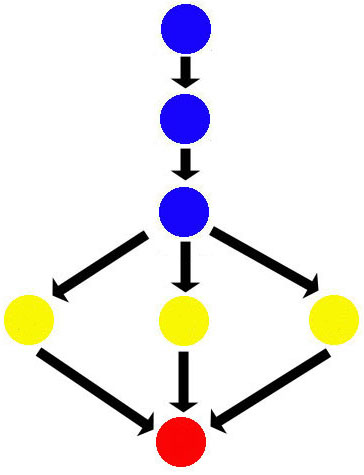
In conceptualizing these hidden nodes, it may be useful to reflect once again on Kenneth Hite’s Conspyramid from Night’s Black Agents, which provided the most immediate inspiration for this added dimension:

Conspyramid - Night's Black Agents

You don’t necessarily need to engage in the same rigid hierarchy or chains of communication (the geographic component of the urbancrawl will cover a lot of the same bases), but it also can’t hurt, right?

Of course, the third dimension of some urbancrawls will be more conceptual rather than organizational: Different targets for heists, for example, may not be directly connected, but you can still add additional levels to a heist-based urbancrawl layer (representing the attention of more powerful clients or security arrangements which have been exposed or simply a pacing mechanic for heists over time).

Go to Part 11: The Investigation Action

Go to Part 1

By 1982, urban RPG supplements had pretty much universally transitioned to become narrative-backdrop travel guides: The modern gazetteer format that generally features a history of the city, a description of notable locations, and a cast of important NPCs. (Vestigial rumor tables hung around here and there for a few more years, but generallyL5R: City of Lies - Greg Stolze faded away until the OSR began bringing them back into vogue.)

Which is not, of course, to say that there aren’t some truly fantastic city supplements. I actually ended up surveying a lot of great stuff while researching these posts: The City of Greyhawk boxed set, the truly prodigious combination of FR1 Waterdeep and the North with the Forgotten Realms: City System Boxed Set, Greg Stolze’s City of Lies for L5R, Monte Cook’s Ptolus, Chicago by Night, City of Freeport, and so forth. It’s just that they’re being designed for a narrative-based game structure that’s not particularly illuminating when it comes to urbancrawling.

Recently, however, we’re starting to see a resurgence in games that are willing to get a little experimental with their game structures. (This has been particularly true among STGs, but it’s also happening with RPGs.) The result has been a handful of “new school” urbancrawls.

DRESDEN FILES

Dresden Files - Volume 2: Our World - Evil HatWhen I first started chattering about urbancrawls, a lot of people pointed me in the direction of the Dresden Files. This game has gotten a lot of buzz for its robust city-creation system and I was told it might be exactly what I was looking for.

Unfortunately, it’s not.

The city-creation system in Dresden Files is really a campaign creation system in which the creation of the city is tied to the creation of the PCs and the players share narrative responsibilities in defining the themes, threats, and locations which define the city. It’s a nifty approach (and I recommend checking it out), but the focus is still on creating a backdrop for narratives.

NIGHT’S BLACK AGENTS

Kenneth Hite’s Night’s Black Agents has an international focus, but it features two very clever systems for running conspiracy-based sandbox campaigns that I think may prove useful in our thinking about urbancrawls.

First, there’s the Conspyramid. When you’re prepping your campaign you draw up a Conspyramid with six levels of power: “Each ascending level has fewer, more important nodes.” So, at street-level power you’ve got six different nodes. Bump it up a couple levels to provincial powers and you’ve got four different nodes.

Conspyramid - Night's Black Agents

The Conspyramid is useful because it simultaneously shows the GM how the organization of the conspiracy works (in an abstract way) and how the PCs can investigate the conspiracy.

The Conspyramid is clever because Hite also ties it mechanically into the game mechanics: As the players fill out their adversary map (i.e., figuring out how the conspiracy hooks together), they gain dedicated pools of points to spend on ops targeting connected nodes on the Conspyramid. They can also use Human Terrain and Traffic Analysis skills to figure out the connections between a node they know and other nodes (i.e., generating leads).

That’s a default goal, a default reward, and a default action.

Hite then adds a second track in the form of the Vampyramid:

Vampyramid - Night's Black Agents

He describes this as an “escalating response algorithm” which provides the vampire conspiracy with a naturalistic response to the PCs: So the Conspyramid represents a largely static ‘crawl; the Vampyramid provides easy-to-manage active responses.

It’s the most innovative, creative, and gobsmackingly brilliant work I’ve seen on an RPG game structure in over a decade. Hite’s a genius and you should check it out.

(UPDATE: Hite has informed me that his own work on NBA was inspired by Elizabeth Sampat’s Blowback. I recommend checking that out, too.)

While these structures cannot be directly applied to the type of urbancrawling structure we’re looking for, where I think the NBA systems are extremely informative is the intersection of investigative “layers” combined with default, mechanically-driven investigative actions. (We’ll come back to this idea shortly.)

VORNHEIM

Vornheim by Zak S. proffers a quote about Moving vs. Crawling which is so extremely useful that I’m going to provide it here in full:
Vornheim - Zak S.

In a dungeon or wilderness adventure everything is hard – navigating, finding food, getting a decent night’s sleep, etc. – and so everything is part of the adventure. Adventuring in a city is different from adventuring in a dungeon or wilderness because cities are actually meant for habitation. In most cities, many things will be easy and therefore not part of the adventure and the GM has to do a great deal of deciding when to “zoom in” and deal with the situations in more detail. For this reason we’re going to create a distinction between simply “moving” through the city and “crawling” through it. (…)

“Crawling” occurs when:

• The PCs are being chased.
• The PCs are in a hurry.
• A large number of elements in the city are actively hostile to the PCs (such as during an invasion or plague of madness).
• The PCs are systematically searching a small area of the city for something.
• The PCs are trying to avoid running into someone or something.
• It’s night.
• The city is transformed in some way such that it ceases to function like a city (post-nuclear bomb, etc.).
• The PCs don’t really know where they’re going.
• There’s urgency attached to the PC’s decisions about how to proceed for any reason.

A lot of the Old School Renaissance has largely spent its time regurgitating the forms and content of the ‘70s and early-‘80s. (And, don’t get me wrong, produced a lot of good material doing it.) Vornheim is a prime example of the OSR being a little more daring, grounding itself in the old school material, and then innovating.

For ‘crawling, Vornheim creates a pair of simple structures: If you’re crawling from neighborhood to neighborhood (i.e., trying to traverse the city) you generate one random encounter per neighborhood. If you’re crawling within a neighborhood (i.e., they’re trying to find something in the neighborhood) he uses a method of rolling 2d10 and using:

• The relative position of the dice to determine where the goal of the ‘crawl is relative to the PCs.

• The number on the die to determine the layout of streets between them and their destination. (Literally. You can check out the diagrams of how this works here.)

It’s a very clever and quick system. Where it comes a little short is in providing structure for making the journey from Point A to Point B a meaningful/interesting one.

What makes Vornheim truly invaluable in any discussion about urbancrawling, however, is the plethora of incredibly cool, incredibly useful, and incredibly original tools that Zak has designed for procedural content generation. (This is something I talked about in my Fun With Vornheim series, which you should check out for some awesome examples of what the book is capable of.)

TECHNOIR

Technoir is another system I’ve talked about quite a bit. It’s got an incredibly clever resolution mechanic, but what makes the game truly exceptional are its plot-mapping mechanics.

The short version is that the game is built around “transmissions” which each describe a city of the future. Each transmission consists of six connections, six events, six factions, six locations, six objects, and six threats. These are organized into a 6 x 6 master grid which allows you to randomly generate elements and add them to your plot map.

Technoir - Jeremy KellerBy itself, that’s a nice little procedural generator. But Technoir takes it one step further by including explicit mechanics for how elements are added to the plot map, and the primary method is controlled by the PCs: Whenever they hit up one of their contacts for information, an element is generated based on the contact’s current relationship to the plot and it’s connected to the map based on situational mechanics as well.

(A lengthier example of using the Technoir system can be found here.)

The result is a robust improvisational structure which has the delightful property of allowing the GM to discover the “true conspiracy” of their ‘noir adventure at the same time that their players are investigating it. (It’s also a system which could be very easily translated to any genre or setting.)

In terms of urbancrawling, the key insight from Technoir is the ‘crawl action itself: Hitting up your contact.

What makes this notable is that this is not a decision about geographic navigation, but it nevertheless fulfills the same exploratory function. The only limitation is that this is a mystery-based structure and, as you’ve probably gotten sick of me saying, mysteries don’t work for open table play. Technoir solves the problem of being unable to solve the mystery if you missed the clues in the first half (by utilizing a structure which constantly manifests new clues), but you still have the problem of players experiencing the first half of a mystery and never getting the satisfaction of its solution. (But if you want an urbancrawling structure and you don’t need it to support open table play, then I enthusiastically recommend Technoir.)

Go to Part 10: One City, Many Urbancrawls

Archives

Recent Posts

Recent Comments

Copyright © The Alexandrian. All rights reserved.