The Alexandrian

Archive for the ‘Reviews’ category

Downbelow Station - C.J. CherryhThe first term which springs to mind in considering Cherryh’s Downbelow Station is “military SF”. But, somehow, that doesn’t seem adequate. When I think of military SF visions of Weber’s Honor Harrington or Moon’s Heris Serrano dance before my eyes. And comparing Honor Harrington to Downbelow Station is like comparing a table knife to a machete: It may be technically correct, but it is more than lacking in its descriptive accuracy.

Downbelow Station is a war story. Not a story of the glorified war seen at a Saturday matinee, bur rather the story of a war seen through the eyes of an Anne Frank or a Vietnam vet. It is a war brutal, savage, and viciously capricious. Indeed, Cherryh’s vision of future war is, if anything, more horrific than anything the modern world has seen: It is a thing of vacuum and hapless impotence.

The best comparison I can draw to Downbelow Station would be Haldeman’s Forever War. But Haldeman’s masterpiece pales in comparison to the rich textures of Cherryh’s classic: Where Haldeman’s message is a relatively simple, Vietnam parable, Cherryh weaves an elaborate tapestry of motive, judgment, and consideration. As a result, by the end of the book, I certainly know what my own opinions on the war are – but I rather suspect that others will draw completely dissimilar conclusions. Cherryh conjures a stark, appalling reality: Complex, textured, and detailed. Attempting to grasp what she has created is like trying to come to grips with Beirut or Iraq – it has that kind of startling depth.

The other work which I invariably found myself thinking of while reading Downbelow Station was Cyteen, the only other work by Cherryh which I have read to date. Downbelow Station, being the earlier work, is almost inevitably a little cruder than Cyteen, but many of the same strengths are to be found here: Most notably, Cherryh’s ability to fully realize the characters on all sides of a conflict. Unlike Cyteen, the effect is not quite perfect: Characters like Lukas and Mazian may be given some depth, but they’re still palpably the unmitigated villains of the piece, while, on the other hand, the Konstantins are the sainted heroes. In other places, though, Cherryh’s future gift for characterization shines through – Signy, Elene, Satin, Josh, Kressich – and it is in these places, naturally, that the work finds its greatest resonance and most meaningful facets.

One thing I find particularly interesting is Cherryh’s prose. When I begin a Cherryh novel, I will often find myself noticing its distinctive style. It seems to stand out in a way that I can’t quite put my finger on: Perhaps it is an unusual word choice. Or a way of structuring sentences and paragraphs. It’s difficult to describe. But within a handful of pages, I find that I have adjusted to it completely – at which point it becomes a powerful storytelling tool, wielded by a master of her craft.

In short, I found Downbelow Station to be a powerful and moving experience. Between this and Cyteen, I am now officially a Cherryh fanatic.

GRADE: A+

C.J. Cherryh
Published: 1981
Publisher: DAW Books
Cover Price: $7.99
ISBN: 0-7564-0059-7

Buy Now!

The Vor Game - Lois McMaster BujoldThe Vor Game is, almost certainly, the worst of Bujold’s Vorkosigan novels.

Last week I wrote that Memory combined all of Bujold’s strengths without any of her flaws. The Vor Game is almost an inversion of this: It combines her worst flaws as an early writer with very few of her strengths. The powerful themes of her others works are missing. The plot is driven by one implausible chance encounter and improbability after another. Even the little touches and subtle nuances seem absent once you are past the first fifty pages. The one strength which may still be cited are the characters – but even they are somewhat lamed as the absurdity of the plot grows.

In many ways, this is actually a book of two parts: The first part is an effective novella (which, unfortunately, lacks an ending). The second part is a disastrous outing compared to the standard Bujold has set for herself, primarily as a result of the SOD-breaking coincidences which drive the plot.

When you read this book, try counting the number of times the plot is advanced because Miles has a chance encounter with someone. In some cases these are merely as improbable as running into someone by chance in New York City. In other cases it’s as improbable as running into someone in Beijing who you just saw two weeks ago in Los Angeles.

If it happened once, it wouldn’t be a problem. Heck, Bujold might even be able to pull it off two or even three times if she were careful.

Instead, she does it more than a dozen times. The entire plot is driven along this single-minded authorial fiat.

Okay. So there are some significant problems here. There are also good points: If you can swallow your disbelief repeatedly, the plot is a rip-roaring ride. Watching Miles at his most hyperactively desperate is as much fun as it usually is, and the supporting cast can be truly delightful.

When all is said and done, this is still a good book. It’s a frustrating and disappointing book compared to Bujold’s other works, and its utterly baffling that such a poorly-constructed novel could win the Hugo. But that doesn’t change the fact that this is still a fun little read, as long as you don’t come to it with artificially heightened expectations.

GRADE: B-

Lois McMaster Bujold
Published: 1990
Publisher: Baen Books
Cover Price: $15.00
ISBN: 0-671-87782-8
Buy Now!

Warrior's Apprentice - Lois McMaster BujoldI made the mistake of re-reading Bujold’s Memory last week. I say “mistake” because reading Bujold is, above all, an addictive pleasure. I have thus been consuming her books at a rate of 1 or 2 per day ever since.

I’m reviewing The Warrior’s Apprentice and Cetaganda together here because, in many ways, they are very similar works. They are also, perhaps, the books I see most consistently cited as the “worst” or “weakest” examples of the Vorkosigan series. This is not a reputation they deserve. Even The Warrior’s Apprentice — which may, in fact, rank last on the list of stories starring Miles — is ill-served by a description of “weak”. It is, rather, a good novel which has the relative misfortune of being written by a woman who has gone on to write great novels.

THE WARRIOR’S APPRENTICE

This is only the second time I’ve read The Warrior’s Apprentice. It was the second Bujold book I ever read, taking up the second half of the Test of Honor omnibus (which also collected Bujold’s first novel, Shards of Honor).

In my memory, The Warrior’s Apprentice didn’t particularly distinguish itself. I was left with the vague impression of a light adventure story, without the depth of character or theme which I came to recognize in Bujold’s later work. An addictive reading experience, yes, but not a lasting one.

My memory has been playing tricks on me.

Sure, at first glance this is nothing more than a light adventure story: Boy seeks adventure among the stars. And, to be sure, Bujold embraces the plot with fast-paced prose and character, carrying you along with stylish verve on a thrilling rollercoaster ride.

But, as the novel progresses, you begin to gain the sense that there’s more at work here: Why, for example, does Bujold choose to touch so lightly on some of the adventure elements in her plot? Why do none of the characters develop the way you would expect them to in an adventure story?

Because Bujold isn’t telling a light adventure story. She’s telling a coming of age story, and the light adventure is just a trapping. What’s really clever is that it isn’t just a random trapping selected to spice things up: It’s a light adventure trapping because that’s what Miles goes looking for. (What Miles finds, of course, is something quite different.) Throughout the novel there is a running joke about the difference between the way things work in holovids and the way things work in reality. It’s charmingly witty throughout and has a wickedly amusing pay-off towards the end, but I also see it as a commentary on the novel at a much deeper level: There’s a way things work in a light adventure story, and its quite different from the way things work (and why they work) in this story.

And, like so many of Bujold’s works, the story of Miles is only the beginning of what the novel has to offer: Take a look at how his coming of age is eloquently mirrored in Elena’s. (And it is mirrored, not duplicated, you’ll note.) And once I realized that it was also a story of redemption, whole new layers of the narrative opened up for me.

Which isn’t to say that The Warrior’s Apprentice doesn’t have its problems. The construction of the plot is not as smoothly or as brilliantly handled as a later Bujold might have done. There are notable occasions of authorial fiat and startling coincidence (although they’re generally well-covered). The ending, in particular, is very weak: Its pacing is rushed and the earlier scenes which established its basis were clumsily included.

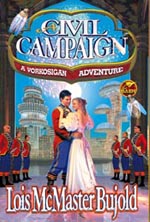
Young Miles - Lois McMaster BujoldSo I’m left looking back on my memory and trying to figure out why it betrayed me: Sleep deprivation might have something to do with it. After finishing Shards of Honor around 3 A.M. or so I just kept reading straight through The Warrior’s Apprentice, which probably degraded the reading experience (no matter how much Bujold demanded my continued attention). I think I can also blame it, in part, on the fact that – after Shards of Honor – I was expecting a sequel starring Cordelia, not one starring her son twenty years later. And the weak ending probably didn’t help to give the book a strong, lasting impression, either.

Or maybe, with more Bujold experience, I just know what to look for now. Books like Memory made it plain that Bujold offered hidden depths, and so now – coming back to The Warrior’s Apprentice – I am more apt to see that which was there all along, instead of reading it “merely” as a light adventure and overlooking the nuances of its true quality.

I also think a greater exposure to the stories of the Vorkosigan cycle as a whole help to soften the sharp edges of the novel’s flaws. For example, the redemption of the future Dendarii has a deeper resonance when you recognize their future selves. The ending, too, works better now that I have a prior understanding of, for example, the relationship between Miles and Gregor, whereas – when I first read the novel – the revelation of their prior relationship was dumped on me only at the very moment that it was required.

Another thing: I’m struck, once again, by the fact that Bujold’s books function so differently depending on the order in which you read them. There’s a lot of material in The Warrior’s Apprentice, for example, which alludes to events in Shards of Honor. When I first read it, I was intimately familiar with those events (having just finished Shards of Honor) – and the book read one way as a result of that. Coming back to The Warrior’s Apprentice, its been several years since I read Shards of Honor and The Warrior’s Apprentice reads very differently as a result.

And it works both ways. It even works (in yet a third way) if you’ve read Barrayar before reading The Warrior’s Apprentice, even though Barrayar had not yet been finished or published when The Warrior’s Apprentice first appeared. That’s an astonishing accomplishment. And is a depth which, undoubtedly, makes re-reading Bujold such a uniquely enjoyable and enriching experience.

CETAGANDA

Cetagana - Lois McMaster BujoldCetaganda suffered a horrible fate: It was a published after Mirror Dance and before Memory.

If you’ve never read the books, you’ll have no idea why that’s important. Suffice it to say, however, that Mirror Dance and Memory are one type of book… and Cetaganda is a very different kind of book. As a result of its place in publication order, however, Cetaganda is repeatedly contrasted against its two closest siblings: The result is like comparing an apple to oranges, and Cetaganda seems to lose out every time.

Like The Warrior’s Apprentice, Cetaganda is a light adventure story. Where The Warrior’s Apprentice tends towards space opera, however, Cetaganda tends towards mystery and political intrigue.

I could wax eloquent about all the amazing things that Bujold does in this book, but most of it would be merely repetitious (since it’s the same amazing things she does in all of her books). Instead, let me point out three specific things and let it rest at that.

First, the plot is a fast-paced tale of mystery and romance. Of course, Bujold being Bujold, neither plot has the good manners to play by all the rules. Have you heard the anecdote about the author who, when all else fails, would have someone come through the door with a gun? That happens on page two. (Well, not quite. Bujold doesn’t play by the rules remember.) That gets the plot running. By page twenty-five, the plot has hit Mach 2 and you’re basically stuck on the ride until it comes to an end.

This means that, above all, Cetaganda is a fun book to read.

Second, the world-building is literally breathtaking in its beauty and startling in its depth. Cetaganda is a world on the cusp of the transhuman, and Bujold conjures forth a grand image: Here, the social intricacies of a byzantine imperialism. There, the wondrous spectacles of a world where nature, technology, and art are one and the same. And then, just as you are being seduced by Cetaganda’s charms, Bujold reminds you that there is no such thing as perfection: Here, the corruption and degeneracy of caste. There, the subtle horrors which can only be created by those with a godlike power over life itself.

Third, the character arc of Miles. When read in publication order, this arc suffers from the fact that the Miles of Mirror Dance (the previous volume) has already moved beyond the personal issues he must grow through here. When read in internal chronological order, on the other hand, the arc suffers because Miles is beginning to consider issues which are not fully explored until Memory and Komarr. But if you can approach Cetaganda as a novel unto itself, I think you’ll find a lot of entertainment in watching Miles grow as a character.

In short, I find Cetaganda to be a book both fascinating and entertaining. It has withstood the test of being re-read twice, and I have no doubt that it will stand that test again.

GRADES:

WARRIOR’S APPRENTICE: A-
CETAGANDA: A

Lois McMaster Bujold
Published: 1986 / 1996
Publisher: Baen Books
Cover Price: $7.99
ISBNs: 1-886-77827-2 / 0-671-87744-5 / 0-671-87782-8 (omnibus)
Buy Now!

My Bedroom: The Swamp

August 4th, 2005

My bedroom has been turned into a swamp.

A poorly designed gutter wore away the seal along a cement drainage channel. The water, forced into the crevice behind the drainage channel, eroded the earth along the foundation of my building. Torrential downpours last week finished the damage, creating a sinkhole right next to a window well. Last night, when it rained again, the gutter essentially directed a torrent of water directly through the sinkhole, into the window well, and from the window well directly into my bedroom.

So… that’s been fun.

I haven’t had a chance to polish up the education standard I was hoping to post yesterday. Instead, I’m going to give you five more What I’m Reading reviews:

11. Warrior’s Apprentice / Cetaganda – Lois McMaster Bujold
12. The Vor Game – Lois McMaster Bujold
13. Downbelow Station – C.J. Cherryh
14. Diplomatic Immunity – Lois McMaster Bujold
15. A Song of Ice and Fire – George R.R. Martin

These would have originally been written in October and November of 2003. As you can see, I was on a bit of a Bujold kick at the time. Basically, I think her books need to be classified as an addictive substance. If I read one of them I literally can’t stop myself from reading all the rest.

Digital Knight - Ryk E. SpoorNOTE ABOUT SPOILERS

Although billed repeatedly as a novel on its front and back covers, Digital Knight is, in fact, a collection of previously unpublished short stories which – as far as I can tell – have only been lightly touched up (if at all) to form the “novel”. I’m going to spoil significant chunks of the first short story (although not its plot), because – otherwise – it would be impossible to discuss this book in any meaningful way. The rest of the book is left blissfully mysterious.

END NOTE ABOUT SPOILERS

Neither the exceptionally poor cover art nor the somewhat cliched back cover blurb drew my attention to Digital Knight. Not even the effusive cover quote praise from Eric Flint would have made me pass over the eight bucks Baen was asking for it.

What did make me pick it up was the fact that Ryk E. Spoor had written it. For those of you who don’t already know, Ryk posts regularly around Usenet under the handle Sea Wasp. As the friendly Wasp, I’ve been acquainted with Ryk for almost exactly a decade now – during which time he’s distinguished himself as a person of singular creativity, insight, and intellect.

So, if Spoor had written it, I wanted to read it. Once a copy put in an appearance at my local bookshop, I snatched it up and stuck it on my reading list. Which brings us here.

As noted above, Digital Knight is more a short story collection than a novel. It contains a cycle of short stories, all focusing on the character of Jason Wood: A private investigator who finds himself plunged into a world of urban fantasy.

Reading this book is fascinating, because you can see Spoor growing as a writer right before you eyes. The earlier short stories are plagued with a lot of problems: The plotting is awkward and contrived, and its strength is further sapped by the fact that Spoor seems to be making an attempt at stylizing his prose by adopting the hard-edged, slightly ironic feel of a PI novel. Unfortunately, he doesn’t quite get there and the result is jarring and off-putting.

Worst of all, the early dialogue can be actively painful. People just don’t talk the way Spoor has them talking. The thing I noticed most was that his characters weren’t using contractions, but this was really just the tip of the iceberg: A lot of factors combined to make the dialogue jarring and unbelievable.

But, like I said, as you read further you see the book improve dramatically before your eyes:

The dialogue begins to flow naturally, and the characters develop rich, distinct voices. The stiff, uncomfortable prose resolves itself into a unique, effective voice – still rough around the edges, perhaps, but clean and entertaining nonetheless. And once Spoor finds his rhythm, he starts playing some powerful beats: There are bits that I found myself reading out loud, and I only do that when the wordsmithing becomes remarkable.

Meanwhile, the plotting is shedding its awkwardness step-by-step, until you eventually find yourself compulsively turning page after page, drawn inexorably along by Spoor’s action and world-building.

In short, the book is well worth pushing through its weak start: The early stories have some diamonds in the rough to offer you, and the book starts to really pay off with “Photo Finish” (which starts around page 90). Shortly thereafter Spoor throws a twist at you which makes you realize that he’s just been toying with you all along, and then he follows it up with a revelatory punch that will send you reeling. You can practically hear the starter pistol going off as the novel starts racing.

There are a lot of treasures hidden away in the nooks of this book, but one thing which is delightful right from the beginning is what I’m going to call, for lack of a better term, the “genre-awareness” of the characters. When Jason Wood runs into vampires he has his moment of disbelief… but then he realizes he’s acting just like the characters he makes fun of in the horror movies and gets down to the business of using his collected knowledge of horror and fantasy to his advantage. Not everything he tries works – because, of course, myth isn’t the same thing as reality – but that just sells it: Wood is a skeptic in an unskeptical world. But he’s not Dana Scully dense: Once he’s seen the evidence of something being true, he accepts it as truth and moves on.

In grading this book I am left in something of a quandary: I would rate the early material at roughly a C+ (average-to-mediocre material with the occasional reward). For the later material – and greater bulk of the novel – however, I would probably give an A- (highly rewarding with only the occasional, minor flaw). In a completely non-linear fashion, I’m going to average that out to a B+ (notable, fun, and well worth your time).

GRADE: B+

Ryk E. Spoor
Published: 2003
Publisher: Baen Books
Cover Price: $7.99
ISBN: 0-7434-7161-X

Archives

Recent Posts

Recent Comments

Copyright © The Alexandrian. All rights reserved.