The Alexandrian

Archive for the ‘Reviews’ category

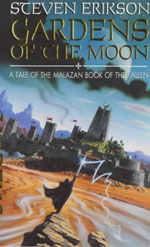
Gardens of the Moon - Steven EriksonGardens of the Moon is the first volume in Steven Erikson’s Malazan Empire series. I was drawn to the series after hearing roughly a dozen different people heap mighty amounts of praise upon it. Although it was still shockingly unavailable in the United States , I managed to obtain the first three paperbacks from www.amazon.ca. (Tor has now acquired the rights to the series and will be releasing Gardens of the Moon sometime this summer.)

I think Gardens of the Moon can best be described as “epic fantasy with the dial cranked up to 11”: The dragons, empires, and wars are all bigger. The cast of characters is larger. The intrigues more convoluted. The elder races more alien. The magic more powerful (and its forms more mysterious). Even the world is too big for the map (and its only one of many).

And I mean all of that in the best possible way.

No, seriously, I do. Erikson has invested his world with some truly amazing depth and a truly astounding scope, and it’s perfectly delightful to behold.

For example, Erikson manages to detail a complex, interwoven set of magical systems – yet, at the same time, his magic feels magical. He manages to sidestep the trap of making magic nothing more than an alternative physics, but he also doesn’t cheat by simply drawing a curtain across its workings.

Another remarkable thing about Gardens of the Moon is the history. Its so thick that it seems to ooze right off the page. And its not just the world which has received this lavish attention: Every single character has been gifted with a rich backstory that, once it becomes apparent, gives them a life and vitality and reality all their own.

I could rave on for quite some time in this vein, because Erikson has truly created a marvelously complex and lovingly detailed world: A work of art with few equals.

Unfortunately, not everything about Gardens of the Moon is so deserving of praise. The book is, to put it bluntly, very rough around the edges. Where Erikson succeeds so brilliantly at evoking a world and creating a compelling plot, he frequently falls down when it comes to prose and (most importantly) basic storytelling. And what is perhaps most frustrating about these latter flaws is that you can see, here and there throughout the book, that he is capable of so much better.

It was nearly 150 pages before I began to have something resembling a firm grasp on what was happening. Erikson dumps you right into the middle of a complex society, history, cast of characters, and action – and then skips around like a rabid rabbit, flashing forward and backward in time, between characters, and across continents.

To be perfectly clear here: It’s not simply starting you in the middle of things which is the problem here. I don’t have any problem with starting a story in media res. But Erikson never stops. No narrative thread is held onto for longer than a couple of pages. You’re constantly flipping between the literally dozens of POV characters and are never allowed a chance to focus your attention on anything.

Adding to this problem is Erikson’s concerted effort to withhold information from one end of the book to the other: Unnamed characters do cryptic, unexplained things to other characters (who are frequently no more than a name on the page); false cliffhangers are created through selective description; motivations are often left unexplained until hundreds of pages after the fact.

Which leads to another problem: There are significant spans of the novel where characters stop doing things for any particular reason and start doing them because, well, that’s what happens next (and, besides, they need to do it so that something else can happen later on). Sometimes this is just an impression left by Erikson holding back essential information. And sometimes its justified by having gods explicitly or implicitly mucking around in the mix. But, just as frequently, the only all-powerful hand at work seems to be the author’s, fating characters to an inevitable outline.

(This is all simultaneously contrasted and highlighted rather oddly by a stretch of the book in which vast amounts of secret history comes spilling out during a casual conversation between two characters. I was left with the vague sensation of taking a walk with someone and having them casually – and for no apparent reason – describe the secret history of the Illuminati, the Masons’ involvement in the Fall of Atlantis, and the secret war between the Templars and Papist Loyalists over the Holy Grail in Victorian India. Ironically, very little of this conversation actually serves to directly illuminate the active threads of the plot.)

In the end, I was simply left with the vague feeling that – if I had known everything I knew by the end of the book at the beginning of the book – the whole work would have been a lot more effective for me.

More than anything, though, I’m left with a general feeling of inconsistency, because, like I said, there are large spans of the book where Erikson’s potential shines through unfettered by these storytelling flaws. (Most notably the last 150 pages flew by with only a couple of rough spots standing in the way.)

A couple more problems I need to throw out here before moving on:

First, Erikson cannot write poetry. Which is unfortunate, because he spreads it around pretty liberally in the books. Fortunately, the vast majority of it is found at the beginning of chapters and is easily skipped.

Second, someone hereabouts mentioned recently that Erikson has a tin ear for names, and that’s true in spades. He varies between two extremes: Names which are common words (Burn, Sorry, Whiskeyjack, Hairlock) and names which are nearly unpronounceable. Mixed inbetween the two extremes are more traditional-sounding fantasy names (Kalam, Paran) and a few names drawn from the real world (Quick Ben). The result is simply chaos, and I surely can’t see any rhyme or reason to the divisions: Whether a character is a god, a mage, a noble, or a common soldier seems to have no bearing whatsoever on the type of name they’ll possess.

Okay, I’ve now spent nearly a dozen paragraphs hashing out the problems I had with Gardens of the Moon. But take all that with a pinch of salt: The only reason that these problems stand out like sore thumbs is because they mar what would otherwise be a colossal triumph and achievement.

Erikson offers a rich world, spectacular settings, and powerful characters tied together in a plot of epic proportions and fiendish intrigue. If he ends up tripping over his feet every so often in the process, then that’s something I’m willing to forgive.

Before I bring this to an end, there’s one last thing that I want to point out: Gardens of the Moon functions as a stand-alone novel, not just the first volume in a series. The story being told here has a beginning, a middle, and an end. There are also clearly some threads which will be picked up and used later in the series, but they’re handled in a way which is entirely consistent with Gardens of the Moon having an independent existence. So even if you’re the type of person who doesn’t want to pick up an unfinished series, you might want to give Gardens of the Moon a try.

GRADE: B+
Steven Erikson
Published: 2003
Publishers: Tor
Cover Price: $18.00
ISBN: 0-765-31001-5

Buy Now!

Diaspora - Greg EganDiaspora is science fiction at its purest.

The era of the transhuman has begun: Entire communities of AIs are born, live, and die entirely within artificial environments. Robots of born of human sentience mine the asteroids and prepare for the first interstellar flights. The few remaining enclaves of ‘fleshers’ are dominated by the genetically enhanced. The very definition of what it means to be human is rapidly expanding, the entire species is heading in a thousand directions are once.

This novel begins at the end of the 30th century, with the birth of an AI in the Konishi polis. As the main character comes of age, we see his life journey mirrored by the species as a whole. Through vis biography, the story of humanity’s future unfolds across a tapestry of millennia: A bold, startlingly vivid vision of our first, tentative steps into the greater universe beyond the cradle of our pale sun.

From the very first page, as he describes the AI’s birth of consciousness with lavish insight, Egan dazzles you with his ideas. Here, with extraordinary detail, you will read of scientific revolutions, technological marvels, titanic journeys, startlingly alien life, unimaginable tragedies, cyclopean art, and vast accomplishments. Egan takes a canvas of mammoth proportions and paints upon it epic strokes.

And yet, despite this astronomic and captivating backdrop, Egan weaves a human drama out of the seemingly inhuman. Where most authors would be satisfied with telling a Story About the Scenery, Egan makes it clear that the setting is just one of the dimensions to his novel: Characters, events, and science are all perfectly balanced, and the result is a seamless whole. Everything seems to fall out of Egan’s prose with perfect, ethereal grace – unconstructed and unconstrained.

A closing thought: I picked up Diaspora on the recommendation of Elf M. Sternberg, who said: “Everything since then has been a commentary.” Well, that’s not quite true, but I’m amazed at the degree to which it can be said. In a stunningly slim volume, Egan has created a gestalt of the genre and pushed its frontiers in a dozen different directions.

For a long time now there have only been nine books on my Top 10 list of science fiction novels because I could never quite put my finger on a book which seemed to fully deserve a place with the other titles on the list. With Diaspora, I’ve found the tenth book.

GRADE: A+
Greg Egan
Published: 1998
Publisher: HarperPrism/Eon
Cover Price: $6.99
ISBN: 0-06-105281-7

Buy Now!

THE TOP 10

1. The Lord of the Rings (J.R.R. Tolkien)
2. The Hour of the Dragon / Conan Series (Robert E. Howard)
3. Small Gods (Terry Pratchett)
4. A Song of Ice and Fire (George R.R. Martin) (preliminarily)
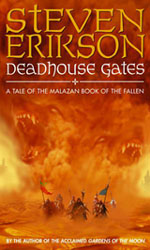
5. Deadhouse Gates (Steven Erikson)
6. Harry Potter Series (J.K. Rowling) (preliminarily)
7. Good Omens (Terry Pratchett / Neil Gaiman)
8. First Chronicles of Amber (Roger Zelazny)
9. Elric Series (Michael Moorcock)

HONORABLE MENTIONS

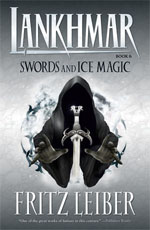
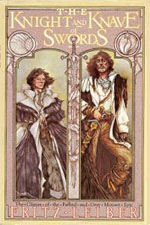
Fafhrd and the Grey Mouser Series (Fritz Leiber)
Chronicles of Narnia (C.S. Lewis)
Dragonflight (Anne McCaffrey)
Wrinkle in Time (Madeleine L’Engle)
Spell for Chameleon / The Source of Magic / Castle Roogna (Piers Anthony)
War for the Oaks (Emma Bull)
The Weirdstone (Alan Garner)
Kane Series (Karl Edward Wagner)

NOVELS ALSO BY…

The Silmarillion (J.R.R. Tolkien)
Discworld (several volumes) (Terry Pratchett)

One of the interesting results of putting together these lists last year was my discovery that, quite contrary to my own personal belief, I was far more deeply read in the field of science fiction than I was in the field of fantasy. (Hence the shorter list.)

In fact, you’ll notice that the Top 10 list only contains nine entries. That isn’t a typo. That’s because none of the Honorable Mentions I list seem to quite justify a position on that list. They aren’t quite in the same league. (To be fair, the science fiction list only had nine entries on it until late last year when Egan’s Diaspora finally filled the last spot.)

You may also note that several incomplete fantasy series have been preliminarily placed on the Top 10 list. Their placement is, of course, based solely on the books released to date, and this placement could certainly change based on future releases. (For example, I tentatively placed Michael Kube-McDowell’s Trigon Disunity trilogy on the Top 10 List of Science Fiction Novels based on the outstanding quality of the first two volumes, only to drop him back down to the Honorable Mentions list after a relatively weak conclusion.)

It is also notable that there is an inconsistency on how volumes within a series are handled. Why are Pratchett’s Small Gods and Erikson’s Deadhouse Gates singled out on the list, while J.K. Rowling’s Harry Potter novels and George R.R. Martin’s A Song of Ice and Fire are grouped collectively? Why is Howard’s The Hour of the Dragon given particular note as part of the series of Conan stories?

Walt, would you like to field this one?

“Do I contradict myself? Very well, I contradict myself. I am large. I contain multitudes.”

Go to Top 10 List of Science Fiction Novels

THE TOP 10

1. Foundation Trilogy (Isaac Asimov)
2. Use of Weapons (Iain M. Banks)
3. Memory (Lois McMaster Bujold)
4. Lord of Light (Roger Zelazny)
5. The Stars My Destination (Alfred Bester)
6. Fury (Henry Kuttner / C.L. Moore)
7. A Deepness in the Sky (Vernor Vinge)
8. Cyteen (C.J. Cherryh)
9. Diaspora (Greg Egan)
10. Ender’s Game / Speaker for the Dead (Orson Scott Card)

HONORABLE MENTIONS

Snow Crash (Neal Stephenson)
Rendezvous with Rama (Arthur C. Clarke)
Dune (Frank Herbert)
I, Robot (Harlan Ellison Screenplay)
At the Mountains of Madness (H.P. Lovecraft)
Lensmen (E.E. “Doc” Smith) (Galactic Patrol thru Children of the Lens)
Contact (Carl Sagan)
The Forge of God (Greg Bear)
Door Into Summer (Robert A. Heinlein)
Gateway (Frederick Pohl)
Dragon’s Egg (Robert Forward)
The Trigon Disunity (Michael P. Kube-McDowell)

NOVELS ALSO BY…

The Fire Upon the Deep (Vernor Vinge)
The Player of Games (Iain M. Banks)
Look to Windward (Iain M. Banks)
Mutant (Henry Kuttner / C.L. Moore)
Northwest Smith (C.L. Moore)
Robot Novels (Isaac Asimov)
I, Robot (Isaac Asimov)
The End of Eternity (Isaac Asimov)
Barrayar (Lois McMaster Bujold)
Mirror Dance (Lois McMaster Bujold)
A Civil Campaign (Lois McMaster Bujold)
Shards of Honor (Lois McMaster Bujold)
Borders of Infinity (Lois McMaster Bujold)
The Demolished Man (Alfred Bester)
Downbelow Station (C.J. Cherryh)
Merchanter Novels (C.J. Cherryh)

What do all these categories mean? Well, the Top 10 list itself should be fairly self-explanatory. The Honorable Mentions are works which just barely miss the Top 10 list for one reason or another. The list of Novels Also By is a result of self-imposed rule which limits an author to a single work on the Top 10 list. The other books listed in the Novels Also By are works by authors already appearing on the other lists which, if those slightly superior works did not exist, would themselves be considered for placement on the list.

This is not, needless to say, a precise science.

The conspicuous absence from these lists, I think, is Heinlein. In general, I think that Heinlein was at his best in his early, short fiction. (“The Green Hills of Earth” is my favorite Heinlein piece.) Of the novels I’ve read, the best two are The Door Into Summer and The Puppet Masters, and even those are flawed in fairly significant ways. Stranger in a Strange Land is mush; Starship Troopers is a short story padded with political essays; and The Moon is a Harsh Mistress is a novella padded with political essays. (Which isn’t quite fair to The Moon is a Harsh Mistress, but makes for a nice line.)

Go to Top 10 Fantasy Novels

The Misenchanted Sword - Lawrence Watt-EvansThe Misenchanted Sword is the first of Lawrence Watt-Evans’ Ethshar novels. The world is soaked in magic – one of those mid-‘80s creations of heavily D&D-influenced fantasy. The attitude can, perhaps, best be summed up by a quote from the book itself: “They wanted to believe in heroes, not ordinary, everyday magic.” (Think about it.)

The concept of the plot is a fairly clever twist on familiar themes: The main character, trapped in the middle of a generational religious war between the followers of the gods and the northern demon-worshippers, is gifted with a magic sword. Unfortunately, as the character rapidly learns, the sword’s enchantments include some rather annoying side-effects – among them the fact that the main character can’t get rid of it. (One might even say it was cursed.)

The back cover blurb on my copy of the book gives the impression that this will all result in something of a farce – like Asprin or Anthony in their prime. In reality, there’s nothing particularly funny about the book at all, and it’s rather clear that Watt-Evans never meant it to be. The story would better be described as something of a melancholic character drama.

The prose (or, perhaps more appropriately, the storytelling) can be awkward at times: There seems to be no trust that the reader will hold on to certain concepts (like the emerging nature of the sword’s enchantment), and thus the same information will be repeated incessantly.

In fact, there is a general lack of authorial confidence: Even the smallest details are given awkward justifications (as if the author were constantly fearful that someone were going to shout “gotcha!”). Every fact is repeated, and the main character goes round in circle after circle as he considers every possibility two or three times before finally taking action.

The setting also poses some problems. Ethshar is formed on the foundation of some rather intriguing and unique ideas, but the details seem to vary randomly between cleverly suggestive and puzzlingly vague.

Ultimately, the biggest problem is that the story seems to simply meander without much of a point.  On the one hand, the most interesting sequences are simply glossed over – probably because the book is meant to be a character drama, not an adventure book. On the other hand, the main character never seems to achieve that vivid depth which would make his story interesting in-and-of itself. And, on the gripping hand, the flaws in the storytelling cause the entire book to wander with wild abandon.

All in all, I found this to be a solidly mediocre book – neither exceptional nor horrendously flawed. It would be a better book if it had been ruthlessly trimmed of its repetitive elements, with the freed-up space being used to move several incidents banished to exposition into the active narrative. As it is, this isn’t a book I’ll caution you against – but it’s not a book I’d recommend, either.

I’m glad that this wasn’t my first Watt-Evans, because otherwise I might draw very different conclusions about his quality as an author. As it is, I’ll almost certainly check out the second Ethshar book at some point to see how the intriguing and cleverly suggestive elements of the setting develop in the hands of a more mature author. My next Watt-Evans, however, will probably be Crosstime Traffic.

GRADE: C

Lawrence Watt-Evans
Published: 1985
Publisher: Wildside Press
Cover Price: $14.95
ISBN: 1-587-15282-7

Archives

Recent Posts

Recent Comments

Copyright © The Alexandrian. All rights reserved.