
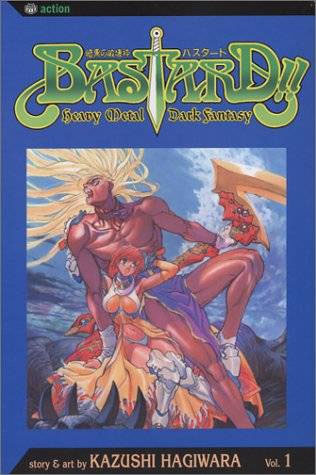
A manga that really didn’t manage to distinguish itself in my eyes.
Review Originally Published February 5th, 2002
WHAT IT IS
Bastard!! is a series of manga created by Kazushi Hagiwara and first published in Japan in 1988 in the pages of Shonen Jump. New episodes are still being published today, and over the years (as the success would imply) it has garnered a fervent fan base and continues to enjoy a high level of popularity.
In 2000, in Japan, Hagiwara began releasing the Bastard!! Complete Edition: This was a re-release of the original 1988 manga. Like the Special Edition of the Star Wars movies, this Complete Edition was retouched, redrawn, and variously improved. Viz Comics is now releasing this Complete Edition in an English translation (oddly credited as being translated by Kaori Kawakubo with an “English adaptation” by Fred Burke – I don’t know what that means).
The comic is subtitled (at least in English) as “Heavy Metal Dark Fantasy”. Based on this first issue, it’s a little difficult to see where either of those terms would apply: The general tone is more comical than dark; and Hagiwara’s Heavy Metal influence doesn’t seem to really enter the series until later based on what I’ve seen.
Basically, here’s the concept of the series: The legendary evil sorcerer Dark Schneider was imprisoned several years ago by the high priest of the kingdom of Metallicana. Dark Schneider’s personality was sealed away and his body transformed into that of a young boy named Lucien. The good priest then “adopted” Lucien, raising him as the younger brother of his own daughter, Tia Noto Yoko. Dark Schneider can only be released by a spell which requires, as catalyst, the kiss of virgin innocent. The high priest taught this spell to his daughter. It is known to no one else.
In the first issue, Metallicana is beset by an army led by an evil sorcerer. To save them from their peril, they are forced to call upon Dark Schneider. Dark Schneider, of course, is not only evil, he is also breathtakingly gorgeous – and Tia Noto Yoko is instantly attracted to him, despite the fact that’s he Pure Evil(TM). Of course, to add a little spice to the mix, every time she kisses him he transforms.
Much comedy ensues.
WHERE IT’S GOOD
Hagiwara is justly commended for the high quality of his artwork. Even in the more primitive forms and compositions present at this early stage of his career, it is easy to make out the seed of an immense talent. In addition to being simply gorgeous at many times, Hagiwara is also capable of simplifying his style and compositions when it serves the story and characters.
The other high point of Bastard!! for me was the humor. The tone is nicely set on page four, when the soldiers of Metallicana, standing before the oncoming horde, say: “Dammit! They’ve attacked when the king, imperial forces, and the priest are gone!”
What are the odds, right? That type of tongue-in-cheek satire is designed to warm the cockles of a fantasy fan’s heart. Hagiwara also gets some decent mileage out of the somewhat strange, mystically tainted love triangle of Tia, Lucien, and Dark Schneider.
WHERE IT’S NOT
Although one can make out the seed of Hagiwara’s talent, these early issues of Bastard!! still need a lot of work. The pacing is dizzying and inconsistent. Many of the compositions are too crowded. Some panels appear to have been simply rushed. In several instances Hagiwara simply drops the ball when it comes to telling the story he’s apparently trying to tell.
Nor is Hagiwara helped much by what I consider to be a sub-par translation. (Or, at least, I’m going to choose to blame it on the translator, rather than on Hagiwara.) All of the characters talk with the exact same voice. Most of the dialogue makes you simply want to wince. Worst of all, many things which you can see are meant to be jokes are translated so badly that the humor is lost. For example:
Tia Noto Yoko: I swear … you little ant! Don’t you have any feelings of frustration – of being pissed off, or of wanting to pulverize someone?! How can you be totally VOID of those kinds of emotions?
Lucien: Y-you’ve got more than enough for BOTH of us!
You can see the potential humor in those lines, but it’s lost because the translation of Tia’s dialogue doesn’t ring true. It’s like watching one of those bad sitcoms where you can tell the joke is being set up because all the characters have suddenly become mouthpieces of the writers.
Similarly, you have instances where the dialogue fails to rise to the dramatic quality of the action. Thus, not only do all the characters sound like each other, they sound the same regardless of whether they are having a quiet chat over breakfast or annihilating giants with mighty magicks.
A FEW CONCLUDING REMARKS
Having read Bastards!! from cover to cover, here’s my assessment: Slayers is better at RPG parody. Record of the Lodoss War is better at the RPG-inspired plot. Rumiko Takahashi is better at the bizarre love triangles complicated by strange magic.
Nor can I even say, based on this first issue, that Bastard!! earns the distinction of combining the three to any great effect. It doesn’t. Instead, Bastard!! simply seems to create an uninspiring mishmash.
I would suspect that I would enjoy this comic more if the translation were better at capturing character and conveying the humor. (There’s nothing more annoying to me than to read something and say to myself: “Wow, that would have been really funny if you’d just delivered the punch line correctly.) I also suspect I would enjoy Bastard!! more a year or two down the line – when Hagahashi’s talent has had a chance to mature.
Those of you who are big fans of Slayers, Record of the Lodoss War, or Rumiko Takahashi’s works might want to give this a shot, though: It would definitely be up you alley, and might appeal to you more than it did to me. I’ll probably be stopping back at this well from time to time myself to see if things have improved.
Style: 4
Substance: 2
Authors: Kazushi Hagiwara (Translated by Kaori Kawakubo; Adapted by Fred Burke)
Company: Viz Comics
Line: Viz Comics
Price: $3.95
Pages: 72
I received Bastard #1 as a review copy. I have absolutely no memory of how or why that happened. While I had some channels for receiving RPG review copies in 2002, I hadn’t done any work with comic books. (It’s possible this was somehow related to a letter I wrote that got published in a Punisher comic book several years earlier. My address had been published with the letter and several smaller companies sent me new comic books hoping that I would write back with letters they could use to fill their letters pages. I seemed to linger on some mailing lists for a while, but although I don’t remember the actual events, I don’t think that’s actually why I received Bastard.)
In any case, receiving a review copy it’s the only reason this review exists: This was still during the time when receiving review copies was such a novel experience for me that I felt honor-bound to review everything I received. For better or for worse, that’s not an ideal I can live up to any more: I’m simply too inundated with requests for reviews. When people ask if they can send me review copies, I tell them that the odds of getting an actual review from me are quite small. Even after getting the copy, the book has to intrigue me enough to read it cover-to-cover. Then, particularly if it’s a new game, it generally needs to be good enough to convince me to actually play it. And even then, it may still not get a review if I don’t have anything interesting to say about it.
The existence of review copies creates a surprising amount of distress for some people, which, to be perfectly frank, is mostly just amusing to professional reviewers, who know it’s standard industry practice and always has been. “But you won’t review something honestly because then you won’t get more free stuff!” is a pretty common refrain, and there are some reviewers who think that way. But those reviewers don’t have integrity to begin with, so it doesn’t matter. The reality, particularly for professional reviewers, is — as I said — being inundated with more review copies than we know what to do with.
I do think it’s important to disclose when you’ve received a review copy. It’s an important facet in what brought you to the product. Something I try to be aware of is that receiving a book for free can have an impact on perceived value. This is also true of birthday presents, of course, but you subconsciously expect less from something that you got for free than you do for something you paid for.
For an explanation of where these reviews came from and why you can no longer find them at RPGNet, click here.









“with an “English adaptation” by Fred Burke – I don’t know what that means”
If you’ve been immersed in the world of Japanese to English translations of Anime/Manga/Video Games, this means “I’m the localizer who will change the Japanese text because I don’t like it and make it palatable to the lowest common American reader denominator”
It’s how you get things like Rice Balls being translated as Jelly Donuts or Kirby being angry on the American cover art of his games.