The Alexandrian

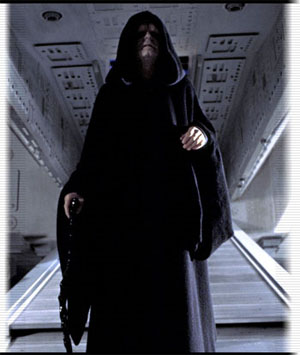
PalpatineI have a theory when it comes to the Star Wars prequels: I think that they are, fundamentally, stories and theatrical experiences with the same depth, scope, grandeur, and quality of the original trilogy. This fundamental strength, however, is masked by the peculiar foibles that have, unfortunately, become emblematic of George Lucas’ recent work: The fart jokes. The anachronistic comedy. The self-indulgent special effects sequences.

But I would further hold that these foibles are, in fact, only cosmetic in nature. In fact, I think an analogy can be drawn to the Special Editions of the original trilogy. Here, too, we see the same foibles: The sinister rendered comical. Droids performing Three Stooges routines. Scenes reinstated which should have (and did) hit the cutting room floor because they lessened the films.

But if you take away all the foibles and sweep them away, you still have the fundamentally great movies we all remember and love.

I think the same thing is true of the prequels. The only difference is that we were never given the chance to see the great version of these films. Instead, all we’ve ever seen are the “special edition” edits — complete with all the foibles and flaws that turn greatness into heartbreaking mediocrity.

This is why, I think, there is a particular fascination with the “phantom edits” of these films (particularly The Phantom Menace and Attack of the Clones). I don’t think any of these “phantom edits” have, in fact, managed to be entirely successful — either due to lack of talent; insufficient technical facility; or the excesses of fanboy agendas — but that’s a subject for another time.

Instead, I want to talk about one of the things that I think Lucas does particularly well in the original trilogy: The scheming of Palpatine.

A common misunderstanding is that “everything goes just like Palpatine wants it to”. The reality is actually a lot subtler and more powerful than that.

THE ORIGINAL PLAN

Let’s begin at the beginning. Before The Phantom Menace opens, what is Palpatine’s plan? Well, to some degree, we need to interpolate (since Palpatine never deigns to monologue like a Bond villain). But the best answer would seem to be this:

As Senator Palpatine, arrange for the Senate to pass exorbitant tax laws targeting the trade guilds. Then, as Darth Sidious, use the outrage over these new tax laws to forge an alliance with the Trade Federation. Use the Trade Federation to trigger a crisis by having them invade his own home planet of Naboo. Use this crisis to trigger a vote of no confidence in Chancellor Velorum and then use his own political connections plus the sizable sympathy vote to be elected the new Supreme Chancellor.

Once that’s been achieved, he would force Queen Amidala to sign a treaty with the Trade Federation, creating a home base for the Separatist movement. He could then gradually increase the scale and scope of the crisis until the Senate was forced to vote him emergency powers. Once he had those, he could tighten his grip on the universe.

THE PHANTOM MENACE

In The Phantom Menace we see these plans get disrupted — at least to some extent. With the help of Qui-Gonn and Obi-Wan, Queen Amidala escapes. Palpatine tries to cope with this situation by sending Darth Maul to recapture Amidala.

In fact, recapturing Amidala is absolutely crucial for the success of Palpatine’s original plan. But Amidala escapes again, finally reaching Coruscant. This forces Palpatine to adjust his scheme: He uses Amidala’s presence on Coruscant to trigger the no confidence vote.

But no sooner is that done than Amidala throws a new wrench into his plans by announcing her intention to return to Naboo. Palpatine tries to have Amidala killed (“Wipe them out, all of them.) — probably in the hopes of creating a martyr — but she thwarts him again, this time by winning the war and defeating the Trade Federation’s droid army.

Ironically, however, this helps Palpatine, too: He was elected Chancellor on a promise to clear up this Trade Federation problem and, within a matter of weeks, the problem has apparently been cleared up. Palpatine can undoubtedly use this huge success to solidify his political support and his position as Chancellor.

The brilliance of The Phantom Menace, masked by Lucas’ foibles, is a story in which the heroes win every single battle… and end up losing the war. And they don’t even know it.

ATTACK OF THE CLONES

To be fair, the heroes in The Phantom Menace probably delayed Palpatine’s plans — forcing him to re-trench and re-establish his plans for a Separatist movement.

But over the next ten years, Palpatine secretly uses his political connections to prevent any lasting repercussions from reaching the Trade Federation; somehow arranges for the creation of a Clone Army; and gets his plans for the Separatist movement back on track. In Attack of the Clones we see the Separatist movement create a crisis great enough for the Senate to vote Palpatine emergency powers (essentially giving him complete control of the government). Palpatine can then activate his clone army and create a conflagration across the galaxy.

The brilliance of Attack of the Clones, masked to a somewhat lesser extent by Lucas’ foibles, is a villain playing both sides of the game while making the heroes do all the work for him. For Palpatine it doesn’t actually matter which side wins the Clone Wars: He controls them both.

Attack of the Clones also features the type of rapid readjustment we saw Palpatine perform in The Phantom Menace. At the very beginning of the movie, there is an attempted assassination attempt on Senator Amidala. One reason for this assassination is explicitly given in the film: The Trade Federation wants her assassinated before they’ll agree to sign on with Count Dooku.

But there’s also a deeper level at work here: Amidala is the leader of the Loyalists, who are opposed to the Military Creation Act. Palpatine is publicly her ally in this, but privately he knows the time is fast-approaching when he’s going to be making a political about-face on this one (all the while talking about the “sad necessity” of his actions). Amidala, however, is an idealist and might prove troublesome. As a martyr, however, she’s not only out of the way — her death could be used as his reason for performing the about-face.

When the assassination attempt fails, however, Palpatine manipulates events again to achieve his desired results: He gets her to return home to Naboo. Meanwhile, on Coruscant, he manipulates the junior senator from Naboo (Jar-Jar) into proposing the very measure Amidala would have probably fought with her last breath.

On top of all that, I suspect an even deeper level of machination: Palpatine knows of Anakin’s feelings for Amidala. And not only does he manipulate the situation to get Amidala off Coruscant, he manipulates it so that she’s sent off of Coruscant with Anakin. Palpatine must suspect that this will create a love that he can then use as a lever to help turn Anakin to the dark side.

REVENGE OF THE SITH

Finally, in Revenge of the Sith, we see the end-game which allows Palpatine to simultaneously become Emperor and destroy the Jedi.

The war he has created and orchestrated from both sides has served not only to create a military state that he rigidly controls, it has also thinned the ranks of the Jedi. Both of these are necessary for the successful execution of Order 66, which paves the way for the dissolution of the Jedi Council and the extermination of the Jedi.

Once those goals have been accomplished, Palpatine quickly brings the civil war to an end. (Easily accomplished, since he controls both sides.) Like an antique Roman, Palpatine refuses to relinquish his emergency powers and becomes Emperor.

THE ORIGINAL TRILOGY

Between the end of Revenge of the Sith and the beginning of A New Hope, Palpatine has continued to “tighten his grip” (as Princess Leia puts it). In terms of the Jedi, this means Darth Vader’s hunting down and destroying the last of that “ancient order”. In the case of the Empire, it means steadily strengthening the regional governors and weakening the Senate.

As A New Hope begins, Palpatine is actually laying down the finishing touches of his Imperial dreams: The Senate has been dissolved and he will rule directly through the governors. All of this is possible, however, only because the Death Star gives him an absolute threat of tyrannical force with which to enforce his will.

When the Death Star is destroyed, Palpatine is dealt a serious blow. What we see in The Empire Strikes Back is the Empire trying to maintain its absolute power using the Imperial Navy. But Palpatine knew that would never be sufficient (that’s why he built the Death Star in the first place) — and, just as Princess Leia predicted, more and more systems are slipping through his fingers. The Rebel Alliance is growing in strength, although it’s still on the run.

In Return of the Jedi we see it all fall apart: The new Death Star is Palpatine’s attempt to restore the control he tried to grasp in A New Hope. And, of course, it fails rather dramatically.

POLITICS AND THE FORCE

This little essay has dealt primarily with Palpatine’s political machinations. But one of the things that makes Star Wars particularly powerful is that there are actually three meta-stories being woven throughout the saga:

First, there are Palpatine’s political machinations — the story of the rise and fall of the Empire.

Second, there is Palpatine’s war against the Jedi — the story of the rise and fall of the Sith (and, conversely, the fall and rebirth of the Jedi).

Third, there is the saga of the Skywalkers — the corruption of Anakin and the pure hero quest of Luke. (Particularly notable here is that a strong argument can be made that Palpatine actually fights a battle against prophecy and, for a limited time, wins. As Obi-Wan tearfully cries out in Revenge of the Sith, Anakin was the Chosen One… and Palpatine took that away from him.)

And although I’m not going to go into it here, there is as much depth and complexity in the second and third tales, in my opinion, as there is in the first.

Explaining Hit Points

January 28th, 2008

Hit points have been around for more than 30 years now. (Longer if you count their antecedents in wargaming.) So you might think that, by now, people would have a pretty firm grasp on how these mechanics worked, what they represented, and what it means to lose hit points.

You might think that. But you would be horribly mistaken.

Basically I’m writing this little mini-essay because I’m tired of engaging in the same painful debate every two months. I want to be able to simply point people to this essay and say, “Look, this is the way it works.” (This won’t actually have much effect with people who prefer to be mired in fallacies and foolishness, but it will at least delay the day on which I will inevitably succumb to a lethal case of carpal tunnel syndrome.)

So, first I’m going to repudiate the two primary fallacies which lead the innocent astray when it comes to understanding hit points. And then I’m going to pull my Big Reveal an explain the beautiful abstraction which lies at the heart of the hit point system.

(It should be noted that this essay specifically deals with the type of inflationary hit point system found in D&D. The term “hit points” may also be used for very different damage tracking systems, to which this essay probably won’t apply at all.)

FALLACY THE FIRST: THE AXE TO THE FACE

The first fallacy goes like this:

1. Dupre has 100 hp.

2. A goblin with an axe has hit him 10 times and done 78 points of damage.

3. Clearly, the goblin has hit Dupre in the face 10 times and Dupre is still alive! That’s ridiculous!

The fallacy lies in the illogical leap from point 2 to point 3. A moment’s consideration clearly reveals that there is absolutely no reason to assume that, every single time the goblin landed a solid blow, it meant that the goblin planted his axe straight between Dupre’s eyes.

For example, imagine that you’re talking to someone in real life and they said, “Did you know that Bill was actually shot three times during a mugging a few years back?” Given that Bill is still alive, would you immediately assume that, during the mugging, Bill was dropped to his knees, a gun held to his head execution-style, and the trigger pulled three times?

Of course not. You would assume that Bill was probably hit in the legs or the arms. If he was hit in the chest, you’d assume that he only survived because he got prompt medical attention. And if one of the bullets actually did take him in the head, you’d know that it was a medical miracle that he was still alive.

Similarly, there’s no reason to assume that Dupre was hit in the face ten times with an axe. In fact, quite the opposite is true: There is every reason to assume that he wasn’t hit in the face ten times with an axe.

FALLACY THE SECOND: DEATH BY DODGING

The second fallacy is most often committed because, after escaping the trap of the first fallacy, people go to the other extreme:

1. Dupre could not have been hit 10 times in the face with axe and survived.

2. Therefore, Dupre was never hit with the axe.

3. Dupre won’t be hit by the axe until a blow causes his hit points to drop below 0. When that happens, the goblin will have finally hit him with the axe.

The fallacy here lies in the leap from point 1 to point 2.

Let’s go back to the example of Bill’s mugging. If you friend said to you, “Did you know that Bill was actually shot three times during a mugging a few years back?” Would you assume that he meant, “The guy mugging bill shot his gun three times, but never actually hit Bill.”?

Of course not.

In terms of D&D, the nature of this fallacy is more explicitly revealed when you look at something like poison. If the orc’s axe is coated with poison and we embrace this fallacy, then Dupre has been exposed to the poison 10 times despite the fact he’s never actually been hit by the axe.

And you can reproach this fallacy from multiple directions: If the hit point loss from blows that don’t “really” hit is because Dupre is wearing himself out from dodging, why is dodging a +1 flaming sword more exhausting then dodging a +1 sword?

And, of course, you also have the oddity that, apparently, dodging a blow from a sword can be even more deadly to you than being hit by the sword.

THE BEAUTIFUL ABSTRACTION

The trick to understanding the hit point system is understand that a hit point is not equal to a hit point. In D&D, 1 hit point of damage always represents a physical wound. However, the severity of the wound represented varies depending on how many hit points the victim has.

For a character with 1 hp, that 1 hp of damage represents a serious wound — a punctured lung, a broken leg, or something of that ilk.

For a character with 10 hp, that 1 hp of damage represents a meaningful wound — a deep but or a broken rib.

For a character with 100 hp, that 1 hp of damage represents an essentially inconsequential wound — a scratch, a bruise, or the like.

The reason any particular character has fewer of more hit points (and, thus, varying the severity of any given wound they receive) is abstracted. For some characters its skill; others luck; others physical toughness; others divine grace; others magical protection; and so forth. For most PCs, it’s some combination of all these things.

This is a beautiful abstraction because it allows for quick, simple, and entertaining gameplay. One could certainly design a system with variances in skill, luck, toughness, divine favor, magical protection, and the like were all separately modeled. Many such systems exist. But none of them are as simple, easy, or fun or as hit points have proven to be.

IS IT PERFECT?

No. The system is an abstraction, and that brings with it both advantages and disadvantages. The advantages are simplicity and completeness. The disadvantage is that you can’t reliably pull concrete information back out of the abstraction — and, if you try, you’ll eventually find corner cases where seeming absurdities crop up.

For example, it’s theoretically possible for a sufficiently weak character to deal no more than 1 hp of damage per attack. Such a character could, theoretically, land 100 blows on a character with 100 hp before taking him down. Add poison to the scenario, and you’ve now locked yourself down to a scenario where the weak character is, apparently, whittling his opponent to death.

Such corner cases are statistical oddities, but they’re going to reliably crop up in any system which doesn’t require several additional orders of complexity.

Which leaves the only significant and intractable problem with the hit point abstraction: The cure spells. Despite the fact that the number of hit points required to represent a wound with a particular severity varies depending on the character’s total hit points, a cure spell heals a flat number of hit points. Thus, a cure light wounds spell used on a 1st level fighter will heal grievous wounds. When the same spell is used on a 10th level fighter, on the other hand, it can’t handle more than a scratch.

This is a legacy issue which has been retained for reasons of game balance. But if you want to fix this, simply have cure spells work more like natural healing: Multiply the number of hit points cured by the creature’s HD.

Hit points aren’t a one-size-fits-all solution to tracking wounds in roleplaying games. There are lots of reasons why you might want a more concrete representation of actual wounds or a realistic modeling of incapacitation.

But hit points are often attacked for the most erroneous of reasons. And, as I said up front, I don’t necessarily expect this little essay to make any sort of huge dent in that tidal wave of ignorance and faulty logic. But it might help me keep my blood pressure down.

Henry V – Constable of France

December 11th, 2007

Henry V - Coat of Arms

I’ve been absent for a bit being morose and unproductive, but I’ve got some excellent news: I have been cast as the Constable of France in Theatre in the Round‘s production of Henry V. The show opens on February 8th and runs through March 2nd. This will be the first piece of fresh theater I’ve done in 6 years.

… and when I actually say that out loud, it sounds absolutely insane.

So I hope to see ya all there in February. I’ll drop another reminder on the site when the time draws on apace.

Seal of the 3rd Edition

November 29th, 2007

As you may have already heard, the D20 Trademark License is being revoked with the release of 4th Edition. WotC considers the D20 mark to have been a failure due to the lack of quality control: In their opinion, the value of the brand had been diluted because consumers associated it with a lot of bad products.

That may or may not be true, but the utility of the D20 Trademark License was never about identifying quality products: It was about identifying compatible products.

This leaves third-party publishers (like myself) in something of a bind: Without the D20 Trademark License, we have nothing that we can use to quickly and easily identify our products as being compatible. (The D20 Trademark License not only covers the use of the trademark itself — it also covers the “Requires the Use of the yada yada yada” language which is the second-most common way of identifying a compatible product.)

This sudden yanking of the D20 Trademark License only complicates a situation which was already on the verge of being completely muddied by the advent of 4th Edition: To whit, there’s no easy way for a publisher to indicate that their new product is compatible with the new edition. (Or, if the market forks, that their product is compatible with 3rd Edition and not with 4th Edition.)

In order to solve both of these problems, Dream Machine Productions has created two trademark logos that can be used to indicate compatibility: The Seal of the 3rd Edition and the Seal of the 4th Edition.

Seal of the 3rd Edition

The Seal of the 3rd Edition is being immediately released under a free license so that anyone who wants to use it — whether a professional company or amateur designer — can use it freely.

3rd Edition Seal – Color
3rd Edition Seal – Black
3rd Edition Seal – White
3rd Edition Seal – Grayscale
3rd Edition Seal – Full Size
3rd Edition Seal – PSD File

Seal of the 3rd Edition Trademark License – Version 1.0
Seal of the 3rd Edition Trademark Guidelines – Version 1.0

Seal of the 4th Edition

The Seal of the 4th Edition will be released under a similar license as soon as the 4th Edition SRD becomes public. (Until the SRD of the new edition becomes public, we can’t finalize the compatibility guidelines.) (EDIT: The GSL actually released for 4th Edition made this project untenable.)

4th Edition Seal – Color
4th Edition Seal – Black
4th Edition Seal – White
4th Edition Seal – Grayscale
4th Edition Seal – Full Size
4th Edition Seal – PSD File

If you have questions, suggestions, or concerns, please feel free to drop me a comment or an e-mail.

Similarly, if you have a need to use the Seal of the 4th Edition trademark logo before the 4th Edition SRD becomes public, simply contact me for permission.

Recently I’ve been involved in several discussions regarding skills in D&D.

There’s an attitude I’ve never been able to understand when it comes to roleplaying games (or anything else for that matter): “I have too many options.”

For example, lots of people complain that there are “too many supplements” for their game. In fact, a lot of people are looking forward to 4th Edition precisely because it will strip away all of those supplements. Ignoring for the moment that 4th Edition will have supplements released for it several months before the game itself is actually available, these complaints and this glee simply leave me scratching my head.

If you don’t want them, don’t buy them.

It’s not like someone is coming round to your house, holding a gun to your head, and forcing you to buy a supplement. If you don’t want them, then don’t buy them. Nothing could be easier. Your “problem” can be solved by doing, literally, nothing at all.

On the other hand, if you need them or want them… well, there they are. And the more of them there are, the better it is (because that drastically increases the odds that whatever supplement you need at this particular moment in time will, in fact, exist).

I bring this up because I see the same complaint leveled at 3rd Edition’s skill system.

The sentiment is perhaps most eloquently put by Vinicus Zoio on WotC’s messageboards: “God, I hope they get rid of skill points!”

“GOD, I HOPE THEY GET RID OF SKILL POINTS!”

I really couldn’t disagree more.

The existing skill point system is the best of both worlds.

(1) If you want to quickly generate a character’s skills, select a number of class skills equal to # + Int modifier and give them skill ranks equal to 3 + your level, where # is based on your class. (Multiclass Characters: For each class, select a number of class skills equal to # + Int modifier and give them skill ranks equal to their class level. Add +3 skill ranks to the class skills selected for whatever class was taken at 3rd level.)

(2) If you want to customize your character’s skills, on the other hand, you have complete flexibility to do that.

The only thing I’d tweak is the rules for handling increases in Intelligence so that they retroactively grant you skill points (the same way that Con increases retroactively boost your hit points). You can argue the “realism” of this (I don’t have a problem with it), but it removes the only mechanical hiccup getting in the way of the fast-and-easy creation method of scenario #1.

The Star Wars Saga Edition method of doing things (which appears to also be the way that 4th Edition is going), on the other hand, is remarkably inferior: It gives you scenario #1… and only scenario #1.

And here’s the trick: It doesn’t make scenario #1 any faster or easier. So by adopting the SWSE method of doing things, you’re sacrificing flexibility and customization, and you’re gaining… absolutely nothing.

SKILLED vs. UNSKILLED

To be fair, there is another argument for adopting the SWSE system for handling skills: It eliminates the disparity between skilled and unskilled characters.

The argument goes something like this: A character who specializes in the Hide skill will eventually become so skilled at hiding that a person who hasn’t invested any skill points into Spot will never be able to spot them. (This happens when there is a 20-point difference between the Hide skill bonus and the Spot skill bonus — the 1d20 roll can no longer span that difference.)

SWSE solves this “problem” by turning every character into a renaissance man: Your trained skills are set to:

1d20 + 5 + character level + attribute modifier + miscellaneous modifiers

Your untrained skills are set to:

1d20 + character level + attribute modifier + miscellaneous modifiers

As you can see, this means that all characters become skilled in all things (with the exception of some trained-only skills). A 10th level characters is as a good at every single skill as a trained 1st level character.

This does eliminate the disparity between the skill bonuses of various characters… but it also means that every single character in SWSE is Doc Savage.

FIXING A FALSE PROBLEM

But the real problem with SWSE’s “fix” is that this disparity isn’t actually a problem.

This type of disparity is a problem when it comes to attack bonuses and saving throws, because those are target numbers which are fundamental to a wide array of common challenges in the game: If you’ve reached a point where the rogue will automatically succeed (barring a natural 1) on any saving throw the fighter has any chance of making, then it becomes increasingly difficult to design challenges for the group.

But skills, in general, don’t suffer from these problems. Any problems created by disparities between skilled and non-skilled characters can be simply addressed by:

(1) Rewriting the skill rules to remove a handful of truly problematic skill uses. (Diplomacy and Tumble, I’m looking at you.) These are areas that need to be addressed any way.

(2) Not worrying about it. If the wizard can cast improved invisibility, why are you fretting about the fact that the uber-specialized Hider finds it trivial to sneak past the unskilled Spotter? If the spellcaster can whip off a dominate person, why is it a problem that the relatively naive guy who has never spent a rank in Sense Motive is consistently getting the wool pulled over his eyes by the legendary Bluff specialist?

LACK OF FLEXIBILITY

But an unnecessary lack of flexibility increasingly seems to be the design methodology for 4th Edition. For example, Andy Collins recently discussed the fact that, in 4th Edition, abilities which were once feats and available to any character will now be class-specific abilities. This is one giant leap backwards for the game.

Similarly, it now appears that monsters and PCs will be built on mutually incompatible frameworks.

All of these things are major strikes against 4th Edition, in my opinion. Combined with decisions like removing saving throws from the game (fundamentally altering something that has been a core component of D&D gameplay for more than three decades), focusing the game exclusively on miniature-based tactical play (both in terms of removing real-world measurements from the rules and in terms of designing monsters so that they have no function outside of combat), and changes to the meta-setting of the game (something roughly akin to changing the property names in Monopoly) the prospects for 4th Edition looker bleaker and bleaker for me.

It seems increasingly likely that the game is heading in the wrong direction. I’m still holding out some hope, but my suspicions are growing that I will not be making the transition from 3rd Edition to 4th Edition.

Archives

Recent Posts

Recent Comments

Copyright © The Alexandrian. All rights reserved.