The Alexandrian

And We’re Back…

January 19th, 2009

I’ve got things set-up now so that I can do regular updates without breaking my mind or the website. Now all I need is the time to do it.

What have I been up to? Well, in addition to the new house that I mentioned awhile back (and which triggered the sporadic nature of recent updates), I’ve had several major projects on my platter.

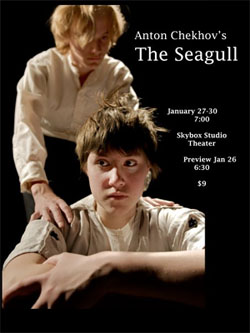
THE SEAGULL

The Seagull - South High School

I did a proxy translation of Anton Chekhov’s The Seagull and have been directing it at South High School (my alma mater). The show opens next week with a preview on the 26th. It’s high school theater, but it’s very good high school theater.

THE FLICKERING WALL

The Flickering Wall - Illusion Theater

I am also appearing in The Flickering Wall, an original play written specifically for the Illusion Theater. It’s a really fascinating installation piece in which the audience moves through the backstage spaces of what was once a Masonic temple and is now one of the premiere theaters of the Twin Cities.

Between these two projects, I’ve been doing back-to-back rehearsals for most of the past two months. It’s been exciting, but also exhausting.

PTOLUS – IN THE SHADOW OF THE SPIRE

Ptolus - In the Shadow of the Spire

One of the perks of finishing the moving and renovation process is that we’ve been able to meet for more regular game sessions in the ongoing campaign I’ve been DMing. Before the disruption to the website, I’d been posting the early campaign journals. I’ll be getting more of those campaign journals up soon, along with various snippets of commentary and analysis.

DREAM MACHINE PRODUCTIONS

Legends & Labyrinths

I have several 3rd Edition products in development.

Many people have been asking me about the current status of Legends & Labyrinths. Development is progressing, but the long and the short of it is that it will be done when it’s done. The truth is I’m probably being too much of a perfectionist with it.

Response to Spells of Light and Darkness and City Supplement 3: Anyoc have been strong. For now I’m taking that as an indication that the 3rd Edition market is still extant. It’ll be interesting to see how that progresses over the next several months, particularly with so many publishers pulling down their 3rd Edition material.

THE ALEXANDRIAN

I’ve actually been backlogging a lot of material for the website during this technological furlough. If you come back tomorrow, you’ll get to see some of it…

(I’m such a tease.)

It’s My Birthday!

December 4th, 2008

Boom de yada!

Sorry the website hasn’t been getting the proper TLC. My attention has been almost wholly consumed — albeit divided — between (a) working on my new house and (b) the production of The Seagull I’m directing at South High School in Minneapolis.

South High is my alma mater, and under the guidance of Louise Bormann it has had a consistently excellent theater department. I feel very honored to be serving as a guest director. For The Seagull I started by producing a completely original proxy translation of the play, and am now embroiled in the actual directing of the play — which also includes developing in-depth acting workshops for the actors.

I keep expecting to be able to get a few days ahead in my prep work for the project and, thus, find the time to work on other projects. But that hasn’t actually happened yet.

And I’m still stuck working off my laptop… which is a perfectly nice computer, but has only a fraction of the software I use to keep this website properly up to date.

Soon, however, I’m hoping to have things back to normal.

Thanks for your patience.

THE LEGACY

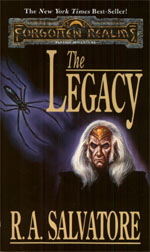
The Legacy - R.A. SalvatoreThe problem with The Legacy is that Salvatore allows one of his strengths (his ability to vividly describe fight scenes) to bloat horribly out of control. The plot, with minimal spoilage, can basically be summarized as such: There is about twenty pages of meaningful character interaction. Then there’s a big battle between dwarves and goblins. This battle is extensively described in both tactics and detail, but is ultimately meaningless: It has no effect whatsoever on the rest of the book. Then there’s another twenty pages or so of meaningful character interaction. And then there’s another huge, rambling fight sequence that lasts for two hundred pages.

The End.

In fairness to the novel, while the battle between the goblins and the dwarves is utterly pointless, the big fight sequence which makes up the bulk of the book is laden with plot. But it’s still just a big fight scene: It’s page after endless page of detailed thrusts, parries, dives, cuts, blood, noble charges, and hard struggle.

Die Hard literally has a narrative with more breathing room.

More damning, however, is that the plot is poorly formed.

(There are some meaningful SPOILERS from this point forward.)

In my reaction to the Icewind Dale Trilogy, I mentioned my belief that perhaps the biggest reason Drizzt Do’Urden caught the imagination of so many readers was Salvatore’s decision to give him a rival of equally deadly skill in the formidable assassin Artemis Entreri.

I don’t waver in that conviction, but in reading the handling of the Drizzt-Entreri rivalry in The Legacy, I kept expecting one or the other to don a leather jacket, hop on a motorcycle, and jump over a shark.

Let me see if I can sum this up: Mixed into the larger fight sequence, Drizzt and Entreri fight. Their fight gets interrupted. They futz around for a bit, and then they fight again… but this fight gets interrupted. So they futz around for a bit, and then they fight again… and this fight gets interrupted, too. So they futz around for a bit, and then they fight again… and this time Drizzt wins by knocking Entreri off a cliff. Entreri falls to his doom.

Except Entreri isn’t dead. He’s got a magical cloak that lets him fly. So he flies back up and they fight again. Drizzt wins again, and this time he knocks Entreri unconscious, causing Entreri to fly into a cliff at literally breakneck speed. Entreri falls to his doom.

Except Entreri still isn’t dead. His now-broken magical cloak has caught on a rocky spur and he’s dangling from a cliff. So a completely different character climbs up to Entreri, cuts the cloak off him entirely, and then watches him fall to his doom.

For real this time.

(Just kidding. In the next book, it’s revealed that Entreri was miraculously saved from his fall by people who had no reason or opportunity to do so.)

There are just so many problems with this…

By the time Salvatore is done, the Drizzt-Entreri rivalry has been robbed of its meaning and significance: While there was definitely room left open for a rematch after the end of The Halfling’s Gem, the numerous fights between the two in The Legacy eventually just become so much noise on the page.

Salvatore, to his credit, manages to recover from his mistakes by providing a really powerful conclusion to the fight… the first time Entreri falls from the cliff. By the third time that Entreri has supposedly fallen to his doom, even that has been turned into a hollow mockery.

More importantly, there are only about fifteen pages of actual plot to be found here, yet Salvatore has stretched that material to cover more than fifty pages through sheer, dull-minded repetition. This is infinitely worse than the wasted space in Exile: There you had random encounters which served no greater purpose in the plot, but at least they were interesting and original in their own right. In The Legacy, you simply have bloat.

And this is just one plot thread. The bloat within the other plot threads is not nearly as egregious, but all of them suffer from it.

Here’s what it really boils down to: The Salvatore who wrote The Crystal Shard would have boiled The Legacy down into about 50 pages of taut, action-packed storytelling. Unfortunately, the Salvatore who actually wrote The Legacy gave us a 300 page mess leading to…

STARLESS NIGHT
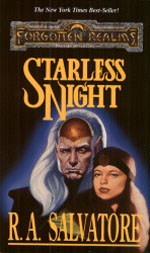
Starless Night - R.A. SalvatoreBasically, Starless Night suffers from the same problem The Legacy does, although to a slightly lesser degree: Instead of 50 pages of plot bloated into 300 pages of novel, it’s 100 pages of plot bloated into 300 pages of novel.

The actual, meaningful plot of Starless Night is fairly straightforward: Drizzt returns to his homeland and discovers that the dark elves are planning to conquer the kingdom of his dwarven friend.

That’s a solid plot. It not only moves along the arc of the greater story Salvatore is obviously trying to tell, it also offers up those essential crucibles which reveal and develop character: Drizzt, returning to the homeland he had forsaken, has a meaningful internal struggle. His friends’ reactions to his decision are meaningful turning points. And so forth.

But again, Salvatore can’t keep his eye on the ball: The plot wanders off in a thousand random and meaningless directions. Several pointless fights consume page after page of empty action. Narrative beats are repeated again and again and again… and again until you’re reduced to tears of boredom.

Characters also begin acting in a shallow and random fashion. Whether it’s a dark elf priestess monologuing with Machiavellian glee over the doom of our hero while the hero’s allies rally right behind her or a dark elf mercenary, immediately after capturing Drizzt, launching an elaborate and completely unmotivated plan to free him again, Salvatore’s characters simply lack any believability.

(To clarify: Motivation is given to Drizzt’s liberator. However, the motivation makes no sense. After being instructed by his employer to kill all the witnesses to Drizzt’s capture, the character concludes that his employer will make a public announcement that Drizzt has been captured and, thus, screw things up. The character, therefore, decides to free Drizzt and avoid the crisis.)

(Feel free to read through that again. But it won’t help.)

Salvatore doesn’t do himself any favors by introducing a plethora of new characters. Mostly villains, these new characters aren’t meaningfully vested with any identity or purpose: They’re given names, shoved briefly onstage, and then hacked down.  You have the vague feeling that perhaps you should be cheering Drizzt on with particular vigor when he confronts the drow priestess who’s been torturing him… but since that torture was scarcely even mentioned before the confrontation happens, you don’t really care.

And don’t even get me started with the half dozen people who all want to fight with Drizzt so that they can prove that they’re the Biggest Drow in Town. The final confrontation between Drizzt and one of these would-be challengers was cleverly handled (with Drizzt’s natural talents facing off against magically-enhanced skill), but since the challenger had absolutely no personality or existence beyond “I want to fight Drizzt!!!” the entire confrontation felt pointless. It was just a fight for the sake of a fight.

These books are deeply disappointing after the fun times of the Icewind Dale Trilogy and the Dark Elf Trilogy. I own several more books in the series (having bought them in bulk so that I could take them on a vacation to Mexico), but have never bothered to read them.

GRADES:

THE LEGACY: D+
STARLESS NIGHT: D+

R.A. Salvatore
Published: 1993 / 1994
Publisher: Wizards of the Coast
Cover Price: $7.99
ISBNs: 0786948590 / 0786948612

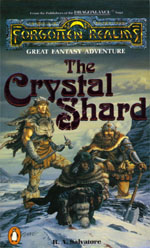
The Crystal Shard - R.A. SalvatoreR.A. Salvatore has two strengths as a writer. First, he’s capable of writing fresh, detailed, and exciting battle scenes – battle scenes which not only serve as really excellent set pieces, but which also actively contribute to the plot. Salvatore’s stories don’t get put on pause while his characters throw down. Instead, each fight is an important part of the evolving drama.

Salvatore’s second strength is his ability to craft epic, rapid-fire plots, cramming them full of the action scenes he writes so well, and then moving the whole package along at a fast clip. He keeps you entertained on every page.

For example, The Crystal Shard, the first novel in the Icewind Dale Trilogy, stretches across half a decade. It starts with a barbarian invasion, moves through a well-done coming-of-age story, and then concludes with a massive military campaign against the armies of an evil sorcerer. It includes dragon-slaying, demonic machinations, and barbarian heroes becoming kings.

That’s a lot of stuff to cram into 300 pages or so.

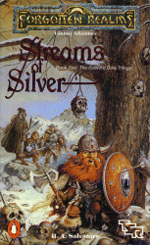
And Salvatore doesn’t slow down. In the second novel, Streams of Silver, you’ll find a deadly assassin bent on vengeance, a beautiful elven queen, a quest to reclaim a dwarven city lost to an ancient evil, a circle of evil wizards plotting for power, bar-room brawls, back alley dealings, and (of course) more dragon-slaying.

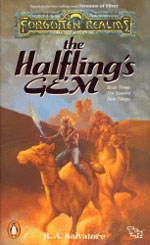
And in the third volume, The Halfling’s Gem, the trend continues: Desert intrigues, damsels in distress, wererat thieves, battles with pirates, an epic duel between the two greatest swordsmen in the world, and a portal to hell.

Streams of Silver - R.A. SalvatoreSalvatore’s narrative palette, as you can see, is drawn straight from stock fantasy and adventure fiction. His prose (except for his exceptional battle sequences) is purely pedestrian and frequently marred by his penchant for repeating the same piece of information (just in case you weren’t paying attention the first time he said it, I suppose). But what makes Salvatore’s stuff fun to read is his ability to reach a critical mass of sheer niftiness.

And that’s an important word: FUN.

If you’re looking for the next Great Fantasy Novel that will touch your soul and live unmarred in the book and volume of your mind, this isn’t it. But if you’re looking for some serious fun — the type of fun that used to be found in the best pulp fiction – then you can’t go too far wrong by grabbing some Salvatore.

There are a couple of other qualities which make the Icewind Dale Trilogy worth your while:

First, it feels like a really good D&D campaign. And I mean that in the best possible way. I don’t mean that you can see the dice being rolled or anything like that. Rather, I mean that the main characters have that rare sense of camaraderie, witty repartee, and ineffable chemistry that can be achieved when a gaming group really gets into the groove. They feel like the Three Musketeers. Again, it’s fun. (Just in case you weren’t paying attention the first time I said that.)

And, speaking of characters, they’re another highlight of the trilogy. The supporting cast is a bit cardboardy, but the main characters are a memorable and entertaining bunch: Each has a unique voice and personality. Each is given a distinct and interesting backstory. Each is developed in detail, with meaningful growth and change.

In this last regard, Salvatore shows a remarkable degree of skill when it comes to putting his characters into crucibles which serve to not only actively reveal but also change their quality.

Perhaps the most notable of Salvatore’s characters is Drizzt Do’Urden, a dark elf. Although the dark elves are known for their cruelty and evil, Drizzt is possessed of a noble heart. An exile from the great underground cities of his people, Drizzt is also an outcast in the surface world he has chosen as his home — perpetually judged by the color of his skin.

The Halfling's Gem - R.A. SalvatoreDrizzt is notable because he’s probably the first swords-and-sorcery hero of significance – cut from the same cloth as Conan, Elric, or the Gray Mouser – to appear since Karl Edward Wagner’s Kane stories in the 1970s. (His status as an outcast seems to draw frequent comparison to Elric, although that’s pretty much where the comparison comes to an end.)

In the narrative of the Icewind Dale Trilogy, Drizzt is on an equal footing with the rest of the main cast. But something about the character simply resonated with the readers. Personally, if I had to take a guess at what caused Drizzt’s immense and inordinate popularity, I would point my finger at Salvatore’s inspired decision to not only make Drizzt the finest swordsman in all the land, but to simultaneously give him a villainous rival of equal skill and ability. Conan, Cyrano, and the Gray Mouser are all clearly swordsmen of legendary prowess and skill… but only Drizzt, after being similarly pumped up in the expectations of the readers, gets to demonstrate his skill in a life-or-death duel with a villain of equal talent in the form of Artemis Entreri.

(For the record, Cyrano de Bergerac is still the finest swordsmen in all the many worlds. Leiber is an idle boaster.)

Drizzt’s popularity lead to a prequel trilogy dedicated to the telling of his personal history. And from that point on, he became the main character of the series (which is now referred to collectively as “The Legend of Drizzt”).

GRADES:

THE CRYSTAL SHARD: C+
STREAMS OF SILVER: C+
THE HALFLING’S GEM: C

R.A. Salvatore
Published: 1988 / 1989 / 1990
Publisher: Wizards of the Coast
Cover Price: $19.95 (Collected Edition)
ISBN: 078691811X

I originally wrote my What I’m Reading reactions for Dune and Dune Messiah in the summer of 2006. They were supposed to be part of a series of reactions covering the entire Dune saga, but I got distracted by other projects and never finished it.

Basically, I think the Dune sequels are almost universally under-rated.

In order to complete proper reactions for the later books at this late juncture, however, I would need to re-read the series. That’s unlikely to happen for awhile, so — in the interim — here’s a quick summary of my thoughts.

CHILDREN OF DUNE

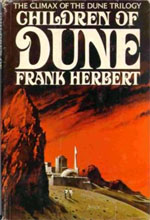
Children of Dune - Frank HerbertI think that either Dune Messiah or Children of Dune is the weakest book in the series. However, it’s difficult to figure out which book is worse because it depends on how you choose to look at the problem

On the one hand, Children of Dune is almost certainly a better novel than Dune Messiah. On the other hand, it is also very derivative of Dune Messiah. Essentially, Children of Dune retells the same story: In Dune Messiah, Herbert tells the story of how Paul slips out of the shackles his prescience had placed upon the human race. And it culminates in the birth of twins he did not foresee, which (for me) pretty clearly indicates that Paul’s vision has been derailed.

But then Children of Dune comes along and says, “Nah, just kidding. You need to pursue the Golden Path to derail the shackles of prescience.” And then it promptly retells the same story as Dune Messiah, starring Paul’s son instead of Paul.

Given the somewhat half-baked quality of Dune Messiah, I suspect that this is literally a case of Frank Herbert wanting a do-over. But the derivative nature of Children of Dune greatly diminishes it if you’re reading the series in sequential order.

On the other hand, if I had to choose one book or the other, I think it’s a no-brainer to choose Children of Dune.

GRADE: A-

GOD-EMPEROR OF DUNE

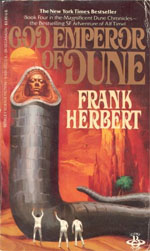
God Emperor of Dune - Frank HerbertI think it safe to say that God-Emperor of Dune is probably the most-reviled book in the series. But I actually enjoyed it a lot. It’s a very different novel from the earlier books. It’s a contemplative, almost zen-like poem — but one laced with deeply horrific tragedy. Watching Leto slowly strip away his own humanity in order to save all of humanity was a profound experience for me.

I think God-Emperor of Dune also speaks to the problem many people have with the series: Herbert didn’t write sequels in the traditional sense of the word.

If you look at works like Star Wars, Lethal Weapon, Harry Potter and the Sorcerer’s Stone, Bridget Jones’s Diary, or Asimov’s Foundation, for example, you will find that the sequels are all pretty similar in tone, content, and style to the original work.

But that’s really not the case with the Dune novels. Even Dune Messiah is fairly distinct from Dune, and God-Emperor of Dune is a completely radical departure. And I can easily see how someone who enjoyed Dune would find absolutely nothing appealing about the style or structure of God-Emperor.

Fortunately, I like both styles of fiction. And, for me, the contrast between the two only enriches the experience.

GRADE: A-

HERETICS OF DUNE / CHAPTERHOUSE OF DUNE

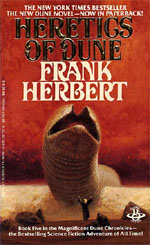
Heretics of Dune - Frank HerbertI enjoyed Heretics of Dune and Chapterhouse of Dune quite a bit. They, again, took the Dune saga in a radically different direction and developed the milieu in ways I had never expected.

But it’s also difficult to know exactly what to make of them. Unlike the earlier books, they were specifically conceived and written as a trilogy… but Herbert died before the trilogy was completed. So it feels a little bit like reading The Fellowship of the Ring and The Two Towers if Return of the King had never been written.

They’re good books… but you’re left dangling with no sense of conclusion or thematic closure.

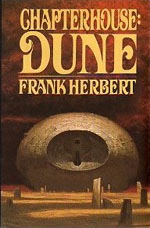
Chapterhouse: Dune - Frank HerbertWhen I was reading these books, the concluding duology — written by Kevin Anderson and Brian Herbert — had not yet been published. Although I’ve generally avoided those books like the plague, the next time I read through the Dune saga I’ll probably break down and read the duology. If nothing else, it’s supposedly based on Frank Herbert’s original outline — so it will hopefully give me some sense of where Herbert was planning to go.

GRADE (HERETICS): A
GRADE (CHAPTERHOUSE): A

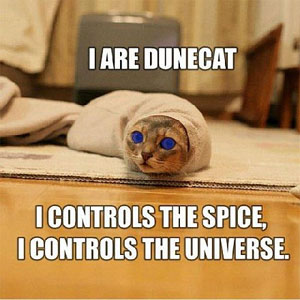
I Are Dunecat

Archives

Recent Posts

Recent Comments

Copyright © The Alexandrian. All rights reserved.