IN THE SHADOW OF THE SPIRE
PRELUDE 2C: THE AWAKENING – AGNARR
PBeM – March 5th thru 9th, 2007
The 15th Day of Amseyl in the 790th Year of the Seyrunian Dynasty

IN THE SHADOW OF THE SPIRE
PRELUDE 2C: THE AWAKENING – AGNARR
PBeM – March 5th thru 9th, 2007
The 15th Day of Amseyl in the 790th Year of the Seyrunian Dynasty
IN THE SHADOW OF THE SPIRE
Prelude 2C: The Awakening – Agnarr
In which our hero awakes on the softest bed and pillow he’s ever laid his head upon. (Could it really be stuffed with feathers?) And many other astonishing sights and sounds are to be seen and heard.
One of the advantages of using Ptolus as a setting is the wealth of graphical resources available for the setting. The big book itself is packed full of full-color illustrations, maps, symbols, and all manner of such things.
For example, there’s the Ghostly Minstrel — an inn and tavern specifically designed to service delvers, wanderers, and adventurers of all sorts. Here’s what it looks like:
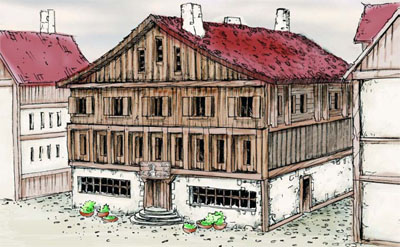
Illustration from Ptolus: City by the Spire
It’s located in Delver’s Square, a plaza of small businesses dedicated to profiting off the gold-rush explorers of the caverns and complexes beneath the city. It, too, is illustrated. And so, when Agnarr looked out the window in this week’s installment, I was able to show his player:
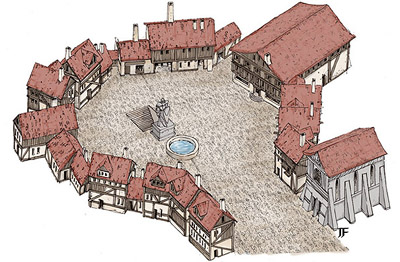
Illustration from Ptolus: City by the Spire
I also spent $5.00 to pick up the Ptolus: Deluxe City Map supplement, so if I wanted to I could print this out as a handout for my players:
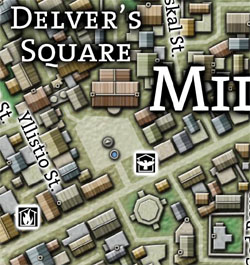
Illustration from Ptolus: Deluxe City Map
(When snipped out of the deluxe map, that defaults to a 7.5″ x 7.5″ image.)
And since I was planning to use the Ghostly Minstrel as the initial homebase for the campaign, I also spent $4.50 on Ptolus Adventure Maps: Ghostly Minstrel. This wonderful product gave me beautiful, miniature-scaled maps of the Ghostly Minstrel. Since the campaign has moved to the table-top, these maps have proved ridiculously useful over and over again — whether the PCs are getting ambushed in their rooms or surprising gangsters in the entry hall.
And most of the time, it’s not even about combat: Being able to show the crowded common room by actually showing the crowded common room is delightful. And just having this kind of visual reference, I think, helped to make the Ghostly Minstrel feel more like home.
It also meant, as the PCs were waking up in strange rooms with no memory of how they had gotten there, I could pretty much instantaneously prep handouts like this one:
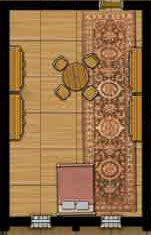
Agnarr’s Room
“Here’s what you see. Now, what do you do?” That type of handout immediately raises questions. What’s in those dressers? What’s beyond the door? What can I see out the windows?
Even if I had the artistic chops to pull off this kind of work on my own (and I don’t), it’s still incredibly rewarding to have this kind of graphical panoply to draw upon. To be sure, the Ghostly Minstrel is an exceptional example of what Ptolus offers as a gaming resource — but the detail of the Deluxe City Map alone (which may be the best $5 I’ve ever spent) is enough to guarantee that, if I want it, there’s no place in the city that I can’t give some sort of visual reference for.
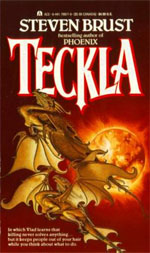 Following on the heels of Jhereg and Yendi, Teckla was a completely unexpected — and thoroughly pleasurable — suprise.
There is a unique pleasure to be had in discovering, as you’re reading through a series of novels, that an author has suddenly reached a higher level in their craft. And Teckla is the point at which Steven Brust raised his personal bar of excellence.
Everything positive I had to say about Jhereg and Yendi remains true: The seamless mixing of high and low fantasy. The addictive nature of Brust’s prose. The intriguing suggestions of a non-linear meta-narrative. The unique take on familiar scenarios.
But unlike Yendi, Teckla raises the stakes. In my reaction to Yendi, I wrote: “The first time you show me a rocketship? Awesome. The second time you show me a rocketship? Nifty. Now, what are you going to do with it?”
In Teckla, Brust uses the (metaphorical) rocket ship.
Perhaps the most dramatic improvement in Teckla is the depth with which the characters are drawn. In the previous books, Vlad himself was a great narrator and quite a few members of the supporting cast were interesting people. But in Teckla, Vlad basically walks up to you and says, “Hi. I’m a real person.” There’s no single, clear-cut example that I can point to with that — but the difference is palpable.
The supporting cast is similarly drenched with utterly believable characterization. And Brust is impressive in his ability to write characters with radically different personal philosophies while still having them ring completely true.
I was particularly blown away when I realized, halfway through the book, that I was frequently in vehement disagreement with Vlad… and yet I still sympathized with him and had no problem being inside his head for the duration of the novel.
That, frankly, is not easy to do.
And because Brust manages to pull it off, Vlad’s personal journey — a journey that actually transforms him in deep, meaningful, and utterly non-contrived ways — really pops off the page here.
I can contrast this directly with the love story in Yendi, which was supposed to be a similarly transformative experience for Vlad… but was instead a fairly flat and unbelievable “love at first sight” and “burning loin hormones” affair that I was really only able to buy into because I had previously seen the couple’s later married life in Jhereg (which had been drawn with some legitimate affection and detail).
Here’s the meat of it: At the heart of the novel, Teckla is the story of a failing marriage and a man’s desperate quest to find peace with himself. It manages to be both heartbreakingly true and upliftingly hopeful, without riddling itself with either maudlin pathos or cheerful relationship porn.
Wrapped around this story (and playing into it), Brust weaves a complicated tale of gang warfare which ties into a social uprising… all of which is told from the POV of a man who understands the former, but doesn’t understand the latter at all. The effect is incredibly evocative, and Brust takes full advantage of not having an omniscient viewpoint form which to tell his story in order to get you really living the story right down at street level.
GRADE: A
Steven Brust
Published: 1987
Publisher: Ace
Cover Price: $7.99
ISBN: 0441799779
Buy Now!
(1) The first step on the path of maturing as a human being is the acquiring of a sense of self — learning the distinction between Self and the Others around you.
(2) The necessary precept of the tribe also necessitates our ability to identify ourselves as a member of a larger group, creating a sense of Us versus the Other.
(3) This sense of community has resulted in many good things — its the basis of cooperation and civilization. However, it also a darker side: The origin of all prejudice lies in the instinctual elevation of the individual’s immediate community (Us) above other communities (Other).
(Some of this is an outgrowth of our natural competition as a species. But part of it is an unhealthy tendency to elevate oneself not through personal achievements but by denigrating others: The poor pale-skinned southern farmer can feel good about himself because he “knows” himself to be superior to those with dark skin. The abusive husband mitigates his own failures in life by destroying his wife. And so forth.)
(4) Cultural or systemic prejudice sets in when the other becomes subjugated — either physically or ideologically — into accepting the elevation or “superiority” of the other group.
(5) The natural first step in attempting to liberate the oppressed and create a proper equality between two separate communities, therefore, has been to increase the pride of the oppressed group. Blacks must first be willing to have pride in themselves before they can fight for their rights. Women must have pride in themselves before they can leave the feminine mystique of “housewife”.
(6) However, there is a trap. First, and most obviously, the search for pride can often tap into that same instinctual elevation of the individual’s immediate community. Thus, it’s not enough for women to claim their rightful place as human beings… all men must become rapists. It’s not enough for the slaves to be set free… the slavers must be made the slaves.
(7) The more insidious trap, however, is that be emphasizing the need for pride, the civil rights movements deepen the sense of identity in the community. But it is the very distinction between communities which allows the racists or the sexists to flourish.
When there is a legitimate basis for the community, the possibility of prejudice against that community is unavoidable and must simply be guarded against with constant vigilance. For example, a Jew or a Catholic or a Republican all have a legitimate community.
But what about those communities which only exist because of prejudice? Why, for example, are all those with dark skin grouped together into a single community whereas all those with blue eyes or red hair are not similarly grouped together?
These illegitimate communities are, fundamentally, part of the problem. Ironically, however, they have also been made part of the solution: By creating a sense of pride in a community which, by all rights, shouldn’t exist, the illegitimate community is perpetuated and the fundamental foundation on which all prejudice is built remains intact.
At some point, therefore, it follows that the illegitimate community must be discarded entirely and the foundation ripped away. But here the trap snaps shut: In order to fight back against prejudice, the civil rights movement has fostered a sense of pride in the illegitimate community. In doing so they have turned that community into a force capable of effecting societal change… but it has also led them into a cul-de-sac. Such a movement can effect great change, but — like a man trying to pick up the board on which he is standing — it will find itself fundamentally stymied in attempting to rip away the foundation in which the prejudice it fights takes root.
The question then becomes: How do you escape from this pride cul-de-sac? How can a community voluntarily — and positively — disassemble itself?
Several months ago, Kynnin Scott sent me a very nice e-mail requesting that I change my RSS links for the website so that they point to the archived versions of the articles. I put that on a checklist of things to accomplish and promptly procrastinated it to death.
And then a few days ago Jalapeno Dude posted a comment pointing out that some RSS readers (including his) didn’t recognize the anchor-based links as being distinct links — instead it noted that Jalapeno Dude had already read “index.html” and marked each new feed item as already read.
Jalapeno Dude asked me to have the RSS feed link to the individual articles on separate pages. This, unfortunatley, isn’t technically feasible at the moment. Most of these daily entries simply do not exist as individual webpages.
But what I can do is finally get around to implementing Kynnin Scott’s request. So, as of yesterday, the RSS feed links now point to the permanent archive pages. I’m afraid those of you with readers similar to Jalapeno Dude’s will still have multiple entries show up as “already read”, but you will at least get pinged whenever a new archive page is initiated.
However, since the RSS feed will now be pushing readers into the archives (instead of the front page), the new archive pages will feature increased advertising. (Roughly equivalent to the front page.)
Which allows me to address another semi-frequent topic of e-mail: “How can I support the site?” or “Where’s your Paypal tip jar?”
I don’t have a Paypal tip jar (and probably won’t have one any time soon), but thank you for asking. If you want to send me a tip, it’s just as productive to buy one of my products linked to on the left. Dream Machine Productions features RPG supplements and audio books ranging in price from $2 to $20. And it’s even better than tipping, because you get a nifty RPG supplement out of the deal!
If you don’t want any of my books, but you still want to support the site, then you might consider clicking through my Amazon associate links. Many of the books I talk about get linked to through associate links. (For example, if you were to buy a Kindle through my associate link, you’d be taking care of my hosting fees for half a year or more.) But even if you aren’t interested in the specific books I’m linking to, if you click through the link before completing any order with Amazon, the site garners a small commission from the sale.
Okay, that’s enough site maintenance jabber. Tomorrow we’ll pick up with more content that you actually care about.