Go to Part 1
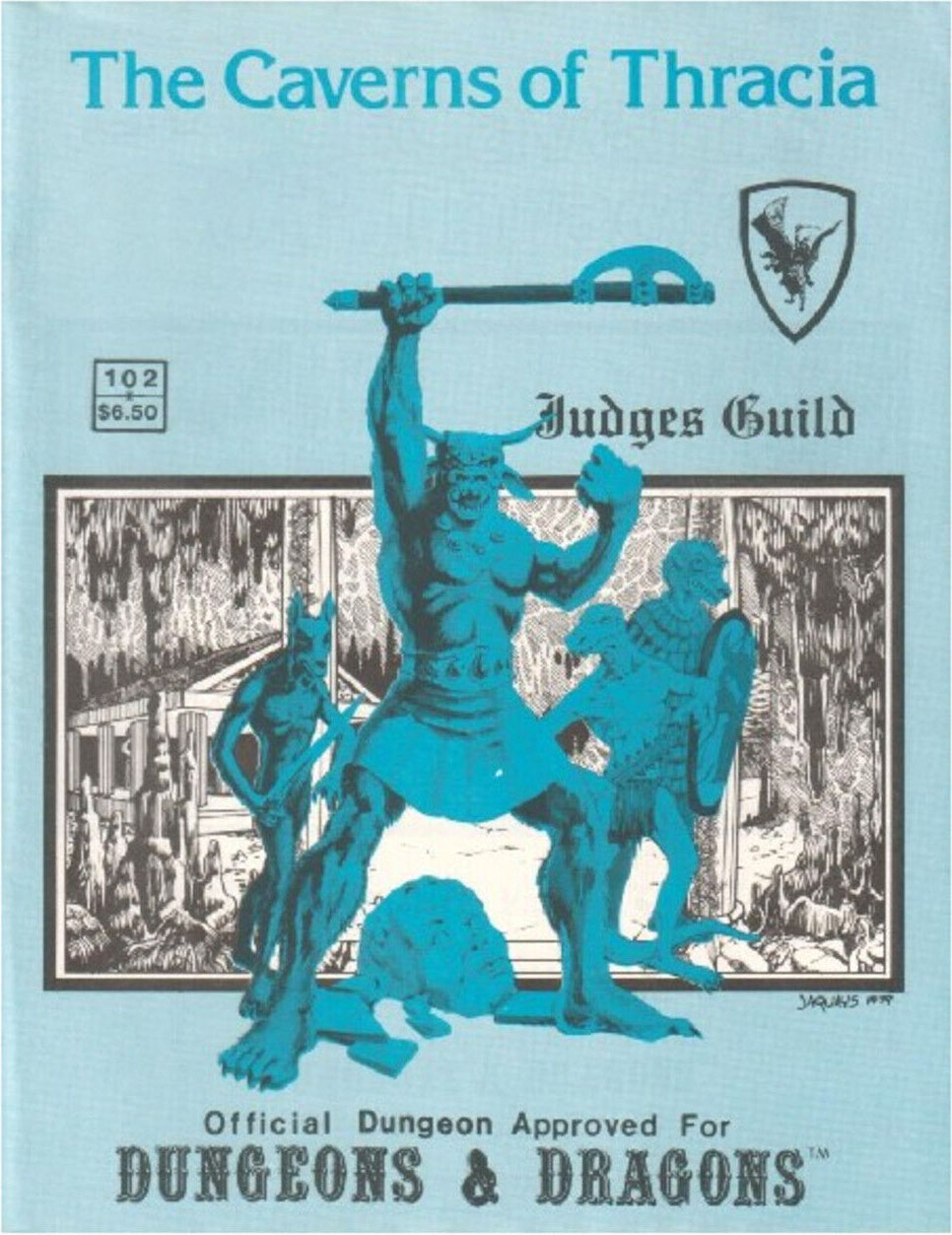 For our third OD&D session in the Caverns of Thracia, we had four new players. Two of these players were completely new to RPGs; one had spent most of her time playing in the original World of Darkness; and the last had once played in a D&D campaign where the other players didn’t bother explaining the rules to her and she had basically watched while somebody else played her character for her.
This last player was particularly leery about giving D&D another try. In fact, I’m not sure if she would have shown up at all if it hadn’t been for the fact that OD&D was only one of the options for what we might play that night (the other was Arkham Horror). When the group decided on OD&D by a single vote, however, she joined the rest of us in rolling up a character.
I’m going to spoil the ending here: All five of the new players had a great time and all of them were eager to play again, including the player who had suffered such a sub-par experience the last time that she’d tried to play.
The new characters were: Greenwick the Halfling, Brennan the Fighting-Man, Howard the Magic-User, and Bob the Fighting-Man.
The spiel for introducing the rules and walking everyone through character creation took a little longer than in previous sssions because of the complete neophytes at the table, but we all had a good time of it. Howard’s player, in particular, glommed onto the OD&D rule that all weapons deal 1d6 points of damage and decided that, instead of buying a weapon, he could just convert a gold piece into copper and then throw the copper coins at people.
WHEN LAST WE LEFT OUR HEROES…
We also had two returning characters: Reeva (who had missed the second session) and the halfling Thalmain, who had now catapulted himself all the way to 3rd level (despite suffering an XP penalty from his low prime requisite).
At the end of the previous session, Thalmain had gotten himself cursed while opening a chest. Making a ruling based on the costs for creating a magical scroll, I decided that getting the local priest to cast remove curse would cost him 200 gp.
Fortunately, Thalmain’s share of the loot from the previous session had tallied at 240 gp.
This also gave us a nice hook for the new session: While the other PCs from the previous session were carousing with their loot, Thalmain found his own personal purse considerably lighter. Thus he had a motivation for rounding up a likely group of rag-tag treasure hunters (i.e., the other PCs) and returning to the ruins ASAP.
It was around this point, as the group was gearing itself up for the expedition, that Thalmain’s player asked for the map they’d made in the previous session.
I grinned my evil DM grin and said, “Herbert was the one mapping.”
And, of course, Herbert wasn’t there.
After a bit of haggling, I decided that Herbert would be willing to sell the map to Thalmain. Thalmain had 40 gp left, so I grabbed 2d20 and rolled… two natural 20’s.
Thalmain decided that he didn’t particularly want to go completely broke, so he decided to instead steal the map. This proved easy enough, since Herbert was cavorting at the local tavern with his wealth.
THE GRAND TOUR
As Thalmain led them into the Caverns of Thracia, he was able to act as a bit of a tour guide for the new players/characters. (“Here’s where the bridge almost burned down… Don’t open that door… Here’s the pit trap I heroically saved the party from… Here’s the place where I roasted lizardmen…”)
Eventually, however, they began pressing on into unexplored territory. A short while later, they found themselves descending broad stairs of stone…
And that’s when things got epic.
In the Caverns of Thracia, there is a room keyed thusly:
The Burial Crypt of the Cult of the Dark One: The reek of decaying flesh permeates the air here. Lying in ordered rows are rank upon rank of corpses. Most are long decayed and in skeletal form, but many are still fairly fresh, not having been dead for more than a few weeks (if you can call that fresh!). […] If the southernmost pair of columns is approached within 5′ or if the columns are passed between or to either side, 1-4 skeletons will animate and begin to attack intruders. Each additional melee round 1-4 more skeletons will animate as long as there are living intruders to fight, up to a total of 400 skeletons. Skeletons, AC: 7, Move: 12″, HD: 1, Damage 1-6, HP 3.
I decided that the Thanatos cultists that they had killed before would have been moved down here, so there were also about a dozen bodies laid out directly before the leading into this large chamber and covered with fresh linen. (This creeped them out because, of course, it implied that there had been somebody around to move the bodies.)
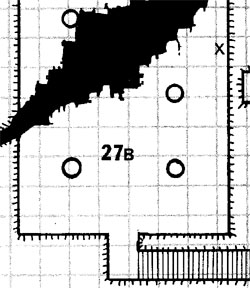 Inevitably, of course, the PCs moved far enough into the room to trigger the undead guardians. As the corpses began to stir and wrench themselves free from the cordwood-like stacks of the dead, the party fell back to the entrance.
The two halfings — skilled in ranged weaponry — picked off the first wave. (Aided by the occasional coin-toss from Howard.) But more and more of the dead were beginning to stir, and they realized it would only take a few unlucky die rolls for the skeletons to reach their defensive position.
(Actually, I don’t think I’ve discussed this previously: Halflings are described in OD&D as having “deadly accuracy with missiles as detailed in CHAINMAIL”. These sessions are being run with the conceit that I don’t “have” Chainmail, so we decided that halflings would simply get a +1 bonus to damage while using ranged weapons.)
Against the eminent risk, they quickly rearranged their lines. Brennan and Reeva took the front line. Greenwick switched from ranged attacks to a polearm in the second rank. And then Howard, Thalmain, and Bob lined up in back using their ranged attacks to thin the undead ranks before they reached the melee fighters.
But, more importantly, they also started spreading oil in front of their defensive position. And as soon as some of the undead got close enough, they lit the oil.
Based on my interpretation of the room key, the undead would just keep coming. Each undead had 1d6 hit points. Those that survived the ranged attacks would enter the oil, suffer 1d6 hit points, and frequently die before they even threatened the melee fighters.
After a couple of rounds, it was clear that the 1d4 skeletons per round were just never going to pose any kind of credible threat: The defensive position they’d created was too strong. And while the oil would only last for 1d6 rounds, they had stocked up on it (in large part due to Thalmain’s success with a similar tactic during the last session).
THE MASSACRE
I was in the process of trying to figure out how to make the encounter more interesting (since wittling through 400 undead 1d4 at a time wasn’t particularly exciting) when the PCs made it easy for me: They decided to try proactively eliminating the undead before they could rise. They tossed a flask of oil onto one of the piles of corpses and then fired a flaming arrow into it.
I ruled that the resulting conflagration was successful in destroying a large number of potential undead… but it also had the effect of rousing them. I rolled 1d10, got a result of 8, and went from rolling 1d4 to rolling 8d4 for the number of undead animating each round.
As the undead rose en masse, the piles collapsed — sending the dead cascading across the floor of the chamber.
It’s a testament to the strenght of their defensive position that they managed to hold out for several more rounds against the larger waves of undead without sustaining any injury. I was literally rolling fistfuls of d6’s to calculate the skeleton’s hit points while the players rolled a fistful of d6’s to calculate the damage wrought from the wide moat of fire they had laid down. They would read off the results and I would toss d6’s aside or lower their totals to reflect the current hit points of the skeletons.
Unfortunately, many of them were just 1st level characters. Eventually the law of averages worked against them and one of the skeletons emerged from the flaming oil and with a howl of undead rage managed to rip out Brennan’s throat.
Around this same time, my d4’s rolled high and a wave of 22 skeletons started heading towards them. At that point, they decided that discretion might be the better part of valor. But they weren’t done yet: Howard moved up to the melee line and they held the position for another couple of rounds.
As the wave of the 22 skeletons got close, however, they fell back.
But they weren’t done yet. See, Brennan had been the one carrying most of their (very large) supply of oil. So before they retreated, they rolled Brennan’s body into the flames.
1… 2… 3….
KA-BOOM!
Surprisingly, a couple of the skeletons managed to actually emerge from the far side of the inferno and pursue them a couple of steps up the stairs. (I say a couple of steps, because Thalmain and Bob put arrows through their skulls before they got any further.)
When it was all said and done, I tallied up the dead:
They had killed 76 skeletons.
Killed? It’s probably more accurate to say “slaughtered” or “massacred” on a scale that a bunch of 1st level characters (with the exception of the 3rd level Thalmain) should really not be capable of dealing out.
Of course, they weren’t 1st level any longer. Everybody not only leveled up, but also maxed out their XP for the next level, bumping into the “thou shalt not get enough XP for two levels” ceiling. (Well, except for Thalmain, who bumped into the “thou shalt not advance past 4th level” ceiling for halflings.)
76 skeletons.
It isn’t the largest single-battle slaughter I’ve ever seen in a D&D game, but it’s almost certainly the most impressive. The only battles that rival it in terms of sheer number involve groups fighting large hordes of significantly weaker opponents.
Smart play. Very smart play.
Admittedly, if the skeletons had been smarter they wouldn’t have continued marching into the flames. But, on the other hand, I’m not sure how much difference it would have made: The skeletons had no access to ranged weapons and any possibility of a retreat was cut off by the chasm to the north. Even if they had hung back, they would have simply been picked off by the party’s ranged attacks.
To be continued…

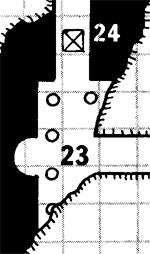 The pit trap in this section of the dungeon also led to some hilarity: After detecting its presence, Thalmain spent the better part of 15 minutes working out massively elaborate and overwrought work-arounds for trying to get across it… having missed the fact that there were 1-foot wide walkways to either side of the pit that could be easily walked across.