Tagline: An excellent story which, unfortunately, has some flaws as a module, which are further compounded by some truly baffling design decisions.
Running the Darkness Revealed trilogy in its entirety is on my bucket list. I’ve tried on three occasions, but have never managed to actually make a campaign congeal. Some day…
(In other words, if you’re potentially one of my players you shouldn’t read this review!)
Note: This product is a module. In the following review there will quite likely be spoilers of various sorts. Don’t say I didn’t warn you.
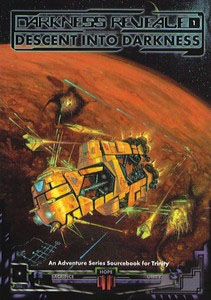 Descent into Darkness is the first of a three-part adventure series for White Wolf’s Trinity. It contains three separate adventures which are joined thematically, thrusting the PCs into the heart of a major development in the Trinity universe. At $15.95, its a great deal in this age of $20 single-sheet modules and $25-$35 sourcebooks.
That being said, this product possesses some serious – although not irreparable – flaws.
GOOD STORY, WEAK MODULE
The adventure is based on some rock-solid material. The vast conspiracy plot being described in this adventure is nefarious, wicked, and cleverly conceived – my mouth was practically salivating thinking of running players through this puppy and having them slowly piece the puzzle together. Unfortunately I discovered that, having this rock-solid material in place, the writers then fell down flat in presenting it. In two of the adventures the full picture has absolutely no chance of being revealed until the very end – where we are instructed to have the PCs discover what’s been going on by looking at the minicomps possessed by the NPC conspirators. In the third you might be able to discover some of what’s going on, but only if you possess a specific psi power and make a specific die roll which will send you down the right path. Otherwise you have to wait until the end and disseminate the data files. The writers here wanted a mystery, but apparently didn’t have either the skill or the patience to see it carried out properly – so instead the PCs are onslaughted by forces they don’t understand in a series of segues they can’t comprehend, until the end where the GM is apparently supposed to lecture them for several minutes explaining the really excellent story they didn’t understand while experiencing it.
COLORED SECTIONS
This problem is further compounded by the three glossy color sections found in the book. These are designed to be given to the players as briefing files from the Aeon Trinity organization. Besides the obvious problem that these three sections are spread throughout the book so that you are faced with a decision of (a) ripping them out and completely destroying the product; or (b) xeroxing them (and thereby removing the entire reason for having them in color to begin with), these sections also successfully serve to completely destroy the plots of the adventures and suspension of disbelief.
For example, in the first adventure the PCs are supposed to be investigating shady activities of the Aesculapian Order on Luna. Eventually they will discover that this secret “biorg project” is being conducted under the supervision of Dr. Jerzy Grabowski, that it is using Aberrant taint to genetically alter psions in order to greatly increase their power, and that these new bioapp-enhanced psions were field tested in destroying Freak Alley while fighting Aberrants at a Lunar Base; and, finally, that a Dr. Malachi Ross was tested with these bioapps, escaped, and is now hunting Dr. Grabowski.
Reading the color briefing section for this adventure (to be disseminated to the players before the adventure starts) we are given the following pieces of documentation: (1) A transcript describing the attack on the Lunar Base in great detail; (2) An autopsy report of a John Doe found at the site of the attack who died of bioapp-feedback and then subsequently had all the bioapps removed from his body before the docs arrrived at the scene; (3) a hand-written note at the bottom of this autopsy report saying (essentially), “Jerzy—this guy knows too much, we need to transfer him to a place where he’ll never bother us again”); (4) excerpts from the diary of Dr. Malachi Ross which not only tells us his name, but also that he’s involved in the “Huang-Marr” bioapp project.
Do we see a pattern of similarity here? By the time the players finish reading their mission briefings they already know everything they need to know; they just have to go through the motions. Not only that, but the material found in these Aeon Trinity briefings pretty much invalidates the PCs actions: If you are wondering whether or not Jerzy Grabowski is involved in something fishy, is it really necessary to have the PCs look for that something if you’ve already got a memo with an incriminating note on the bottom of it?
BREVITY
The other major problem I was having with the adventures as described is that they are awfully brief and light on character activity. The first adventure, for example, has the players go to the clinic where Grabowski works and accomplish very little. Then they go to the site of the Aberrant attack, look around, and find nothing of much interest. Then they go to Freak Alley and find (you guessed it) little of interest. Then they go back to the clinic and, for some reason, they are now supposed to have enough evidence to arrest Grabowski (despite the fact they have uncovered NO evidence that wasn’t already in the briefing report, unless they randomly decied to hack into the clinic’s computers and discover the completely non-incriminating evidence that Grabowski is scheduled to go to Earth soon). Assuming they do this, Ross breaks into his cell and Grabowski is killed. Once Grabowski’s dead they hack into his minicomp and find out the details.
At no point (as a result of the color inserts) do the PCs really learn anything, nor do they really accomplish anything (the real work is done by the people they’re supposed to call in to arrest Grabowski), nor is it really ever explained to us what drives them along the course they’re supposed to take. However, the module does imply that they are supposed to waste great quantities of time (for example, when going to Freak Alley it is apparently assumed that they will spend great amounts of time talking with those who saw the accident… but no one will know anything of any interest).
The second adventure is the strongest of the three, but still suffers from unsubstantiated leaps of “logic” which the PCs are supposed to be making. In my experience, this type of module design inevitably leads to a necessity of dropping “subtle GM hints” in order to prod the players along the railroad.
PLOTTING BY LOCATION
No, the book doesn’t have location-coded maps, but one of the more egregious plotting stupidities they pull takes place in the third episode. The PCs arrive at Summit Center, a giant complex which literally circles the peak of Olympus Mons on Mars on a rail. Once there they are apparently supposed to wander around the place accomplishing absolutely nothing until such time as they end up standing in front of the power core (which, for some idiotic reason, is located at the very center of the complex and is highly visible to the public). At this point a would-be assassin launches a grenade at them.
Why? Because it’s necessary to blow up the power core so that Summit Center will collapse and go rolling down the side of Olympus Mons. Huh? The number of things ignored in this railroaded plot (what if the PCs split up? what if the PCs never go anywhere near the required location?) is mind-boggling.
INVOLVEMENT
One nice touch is the way in which the designers don’t simply gloss over PC involvement. Throughout the work several different methods are mentioned as to different ways PCs can become involved (fresh starts, skipping certain episodes, etc.) and then these are actually followed up later on, with pointers on how various PC involvement strategies will affect the way certain sequences play out.
This is a nice touch, especially in comparison to many other adventure products out there (which either leave the work up to the GM entirely or gloss over a few weakly inspired ideas and then drop them – as if why the PCs are involved in an adventure has no impact on how they will approach the events which envelop them).
ARTWORK AND TEXT
The quality of the artwork is quite excellent in some cases, and never worse than average. However, in several cases little connection between what the art is representing and the text can be made (although often you will realize that the art was depicting something that would be discussed later in the text), and is often recycled several times through the work (confirming that no connection is actual, although often it is implied).
The text is very readable, full of information, and nicely laid out on the page. Even the sidebars are placed in such a way that they are informative and easily digested (too many products just stick the sidebars in any old place, and it becomes difficult to assimilate what they are trying to tell you).
CONCLUSION
Having said all these negative things about the plotting and construction of these adventures I’m going to do a rather surprising thing: I’m going to suggest that you buy this product.
No, White Wolf isn’t paying me sizable amounts of cash to say this (or even insignificant amounts of cash). I say it because the background-material on which these adventures are based is, as I said at the beginning of this review, rock-solid and highly worthy of your consideration. Naturally they need a bit of work. Here’s what you’ll need to do to make this product worth your while:
(1) Don’t hand out those color sections.
(2) Redesign the flow of the adventures so that they operate like true mysteries. Only a hack designs a mystery where everything is discovered at the last minute: Have the PCs gather clues slowly throughout the process, and then have them put it together before the big finale (not in the aftermath by finding a handy minicomp).
(3) Seriously work at the connective material. Right now the modules are driven along a railroad; find a reason for the PCs to progress. Better yet, find many possible reasons, and many possible routes. Your players will probably still thwart you, but at least you’ll be better prepared to deal with them.
So I guess that’s my conclusion: The adventures are crummy, but they rest on such a fascinating, rock-solid set of background information that the product is still worth picking up (particularly at $15.95 – great price!). Just be aware you’re going to have to put a little bit of elbow grease into making this one serviceable.
Style: 4
Substance: 3
Author: Bruce Baugh and Richard E. Dansky
Company/Publisher: White Wolf
Cost: $15.95
Page count: 120
ISBN: 1-56504-751-6
Originally Posted: 1998/12/11
For several years after writing this review, Bruce Baugh would publicly cite me as his favorite reviewer and credit the useful critiques of this specific review for greatly improving the second and third volumes of the series. (And they were, in fact, very much improved, as you’ll see in later reviews.) I enjoyed Baugh’s work before, but after that I respected him greatly. Not because he was praising me (although that was nice), but because he was willing to take a critique that wasn’t sugar-coated and grow from it.
I wrote this a few years before formulating the Three Clue Rule, but you can already see some of its roots here. I’ve had a long dislike for the “mysterious shit happens and the PCs have no way of figuring it out” method of adventure design, though. It goes all the way back to reading the Touch of Death module in junior high, as I describe here: Stop playing poker with your players!
I’m also faintly amused by the quaintness of my complaints vis-a-vis xeroxing the color sections of the modules. These days, of course, I’d just pop open the PDF and use my color printer to crank out as many copies as I thought might be useful. (I wouldn’t in this case, of course, because they really do suck as handouts. Although it should be noted that a few pages can probably be salvaged.)
Read the review of Darkness Revealed 2: Passage Through Shadow
For an explanation of where these reviews came from and why you can no longer find them at RPGNet, click here.