The Alexandrian

Posts tagged ‘untested’

Untested: D20 Piggybacking

November 3rd, 2010

One of my long-standing concerns with the D20 system was the skewed probabilities of opposed group checks. For example, consider the example of a PC making a Move Silently check opposed by an NPC’s Listen check where both characters have the same skill modifier. In this scenario, a single PC attempting to sneak past a single NPC has a 50% chance of succeeding.

Compare this to a situation in which 5 PCs are attempting to sneak past 5 NPCs (with, again, all of the characters involved having the same skill modifiers). This effectively becomes a check in which the 5 PCs are rolling 5d20 and keeping the lowest result, while the NPCs trying to detect them are rolling 5d20 and keeping the highest result.

The average roll of 5d20-keep-lowest is 3. The average of 5d20-keep-highest is 17. That 14 point differential means that it’s virtually impossible for a party of characters to sneak past a group of evenly matched opponents. (And even sneaking past a single watchman is difficult as the average party roll of 3 is opposed by an average roll of 10.)

Of course, the odds are actually worse than this: A successful stealth attempt will also usually require a Hide vs. Spot check, so you need to succeed at not one but two checks at these outrageous odds. And this assumes that the PCs all keep their stealth skills maxed out (which in practice they won’t, particularly since it’s so pointless to do so).

The argument can certainly be made that this is realistic in some sense: A large group should have a tougher time sneaking past a sentry than one guy and more eyes means more people who can spot you. But I would argue that the probability skew is large enough that it creates results which are both unrealistic and undesirable.

In practice, the effects of the skew are obvious: Group stealth attempts quickly drop out of the game. When stealth is called for, it takes the form of a sole scout pushing out ahead of the rest of the group. And when the scout becomes too fragile to survive when the check finally fails, stealth stops being a part of the game altogether.

Since I’d prefer stealth to be a potentially viable tactic, a solution is called for.

QUICKIE SOLUTIONS

DISTANCE / DISTRACTION PENALTIES: A guideline that can really help the stealther is the -1 penalty per 10 feet that is supposed to be applied on Listen and Spot checks. Keep about a hundred feet away from the guy trying to spot you and you can quickly cancel out the probability skew of the dice.

Unfortunately, these modifiers become kind of wonky, particularly when it comes to Spot checks. On the open plains, for example, the “maximum distance at which a Spot check for detecting the nearby presence of others can succeed is 6d6 x 40 feet”. The minimum distance of 240 feet, therefore, is supposed to impose a -24 penalty and the maximum distance of 1,440 feet impose a -144 penalty.

I’ve tried a few different ways of fixing these modifiers, but am currently just using an ad hoc sense of what the range of the check is.

TARGET NUMBERS: Instead of making these opposed checks, set a target number for the PC’s skill check of 10 + the NPC’s skill modifier. (This essentially halves the probabilty skew.)

GROUP CHECKS: Make only one check for each group. But what skill modifier to use? Using the average value is cutesy, but impractical at the game table. Using the lowest value still effectively takes group stealth off the table. Using the highest modifier means that everyone except the rogue ignores the stealth skills entirely and also creates issues with determining surprise.

And how big can a group be? One guy with a decent Hide check shouldn’t be able to sneak an army of ten thousand soldiers under the nose of a watchtower, but where do you draw the line?

Maybe you could limit the number of people covered by a check to equal the skill leader’s skill ranks? Or impose a -2 penalty per person in the group?

COMBINE STEALTH / PERCEPTION SKILLS: I’ve been folding Hide/Move Silently into a Stealth skill and Listen/Spot into a single Perception skill intermittently since 2002, so I wasn’t particularly surprised when both Pathfinder and 4th Edition went in the same direction. It cuts down on dice rolls and eliminates the undesireable “need to succeed twice” feature of stealth checks.

This does create some interesting oddities around trying to resolve invisibility, and while I haven’t found the perfectly elegant solution yet, this slight corner case is (in my experience) preferable to the constantly degrading effects of splitting the skills.

Using some combination of these solutions tends to mitigate the problem, but I’ve generally been unsatisfied with the hodgepodge fashion of it all. So taking my unified Stealth and Perception skills in hand, I’ve been looking for a more elegant solution.

GUMSHOE’S PIGGYBACKING
Esoterrorists - GUMSHOEI found the roots of what I think may prove a usable mechanic in the GUMSHOE system:

When a group of characters act in concert to perform a task together, they designate one to take the lead. That character makes a simple test, spending any number of his own pool points toward the task, as usual. All other characters pay 1 point from their relevant pools in order to gain the benefits of the leader’s action. These points are not added to the leader’s die result. For every character who is unable to pay this piggybacking cost, either because he lacks pool points or does not have the ability at all, the Difficulty Number of the attempt increases by 2.

Obviously the point-spending mechanics which underlie the GUMSHOE system can’t be translated directly into the D20 system, but the basic structure of a lead character making a check onto which others could “piggyback” was inspiring.

D20 PIGGYBACKING

When the whole group needs to perform a single task collectively (like sneaking past a guard or using group-climbing techniques to scale a cliff) they can make a piggybacking skill check.

(1) One character takes the lead on the check. This character makes the skill check using their normal skill modifier, just like any other skill check.

(2) Other characters can “piggyback” on the lead character’s check by succeeding on a skill check. The Piggyback DC of the check is equal to half its normal DC. (So if the leader is making a DC 30 check, the other characters must make a DC 15 check to piggyback on the check result.)

(3) The lead character can reduce the Piggyback DC by 1 for every -2 penalty they accept on their check. (They must make this decision before making the check.)

(4) The decision to piggyback on the check must be made before the leader’s check is made.

OPPOSED PIGGYBACKING CHECKS: The DC of the check is set by the lead character’s check. Just like any other piggybacking check, only characters who succeed on the piggybacking check benefit.

(To simplify the resolution, you can start by rolling only the lead characters’ checks. After you’ve determined which lead character succeeded, you can call for the necessary piggybacking checks. Anyone piggybacking on the failed check, of course, will fail no matter what their piggybacking check would have been.)
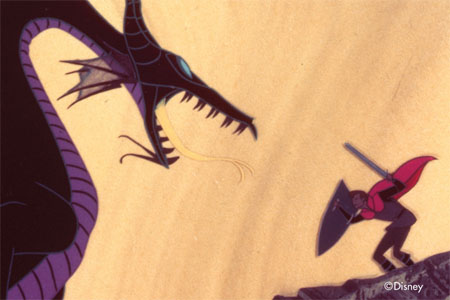
Sleeping Beauty - Sword and BoardingInspired by the “Shields Shall Be Splintered!” houserule at Trollsmyth, I’ve been thinking about how such a mechanic could be used to make sword-and-boarding a more interesting and flavorful mechanical choice. And maybe address some of the balance issues that make them so much less appealing than wielding a two-handed weapon.

SHIELDS: Once per round a character can use their shield to block (or partially block) an incoming attack. Both the shield and the shield’s wielder suffer the full damage of the attack, but the shield’s wielder can subtract a number of points of damage equal to their Base Attack Bonus. A shield cannot be used to block a touch attacks or attacks that bypass armor in any way.

A shield can be used to block damage from any effect which requires an attack roll (such as a scorching ray).

A shield can also be used to block damage from any effect which allows a Reflex save (such as a fireball). If the character makes a Reflex save for half damage, the damage blocked by the shield is subtracted before being halved.

A character who is flat-footed or unaware of an attack cannot use a shield block.

THOUGHTS AND QUESTIONS

(1) There are quite a few possibilities here for feats to extend this basic capability: For example, allowing characters to block up to twice their BAB in damage. Or a feat similar to Combat Reflexes that would allow a character to make a number of shield blocks equal to their Dexterity bonus. Should the “blocking spells and other effects” be relegated to a feat, as well? Is it too useful straight out of the box?

(2) Instead of making this a 1/round ability, should it be an immediate action?

(3) Is this useful enough that the normal AC bonus from a shield should be eliminated?

And, of course, the big question is: Does it work? Is it balanced? As the title of the post suggests, I’ve given this zero playtesting. It’s just a nifty idea that tickled the hind-quarters of my brain. It undoubtedly needs some tweaking at the very least.

Untested: Research Checks

March 12th, 2009

Shamus Young has posted his proposal for an interesting Learning Mechanic at Twenty Sided. Here’s how he describes the goal of the mechanic:

Most gameplay mechanics are set up so that characters learn and grow from success. The more success, the more XP. I wanted a mechanic that would simulate an activity that was inherently driven by trial-and-error, and where (this is the important part) the character got gradually better at the activity as time went on. Learning would be fast at first, but progress would be slow. Later on, learning would slower, but success would be more frequent.

He recommends the mechanic for tasks like translating a tome written in an archaic language; finding the cure for a zombie plague; breeding animals; and the like.

Here’s how he describes the mechanic:

The player writes down all the numbers from 1 to 20 on a notecard. Every time they roll a number, that number will be crossed out on the card. If they roll a 15, then they cross out 15.

Each attempt needs to simulate a stretch of in-game time. Hours of labwork, meditation, tinkering, writing on the chalkboard, or whatever is required.

When they make an attempt, they roll the d20. If the resulting number is already crossed out, then the action was a success and they get their reward. If not, they still get to cross out the number they rolled, which will improve their chances next time around. Using a d20, they have no chance of success on their first attempt, and a 5% chance on their next attempt. Every failure improves their chances by 5%, and every success moves them closer to their goal. You decide ahead of time how many successes it will take to reach their overall goal. (For our game, I had the book broken into 13 sections. So the character finished the translation after 13 successes.)

I like the basic concept of this mechanic a lot. It’s similar to a complex skill check, but offers the specific benefits Shamus describes: At first, learning happens fast but progress is slow. Later, learning is slow but progress is fast.


STREAMLINING THE MECHANIC

The idea of keeping a notecard and crossing off number is a nifty gimmick, but if you want to streamline things then you can simplify this mechanic:

Roll 1d20. If the result is equal to or lower than the number of failed attempts you’ve made, you score a success. When you achieve the requisite number of successes, you succeed at the task.

I recommend checking out Shamus’ article directly, as he includes a probability chart useful for determining how many successes a task should require.

It should be noted that, by default, the problems handled by this mechanic are always soluble — given enough time, you will eventually solve them. There is no possiblity of absolute failure. In addition, the mechanic doesn’t account for skill. For some problems these may be seen as features. For other problems they’re bugs. Let’s take a look at how the mechanic might be made more flexible and robust.


EXTENDING THE MECHANIC

PROGRESSIVE SUCCESS: Each success can yield additional information or some other tangible benefit. (A cure that works against the bite of a specific zombie; several pages of translated text; a slightly improved animal.) The mechanic is specifically designed to model tasks which don’t feature all-or-nothing successes.

ROADBLOCK: After a certain number of successes, progress in the task may only be possible when some other prerequisite is met (additional biological samples, a different type of natural resource, etc.). In many cases, the nature of the roadblock may not be known until the roadblock is reached.

VARIABLE DIE TYPES: For tasks of greater or lesser difficulty, you could vary the die type. (With a 1d4 you learn everything about the project rapidly and then gather successes rapidly. On the other hand, with a 1d100 your learning curve takes considerably longer.)

INTRACTABLE PROBLEMS: For problems that could prove intractable for a character, simply set the maximum number of possible attempts. If the character has not achieved success after X attempts, then they’ve exhausted their insight into the problem. (Having multiple people working on a problem like this is useful not only because it speeds up resolution, but also because it gives greater insight into the problem — as represented by more potential checks.)

FACTORING SKILL, METHOD 1: You can factor the character’s skill into the attempt by limiting the number of possible attempts based on their skill. In D&D, off-the-cuff, I’d recommend something along the lines of 10 + skill modifier attempts.

FACTORING SKILL, METHOD 2: You can also make character skill a factor by simply setting a minimum skill requirement. A particular problem, for example, might require a minimum Knowledge (history) bonus of +10. (The drawback of this method is that it still doesn’t allow for any variation in completion time based on character skill. A character with a +10 bonus is just as capable of solving the problem as a character with a +50 bonus.)

FACTORING SKILL, METHOD 3: Set a DC for the task. Each d20 roll becomes an actual skill check. If the character succeeds on the check, the roll counts double. In other words, depending on the die roll, it either counts as two successes or as two failed attempts. (If you’re combining this method with an intractable problem, however, each die roll still only counts as one attempt against the maximum number of possible attempts.)

DISCLAIMER

I’m just spitballing some ideas here. I have not actually run any kind of mathematical analysis on this mechanic (although, as I noted, Shamus Young did provide useful charts for the core mechanic).

Archives

Recent Posts

Recent Comments

Copyright © The Alexandrian. All rights reserved.