The Alexandrian

Posts tagged ‘running the campaign’

IN THE SHADOW OF THE SPIRE

Prelude 2: The Awakening – Ranthir

I started gaming in the summer of 1989. It was right around this time that I also discovered the local BBS scene in Rochester, MN — most notably the North Castle BBS. At the raging speeds made possible by a 1200 baud modem I was able to plug into the ADND FidoNet echo.

For those of you unfamiliar with FidoNet, it was similar to Usenet: A set of completely text-based messageboards. However, unlike Usenet, the individual BBSes that made up the FidoNet were not in perpetual contact with each other. Instead, during each day, the FidoNet systems would call each other during the ZoneMailHour (ZMH) and exchange messages. Local systems would push messages up to regional hubs and those hubs would circulate the message around the world and then push them back down to local systems.

Which meant that sometimes it would take you several days to see a message posted by someone else and sometimes you would see it immediately (if the person posting it was on the same BBS you were).

One of the features of the ADND FidoNet echo were the campaigns that were played through it. This was my earliest exposure to the concept of Play-By-Mail (PBM) games.

My first experience with roleplaying games was when I created my own. My second major experience was the true old school play of campaign-hopping characters, whipping out dungeons on graph paper, and playing during every possible stolen moment of the school day. But my third major experience was watching and playing in the PBEM (Play-By-Echo-Mail) games of the ADND echo.

Because of the asyncrhonous nature of communication, the ADND games all followed a similar structure: The DM would post a lengthy summary of events and then the players would respond. If they were facing a physical challenge or combat, player responses were usually tactical in nature — summarizing a strategy for the next several rounds of play instead of specifying particular actions. If it was a conversational situation, players would just start responding to each other’s messages.

But the asynchronous communication, of course, meant that not all of these responses necessarily meshed. (For example, you might have two characters both respond to a straight line with the same joke.) So, at some point, the DM would draw a line in the sand and end that particular phase of play. They would then gather up all the responses and summarize the official version of events. These summaries were referred to as “Moves”.

From my understanding, this system is similar to the original Play-By-Mail games which were played by physically posting letters — but with the added advantage that the players could actually talk to each other without the DM acting as an intermediary.

All of which is a long-winded way of saying: PBeM games had a major impact on my formative years as a gamer.

But, on the other hand, I profess that I have never seen a PBeM campaign end successfully. Even keeping a tabletop campaign together is difficult, and while it would seem as if the non-intensive nature of a PBeM would help keep it running… in practice the lack of any physical demand for attention means that players tend to just wander away and interest tends to atrophy.

Which is unfortunate, because — in my experience — PBeM play has some unique strengths. It lends itself particularly well, for example, to a more contemplative style of play. In ongoing tabletop campaigns, I’ve found PBeM to be a good way of dealing with certain types of side-action. It can also be used to fill in the occasional lengthy gap between playing sessions.

All of these features made PBeM play ideal for launching the Ptolus campaign: The characters were separated, the contemplative style gave the players time to ease themselves into their roles, and we had a gap of time before the campaign could start because of incompatible schedules.

(And if anyone reading this happens to have an archive of old FidoNet ADND games — particularly those run by Bruce Norman — I would dearly love to get a copy. I used to have a substantial archive myself, but it was wiped out by a bad floppy disk. Now I only have a handful of random moves that were tucked here and there.)
IN THE SHADOW OF THE SPIRE

Character Background: Ranthir

Many of you are reading this website because of D&D: Calibrating Your Expectations, the essay I wrote in March of last year. One of the points I made in that essay is that low level characters are actually more than capable of being experienced experts in their fields. Even at 1st-level, while they don’t have to be, they certainly can be.

Which brings us to the character of Ranthir, the last of our main characters: This guy isn’t your typical 1st-level apprentice. Instead, he’s an accomplished Acolyte of the legendary Academy in Isiltur, the Spired City. Although his esoteric theories are not fashionable or popular, he is nevertheless an accomplished scholar.

In our world he would be a gifted graduate student. In the world of D&D, there is a much higher ladder for him yet to climb. But I think it’s important not to denigrate the accomplishments of those who would be considered gifted and extraordinary in our world merely because they happen to live in a world where the superhuman is possible.

Which is not to say I don’t like my share of neophyte characters, too. Take a peek at Tee and Elestra, for example.

All I’m saying is that it can also be fun to shake things up a bit and roll up a starting character who hasn’t just fallen off the turnip truck: The guy who was already honored among his tribesmen, served a long and glorious tour of duty in the military, or distinguished himself in a scholastic career.

And I’m pointing out that you don’t need to start the character any higher than 1st-level to make that happen.

IN THE SHADOW OF THE SPIRE

Character Background: Elestra

I have previously mentioned that the events in the campaign journal are an accurate recounting of what happened at the gaming table. There is, however, one exception to this: The character of Elestra.

In the Shadow of the Spire originally started as an online game run through ScreenMonkey and Skype. After several sessions, however, a couple of the long-distance players ended up dropping out of the game and the third long-distance player ended up being local instead. After a lengthy hiatus, we added a new player and jump-started the campaign back to life as a face-to-face game.

This left us with two orphaned characters: Agnarr and Alysta.

One of the other players ended up taking Agnarr on as a second character. And then I offered the new player the choice of either taking over the role of Alysta or creating a new character.

She decided to create a new character (which turned out to be Elestra). At this point I had two options: I could choose to simply kill off Alysta and then figure out a way to get Elestra involved with the group. Or I could retcon the campaign journal, replacing the character of Alysta with the character of Elestra.

Normally it would be a no-brainer to go with Option #1. But I had a few reasons for going with Option #2:

First, the hiatus in the campaign had already created a natural break in continuity. Part of the process in gearing back up from that hiatus was going to be reviewing the campaign journal and getting back into the flow of things. In some ways, it was an ideal time to perform a retcon.

Second, although it would have actually been quite trivial to kill off Alysta, the campaign was structured around this specific group of people waking up to find themselves locked in a common cause. I didn’t want to risk losing or watering down that essential core of the campaign.

Third, retconning would be relatively easy because Alysta had ended up being something of a cipher. Almost as soon as the campaign had started, the work schedule for Alysta’s player unexpectedly shifted and she ended up missing large chunks of the game. Playing the character during these abseences had fallen to me.

Now, on the one hand, I’m not very good as a GM when it comes to playing allies of the PCs. I usually have lots of balls in the air anyway, and I tend to just forget about the extra character who has no physical presence at the game table. In the case of Alysta this particular shortcoming was aggravated because Alysta’s player — as a result of her absences — never really defined who the character was or what her personality was like. Since I felt it was important for the player to be the one to define who the character was, I refrained from making any strong choices.

In practice this meant that Alysta would frequently go off and “do her own thing” whenever the opportunity arose. The result was something of a tabula rasa — one which easily suited itself to having the label that read “Alysta of the Order of the Holy Sword” scraped off and replaced with “Elestra of Seyrun”.

For those who might be curious, here’s the original write-up for Alysta:

(more…)

IN THE SHADOW OF THE SPIRE

Character Background: Dominic Troya

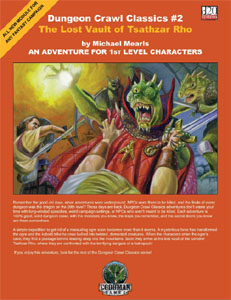
The Lost Vault of Tsathzar Rho - Mike MearlsWith the first prelude concluded, we now move on to introducing the rest of the main characters for In the Shadow of the Spire, starting with an Imperial priest named Dominic Troya.

But while you’re reading that, I’m going to back up and continue talking about the first prelude featuring Tee and Agnarr. This prelude was a modified version of The Lost Vault of Tsathzar Rho, an adventure by Mike Mearls.

One of the issues I faced in designing the prelude was the non-standard party composition: Agnarr was a 1st-level barbarian and Tee was a 1st-level rogue. A barbarian is obviously pretty interchangeable with a fighter, but that still left two of the four core roles — cleric and wizard — unfilled.

But, truth be told, I find the typical hand-wringing over the need for a “standard party” to be a trifle overwrought. I’ve played with lots of odd-sized and odd-classed parties in D&D before, and I’ve virtually never found it to be a problem.

The one exception I’ve found is the mostly immutable need for some form of magical healing. Combat in D&D is strongly designed around the hit-and-heal cycle: The game assumes that you’re going to get hit and that you will then be healed.

Everything else, in my experience, is negotiable. Yes, if you’re missing other key roles in the party they will be missed. Without the consistency of a fighter, adventuring days will probably be shorter. Without the firepower of an arcanist, more powerful enemies will need to be avoided. Without a rogue, traps will become far more dangerous. And so forth. But, as I talked about in Fetishizing Balance, this is just a matter of adjusting the difficulty of encounters and the style of gameplay to suit the characters that the players want to play.

In fact, I’ve even played in a couple of short adventures without magical healing. This isn’t so much impossible as it is radically different. Without magical healing, combat in D&D almost instantly turns into a grim ‘n gritty exercise. Wounds take days or weeks to heal and any kind of serious injury — which can be almost trivial to receive — will force the party into rehabilitation. Hit point inflation still makes it possible for higher level characters to pull off some amazing things, but they’ll suffer for it.

In the case of the prelude, however, this grim ‘n gritty environment wasn’t what I was shooting for. (In no small part because I was using a published adventure as a foundation and I would have had to pretty much toss out the whole thing.) So I targeted the party’s shortcoming — magical healing — and provided a healing totem that had been given to Agnarr by the shamans of his tribe.

Mechanically this was basically just a wand of cure light wounds that worked with a command word instead of a spell trigger (so that it could be used without having a cleric in the party). And, if you’ll pardon the pun, it worked like a charm. Several encounters still needed to be adjusted due to the smaller group size, but with a large supply of magical healing available to them the barbarian and the rogue were still able to enjoy traditional-style romp through a dungeon crawl.

IN THE SHADOW OF THE SPIRE

Prelude 1B: The Lost Vaults Continued

Before our first proper session of In the Shadow of the Spire, I offered to run prelude sessions for any players who were interested. I had never done this before, but I had several reasons for trying it now:

(1) We had some scheduling problems which meant that there was about a three week gap between creating the PCs and starting the campaign. It wasn’t that people weren’t available to play — it was just that we were never all available to play at the same time.

(2) I knew that the campaign was going to start as the PCs woke up with partial amnesia and a period of lost time. I felt this might have a larger impact if the players had actually spent some time playing their characters — in other words, if they actually lost the time.

Because without that first-hand experience, there isn’t that much difference between a character background that ends with the line “… and then you go to the Adventurers ‘R Us Tavern” and one that ends with “… and then you wake up in a bed you don’t know.”

(3) Because most of us were new to the online tools we were using for our virtual gaming table, I thought it might be advantageous to tackle them with smaller groups and work out the kinks.

This experiment with preludes was something of a mixed success. On the one hand, I was mostly right: The smaller groups let us work out the kinks of using the virtual gaming table, the preludes let us get some gaming into a gap when we would have otherwise been idle, and those who participated did feel the effects of the lost time more personally than those who didn’t. (In fact, when one of the players realized what I was doing at the end of the prelude session, they spontaneously exclaimed, “Son of a bitch!”)

On the other hand, only the prelude featuring Tee and Agnarr actually happened. The scheduling for the others just never worked out. Some of the material from those preludes was worked into the character backgrounds of the other characters, but most of it wasn’t.

The prelude had a few other notable effects:

First, it meant that Tee and Agnarr started the campaign at 3rd-level while the others started at 1st-level.

Second, it created a meaningful chemistry between Tee and Agnarr that the other characters didn’t have at the beginning of the campaign. All of the characters (and players) quickly bonded, but I think the instant Tee-Agnarr alliance helped propel Tee into a stronger leadership position.

The original plan had been for two other characters to similarly share an adventure together. Some of that survived into the character backgrounds and, from there, into the actual campaign, but there really is a difference between something that you write up in a character background and something that you’ve “lived” in play. I suspect that if the other preludes had taken place, there would have been a second strong pairing and the group dynamic would have been very different for the rest of the campaign.

Finally, the content of the preludes wasn’t irrelevant to the larger themes and events of the campaign. Many hints and clues could be gleaned from the events that took place (or would have taken place) during the prelude adventures. Most of the content from the other preludes was not included in their character backgrounds, which meant that this material would emerge in different ways throughout the rest of the campaign.

Archives

Recent Posts

Recent Comments

Copyright © The Alexandrian. All rights reserved.