The Alexandrian

Posts tagged ‘chaos lorebooks’

Jubilex - Wizards of the Coast

This codex is a collection of lore describing one of the Galchutt: Jubilex the Shapeless. The Faceless Lord. The End of All Forms.

Jubilex is revered as the dissolution of structure and form. The strictures of society are unjust and he will unmake them. The limitations of our fated physical form are unfair and they can be undone. In all substance and form and structure there is an inherent separation and, thus, inequality. In the end of all substance and form, all things shall be made as one and all things shall be made equal and all things shall be made just.

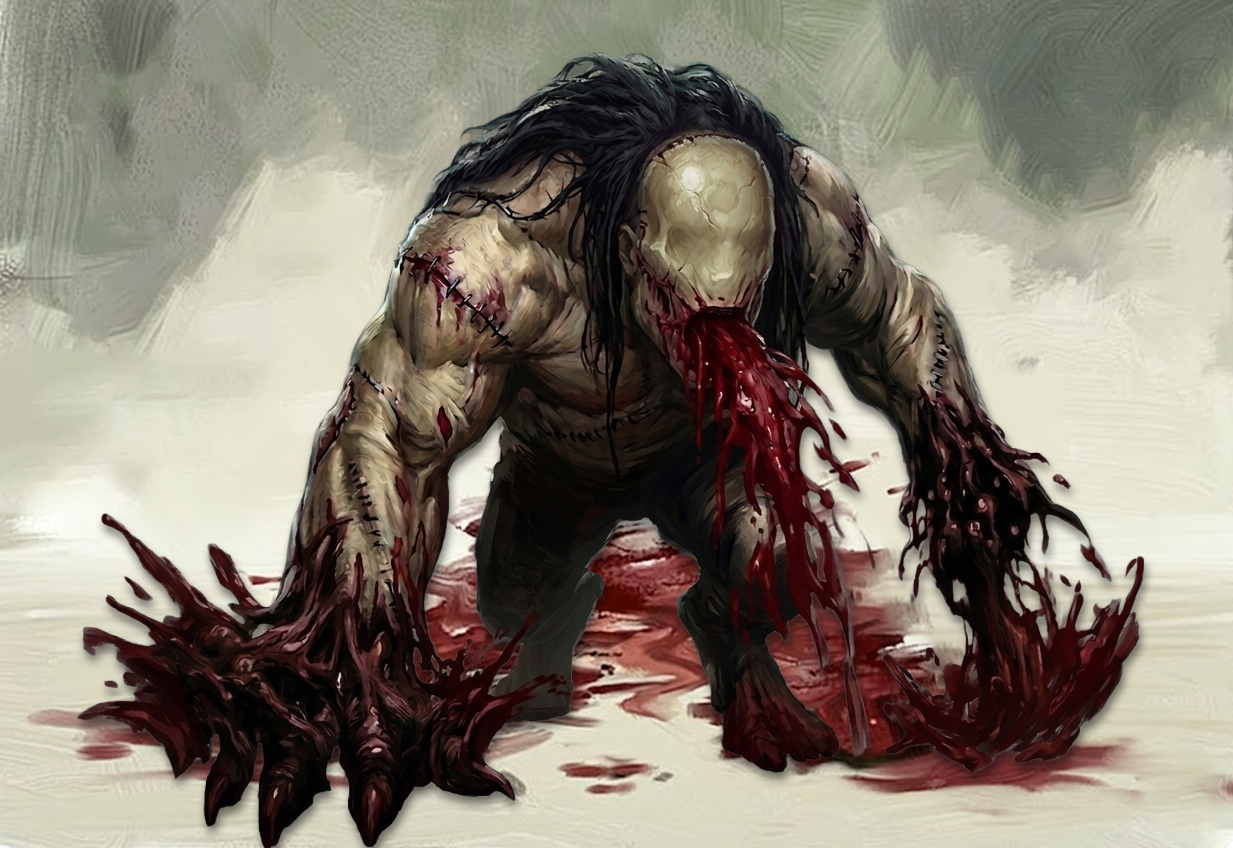
THE SLIME OF ALL ENDS: The manifestation of Jubilex is that of a thing of slime and ooze – disgusting, loathsome, and said to be shunned even by the other Galchutt. Its foul and nauseating body is without set from – it can appear as a vast pool of slime or rise up into a towering column of disgusting ordure. In many texts, however, it is described as a tall, cone-like heap, striated in disgusting blackish-greens, foul browns and yellows, and sickly translucent grays and ambers.

THE RED EYES: No matter what description of Jubilex is given, however, mention is always made of the pulsating, red eyes that “look in all directions from his undulating form”. These eyes are said to “see the making and unmaking of all things”.

THE EFFLUENCE OF CHAOS: Jubilex is also described as “spewing forth the verdigris ichorous”. The remnants of this loathsome effluence – a green, slimish ichor – is said to still lurk in the dark places of the world, shunning forever sources of light and heat (which are anathema to it).

THE DARKNESS GIVEN HUNGER: Jubilex is said to be served by the Darkness Given Hunger – a “black and pulsing creature of nether destruction”. Depending on the texts being referenced, the Darkness Given Hunger was either “ripped from the depths of the Formless Form” (exuded from his own undulating body); created through a demonic infusion; or independently spawned in “stygian pits of ever-dark”.

DESIGN NOTES

I added Jubilex to the ranks of the Galchutt partly because it just makes sense and is an easy way to expand their number, but mostly because I adapted a published adventure featuring Jubilex and used it in my Ptolus campaign. It’s a good example of the campaign stitch.

Back to Chaos Lorebooks

Kihomenethoth - Monte Cook's Ptolus

And at his touch, the black oil of his thought passed from one mind unto the next until all served unto his image and his purpose. And where the Touched went, so the mind and might of Kihomenethoth followed.

This lorebook collects various pieces of knowledge regarding the Galchutt known as Kihomenethoth, the Writhing One.

THE ONE WHO SLEEPS APART: In many of the texts, Kihomenethoth is referred to as the “One Who Sleeps Apart” – “not banished from the Throne of Shadow”, but “choosing to remain separate from his kin, beneath the ancient Crypt of All Crypts, where he might be succored by the souls of winter”. He is also referred to as the “Lost and Living Idol”.

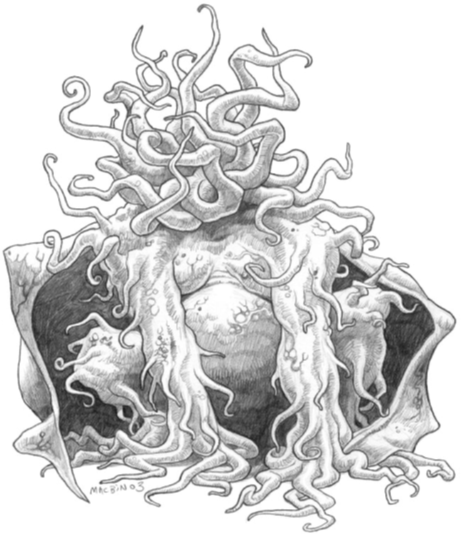
THE TENDRILS OF THE MIND: Kihomenethoth is written of as the most passive of the Galchutt. “He goes not forth to work his feats, but lets his Chosen come to him, so that they might be blessed with his Touch.”

Those who are touched by the “tendrils of its thought” become “as one with the great god”, “extensions of his will left to writhe through the world”. Through these thralls “he can see with many eyes and hear with many ears”. And Kihomenethoth “shall breathe the air they shall breathe and walk where they walk”.

THE SUMMONS OF THE DISSOLUTION: “And on the night when the bonds of all bonds are broken, they shall hear the call of their Master and their footsteps shall guide them to the Path of Chaos.”

DESIGN NOTES

This lorebook is a little on the short side because, if I recall correctly, I had to write it up at the very last moment, just a few minutes before the start of a session. It was originally keyed to The Laboratory of the Beast, and then later added to The Vladaam Affair as well.

Back to Chaos Lorebooks

In his mouth the silent scream of the universal spirit became a siren of endless torment. His body was broken upon the rack of the many worlds. In that moment he became as nothing, and nothing became as him.

This tome records the lore of the Dhar Rhyth, one of the Galchutt.

According to the Lore of the Atapi – copied and translated from cuneiform shards – there is a hole in the fabric of this world. “Beyond the borders of this many-hole” lies the “broken realm of befanged worms”.

The hole acts like a portal, leading to a place filled only with squirming, worm-like creatures of utter horror. But these creatures are not the Dhar Rhyth – the Dhar Rhyth is the hole itself.

Dhar Rhyth

THE ENDING WITHOUT END: One myth tells that the Dhar Rhyth was once a man – a man who welcomed himself into a moment of annihilation, only to find the “existence beyond ending”. He became a personification of nullification – a broken, jagged gap between all things.

Many myths of the Dhar Rhyth, however, do not speak of such things. (Or perhaps merely do not see them in the same light.) The Dhar Rhyth is the antithesis of genesis – it has no beginning and no end. It is like the ouroboros inverted.

THE MANY OF THE ONE: “Dhar Ryth” is both noun and verb; name and genus; identity and property. There are those who believe that there is only one Dhar Rhyth in all of time. Others tell of the “times of congregation” in which more than one of the creatures has been seen at once. But then still others speak of “the fractured mirror which is yet whole”.

THE HOLE WITH NO EDGES: The very purpose of the Dhar Rhyth is annihilation and cultists who follow in its path speak of the “hole with no edges” – that all creation is like a hole with no boundaries; a nothingness with no substance.

THE HERALD OF THE SHADOW: Dhar Rhyth is often seen as the Herald of Shallamoth Kindred, another of the Galchutt. They are also known as the Harbingers of Chaos and Annihilation.

THE GATES OF CHAOS: As sentient holes in the universe, dhar rhythm can alter the connection between spaces. Through their nonexistent forms, they can serve as mobile gateways or summon to them all manner of things and beings.

Some texts speak of great temples of chaos raised above the motionless Dhar Rhyth – temples which last only until the Dhar Rhyth is suddenly given unto action, destroying and killing all those who surround it.

DESIGN NOTES

The Atapi referenced here are a desert nomad culture from the Southern Wastes which replaced the Viking-like barbarians in my version of The Night of Dissolution.

You can also compare this lorebook with The Worm of the Void, which details a cult dedicated to Dhar Rhyth. The two are designed to complement each other, regardless of which order the PCs discover them in.

Back to Chaos Lorebooks

In the midst of the legion horde, the Thousand Eyes of the Destroyer laughed at the blood of the fallen and the souls of the dead.

This collection of texts tell of the many battles of the Galchutt known as Bhor Kei – the Eyes of Legion, the Laughing Destroyer, the Black Reveler.

ASPECT OF THE TITAN: “Its quaded arms – each raised in beclawed glory – wrought fountains of blood and rivers of gore. And in its flesh was reflected the gore of its fury.”

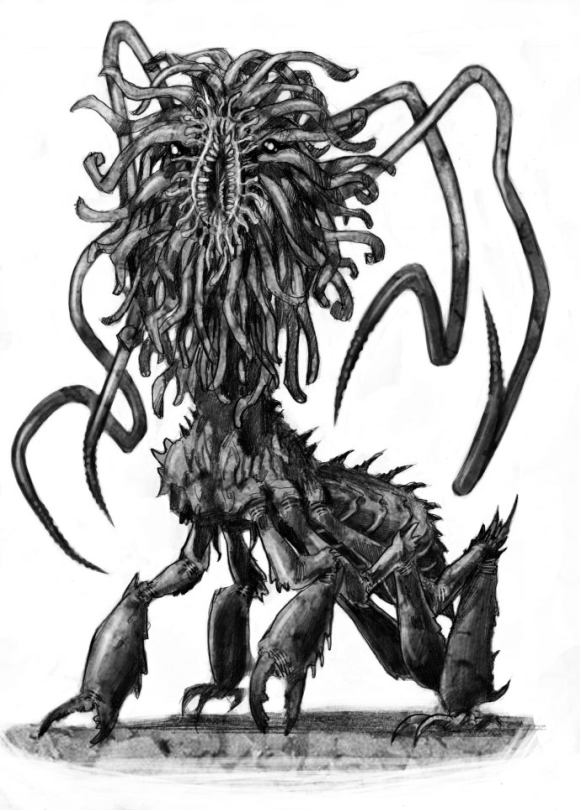
In its aspect as the titan, Bhor Kei maintains a humanoid form with four arms, each ending in huge, terrible claws like serrated cleavers. The eyes of the Bhor Kei titan glisten deeply green, staring out from a long and pointed face. In this form it strides the fields of battle wreaking destruction.

The Aspect of the Titan is also referred to as the “Eye of the Legion”.

ASPECT OF THE MANY EYES: “A murder of craven eyes. A fury of orbed sight. Seeing all that is ending; knowing all that is broken.”

In its aspect of the many eyes, Bhor Kei is seen as a cloud of bloodshot eyes and blackened wings. In this aspect it has no true shape or substance, but exists as a spiritual manifestation of destructive might.

In all its forms, Bhor Kei is seen to work alone. But there are those texts which describe it as actually representing the destructive thoughts of a multitude of beings – and in that form it is the Many-Eyed Prelate of the Blooded Death.

The Aspect of the Many Eyes is also known as the “Eyes of Legion”.

THE TRAIN OF SOULS: Many tales claim that every living thing that Bhor Kei destroys is doomed to follow forever in its ethereal wake – ghosts bound in spirit to its material form for all eternity. From these souls, Bhor Kei is said to draw upon an endless reserve of strength and power.

THE PAEAN OF DESTRUCTION: Bhor Kei is guided only by emotion and instinct. It lives in the moment. It lives for destruction. It lives with a tireless lust for destruction.

The sum and total of its life and deeds is the Paean of Destruction – the Song of All Chaos. In this song, Bhor Kei moves across the many worlds, rending and killing with a scream of dire pleasure. It revels in its endless pursuit of annihilation.

Back to Chaos Lorebooks

The ultimate source of all miscreation and abomination. The gray mass quobbled and quivered, and swelled perpetually – and from within it, in manifold fission, were spawned anatomies that crept away on every side through the grotto. Here there were things like bodiless legs or arms that flailed in the slime, or heads that rolled, or floundering bellies with the fines of fishes; and all manner of things malformed and monstrous. And those that escaped not swiftly ashore when they fell from the pool of the Beast were devoured by mouths that gaped in the parent bulk.

A pool of grayish, horrid mass – a choking river of mud marled with obscene offal. A horrid protean mass of dark muck. Such is the form of Abhoth, the Source of All Filth and Lord of the Zaug.

THE CHILDREN OF ABHOTH: “And from the broken, turgid mass there is given life of dark bounty.”

Those Who Have Gazed Upon Filth (as the Parchments of Bido pronounce them), describe obscene monsters which crawl constantly from Abhoth’s gray mass. These warped and twisted progeny can assume many forms – from the half-functional to mammoth-like horrors. Abhoth’s tentacles and “many-formed limbs” are described as seizing many of these creations and dragging them back into the depths of its bulk. Of those that escape, a few are described as “attendants of the rivulets of muck”, while others wander into the “dark cracks of the world’s black heart”.

THE DARK MIND: The mind of Abhoth is a warped, twisted, and cynical thing. It gives forth great telepathic waves, and Those Who Have Gazed Upon Filth speak of their thoughts being filled with “black rivulets of nether birth” – twisted forms of mental energy that squalm forth from creature’s mind even as its twisted progeny rip their way out of the creature’s viscous body.

LORD OF THE ZAUG: Among those titles given to Abhoth, “Lord of the Zaug” is given often. It is even possible that Abhoth is responsible for their creation. Some, including the Xillian Fragments, even describe the zaug as being “infested with the filth of All Filth”.

THE RAT GOD: Among the ratmen, Abhoth is worshipped as the “Rat God”. But this is nothing more than a guise behind which Abhoth’s true form can be worshipped.

…. a loathsome, night-spawned flood of organic corruption more devastatingly hideous than the blackest conjurations of mortal madness and morbidity. Seething, stewing, surging, bubbling like serpents’ slime is spread its dark mind and mass like a septic contagion.

– The Dasha Codex

UBBO-SATHLA: Even older texts speak of an entity known as Ubbo-Sathla, the Unbegotten Source. Like Abhoth, Ubbo-Sathla is described as a huge, protoplasmic mass resting in deep grottoes beneath the “frozen surface of man’s mind”. Some texts treat this as metaphor, others as literal truth. A few scholars have apparently tried to rectify the discrepancy between these descriptions and those which place Ubbo-Sathla in the “gray-litten crypts of Y’qaa” or “beneath the depths of four-coned Mithradeth”.

In some myths, Ubbo-Sathla is said to have “spawned all life”, yet “whatever her touch lay upon was blighted and no life could be seen in it again”. Other texts limit the extent of her creation to “all life which is dark”. Other speak of her as “the womb of all demon-kin”.

Still other prophecies, such as the Visions of Dezzerak’s Blood, say that Ubbo-Sathla shall one day “take back into her breast the life of all living things” – that all life will be reabsorbed into her mass.

The ultimate identity of Ubbo-Sathla, however, remains hopelessly confused. There are those who see Ubbo-Sathla and Abhoth as the same entity viewed in different epochs and under different names. But there are also other texts that refer to Ubbo-Sathla as the “Mother of All Filth” and Abhoth as the “Father of All Filth”, suggesting some foul and horrid mating between the two. Others describe them as siblings or even as schisms of the same being.

THE TABLETS: “About it, prone or tilted in the mire, there lay the mighty tablets of star-quarried stone that were writ with the inconceivable wisdom of the demon gods.” Ubbo-Sathla (and thus, perhaps, Abhoth) is also said to serve as “murky guardian” to tablets containing secrets of the Demon Gods – “lore lost to all mortal minds and kept in secret lest it be turned against them before the End of Days”.

Fuller records of these tablets (or even the tablets themselves) have been oft-sought by sorcerers and scholars, but none is known to have yet succeeded in acquiring them.

Horrible it was, if there had been aught to apprehend the horror. And loathsome, if there had been any to feel loathing.

DESIGN NOTES

Abhoth can be found extensively in Ptolus and The Night of Dissolution, but was originally created by Clark Ashton Smith. Ubbo-Sathla has been lifted from the short story of the same name, also by Clark Ashton Smith. The reference to “Dezzerak” is to an entity from The Book of Fiends (more on that later).

Back to Chaos Lorebooks

Archives

Recent Posts

Recent Comments

Copyright © The Alexandrian. All rights reserved.