The Alexandrian

Posts tagged ‘chaos lorebooks’

Spiral of the Plagueborn

The pages of the first part of this volume are covered with an exhaustive detailing of disease – partly its symptoms, but always the methods for its spread, and never a word about its cures.

The second part of the volume espouses the teachings of the Brotherhood of the Plagueborn. These cultists seek to achieve destruction and devastation through disease and pestilence. They promote the accumulation of filth, rot, and decay. They sneak contaminated foods into marketplaces. They steal bed linens of the ill and slip them into the beds of children. They dump filth into wells.

Their temples, it seems, are almost always found in the sewers, trash heaps, and waste pits of civilization. They lurk in the places where civilization breaks down into its foulest parts and then – like vermin – seek to spread that corruption and decay to every part of the world.

Deadly Carrier
Transmutation
Level: Clr 3
Components: V, S, DF
Casting Time: Standard action
Range: Personal
Target: You
Duration: Instantaneous

You render yourself immune to the effects of a single disease you currently carry within your body. At the same time, the disease becomes twice as contagious as normal. If the disease does not already have mechanics for contagion, assume that anyone spending at least 10 minutes within 20 feet of you must make a Fortitude saving throw (DC depends on the disease) or become infected.

DESIGN NOTES

Some material on this page is covered by the Open Gaming License.

Like the Songsingers, the Plagueborn weren’t part of the Night of Dissolution conspiracy.

Back to Chaos Lorebooks

Song of Discord - Brotherhood of the Songsingers

This volume appears to be a cult manual for the Brotherhood of Songsingers.

The Songsingers worship chaos in the form of the Discord – the “song of chaos”. They perceive the ways of order as the monotony of a single note beaten again and again. They see, in their acts of chaos and wanton destruction, a “changing of the tune” to include discordant notes. It this discord, they believe, which is the essence of freedom and life. Without discord, liberty would be a hollow and empty shell.

But there is also a deeper level on which the Discord exists. The book speaks of the Galchutt – “Dukes of Chaos” who “slumber in eternal aeons” in their “caverns ever-echoing”. The cult believes that, through their religious rituals, they can open their “inner ear” to the whispers of Galchutt – whispers which are, in fact, the Song of Discord and of Chaos.

In this way, the actions of the cult can be seen as variations played upon an eternal theme chanted into the world by the sleeping Galchutt.

DESIGN NOTES

This lorebook notably describes a cult which DOESN’T appear in my Ptolus campaign. It’s something of a meta-red herring. It’s like the old joke: If you want to prank someone, sneak three pigs into their house. If you want to drive someone insane, release three pigs in their house and label them One, Two, and Four.

If I gave my players a list of the chaos cults who appear in the campaign, then that list simply becomes a checklist. But if that list includes additional entries, then its sows uncertainty: Where are the Songsingers? Why haven’t we encountered them? Did we miss them? What are they plotting?

And even after the players become certain that the Songsingers are not, in fact, part of the conspiracy they’re investigating, the references continue to evoke a wider, deeper, and more mysterious world: The Songsingers were not here, but they are out there. These things that you have experienced are only one part of a larger world.

There is some risk with this technique that the players will take the bit between their teeth and go haring off looking for the thing which, technically, was not part of the current scenario. But this is hardly a bad thing. “Oh, no! The players are pursuing something they’re passionate about!” It’s easy enough to follow their lead and gin up a new scenario. Perhaps it’s only a side quest. Perhaps you (or they) can find some clever way to reflect it back into the primary scenario.

Back to Chaos Lorebooks

Mark of the Beast

According to this book, the thin veneer of civilization is a perversion of the natural order of humanity. We are born as beasts, and it is only by returning to the way of the beast that truth and purity can be found.

In short, the book is a cult manual for the Brotherhood of the Beast – which also refers to itself as the Brood of the Beast.

The core ethos of the cult is complicated in its worship of Ravvan – a chaos god they revere as the True Beast or the Beast Without Shadow. They believe that they can hear the words of Ravvan – the “whisper of the Beast” – in their souls. By surrendering to the guidance of the Beast, the members of the cult experience a religious ecstasy.

Chaotic Possession
Enchantment (Compulsion) [Chaotic, Mind-Affecting]
Level: Clr 6
Components: V, S, F
Casting Time: Standard action
Range: Touch
Target: One creature
Duration: See text
Saving Throw: Will negates (see text)
Spell Resistance: Yes

You cause a chaotic spiritual entity (often a demon) to inhabit the target for a time. Left to its own devices, the entity usually takes control of the target immediately, causing him to commit chaotic (and usually) evil actions. The target falls under the complete control of the DM. When the entity causes the target to commit an act he would normally never do—attack a comrade, commit a crime, and so forth—the target gets to make a new saving throw to cast out the entity. He remains possessed until he manages to succeed at a save

to cast out the possessor. The caster can give the entity one suggestion that it automatically must obey. Sometimes this involves an action to take place much later; until that time, the entity lies quietly dormant within the target. In such a case, the target has no indication that he is possessed.

Banishment, dismissal, dispel evil, or any other exorcism-type effect immediately rids the target of the controlling entity. Protection from evil does not help, however, because the entity is within the subject. Dispel magic has no effect. The target suffers a –2 luck penalty to the saving throw if he currently (knowingly) has any chaositech in his possession.

MONSTER GOD’S MARK

You have been marked as one of the god of monster’s favored minions.

Prerequisites: Con 13, god of monsters as patron deity.

Benefit: Your abdomen bears several ugly scars, as if your belly had been torn open by a clawed hand. The Monster God’s Mark identifies you as favored of this god, and if it is visible, you gain a +2 bonus on Intimidate checks but a –2 penalty on Diplomacy checks.

Once per day as a free action, you may invoke this god’s name as you strike a non-evil foe with any melee attack. As you do, you cause the creature struck to become deformed in some hideous manner (cloven hoof, horns, forked tongues, and vestigal limbs like wings and tails are common deformities). The deformity imparts a penalty of 1d4 points to the target’s Charisma score for 1 hour; the target can resist this effect by making a Fortitude save (DC 10 + your character level + your Charisma modifier). The physical deformity vanishes as soon as the Charisma penalty fades.

Any offspring you sire or give birth to gain the fiendish template.

Some material on this page is covered by the Open Gaming License.

Back to Chaos Lorebooks

Brotherhood of the Tolling Bell

The end of the world we know shall come like to the tolling of a bell.

In the beginning there was a darkness at the heart of the world, and it cloaked itself in the shape of Shadow King – He Who Was Banished and wrapped in the threads of the Demonweb.

But like a shadow banished by a candle, the Shadow King lurked in the flickering darkness. And he reached out and reared up his Demon Court. And like their King, the Princes did furnish forth their Dukes.

And they are known in the Dark Tongue as the Galchutt – the Lesser Lords. And in the tongue of elves they are known as the Natharl’nacna. And in the tongues of men they are the Dukes of Chaos.

War was fought. And lost. And the shape of the world was changed. And the Princes were banished to serve their King in the webs that lie beyond the edge of time and space.

The Galchutt were not drawn into the temptations of that web. But their power was bound to their masters, and so they retreated to their Caverns of Slumber. And there they sleep.

And they wait.

Those who would serve them must sow the seeds of chaos. For the night shall come when the ties between the Dukes and the Princes shall be forever broken. And then their sleep will end. And the Galchutt shall walk the earth and in their footsteps the seeds of chaos shall blossom into the end of days.

And that night shall be the Night of Dissolution.

THE MANIFESTO OF THE TOLLING BELL

The rest of this book reads as a manifesto. The author – who calls himself Wuntad – describes the need for all the forces of chaos to join together in order to bring about the Night of Dissolution and the end of days. They would be led by a single cult known as Brotherhood of the Tolling Bell.

Mark of Chaos
Transmutation [Chaotic]
Level: Clr 2, Sor/Wiz 2
Components: V, S, M, DF
Casting Time: Standard action
Range: Touch
Target: One creature
Duration: One hour/level
Saving Throw: Fortitude negates
Spell Resistance: Yes

The target gains a physical mark prominently on her body—one of the many symbols of chaos or a chaos cult. Each time the target performs a non-chaotic act, she suffers a –2 penalty on any check or die roll (including attack rolls) involved with the act, if any. Each time the target performs a chaotic act, she gains a +2 bonus on any check involved with the act, if any.

The DM is the final arbiter of what constitutes a chaotic or non-chaotic act. Some are easy—attacking a lawful creature is a chaotic act. Casting a chaotic spell is a chaotic act. Using a chaotic (or anarchic) weapon is a chaotic act. Some acts are a bit harder to judge: Destruction, in general, is chaotic, while building and repairing is not. Murder, defying authority, lying, and cheating all can be chaotic acts, but the decision is ultimately up to the DM.

Arcane Material Component: A burning smokestick

DESIGN NOTES

Some material on this page is covered by the Open Gaming License.

Wuntad’s cult of the Tolling Bell is the central antagonist of The Night of Dissolution adventure. As with The Touch of the Ebon Hand, you can see how I’m taking chunks out of the Chaositech sourcebook and parceling it out via the lorebooks, creating an additional layer of lore for the PCs to slowly peel back. (In practice, this sort of material would also appear in cultist spellbooks and the like.)

Back to Chaos Lorebooks

Touch of the Ebon Hand

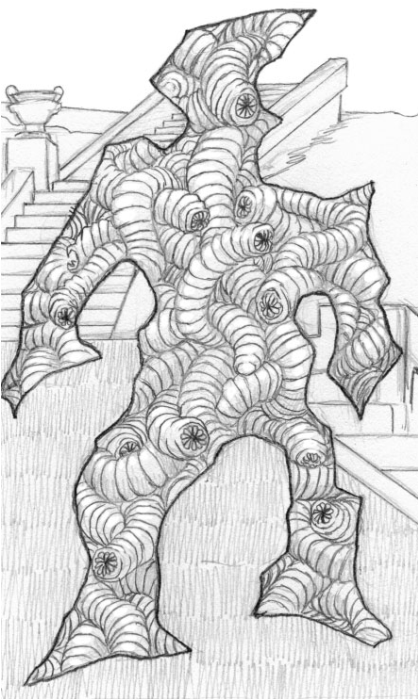
The pages of this volume are filled with disturbing and highly detailed diagrams of the most horrible physical deformities and mutations. A closer reading quickly reveals that these deformities – referred to as “the touch of the ebon hand” – are venerated by the writers as the living personification of chaos incarnate. Particularly prized are those functional mutations – an extra eye or oversized arms, for example.

The rest of the book describes horrid rites which make it clear that the Brotherhood of the Ebon Hand not only idolizes deformity and mutation, but seek to inflict it and spread it as well: Ritual scarring. Magical alteration. Alchemical experimentation. Chaositech-induced mutation.

Members of the cult have no distinctive garb, but they usually bear the symbol of a black hand in some form: A tattoo. A charm. A small embroidery on their clothes. Or so forth. Of course, most of them are also marked by their mutations.

BLESSINGS OF MUTATION

Blessing of Mutation
Transmutation [Chaotic]
Level: Clr 5
Components: V, S, M, DF
Casting Time: Standard action
Range: Touch
Target: One living creature
Duration: Instantaneous
Saving Throw: Fortitude negates
Spell Resistance: Yes

The target gains the minor mutation template (see Chaositech, Chapter 4). These mutations manifest over a period of 1d2+1 weeks. If this spell is cast every other day during thatperiod, the mutation template becomes moderate. If the spell is cast every day during the period, use the major mutation template.

A target gaining the minor mutation template reduces his experience point total to halfway between his current level and the previous level. He does not gain a new level again until he actually reaches a total that would qualify him for the next level. Thus, if the target is 6th level, his experience point total becomes 12,500 (but his level remains unchanged). He does not gain another level (7th) until he reaches 21,000 XP. A target gaining the moderate mutation template reduces his experience point total to midway between his previous level and the level before that. A target gaining the major mutation template reduces his total to the midpoint between the levels two and three levels below his current one. Characters whose experience point totals fall to zero in this fashion drop into a coma for 1d2 weeks. They awaken with no template but a permanent mutation drawback (see Chapter Four).

This spell does not work on targets that are already mutants.

Material Component: 1,000 gp worth of various chemicals and mixtures, requiring an Alchemy check (DC 20) to concoct. Failure indicates that the chemicals are wasted and ruined.

DESIGN NOTES

Some material on this page is covered by the Open Gaming License.

In the version of this lorebook that I gave to my players, I also attached the entirety of Chapter 4: Blessed Mutation from the Chaositech sourcebook. I won’t reproduce that here for obvi0ous legal reasons, but this is an example of how you can use lorebooks to introduce new mechanical elements to the game. I love pulling material from sourcebooks and packaging it as a lorebook reward for the players. Sometimes this will result in the players engaging deeply with the new material, but even when they don’t, I’ve found that they nevertheless get excited by the material.

Back to Chaos Lorebooks

Archives

Recent Posts

Recent Comments

Copyright © The Alexandrian. All rights reserved.