 Reeva woke up before dawn with a stiff and scabrous back. The rest of the night passed quietly and, in the morning, they headed back down the stairs.
Two more guards had been placed at the far end of the rope bridge. But Thalmain and Trust kept them harried with missile fire while the rest of the party rushed across the bridge and engaged them. In short order they were dead.
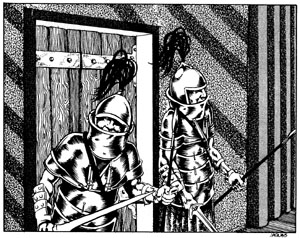
It turned out that the guards had been standing duty outside of two large wooden doors. Jorgen grabbed his 10-foot pole and jammed it through the handles of the doors, barring them shut… And just in time, too, as someone tried to open them from within.
“Dmitri! What is it? Are you all right?”
Jorgen tried to bluff them: “Everything’s fine!”
It didn’t work. Everything within fell quiet… too quiet.
Jorgen grabbed one of the broadswords the guards had carried and jammed it through the handles, taking back his 10-foot pole. Then they kicked the guards’ bodies over the edge of the chasm (they head a splash and a sickening crunch from below).
They headed off in a different direction, crossing over another rope bridge through a chasm where they were harried by giant bats. They eventually reached a chapel guarded by more of the ebon-eyed guards.
These guards they killed, but not before Jorgen, son of Karl, son of Nichol was brutally cut down. (And with a Constitution of 5, he wasn’t getting back up.)
Proceeding into the chapel they found a sacrificial altar hidden behind some black drapes. Bound to the altar and gagged was a prisoner: Herbert the Elf!
THAT’S ALL FOLKS!
And that’s where we ended the session. It was a weeknight and people were beginning to wear out. We’d gamed for about 4 hours (including the 45 minutes or so spent on going over the rules and creating characters at the beginning of the night).
Opinions of the evening were split.
The final PC death tally stood at 7. (It would have been 9 without the Constitution-based survival checks I was making.) After the TPK one of the players very visibly checked out of the game — it seemed like they just couldn’t be bothered to care any more. The player of Nichol/Karl/Jorgen/Herbert — while providing some of the best entertainment of the evening with her spontaneous explanation of dwarven mating habits — was becoming visibly pissed off by the end of it.
(As she later put it, “An entire dwarven family was destroyed tonight.”)
Another player later summed up their impression by saying, “OD&D = Death + Math.”
Everyone else seemed to enjoy themselves. At least one of the players seemed eager to continue playing through the scenario. (Given the mixed reactions from the others, I doubt that will happen. But we’ll see.)
From my perspective, I would have liked to see the Caverns of Thracia get a little more thoroughly explored. But on the flip-side, there was something extremely rewarding about watching the dungeon slowly assume that old school aura of terror/respect.
The players were also slowly learning (or re-learning) classic dungeoncrawling skills. They went from more-or-less barging straight ahead to taking a gradually more cautious and clever approach.
I’d also like to take the opportunity to say that the spontaneous coining of the name “anubis” for the dog-faced humanoid they confronted was probably the highlight of the evening for me. It just felt like the perfect Old School moment — like the first time someone referred to an illithid as a “mind flayer” and the name stuck or something — and I could easily see myself statting up a race of dog-faced anubians for a Monster Manual.
Rules mastery also plays a role in the success of a session. I was certainly struggling in several places trying to figure out how to handle certain things. (And the poor organization, layout, and wording of the rulebooks certainly didn’t help matters.) I was beginning to find my groove towards the end and I wouldn’t mind running a few more sessions in the Caverns just to get a feel for what it’s like to run OD&D from a position of having really internalized the system (however kooky it may be).
I have to, once again, beat down the temptation of trying to rewrite, codify, and re-organize the rules into something more useful. It would certainly make the game (much) easier to run, but it would also kill something vital. Decoding the rulebook is part of the experience here.
If I want to play a cleaned up version of this game, I’ve got 3rd Edition. (4th Edition, of course, is a completely different roleplaying game with no clear lineage to OD&D except its trademark.)
On the other hand, it might be interesting at some point to take the OD&D rulebooks and deliberately explore the path that wasn’t taken: Whenever a rule leaves itself open to interpretation or whenever Arneson and Gygax explicitly give us more than one option, take the path that subsequent editions of D&D didn’t take. See what sort of game you end up with and then refine it from there. Call it the D&D Apocrypha if you like.
Well, maybe some day. I’ve already got one game burning a hole in my pocket.
UPDATE: Continued…
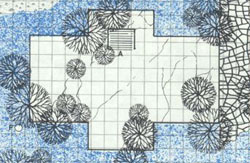
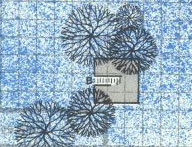 This time the random 1d8 roll determined that they would be approaching the ruins from the southwest. As a result, they ended up practically stumbling over a short, squat building of gray-black stone that was hidden within a small copse of trees. A rusty gate on one side of the building led to a narrow flight of stairs that plunged down into darkness.