Tagline: The Accursed Tower is a fairly solid module, with a handful of potential problems.
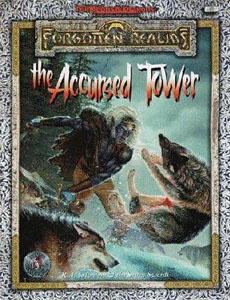 R.A. Salvatore is best known for his novels dealing with the drow character Drizzt Do’Urden – one of the finest swordsman in all of literature. There are some who worship these stories; others who revile them. Personally, I find them to be possessed of both significant strengths (such as Salvatore’s outstanding description of fight scenes and some of the soul-searching for Drizzt found in the Dark Elf Trilogy) and significant weaknesses (such as the repetition of some of the plots and several weak characteristics to Salvatore’s writing).
Similarly these novels are set in the Forgotten Realms, a campaign setting which some worship and others revile. As with Salvatore himself, I find the Realms to be possessed of both significant strengths (breadth of the setting, the wealth of detail and support) and significant weaknesses (some ridiculously bad supplements, over saturation, and general silliness).
I therefore approached The Accursed Tower (an adventure for 4-8 characters of level 1-3) with a fairly open mind – Salvatore and his original gaming group (the Seven Swords) “return to the Savage Frontier” of the Ten-Towns in the Icewind Dale. The characters get a chance to explore a well known area of the Realms, while running into some well known characters of the Realms.
THE PLOT
The PCs are in Luskan, the City of Sails, along the Sword Coast (with that (in)famous “it’s up to the DM to determine how” that seems to be present in every D&D adventure I’ve ever read). They sign up to guard a merchant caravan which is going to the Icewind Dales. When they get there the caravan owner reveals that he has an opportunity for them to earn a great deal more money if they help him out with something.
It turns out that the caravan dealer is searching for a ruined tower where a mage died while researching a healing salve with the potential to help a great many people. If the PCs help him get the notes from that research, they will not only be helping in his humanitarian quest – but will also share in a significant portion of any recovered treasure.
The PCs track down the location of the tower with the help of a few familiar faces – Regis and Drizzt from Salvatore’s books – and then go off to obtain the diary. They do so. End of story.
Except, that’s not all that’s going on. The caravan driver isn’t actually a humanitarian — he’s an evil mage who has killed the actual caravan driver and taken his place. The research he’s after isn’t for any healing salve – it’s for becoming an immortal lich.
It’s time to insert the dramatic music.
THE GOOD STUFF
The set-up is intriguing and provides a solid base for the adventure. Salvatore and his gaming group construct a complex plot with several different hidden agendas and machinations going on behind the scenes – wheels within wheels is the order of the day. First, you’ve got the dual nature of the NPC who hires the PCs. Plus, one of the people the PCs get to help them out is actually an ancient barbarian sorceror, who once fought against the evil mage who owned the Accursed Tower and was responsible for his downfall.
The adventure is also blessed with some remarkably strong NPCs. Drizzt and Regis, of course, get an extra boost thanks to their literary background, but there are several others – including the father-son team from the caravan who befriend the PCs, the barbarian sorceror, and several others.
I was also impressed with a number of hooks which were left open for future expansion at the DM’s discretion – such as a scroll the PCs find half-buried in a snowdrift, with no ready explanation as to how it got there or why.
Finally, the entire package is strong one. As per usual for a TSR book the production values are high, the art is of decent quality, the book has been thoroughly proofread, and the lay-out is clear.
THE BAD STUFF
First, there’s no excuse for recycled art in a 32 page book – even if you are just filling up the quarter page of blank space left on that second-to-last page. This is particularly true if you’re TSR. They’ve published hundreds of books. Surely there was a piece of art from some other book they could have recycled instead of copying the art from page 17.
Second, the book suffers from that perennial Realms problem: Silly names. Maybe some people don’t have problems with names like “Peddywinkle” in their fantasy campaigns, but I do.
Third, random encounters are not a substitute for meaningful plotting. Although the first part of this adventure deals with a caravan trip, absolutely nothing happens on that caravan trip of any significance. The only planned event is a goblin encampment, and that only happens if the PCs follow a specific set of tracks. Everything else is a random encounter. I wasn’t too impressed with this – you could just as easily have said “the PCs are in the Icewind Dales” instead of “the PCs are in Luskan”.
Fourth, the “healing salve” cover for the archmage’s true intentions was a little annoying. It is described as “healing any wound and curing any disease”, and the guy goes on to say how he wants to “make this salve known to all, so that the world would be free of sickness”. Yeah, right. Did the Realms suddenly become devoid of healing potions?
Fifth, the map on the inside front cover is of the caravan route. Along this route are numbers. What these numbers are supposed to be is never mentioned, but you can interpolate and figure out that these represent how far the caravan gets on each day of the journey. This has relatively little importance (after all, it is a set path), especially considering the complete unimportance of the caravan drive to the overall adventure in general. The book would have been better served with a map of the Icewind Dales, where the PCs have to trek all over the place to figure out the location of the tower.
Finally, the early part of the adventure is fairly railroaded (except for those sections where nothing of importance is happening). The last part of the adventure, where the PCs have reached the tower, is nothing more than a standard event-by-location dungeon.
CONCLUSION
The primary appeal to The Accursed Tower is going to be for those familiar with Salvatore’s writing. The basic plot and elements of the adventure are nothing to get excited about (and are, in fact, possessed of several drawbacks) – but this can be mitigated when the PCs run into characters well known to them from their favorite books. It’s the same kind of rush you got from the line, “Anakin Skywalker… meet Obi-Wan Kenobi.” Or from those Howard stories where you’re following some unfamiliar character and suddenly they run into Conan.
So, The Accursed Tower gets an average rating overall. Those with an interest in Salvatore’s writing might want to pick it up; those with an undying hatred of Salvatore, Drizzt, or the Realms should avoid it at all costs.
Style: 3
Substance: 3
Author: R.A. Salvatore and the Seven Swords (Mike Leger, Brian Newton, Tom Parker, David Salvatore, Gary Salvatore, and Jim Underdown)
Company/Publisher: Corsair Publishing, LLC and Sovereign Press, Inc.
Cost: $25.00
Page Count: 168
ISBN: 0-9658422-3-1
Originally Posted: 1999/08/16
I honestly have no idea what my problem with the name “Peddywinkle” was.
For an explanation of where these reviews came from and why you can no longer find them at RPGNet, click here.
 GMs tend to frame to the arrival: If the PCs are heading to a warehouse, the GM will cut to their car pulling up outside the warehouse. If they’re going to question a suspect, the GM will cut to them knocking on the suspect’s door. It’s a safe choice, but it’s frequently unnecessary. For example, if you know that the PCs are going to Boss Man’s office to search for clues, you don’t have to go through the laborious process of having them enter the office building, pick the lock on his door, and so forth. Instead, you can cut straight to them rifling through his filing cabinets and pulling out the incriminating documents.