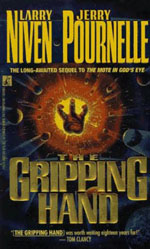
 (Note: In some countries this novel is known as The Moat Around Murcheson’s Eye.)
This is going to be a rather rapid reaction, because the book doesn’t really deserve more than a quick dissection.
First off: DO NOT LOOK AT THE MAP. Good lord. That thing is a cesspool of spoilers. And not in a “well, now we know where they’re going” way, but in a “they just told us what Rosebud is” kind of way. Unless you’re the type of crazy person who likes reading the last page of a mystery first, steer clear of the map.
Now, to begin properly, let’s discuss what works in The Gripping Hand: The prose is smooth and, from sentence to sentence, generally well-written. It’s also nice to revisit the Moties and see their unique culture from a new slant.
…
Okay, now that we’re finished with the strengths, let’s look at the host of flaws which plague this book. Let me count them off:
First, starting off small, there’s the recapping. Niven and Pournelle recap just enough to annoy people who have read the first novel, but don’t manage to cover enough territory to actually fill in those who haven’t. The result is the worst of both worlds: On the one hand, they’re bogging down this book for everyone who read The Mote in God’s Eye. On the other hand, they aren’t actually making this book accessible to anyone who hasn’t.
Second, and in a similar vein, there’s the clumsy and overwhelming exposition. I was literally stunned by the sheer mass of “as you know, Bob” lectures peppering the novel – I think they average about one every ten pages. In some cases, they’re even polite enough to explicitly identify what they’re doing. (Quote: “I may have to lecture. […] I won’t explain that, you got it in high school, but [insert explanation he just said he wasn’t going to give].”)
Third, the entire work is plagued by inconsistencies and contradictions. Mostly these are internal, but there are also several inconsistencies between Mote and Gripping Hand. And that doesn’t even count the deliberate and ham-fisted retcon which drives the entire plot. (Something which I found intrinsically annoying. With all of the interesting possibilities raised by the Moties and the situation at the end of the first book, why did they feel it was necessary to resort to a retcon in order to come up with a plot? Heck, they off-handedly discard another fascinating possibility explicitly. And even the scenario they use in the book would arguably be more fascinating without the retcon.)
Fourth, there’s still no thought put into the setting: A massive interstellar empire can rule over dozens (possibly hundreds) of star systems, but can’t figure out how to ship produce a thousand klicks and keep it fresh. The same society possesses Langston fields which can protect a ship from the fury of a sun, but characters puzzle over how to keep the Imperial family safe from atom bombs. The leaders of a colony are quoted as believing that a fireworks display will be the biggest show since one of their cities was bombed into oblivion (which would be like a Japanese Prime Minister claiming that a fireworks display will be the biggest show since Hiroshima). In one sentence we’re told that two colonies have stopped fighting with each other because they collectively fear war with the Moties; in the next we’re told that they’ve stopped building defensively because they’re no longer afraid of war. Even accepting the fact that Niven and Pournelle were constrained by the 20th century analog they had established in A Mote in God’s Eye, there’s still no depth or thought given to the technology they show or the society it implies. This is world-building of the Star Trek planet-of-the-week variety, and in many cases its even worse.
Fifth, the characters are still as flat as cardboard. In fact, if anything, they’re even more contrived than they were in A Mote in God’s Eye: An ambitious investigative reporter is allowed to sit in at a meeting where top secret material is being discussed, and only after the fact does anyone realize this was probably a really stupid idea. More retcons are used to justify important decisions. And, yet again, you’ve got a couple of people falling in love at first sight and for no apparent reason. (Perhaps that’s the only kind of love there is in the Second Empire.) It’s not that I don’t believe in love at first sight. It’s that Niven and Pournelle don’t make me believe in love at first sight.
Finally, this book seems to suffer from many of the same problems that Niven’s Ringworld Engineers did: The authors seem to be writing the book as much from a desire to patch the problems criticized in the original work as they are from a desire to tell a good story. The result is predictable, turgid, repetitive, and boring.
Let me stress that again: Boring. The entire plot of the novel (from set-up to resolution) is dispensed with in a single scene around page 100 and the rest of the novel is nothing but sound and fury signifying nothing.
That’s the long of it.
Here’s the short of it: This book is a complete and utter waste. It’s a waste of your time. It’s a waste of a perfectly good opportunity. In many ways, it’s a waste of paper.
No matter how tempted you may be after reading The Mote in God’s Eye to discover what happens next, please believe me when I say that the pain of The Gripping Hand just isn’t worth it.
GRADE: D-
Larry Niven and Jerry Pournelle
Published: 1993
Publisher: Pocket Books
Cover Price: $6.99
ISBN: 0-671-79574-0