The Alexandrian

Archive for the ‘Reviews’ category

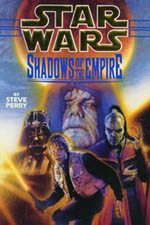
Shadows of the Empire - Steve PerryShadows of the Empire constitutes one of the largest tie-in events in the Star Wars Extended Universe: It featured simultaneous releases of a novel, comic books, video games, and even a specially-commissioned soundtrack, along with ancillary releases including action figures, trading cards, and the like. Multiple, interlocking stories between the three mediums aimed to tell the untold saga of the events between the end of The Empire Strikes Back and Return of the Jedi.

The opening of Steve Perry’s novel exercises an interesting conceit to both hook the reader into the action and immediately cement the legitimacy of this “missing chapter”: His prologue begins with the conversation between Darth Vader and the Emperor in Empire Strikes Back. But rather than viewing the conversation from Vader’s end of the holographic communication (as we did in the film), Perry flips to the other end of the line and shows us what’s happening just off-screen as the Emperor speaks with Vader.

(Ironically, Lucas decided to re-script this entire scene for his “extra special” DVD edition of Empire Strikes Back. Ten years from now we’ll have ignorant Star Wars fanboys reading Shadows of the Empire in college and wondering why Steve Perry couldn’t get the lines right.)

I found that this opening worked for the length of the conversation, but then did something of a pratfall as it wrapped up. The problem is that, throughout the conversation, Perry necessarily shows us Lucas’ use of heightened language: “The Force is strong with him. The son of Skywalker must not become a Jedi.” But once the conversation wraps up, Perry finds himself needing to script some original dialogue for the Emperor. What do we get? “Now, where were we, Prince Xizor?” Chatty cliche.

The book’s ability to convince me that I was actually reading the events between the films went down hill from there. For example, early in the novel we get a lengthy explanation that Chewbacca won’t leave Leia’s side because Han told him to look after the Princess and Chewie owes Han a life-debt. This would make a lot more sense, of course, if the last scene in Empire Strikes Back didn’t involve Lando and Chewbacca flying off in the Millennium Falcon… leaving the Princess behind.

There’s always been an open question in my mind about what, exactly, the plan conceived off-screen at the end of Empire Strikes Back was. It involved Lando and Chewbacca going to Tatooine as an advance team, with Luke and Leia following later. Somewhere along the line, that plan shifted — with Lando infiltrating Jabba’s palace; Chewbacca teaming up with Leia; Luke providing mop-up; and R2-D2 inserted as an insurance policy. Apparently, rather than describing how that plan developed, Perry has decided to simply ignore the continuity of the films altogether. Which, in an effort like this, leaves one wondering: What was the point again?

(Perry also manages to screw up the continuity at the other end of the book, too, having the Emperor leave for the second Death Star about a week before Vader does, rather than the other way around.)

These little inconsistencies are strewn all over the book. For example, Perry also claims that Leia was present on the Millenium Falcon for the conversation in A New Hope which took place on the hyperspace journey between Tatooine and Alderaan (when Leia was, in fact, still imprisoned on the Death Star).

And the problem is that, when the little details are wrong like this, it becomes impossible to accept Perry’s larger leaps. If he can’t even get Chewie’s continuity to track, why would I accept his revelation of Prince Xizor, an Imperial servant wielding as much power as Darth Vader himself? (It doesn’t help that Perry can’t seem to grip Vader’s character. Vader as petulant, sulky, and sarcastic isn’t a portrayal that works for me.)

Perry’s inability to execute this novel effectively is so frustrating, in part, because there are some big ideas here which could have been so right if they’d been done well. For example, the reptilian Prince Xizor — cold and precise in all things — is conceptually a perfect counterpoint to Darth Vader’s essentially emotional nature. Putting Leia in a position where her newfound love for Han is put to the test is dramatically perfect for this transitional period in the saga. The emotional confusion of both Luke and Leia as they grope to understand the true nature of the love and bond between them is very well done.

Unfortunately, there’s those pesky details. And it’s not just a matter of those details sometimes being distracting, it’s also a matter of those details frequently sabotaging the strongest elements in the novel:

If Prince Xizor actually was the coldly calculating, fiendishly clever, incredibly subtle crimelord that the novel keeps claiming he is, then he’d be a villain capable of standing toe-to-toe with Darth Vader. But when it comes time to show us the actual details of Xizor’s cunning plans and machinations, what we actually see is irrational, illogical, and frequently thuggish. (Of course, Vader himself isn’t particularly up-to-snuff, either. In one scene he’ll be amazed at the Emperor’s ability to see a hidden truth with nothing but the Force to aid him. In the next, he’ll be apishly destroying video cameras in an attempt to keep the Emperor from seeing a hidden truth.)

If Leia’s love for Han were actually put to the test, you’d have some interesting drama and character development: A crucible from which Leia’s love could emerge stronger and purer than before. Instead, Perry just slips her some date rape drugs.

I also found the “revelation” that the Bothan spy mission which uncovered the existence of the Death Star was actually carried out primarily by Luke Skywalker to be fairly insipid. One of the things which made the original trilogy of movies special was the implied depth of the universe: There were things happening in the galaxy which didn’t directly involve the main characters. The Bothan spy mission was a prime example of that, and “revealing” that it was Luke Skywalker all along doesn’t add depth to the Star Wars saga — it cheapens it.

There’s also the problem that the main plot of the novel makes no sense: Vader wants Luke captured alive so that he can convert him to the dark side. Xizor wants Luke killed in order to thwart Vader, his rival. The problem? Well, simply having Xizor say, “I wanna thwart Vader just ’cause!” is kinda weak and relatively pointless. So Perry tries to raise the stakes by having Xizor set things up so that it will look like Vader had Luke killed. Why? Because Vader promised the Emperor that he would deliver Luke alive; so if it looks like Vader killed Luke, instead, the Emperor is going to be pissed off at Vader.

The only problem here is that Vader did not, in fact, promise the Emperor that he would deliver Luke alive. What he actually says is: “He will join us or die, Master.” And, in fact, the Emperor wanted Luke dead from the get-go; Vader was the one who suggested the possibility that he might be turned instead. Xizor, remember, knows this because he watched the whole conversation.

So you’ve got an Emperor who wanted Luke dead, but is willing to entertain the possibility that he might be turned into an asset. Why, exactly, would killing Luke piss the Emperor off?

And you’ve got Vader who just got done convincing the Emperor that Luke might be more valuable alive than dead. Why, exactly, does Xizor think it would be believable, in any way, to make it look like Vader then promptly turned around and ordered Luke’s assassination?

Xizor’s plan is just stupid. Which is the problem with most of the plans in this novel:

Attacking an Imperial outpost because Boba Fett’s ship is docked there may make some kind of sense. Failing to (a) anticipate that Boba Fett might simply fly away in his ship; or (b) keeping some kind of look-out to track him if he does fly away… that’s stupid.

Arranging for the destruction of a rival’s shipyard in order to send a message to their leadership that you’re not going to tolerate them honing in on your territory makes sense. Of course, it makes more sense if you didn’t simultaneously dispatch your top assassin to kill the organization’s entire leadership.

Failing to learn a vital piece of information until it’s too late for you to do anything about it does not constitute a devious plan on your part. No, the fact that your rival also found out about it too late to do anything about it doesn’t make it devious, either. And, no, cackling into the narrative camera isn’t going to change anything.

Other bits of stupidity:

– Leia’s top secret password for receiving secret intel is “Alderaan”. (It will no doubt baffle the Imperial crypto-analysis teams for weeks.)

– Leia is baffled that Vader isn’t disguising his interest in tracking down Luke. (Because after confronting Luke directly on Cloud City , chopping off his hand, and telling everyone involved that his real goal was luring Luke to him, it would make perfect sense for Vader to suddenly start pretending that he has no interest in Luke.)

– I never knew this before, but apparently Vader hates subterfuge and deceit. (Did Perry even watch Empire Strikes Back?)

– Leia goes to considerable effort and calls in a life-debt to confirm that Prince Xizor runs the Black Sun crime syndicate. Once she’s done that, she says: “Well, it seems as if that much of X’s story is true.” The only problem? X didn’t tell her that. Lando did. (And it proves nothing. If I said, “I’m the Vice President of the United States . The President of the United States is George W. Bush and he would like to meet with you.” You couldn’t prove the veracity of my statements by calling in a life-debt to confirm that George W. Bush is, in fact, the President of the United States .)

– The introduction of cross-species mating to the Star Wars universe seems a trifle Trekish.

– Princess Leia’s inner voice will be played this week by none other than… Queen Latifah.

– If you’re in a large high-rise building full of work-a-day stiffs, you should feel absolutely no compunction about blowing the building to kingdom come. After all, the guy who owns the building is a crook — so anyone working in the building must be equally complicit. The building is in the middle of an incredibly crowded urban area? Well, all for the better. After all, anyone living anywhere near a building owned by a crook deserves to die.

– The Rebel Alliance does not, in fact, have any problem dropping military vessels into orbit around Coruscant, blowing a bunch of stuff up, and then leaving again. The Imperial navy won’t even bother responding to activity like that.

– The Empire has a holonet which stretches from one side of the galaxy to the other… but Coruscant doesn’t have a communication network that will let you place a phone call to any point beyond the planetary horizon.

In the end, the novel’s very structure fragments. Scenes become shorter and shorter, until — finally — they’re little more than three-paragraph segues of disjointed action. Under those conditions it becomes impossible for Perry to maintain any kind of character development or plotting. The short, staccato beats of his narrative become a discordant mess.

GRADE: D-
This wraps up the Star Wars installments of What I’m Reading:

43. Star Wars: Shadows of the Empire – Steve Perry
44. Star Wars: Han Solo Trilogy – A.C. Crispin
45. Star Wars: Corellian Trilogy – Roger Macbride Allen

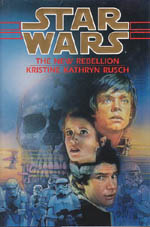
The New Rebellion - Kristine Kathryn RuschWhat I’d like to know is the identity of the editor at Bantam who sent out the memo to all the Star Wars novelists: “Princess Leia is to be portrayed as a complete retard from this point forward.”

In the Black Fleet Crisis trilogy I was willing to accept it as merely a character arc which had gone wrong in the execution. But now I find the exact same misfire as I read The New Rebellion. Leia isn’t quite as stupid as she was at the beginning of the Black Fleet Crisis trilogy (thank god!), but she’s still wandering around with only half her braincells firing.

…

Okay, I needed to get that off my chest. Now, on to the good news: The New Rebellion is a lot of fun wrapped up in a clever little plot. The result is a quick, compelling dollop of entertainment.

We’ll come back to that in a second, but first I need to do some anal retentive bitching about continuity:

In reading The New Rebellion immediately after the Black Fleet Crisis, I’m struck by the fact that the books almost seem as if they take place in alternate timelines. Continuity simply doesn’t track from one to the other:

In the Black Fleet Crisis, Luke has long-since abandoned his X-Wing for the newest model of fighter and Artoo is with Leia on Coruscant. In The New Rebellion, supposedly set only a year after the Black Fleet Crisis, Luke is still flying his X-Wing and Artoo is with him at the Jedi Academy .

In the Black Fleet Crisis, Leia faces a vote of no confidence and numerous, fractious political debates. In The New Rebellion, Leia is concerned that a recent constitutional change allowing members of former Imperial governments to run for the Senate will lead to factious political debates previously unknown to the New Republic. Later, she’s shocked when she faces a vote of no confidence.

Nothing seems to track quite right. And I rather suspect it’s because Rusch originally intended for The New Rebellion to take place at a much earlier time in the post-ROTJ timeline. I could be wrong, but there just seem to be a lot things in this novel which feel as if it were originally meant to take place only 6 or 7 years after ROTJ, not a decade and a half. It also seems that a lot of the references to recent events (such as the Black Fleet Crisis) are tagged onto the novel in a somewhat haphazard way.

In any case, if you’re someone who’s going to get bent out of shape due to continuity lapses, you’re probably going to have some serious issues trying to get the Black Fleet Crisis and The New Rebellion to co-exist in your mental landscape of the Star Wars universe.

For my own mileage, though, I was able to consider such inconsistencies as little more than intellectual curiosities and enjoy The New Rebellion for what it was: A unique vision of Star Wars future history.

I think what I like best about The New Rebellion is the fact that the villain has more up his sleeves than a simplistic “get a really big fleet, sow discord among the leaders of the New Republic, and get the crap beaten out of me in a big space battle at the end of the story”. There’s nothing wrong with such a plot, per se, but between the Thrawn Trilogy and the Black Fleet Crisis it had already worn thin. (And I understand that in several of the tie-in novels I’ve skipped that it gets run through the wash a half-dozen times more.) By contrast, the villain in The New Rebellion is subtle, complex, and indirect.

Other highlights for me include Rusch’s handling of the Solo family: As the crisis grows and the personal threat to the Solos increases, you can really empathize with Han and Leia as the emotional and physical pressures being to weigh upon them.

Actually, with the exception of Leia’s stupidity in the earlier parts of the novel, Rusch is really spot-on in her handling of characters throughout. Evil plots from dastardly villains aside, the real strength of The New Rebellion, for me, were the character dramas which played out upon the stage set by the emerging crisis. I was impressed by Rusch’s ability to put an emotional truthfulness down on the page, revealing all of her characters (both new and old) as fully-rounded human beings. (Or aliens, as the case might be.)

GRADE: B-
Kristine Kathryn Rusch
Published: 1997
Publisher: Bantam Spectra
Cover Price: $6.99
ISBN: 0-55-357414-0
Buy Now!

Hot off the Thrawn Trilogy and still thirsting for more Star Wars I picked up some copies of Michael P. Kube-McDowells’ Black Fleet Crisis. Why the Black Fleet Crisis? Because it looked like the next chunk of significant Extended Universe continuity after the Thrawn Trilogy from an author that didn’t actively turn me off. (By which I mean Kevin Anderson.)

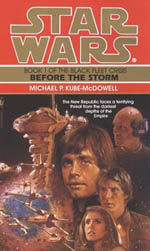
VOLUME 1: BEFORE THE STORM

Before the Storm - Michael P. Kube-McDowellUnfortunately, despite doing my best to avoid the dregs of Star Wars licensing, I found the first volume of this trilogy to be very disappointing.

Why? Well, for starters, Princess Leia doing her best impression of Neville Chamberlain is a bizarre choice, and it quickly goes from simply not ringing true to being painfully stupid. (“Hitler is such a nice guy, it’s just that his hands are tied by his government.” “Hitler might be hiding a massive military force? I can’t believe it, so it must not be true.” “Hitler has derailed the negotiations, slandered my name, and blamed me for the deaths of a dozen people he killed? Then I must be doing something wrong!” “Hitler has killed 300,000 people in a genocidal purge? Cover it up. It’ll make me look bad if it comes out.”) Then she goes home to sulk for awhile before accusing the people around her of being sexist because they’ve been questioning her erratic and moronic behavior.

Kube-McDowell also seems to have some difficulty in keeping his eye on the ball. This entire volume, for example, actually consists of three entirely separate plot lines which essentially never interact with each other. Each plot is characterized by short little spurts of action interrupted frequently by expository lumps, many of which have only a tangential relationship to the action. Individual scenes will often start just AFTER a major event, the details of which will be backfilled a couple of paragraphs later through exposition.

The result is a completely dysfunctional pacing. So when you’re trying not to hurl the book across the room in response to Leia’s latest stupidity, you’re being jerked willy-nilly around the galaxy.

But, in some ways, this disjointed and schizophrenic structure may have been the trilogy’s salvation for me. If the only thing the first volume had offered me was Leia the Incompetent, I doubt I would have continued reading. But the other two plots, one involving Luke’s quest to find himself and the other involving Lando’s exploration of an alien ghost ship, both had enough interesting elements in them to keep me from completely disengaging from the novel.

(Even given that, though, if Leia hadn’t taken her brain off the shelf and put it back in her head where it belongs during the last twenty pages or so of the book, I probably would have given up on the trilogy.)

A few other thoughts here:

Unlike Zahn, Michael Kube-McDowell can’t quite capture the voices of the characters. The characters are true to form, but the words don’t quite sound right in their mouths; the rhythm of the dialogue doesn’t quite flow right. (There are two exceptions to this: Leia, who, as noted, isn’t true to form in the slightest. But also Luke, in quite the opposite direction: Kube-McDowell’s realizing of a Luke fifteen years older and possessed of a profound insight into the wisdom of the Force is simply captivating. It’s not the Luke of the movies, but it’s still Luke — and that’s a very impressive accomplishment.)

In reading this back-to-back with the Thrawn Trilogy, some of the most interesting details are those which conflict with one another: Zahn, for example, postulates that Yoda hung out in the swamp on Dagobah because of the proximity of the cave drenched in the energies of the dark side — a negative charge damping out his positive charge and allowing him to stay hidden from the Emperor and Vader. But Kube-McDowell chooses to focus, instead, on the common element between Yoda and Obi-Wan: Their hermitage. And he reads a great depth of meaning into that hermitage, and draws from it a philosophical revelation of what it means to be a powerful user of the Force.

And watching Luke struggle with the realization that he’s truly outstripped the teachings of his Masters and must now chart his own course is probably the strongest thing about this first volume, and the thing most responsible for getting me to crack the cover on volume two.

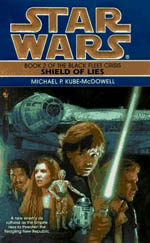
VOLUME 2: SHIELD OF LIES

Shield of Lies - Michael P. Kube-McDowellAnd I’m really glad I did crack the cover on volume two, because Shield of Lies is a massive improvement over the first volume.

The structural problems of the first novel disappear as Kube-McDowell implements the simple expedient of splitting each of this three plots (Leia, Luke, and Lando) into separate parts and presenting them one at a time. The result looks more like a collection of three novellas than a novel, but if it makes for good reading, I’m not going to complain.

Most importantly, Leia’s veil of stupidity is lifted. And with Leia firing on full-thrusters, the political thriller at the heart of the Black Fleet Crisis goes from unrealized potential to page-turning intensity.

If this trilogy were published today, we’d be hearing endless gripes from people complaining that Kube-McDowell has tainted the Star Wars universe with an injection of modern politics. The Black Fleet Crisis, particularly in this second volume, looks an awful lot like the current war in Iraq . And after a quick glance at the copyright date dispels any suspicion of the novel’s possible influences, you can only sit back and appreciate the versimilitude and depth of Kube-McDowell’s narrative.

Where I struggled through the first volume in this trilogy, the second volume gave me a couple of sleep-deprived nights of “just one more chapter” reading. And when I finished the last page, I was immediatley compelled to snatch up the third volume and continue reading.

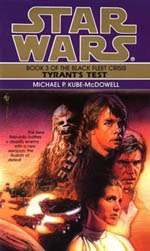
VOLUME 3: TYRANT’S TEST

Tyrant's Test - Michael P. Kube-McDowellNor was I disappointed. The third volume delivers on much the same level as the second.

Perhaps the strangest thing about the trilogy’s third volume, however, is the revelation that one of the three plot threads in the trilogy does not, in fact, have any connection to the Black Fleet Crisis in any way, shape, or form. It could be completely excised from the trilogy and published as it’s own novella without any negative effect upon either itself or the rest of the trilogy. This is, needless to say, pretty bizarre.

Not that I’m complaining about the content of this particular sub-plot. It’s a solid piece of storytelling, and it manages to tell an honest-to-god science fiction story, albeit with Star Wars style.

It’s just odd that this novella, while it may be interspersed throughout the trilogy, doesn’t truly seem to belong to the trilogy.

This third volume also delivers a resounding and action-packed finale. Unfortunately, I can’t quite claim that it was an entirely satisfying finale, in large part due to the fact that — like Zahn’s Thrawn Trilogy — this conclusion seems to have large elements of deus ex machina and liberal coincidence strewn around.

But, in the final analysis, I’m really glad that I persevered through the tribulations of the first volume here, because the second and third volumes provide some great entertainment.

GRADES:

BEFORE THE STORM: C
SHIELD OF LIES: B
TYRANT’S TEST: B-

Michael P. Kube-McDowell
Published: 1996
Publisher: Bantam Spectra
Cover Price: $6.99
ISBNs: 0-55-357273-3 / 0-55-357277-6 / 0-55-357275-X
Buy Now!

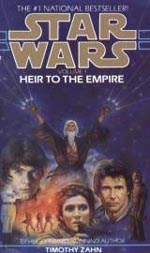
Heir to the Empire - Timothy ZahnPerhaps against all common sense, I’m actually excited by the imminent release of Revenge of the Sith. Actually, “ecstatic” would be the better word (although that doesn’t help my case for sanity.)

Sure, the last two films have shown what happens when you take someone who hasn’t written a script in 15 years and hasn’t directed a movie in 22 years and give them a $200 million budget without any editorial oversight: You get a flabby film from someone showing a lot of creative rust. But, hey, if you work off some of that flab, sand away that rust, and imagine a fresh paint job in a couple of places, you can turn these mediocre movies into some great movies.

But, more importantly, Attack of the Clones was a much better film than The Phantom Menace out of the starting gate. Lucas is working off that flab and he’s getting those rust spots cleaned up. If Revenge of the Sith shows as much improvement over Attack of the Clones as Attack of the Clones showed over The Phantom Menace — and if Lucas can keep his recent penchant for inappopriate humor in check (and the promised darker tone of the movie may indicate that as a serious possibility) — then Revenge of the Sith will be an absolutely fantastic movie. (The tragedy is that, with Revenge of the Sith completed, Lucas will probably retire back to his producer’s chair. Spielberg has spent the last twenty years constantly practicing his craft and improving his talent; if only the same could be said of Lucas.)

And I’m fully aware of the fact that I may be eating these words and washing them down with the bitter draft of disappointment come this time next month. But, right now, I’m pumped up. And I’m looking for things to slake my Star Wars thirst.

Getting widescreen copies of the original versions of the original movies on LD was what started the anticipation. The Clone Wars animated series is almost certainly what got me jumping up and down. Which left me to turn my attention to the Extended Universe.

Back in ’92, when Bantam first got the tie-in license for Star Wars novels and Timothy Zahn’s Heir to the Empire was released with all the attendant fanfare, I religiously ordered each and every volume from Westfield Comics as they came out. I enjoyed them a lot, and unlike my massive collection of Star Trek tie-in novels (which are now buried in a box in my storeroom somewhere), these have almost always managed to find a place on my shelves. As result, as the hunger for Star Wars began to consume me, my eye conveniently fell upon the Thrawn Trilogy.

(Tangentially, Bantam would probably have benefitted more from my pubescent period of completist collectorism if the Zahn’s Thrawn Trilogy had not been followed by the relatively atrocious Truce at Bakura and The Courtship of Princess Leia. And, if I recall correctly, these were followed by Kevin Anderon’s Jedi Search. At the time, I didn’t know who Kevin Anderson was, but I never forgot him. I didn’t pick up a Star Wars novel for more than a decade after that triumvirate of crap.)

What made these novels work for me? Well…

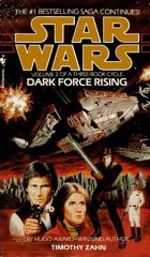
Dark Force Rising - Timothy ZahnZahn never violates my sense of what the Star Wars universe should be. This is a problem that a lot of tie-in novels have: For example, I recently glanced at a Star Wars comic which featured Yoda flying around on the Millennium Falcon with Luke, Han, and Chewie. That was just so wrong, on so many levels, that I immediately put the comic back down.

More importantly, Zahn gives us stories which feel like Star Wars stories. To some extent, he does it by stocking his story with familiar phrases (“I have a bad feeling about this”), locations (cantinas, asteroid fields), and dramatic tropes. But when it comes to Star Wars, that’s a legitimate dramatic technique. Lucas talks about writing the Star Wars movies as if they were true space operas, with certain themes being played again and again in variation. Some would simply scoff at this as being creatively lazy, but I find that Lucas is absolutely right: Exercised with the proper restraint, the technique adds a thematic depth and resonance. Zahn, perhaps, pushes a little too hard at times, but he succeeds at extending the thematic beats of the original movies into his sequels.

With the exception of Threepio, Zahn really manages to capture the unique voice of each character. (And I don’t know what it is about Threepio: I have yet to find a tie-in product that actually manages to capture Threepio’s unique voice. Even Lucas seems to struggle in finding it in Attack of the Clones.) Getting character voices fundamentally right is something a lot of tie-in authors struggle with — and some of them get it so wrong that, whatever other strengths their work may have, I find it impossible to enjoy their story. But when you can succeed at it like Zahn does, it goes a long ways towards legitimizing your story and immersing the reader back into the familiar environs of the original source material.

Zahn also does a great job of balancing familiar friends with brand new faces. Luke, Han, Leia, and all the other mainstays of the original trilogy get plenty of screen time — but Zahn also introduces a cast of new characters and fits them seamlessly into the Star Wars saga. Grand Admiral Thrawn may not be a Darth Vader (who is?), but he’s a great arch-villain nonetheless. Among the others, Mara Jade and Talon Karrde manage to do more than just hold their own as major members of the cast, while characters like Fey’lya, Winter, and Ferrier take up supporting roles alongside familiar faces like Admiral Ackbar, Wedge Antilles, and Mon Mothma.

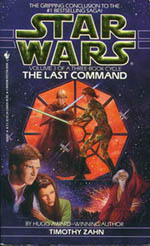
The Last Command - Timothy ZahnWhen I first read these books, I took them up to my mother and I said: “You have to read these. You could literally film these tomorrow and they’d be perfect sequels.”

Looking at them again from a slightly older and wiser point of view, I can’t quite agree with my earlier sentiment. Not only because the prequels have caused these novels to slip out of synch with the canon (Zahn gets the Clone Wars completely inverted, for example), but also due to a certain lack of vigor: There is nothing I would point to here as a debilitating flaw, but there’s also nothing that I would call an outstanding success (with the possible exception of the character of Mara Jade). And, even more importantly, the essentially mythological flavor of the Star Wars movies is lacking here. This is a fun little adventure romp with some great military set-pieces and several moments of intriguing character drama. But that’s all it is.

Of course, that’s hardly a condemnation. The Thrawn Trilogy is a great little piece of space opera, and it’s absolutely perfect if you’re looking for nothing more than some rock solid entertainment.

TRILOGY GRADE: B

HEIR TO THE EMPIRE: B+
DARK FORCE RISING: B
THE LAST COMMAND: B-

Timothy Zahn
Published: 1992-1993
Publisher: Bantam Spectra
Cover Price: $6.99
ISBNs: 0-55-329612-4 / 0-55-356071-9 / 0-55-356492-7
Buy Now!

Archives

Recent Posts

Recent Comments

Copyright © The Alexandrian. All rights reserved.