The Alexandrian

Archive for the ‘Reviews’ category

THE TOP 10

1. The Lord of the Rings (J.R.R. Tolkien)
2. The Hour of the Dragon / Conan Series (Robert E. Howard)
3. Small Gods (Terry Pratchett)
4. A Song of Ice and Fire (George R.R. Martin) (preliminarily)
5. Deadhouse Gates (Steven Erikson)
6. Harry Potter Series (J.K. Rowling) (preliminarily)
7. Good Omens (Terry Pratchett / Neil Gaiman)
8. First Chronicles of Amber (Roger Zelazny)
9. Elric Series (Michael Moorcock)

HONORABLE MENTIONS

Fafhrd and the Grey Mouser Series (Fritz Leiber)
Chronicles of Narnia (C.S. Lewis)
Dragonflight (Anne McCaffrey)
Wrinkle in Time (Madeleine L’Engle)
Spell for Chameleon / The Source of Magic / Castle Roogna (Piers Anthony)
War for the Oaks (Emma Bull)
The Weirdstone (Alan Garner)
Kane Series (Karl Edward Wagner)

NOVELS ALSO BY…

The Silmarillion (J.R.R. Tolkien)
Discworld (several volumes) (Terry Pratchett)

One of the interesting results of putting together these lists last year was my discovery that, quite contrary to my own personal belief, I was far more deeply read in the field of science fiction than I was in the field of fantasy. (Hence the shorter list.)

In fact, you’ll notice that the Top 10 list only contains nine entries. That isn’t a typo. That’s because none of the Honorable Mentions I list seem to quite justify a position on that list. They aren’t quite in the same league. (To be fair, the science fiction list only had nine entries on it until late last year when Egan’s Diaspora finally filled the last spot.)

You may also note that several incomplete fantasy series have been preliminarily placed on the Top 10 list. Their placement is, of course, based solely on the books released to date, and this placement could certainly change based on future releases. (For example, I tentatively placed Michael Kube-McDowell’s Trigon Disunity trilogy on the Top 10 List of Science Fiction Novels based on the outstanding quality of the first two volumes, only to drop him back down to the Honorable Mentions list after a relatively weak conclusion.)

It is also notable that there is an inconsistency on how volumes within a series are handled. Why are Pratchett’s Small Gods and Erikson’s Deadhouse Gates singled out on the list, while J.K. Rowling’s Harry Potter novels and George R.R. Martin’s A Song of Ice and Fire are grouped collectively? Why is Howard’s The Hour of the Dragon given particular note as part of the series of Conan stories?

Walt, would you like to field this one?

“Do I contradict myself? Very well, I contradict myself. I am large. I contain multitudes.”

Go to Top 10 List of Science Fiction Novels

THE TOP 10

1. Foundation Trilogy (Isaac Asimov)
2. Use of Weapons (Iain M. Banks)
3. Memory (Lois McMaster Bujold)
4. Lord of Light (Roger Zelazny)
5. The Stars My Destination (Alfred Bester)
6. Fury (Henry Kuttner / C.L. Moore)
7. A Deepness in the Sky (Vernor Vinge)
8. Cyteen (C.J. Cherryh)
9. Diaspora (Greg Egan)
10. Ender’s Game / Speaker for the Dead (Orson Scott Card)

HONORABLE MENTIONS

Snow Crash (Neal Stephenson)
Rendezvous with Rama (Arthur C. Clarke)
Dune (Frank Herbert)
I, Robot (Harlan Ellison Screenplay)
At the Mountains of Madness (H.P. Lovecraft)
Lensmen (E.E. “Doc” Smith) (Galactic Patrol thru Children of the Lens)
Contact (Carl Sagan)
The Forge of God (Greg Bear)
Door Into Summer (Robert A. Heinlein)
Gateway (Frederick Pohl)
Dragon’s Egg (Robert Forward)
The Trigon Disunity (Michael P. Kube-McDowell)

NOVELS ALSO BY…

The Fire Upon the Deep (Vernor Vinge)
The Player of Games (Iain M. Banks)
Look to Windward (Iain M. Banks)
Mutant (Henry Kuttner / C.L. Moore)
Northwest Smith (C.L. Moore)
Robot Novels (Isaac Asimov)
I, Robot (Isaac Asimov)
The End of Eternity (Isaac Asimov)
Barrayar (Lois McMaster Bujold)
Mirror Dance (Lois McMaster Bujold)
A Civil Campaign (Lois McMaster Bujold)
Shards of Honor (Lois McMaster Bujold)
Borders of Infinity (Lois McMaster Bujold)
The Demolished Man (Alfred Bester)
Downbelow Station (C.J. Cherryh)
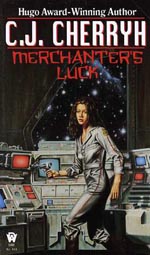
Merchanter Novels (C.J. Cherryh)

What do all these categories mean? Well, the Top 10 list itself should be fairly self-explanatory. The Honorable Mentions are works which just barely miss the Top 10 list for one reason or another. The list of Novels Also By is a result of self-imposed rule which limits an author to a single work on the Top 10 list. The other books listed in the Novels Also By are works by authors already appearing on the other lists which, if those slightly superior works did not exist, would themselves be considered for placement on the list.

This is not, needless to say, a precise science.

The conspicuous absence from these lists, I think, is Heinlein. In general, I think that Heinlein was at his best in his early, short fiction. (“The Green Hills of Earth” is my favorite Heinlein piece.) Of the novels I’ve read, the best two are The Door Into Summer and The Puppet Masters, and even those are flawed in fairly significant ways. Stranger in a Strange Land is mush; Starship Troopers is a short story padded with political essays; and The Moon is a Harsh Mistress is a novella padded with political essays. (Which isn’t quite fair to The Moon is a Harsh Mistress, but makes for a nice line.)

Go to Top 10 Fantasy Novels

The Misenchanted Sword - Lawrence Watt-EvansThe Misenchanted Sword is the first of Lawrence Watt-Evans’ Ethshar novels. The world is soaked in magic – one of those mid-‘80s creations of heavily D&D-influenced fantasy. The attitude can, perhaps, best be summed up by a quote from the book itself: “They wanted to believe in heroes, not ordinary, everyday magic.” (Think about it.)

The concept of the plot is a fairly clever twist on familiar themes: The main character, trapped in the middle of a generational religious war between the followers of the gods and the northern demon-worshippers, is gifted with a magic sword. Unfortunately, as the character rapidly learns, the sword’s enchantments include some rather annoying side-effects – among them the fact that the main character can’t get rid of it. (One might even say it was cursed.)

The back cover blurb on my copy of the book gives the impression that this will all result in something of a farce – like Asprin or Anthony in their prime. In reality, there’s nothing particularly funny about the book at all, and it’s rather clear that Watt-Evans never meant it to be. The story would better be described as something of a melancholic character drama.

The prose (or, perhaps more appropriately, the storytelling) can be awkward at times: There seems to be no trust that the reader will hold on to certain concepts (like the emerging nature of the sword’s enchantment), and thus the same information will be repeated incessantly.

In fact, there is a general lack of authorial confidence: Even the smallest details are given awkward justifications (as if the author were constantly fearful that someone were going to shout “gotcha!”). Every fact is repeated, and the main character goes round in circle after circle as he considers every possibility two or three times before finally taking action.

The setting also poses some problems. Ethshar is formed on the foundation of some rather intriguing and unique ideas, but the details seem to vary randomly between cleverly suggestive and puzzlingly vague.

Ultimately, the biggest problem is that the story seems to simply meander without much of a point.  On the one hand, the most interesting sequences are simply glossed over – probably because the book is meant to be a character drama, not an adventure book. On the other hand, the main character never seems to achieve that vivid depth which would make his story interesting in-and-of itself. And, on the gripping hand, the flaws in the storytelling cause the entire book to wander with wild abandon.

All in all, I found this to be a solidly mediocre book – neither exceptional nor horrendously flawed. It would be a better book if it had been ruthlessly trimmed of its repetitive elements, with the freed-up space being used to move several incidents banished to exposition into the active narrative. As it is, this isn’t a book I’ll caution you against – but it’s not a book I’d recommend, either.

I’m glad that this wasn’t my first Watt-Evans, because otherwise I might draw very different conclusions about his quality as an author. As it is, I’ll almost certainly check out the second Ethshar book at some point to see how the intriguing and cleverly suggestive elements of the setting develop in the hands of a more mature author. My next Watt-Evans, however, will probably be Crosstime Traffic.

GRADE: C

Lawrence Watt-Evans
Published: 1985
Publisher: Wildside Press
Cover Price: $14.95
ISBN: 1-587-15282-7

Ethan of Athos - Lois McMaster BujoldwirOne of the things I like best about Bujold is her uncanny ability to create and evoke alien cultures. (The fact that those cultures don’t actually involve aliens is inconsequential.) The real trick of it, I’ve decided, is that Bujold doesn’t make a big deal out of it. With most authors, every single difference is emphasized and analyzed and justified. The result feels inherently unnatural – partly because the author is making an elaborate production out of it, partly because the author is showing their hand at work, and often because the characters end up being far too self-aware. (Neither I, nor anyone I know, pauses to give elaborate, pseudo-science lectures on why 21st century Americans behave the way they do.)

Bujold, by contrast, simply allows her characters to live in the cultures she creates. Perhaps even more importantly, she lets us see the universe of her story through the unfiltered eyes of her characters, without apology or explanation.

On this level, Ethan of Athos delivers in a big way. The colony of Athos was founded by patriarchs who believed, primarily, that women were a corrupting influence. Using uterine replicators, they successfully created an all-male society way out in the boondocks of civilized space. Now, however, problems have begun to appear: Their original ovarian cultures are dying out, and problems of limited diversity were rearing their head even before the most recent genetic crisis came to a head. Somebody needs to be sent out into the wider galactic community to purchase new genetic material for the colony, and that’s where Ethan comes in: He leaves on the annual galactic census ship on a secret, if somewhat unexciting, mission to save his world.

At which point he promptly falls into the middle of an espionage mission involving Elli Quinn (a delightful character familiar to those who have read Bujold’s other Vorkosigan books).

Coincidentally, this discussion of culture-building brings up something which consistently puzzles me: A lot of people seem to have the belief that Bujold’s work is light on the science fiction. Or, in other words, that her work only has a thin layer of science fiction thrown in to make them genre works. The only explanation I have for this belief is that Bujold is simply too subtle a writer for these people.

At first glance, Ethan of Athos is a simple adventure story starring a protagonist from an unusual culture. But take a closer look: That unusual culture is, in fact, a very sophisticated extrapolation of how technology will affect human society. And Bujold works in a complete analysis of the consequences and mindset of that culture, even while you’re busy turning the pages for the exciting payoffs of the adventure story – she just refuses to Emphasize It With Capital Letters and Long Speeches Explaining the Point.

And against all of this, Bujold weaves yet another theme: A softly-played, emotionally-packed character drama.

Which brings me to another thing that I like about Bujold: Her humor. It’s believable and real and rib-achingly funny. It’s the humor of actual people living in an actual world, and it demonstrates the vividness with which Bujold evokes her stories. And, like most living humor, its all about context. (You’ll see what I mean when you understand the line: “Apparently they had committees on Kline Station, too…”)

So, we’ve got great prose, keen foresights, a fully-realized world, compelling characters, and an exciting plot.

And this is one of Bujold’s weaker novels? There’s little doubt in my mind that she’s the best science fiction author writing today.

GRADE: A-

Lois McMaster Bujold
Publisher: 1986
Publisher: Baen Books
Cover Price: $5.99
ISBN: 0-671-65604-X

The Gripping Hand - Niven and Pournelle(Note: In some countries this novel is known as The Moat Around Murcheson’s Eye.)

This is going to be a rather rapid reaction, because the book doesn’t really deserve more than a quick dissection.

First off: DO NOT LOOK AT THE MAP. Good lord. That thing is a cesspool of spoilers. And not in a “well, now we know where they’re going” way, but in a “they just told us what Rosebud is” kind of way. Unless you’re the type of crazy person who likes reading the last page of a mystery first, steer clear of the map.

Now, to begin properly, let’s discuss what works in The Gripping Hand: The prose is smooth and, from sentence to sentence, generally well-written. It’s also nice to revisit the Moties and see their unique culture from a new slant.

Okay, now that we’re finished with the strengths, let’s look at the host of flaws which plague this book. Let me count them off:

First, starting off small, there’s the recapping. Niven and Pournelle recap just enough to annoy people who have read the first novel, but don’t manage to cover enough territory to actually fill in those who haven’t. The result is the worst of both worlds: On the one hand, they’re bogging down this book for everyone who read The Mote in God’s Eye. On the other hand, they aren’t actually making this book accessible to anyone who hasn’t.

Second, and in a similar vein, there’s the clumsy and overwhelming exposition. I was literally stunned by the sheer mass of “as you know, Bob” lectures peppering the novel – I think they average about one every ten pages. In some cases, they’re even polite enough to explicitly identify what they’re doing. (Quote: “I may have to lecture. […] I won’t explain that, you got it in high school, but [insert explanation he just said he wasn’t going to give].”)

Third, the entire work is plagued by inconsistencies and contradictions. Mostly these are internal, but there are also several inconsistencies between Mote and Gripping Hand. And that doesn’t even count the deliberate and ham-fisted retcon which drives the entire plot. (Something which I found intrinsically annoying. With all of the interesting possibilities raised by the Moties and the situation at the end of the first book, why did they feel it was necessary to resort to a retcon in order to come up with a plot? Heck, they off-handedly discard another fascinating possibility explicitly. And even the scenario they use in the book would arguably be more fascinating without the retcon.)

Fourth, there’s still no thought put into the setting: A massive interstellar empire can rule over dozens (possibly hundreds) of star systems, but can’t figure out how to ship produce a thousand klicks and keep it fresh. The same society possesses Langston fields which can protect a ship from the fury of a sun, but characters puzzle over how to keep the Imperial family safe from atom bombs. The leaders of a colony are quoted as believing that a fireworks display will be the biggest show since one of their cities was bombed into oblivion (which would be like a Japanese Prime Minister claiming that a fireworks display will be the biggest show since Hiroshima). In one sentence we’re told that two colonies have stopped fighting with each other because they collectively fear war with the Moties; in the next we’re told that they’ve stopped building defensively because they’re no longer afraid of war. Even accepting the fact that Niven and Pournelle were constrained by the 20th century analog they had established in A Mote in God’s Eye, there’s still no depth or thought given to the technology they show or the society it implies. This is world-building of the Star Trek planet-of-the-week variety, and in many cases its even worse.

Fifth, the characters are still as flat as cardboard. In fact, if anything, they’re even more contrived than they were in A Mote in God’s Eye: An ambitious investigative reporter is allowed to sit in at a meeting where top secret material is being discussed, and only after the fact does anyone realize this was probably a really stupid idea. More retcons are used to justify important decisions. And, yet again, you’ve got a couple of people falling in love at first sight and for no apparent reason. (Perhaps that’s the only kind of love there is in the Second Empire.) It’s not that I don’t believe in love at first sight. It’s that Niven and Pournelle don’t make me believe in love at first sight.

Finally, this book seems to suffer from many of the same problems that Niven’s Ringworld Engineers did: The authors seem to be writing the book as much from a desire to patch the problems criticized in the original work as they are from a desire to tell a good story. The result is predictable, turgid, repetitive, and boring.

Let me stress that again: Boring. The entire plot of the novel (from set-up to resolution) is dispensed with in a single scene around page 100 and the rest of the novel is nothing but sound and fury signifying nothing.

That’s the long of it.

Here’s the short of it: This book is a complete and utter waste. It’s a waste of your time. It’s a waste of a perfectly good opportunity. In many ways, it’s a waste of paper.

No matter how tempted you may be after reading The Mote in God’s Eye to discover what happens next, please believe me when I say that the pain of The Gripping Hand just isn’t worth it.

GRADE: D-

Larry Niven and Jerry Pournelle
Published: 1993
Publisher: Pocket Books
Cover Price: $6.99
ISBN: 0-671-79574-0

Archives

Recent Posts

Recent Comments

Copyright © The Alexandrian. All rights reserved.