 Vernor Vinge’s output as an author can be described as almost tepid. Over the span of four decades (from 1965 through 2005), his total output consists of only 25 works: 19 short stories and 6 novels.
That’s a slim opus, indeed, but it’s an opus which has completely transformed the entire genre.
Usually when you say stuff like that you’re speaking hyperbolistically. But not in the case of Vinge: At least half of the significant science fiction authors of the last two decades owe Vinge either a direct or indirect debt of enormous proportions. And, as a result, pretty much everyone else in the field has been influenced by his ideas to one degree or another.
A lot of this importance can be credited to Vinge’s conceptualization of the Singularity, which I’ll discuss at more length as it comes up in his work. But he’s also responsible for the modern vision of cyberspace. That, combined with his anarcho-capitalistic social thought experiments, puts him solidly behind the nascent origins of the cyberpunk movement in the 1980s. He is also arguably responsible for the Neo Space Opera Renaissance of the past decade and his most recent work (represented by “Fast Times at Fairmont High”, “Synthetic Serendipity”, and the forthcoming Rainbows End) would seem tantalizingly poised to shape major genre trends for the decade to come in ways we can perhaps scarcely imagine.
But until recently, I, like many others, had read only Vinge’s two most recent, Hugo Award-winning novels: A Fire Upon the Deep and A Deepness in the Sky. I had been previously turned away from his earlier works partly because they were frustratingly unavailable and partly because I’d heard that his earlier novels just weren’t of the same quality as his more recent work.
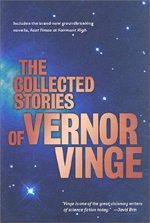
Then, a few weeks ago, I finally cracked open The Collected Stories of Vernor Vinge. Over the course of the following month I proceeded to devour (or re-devour) every word Vernor Vinge has ever published.
THE COLLECTED STORIES OF VERNOR VINGE
The Collected Stories of Vernor Vinge is a very strong testament to the quality and nature of Vinge’s career. At the time it was published in 2001, this was arguably a complete collection of Vinge’s short fiction. It contains less than two dozen stories spread thing across four decades of work, but almost every single story is a masterpiece. The collection contains every word of short fiction published by Vinge, but it reads like another author’s “Best of” collection.
I have to assume that Vinge is essentially a methodical craftsman: Each story painstakingly fashioned like a jewel, with each facet carefully cut to reveal its inner strength and beauty to the utmost. This can create seemingly agonizing waits between the appearance of each work, but it also means that the wait is always worthwhile.
The highlights of this collection include:
“Bookworm, Run!” – This is basically the story of someone who gets Google plugged straight into their brain. A version of Google fully stocked with the mainframes of the Department of Defense, the CIA, the NSA, and the FBI all rolled into one. The result is the ability to instantaneously access an essentially infinite library of networked information in a fashion almost, but not quite, as if it existed in your own memory.
Lots of science fiction authors have been known to let genies out of bottles: Ideas so powerful that they come to define their careers and create a shockwave which percolates throughout the field or transforms our understanding of the genre. Smith’s space opera. Asimov’s Three Laws of Robotics. Herbert’s Dune.
But most of these authors don’t reveal their genies until they’ve got a few dozen stories under their belt. By contrast, Vinge, in the very first story he ever sold, whips out his bottle, smashes it to smithereens, and starts interrogating the genie. The result is a revelation which has been haunting his work, and the entire genre, ever since.
What, exactly, are we talking about? The Singularity. In “Bookworm, Run!”, Vinge asks a very simple question: “What happens when human science creates the first truly superhuman intellect?” And Vinge’s answer is evocative, “You get something incomprehensible. You get a point beyond which the merely human is no longer capable of understanding.”
Vinge’s argument, essentially, is that as you begin to grow intelligence, you reach a point at which that growth becomes essentially exponential. For example, in “Bookworm, Run!”, when you reach the point that your natural memories can be supplemented by artificial databases, you don’t get a situation in which intellect gradually improves: You have an explosive, essentially infinite growth in personal knowledge. And that sudden expansion from knowing a few things to knowing everything creates a dynamic which is, essentially, unimaginable – it can only be thought of in the grossest and most imprecise of ways by those of us who have not yet undergone that change.
In “Bookworm, Run!” Vinge saddles his protagonist and his specific technology with some… unique limitations. In this way he sidesteps the essentially incomprehensible nature of his proto-Singularity (since he hadn’t fully developed the concept yet), and instead sidles up to it from the side. But he doesn’t simply ignore the implications, either, as the end of the story reveals.
This reveals the unique problem of dealing with the Singularity in fiction: How do you tell a story about something incomprehensible by its very nature? Trying to meet that unique challenge of storytelling can give rise to some fascinating solutions and some wondrous world-building. In many ways, his many varied solutions to this problem have come to define Vinge’s career.
“Bookworm, Run!” is also quintessentially Vingean, revealing the future contours of his career, for another reason: In addition to the central conceit of the story, Vinge also casually drops a few other bombshells into his world-building which fundamentally transform society even before the story begins. Not only is he not content in running just a single thought-experiment through his story, the entire setting is permeated with detailed extrapolation.
In this case, the most notable change after the proto-Singularity at the centerpoint of the story, is the availability of cheap fusion reactors. Vinge postulates that this prevalence of cheap energy will create an economic depression, requiring the government to impose a period of strict economic controls. His logic here makes no sense to me, but it’s particularly interesting to look at the story as a starting point for Vinge’s experimentation with the economic organization of a high-tech society, a theme he’ll return to time and again in his work.
(Although I find it interesting to note that if you replace the words “cheap fusion reactors” with “self-replicating nano-factories” I probably wouldn’t have had the reaction of, “How do you figure, exactly?” Is that indicative that self-replicating nano-factories are just the latest “utopia gizmo” of science fiction, or is it that science fiction has finally found the utopia gizmo it’s always been looking for?)
“The Ungoverned” – This question of the ways in which technology can restructure an entire economy and, by extension, society is central to Vinge’s world-building in “The Ungoverned”. Basically, Vinge seems to have quickly reached the conclusion that sufficiently advanced technology inevitably breaks down central authority.
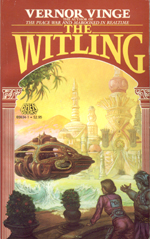
“The Ungoverned” is a novella lying between two novels: The Peace War takes place before it; Marooned in Realtime takes place after it. In The Peace War we see the last desperate efforts of a central authority attempting to cling to power by artificially suppressing technology. In Marooned in Realtime, Vinge takes this question to its extreme: What use is a central authority when an individual is an entire economy unto themselves? “The Ungoverned” lies quite literally between; an anarcho-capitalist society in rapid transition.
But all that is just the world-building. It’s the groundwork and the thematic substance which opens up the door for the rip-roaring war story which is the actual meat of the story. It makes for a fascinating reading because, on the one hand, it’s a fast-paced, no-holds-barred action story; but, on the other hand, it doesn’t take much to peel back the surface and see some frightening conclusions being drawn about the future being drawn. What does it really mean when a handful of people are capable of wielding as much power as a 19th century superpower? Or even a 20th century superpower?
“Conquest by Default” – This story takes a slightly different approach to Vinge’s vision of technological profligacy leading inevitably to extreme libertarianism. Here we have a system with a central control designed to deflect the monopolistic tendencies within the anarcho-capitalist structure. And if you think that Vinge is whole-heartedly endorsing the anarchic chaos which he appears to believe inevitable, then this is a story which will make you think twice.
“The Peddler’s Apprentice” – This story, which is a collaboration between Vernor Vinge and his ex-wife Joan D. Vinge, highlights several of the ways in which Vinge sidesteps the enigma of the Singularity. Once again we have a centralized authority artificially holding society’s technological progress in check, but we also get to view the Singularity through the eyes of a primitive. We also get to see Vinge’s willingness to dream across incredibly vast scales of time: A vision of civilizations rising and falling; or rising and disappearing into the Singularity; with the vestiges of either being given a chance to rise again over the spans of hundreds of millennia.
“The Science Fair” – Vinge also has a real flair for developing completely alien cultures with a great depth of thought. In reading “The Science Fair” I was reminded of something John Campbell once said: A good science fiction author, writing in 1900, would be able to predict the automobile. A great science fiction author would predict the traffic jam. In similar fashion, Vinge doesn’t just create imaginative and memorable alien races, he follows through on the basic qualities of their nature to logically produce the cultures, societies, and technologies such a species would naturally create.
“Original Sin” – This talent for creating alien races and then extrapolating upon their biological imperatives to create unique and multicultural societies is the foundation which makes “Original Sin” such a classic. The other element which deserves comment here is Vinge’s ability to invest a relatively large cast of character with a lot of individual depth. The result is a multi-faceted character drama which is made even more impressive given that several of those characters are completely alien in their countenance and in Vinge’s ability to create that character drama within the confines of a crisis capable of reshaping the known universe.
“Original Sin” is also notable because it shows Vinge hitting the central thesis of A Mote in God’s Eye several years before Niven and Pournelle.
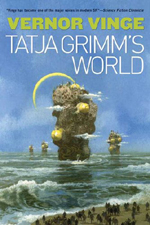
“The Barbarian Princess” – It’s also interesting to note how most of Vinge’s novels have grown out of his short fiction. “The Barbarian Princess” is part of his pastiche novel Tatja Grimm’s World, which will be dealt with at length in its own reaction.
“The Blabber” – This short story is probably most famous because it’s the genesis point of the Zone universe, which serves as the setting for Vinge’s two best-known works, A Fire Upon the Deep and A Deepness in the Sky. But “The Blabber” is a damn fine story in its own right.
The conceit of the Zones universe is a way for Vinge to cheat the exponential growth curve which ends inevitably in the Singularity. Basically, if Vinge is right about the Singularity, humans don’t get to go to space: Long before the industrial trends give us interstellar flight, the informational or biogenetic or artificial intelligence trends result in humanity becoming something transhuman.
So Vinge sidesteps the issue by, basically, waving his authorial hand and saying: “These technologies would surely be nifty… but they just don’t work. Too bad.” Vinge is hardly the only author to do this, but what makes Vinge’s experiment interesting is that he makes his authorial hand-waving explicit to the universe itself AND varies those technological limitations.
The result is a galaxy split into multiple “zones” (hence the name applied to the fictional milieu): In the Unthinking Depths at the galactic core, intelligent thought itself is impossible (or, at least, intelligent thought as we know it). If you and I were to jump on a spaceship and head down towards the galactic core, at some point our brains would simply stop functioning at anything but an animalistic level.
One step up from the Unthinking Depths is the Slow Zone. That’s where we are now: Human-level intelligence is possible, but not much more than that and the limits of physics are already pretty well known to us: FTL and gravity-control systems are impossible, for example.
The next step up is the Beyond. Here you can get some pretty sophisticated AI systems and other forms of superhuman intelligence. FTL, gravity-control, and some other amazing, physics-bending technologies are easily achievable. Basically, the Beyond is the realm of classic space opera.
And beyond the Beyond there is the Transcend: Here Vinge’s Singularity is possible. And, in fact, due to the nature of the Zones universe almost inevitable: A High Beyonder civilization has been artificially arrested on the precipice of the Singularity. Take them into a Zone where the Singularity is possible and they practically fall into Transcendance.
The net result is a universe where you, as an author, can literally scale the technology to whatever your current needs are, while also profiting immensely from unique interactions between the Zones. For example, “The Blabber” takes place near a border between the Zones, on a human colony world just far enough within the Slow Zone to be inexorably stuck, but close enough to the Beyond to know what they’re missing out on.
As a story, “The Blabber” begins to show a truly mature Vinge working his craft like a maestro. It mixes crafty and subtle storytelling; a character drama and coming of age story told with touching sincerity; marvelously intricate extrapolation and world-building; a cleverly conceived alien species; and at least a dozen nifty ideas thrown around to create sensawunda on a grand scale.
“Fast Times at Fairmont High” – As “The Blabber” was the genesis point for A Fire Upon the Deep and A Deepness in the Sky, “Fast Times at Fairmont High” is the genesis point for Vinge’s forthcoming Rainbows End. In this new cycle of stories, Vinge chooses to examine the Singularity by jumping onto the on-ramp and taking us down the gaping maw of the rapid plunge into computer-assisted super-consciousness.
What makes “Fast Times at Fairmont High” so very interesting is that Vinge’s technological predictions are not particularly outrageous. Indeed, what makes this story so utterly compelling, on a level beyond its immediate characterization and plot (which are both sterling), is Vinge’s completely believable extrapolation of the effect that technology scarcely more advanced than our own will have on the daily lives of every man, woman, and child alive.
Indeed, you can begin seeing signs of that change around us even now: The experience that I had in high school in the mid-to-late ‘90s was only tangentially different in the slightest of ways from the high school experience kids had twenty years earlier. Less than ten years later, ubiquitous proliferation of ‘net access, cell phones, wireless devices, online communities, and more have fundamentally changed the high school experience. It’s easy to say “this changes everything” – and it’s so very rarely true – but it’s actually happening right now. These new technologies are fundamentally changing the way you study; it changes the way you learn; it changes the way you socialize – it changes the way in which you live. And when you change the way people live their lives at a societal level, you change the very nature of that society. And it’s not just the change which is notable, it’s the pace of the change: Meaningful generation gaps which begin shrinking into spans of less than a decade.
What gives Vinge’s effort it’s distinction is that he doesn’t simply take a look at current trends, extend the graph lines by a few years, and then present the result. Instead he narrowly looks at the trends in the advance of computer technology and extends those graph lines a few years. Then he imagines what types of applications those technologies will make possible. Then he imagines what people will do with those types of applications. Then he imagines what a whole society of people doing those things would look like; what types of synergies would be created; what other technologies would be pursued. It’s a gestalt; it’s the traffic jam lurking behind the automobile.
OTHER SHORT STORIES
In the four years since The Collected Short Stories were published, Vernor Vinge has published two additional short stories: “Synthetic Serendipity” and “The Cookie Monster”. (These stories are both available legally online — follow the links.)
“Synthetic Serendipity” – This story takes place in the same near-future universe as “Fast Times at Fairmont High”. What I find interesting is that, despite sharing largely the same locales and a similar cast of characters, there is little thematic or content overlap between the two stories. This seems to go back to the discipline which lies behind the austerity of Vinge’s artistic output: He may go back to visit the same settings and even the same characters, but somehow he finds the ability to keep everything *completely* fresh.
I’m reminded by a story that my friend David Kloker told me the other night: The first time he went to New York City he spent the night sleeping on the floor of his friend’s dorm room at NYU and, in the morning, went to an anti-nuclear rally. The second time he went to New York he stayed at a 5-star hotel in Manhattan , supped beneath a glass chandelier, and spent the evening at the opera. The two experiences, though separated by scant miles, seemed to take place in two completely different cities. And, as my friend David says, if you stand on a busy, bustling street corner and reflect upon this, you can be humbled through the understanding that there is a reality which can only be understood through disparate views – at the interstice of diffracted experience.
Similarly, the Fairmont High we see in “Synthetic Serendipity” is the same school as the one we see in “Fast Times”… yet the experience is fundamentally different. And by refusing to hit any of the same beats a second time – by showing a completely fresh facet of his creation – Vinge adds remarkable depth to a setting which has only had a few thousand words dedicated to it.
“The Cookie Monster” – It’s difficult to do a review of this story because any substantive discussion of it would necessarily reveal the central mysteries which Vinge so very skillfully unwraps for you over the course of the story itself.
So let me speak in generalities for a moment: The escalation of the story’s central mystery and the execution of the plot are solid and well-paced. The characters not only have distinct personalities and unique roles, but genuinely make you care for them. The story, as a whole, explores a lot of different dynamics within the situation in a very efficient, entertaining, and creative fashion. There’s essentially no dead air in the story, and Vinge manages to hit a wide thematic range without beating you over the head with any particular message: Slavery. Genocide. Resistance. Freedom. Hope. Despair.
In “The Cookie Monster” I find a summary of Vinge as a whole: He excels at mixing old and new ideas alike, analyzing their implications to an unprecedented depth, twisting them in original ways, combining them in great quantities, accelerating the pace of change, and waiting to see what comes out of the mix. And then, once he’s got all that worked out, he’ll quite casually figure out where the crisis points and character dramas naturally arise and then execute the resulting story in a flawless fashion.
That’s “The Cookie Monster”. That’s Vinge. That’s genius.
GRADES:
COLLECTED STORIES OF VERNOR VINGE: A+
“Synthetic Serendipity”: A
“The Cookie Monster”: A+
Vernor Vinge
Published: 1966-2005
Publisher: Tor
Cover Price: $16.95
ISBN: 0-31-28758-43
Buy Now!

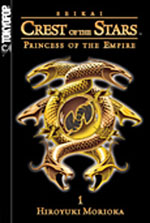 Imagine for a moment that you have been made aware of a novel with a reputation which places it on the same lofty plateau as the Foundation Trilogy, the Lord of the Rings, or Dune. Its author has carefully crafted an entire culture and society, complete with a language so detailed that many have learned to speak it fluently. Its plot is epic in its scope. Its quality is attested to by a legion of dedicated fans, multimedia adaptations, and widespread acclaim.
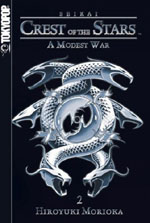 The novel was translated by Sue Shambaugh. And, unfortunately, the decision was made to release the novel as part of Tokyopop’s juvenile line. The work was minorly abridged, but this was almost a minor sin compared to a translation which fundamentally kiddified the work and stripped out its complexities. The glimmering remannts of Hiroyuki Morioka’s brilliant world-building which shine through in these botched translations is utterly eclipsed by the incessant need to make the characters sound “hip” and “current” (in that utterly artificial way which only a thoroughly dreary adult can achieve when trying to copy “the way kids speak these days”).
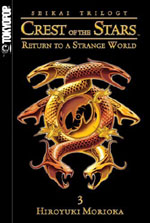 (1) The first words of Crest of the Stars consist of a quote from a fictional text. This quote begins: “This crest depicts the Gaftonash. The grotesque eight-headed dragon was long lost to the ages — forgotten, alive only in myth. Resurrected on an Imperial crest, the Gaftonash became infamous…”