The Alexandrian

The Map of Anyoc

October 22nd, 2008

City Supplement 3: Anyoc was essentially a completed product when Dream Machine Productions went on hiatus. The only thing we were waiting for was the map. In fact, it was my intention to release it as our last product before the hiatus. But, unfortunately, the cartographer we had working on the project never completed it. Since we were shifting into a hiatus state in any case, I shelved the project.

As we started gearing up to come out of hiatus, however, I started working on the map myself. Here’s what the original sketch map that I drew way back in 2001 looked like:
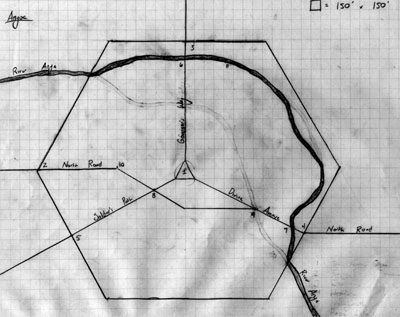
Map of Anyoc - Original Sketch Map

Basically, there was little laid out except for the gross geography and spatial relationships of the city. However, I know that one of the things I love about a good city supplement is the map: As a handout, there are few things more satisfying than being able to slap down a really slick-looking map for the players to look at. And I’ve found that there are few things that can get my creative juices flowing like a good map: Imagine yourself standing on those streets and looking at those buildings. What does that colorful roof really look like? What lies beyond that door or hidden around that corner?

I knew that executing a city map to the standards that I would demand out of a product would be tough. I had previously designed the map for Aerie (City Supplement 2), but that was a very different type of project: Aerie had been carved out of solid rock according to a relatively rigid plan. For Anyoc, I felt it was important to capture the more natural and organic curves of a living city.

So I started researching.

SURVEYING THE FIELD

The first part of this research was a matter of “surveying the field”. I went to my shelves and pulled down a wide representative sampling of city maps from other roleplaying supplements. Notable examples include:
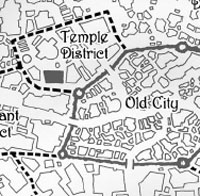
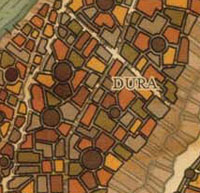
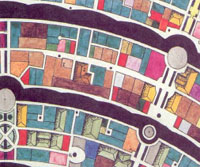
As you can see, there have been many different ways of handling the cartography for fantasy cities. Based on my recent experience with Ptolus, among other things, I knew how incredibly useful it could be to have every street and every building detailed on the map. As a player, I love the ability to say “I’m going to X by heading down this street right here”. And as a DM I love being able to say, “Okay, the House of Violet Gold is this building right here.”

With those goals in mind, I pushed aside the very generic style of maps like the one seen in the Freeport sample above. These types of maps are a bit more graphically detailed than my sketch on graph paper, but the detail is largely illusory — none of those blobs actually represent anything meaningfully concrete.

I also stepped away from the style of map seen in the Minas Tirith sample above: These maps resemble the kind of cartographical lot maps created by city surveyors and the like.

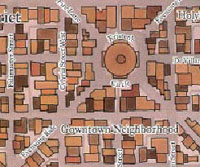
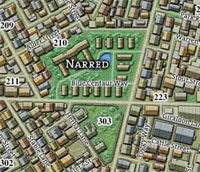
While I couldn’t create the type of detailed, individual buildings created by Ed Bourelle for Ptolus (unless I wanted to charge a lot more for the finished product than I was planning to), I felt that a “roof outline” style (such as those used in the Raven’s Bluff and Sharn examples above) represented the best compromise. Here’s the style I ended up with:

Map of Anyoc - Sample Style

With a style in hand, it was time to start laying out the streets. But before I could do that, I had to finish my research.
Continued…

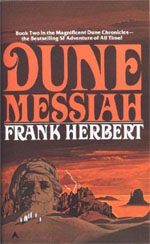
Dune Messiah - Frank HerbertSPOILER WARNING

The following reaction will contain spoilers for both Dune and Dune Messiah. As a policy, I’m trying to keep the spoilers in What I’m Reading reactions to a bare minimum and limited to the first fifty pages of the book. If the spoilers exceed those guidelines, I’ll make a point to include a note up front.

DUNE MESSIAH

From a certain point of view, Dune Messiah is a disappointment: It simply doesn’t live up to the incredibly high standard set by Dune itself.

Some of the problems with Dune Messiah are failures in the basic craft of storytelling; flaws which would be notable in any work. For example, there are far too many scenes – particularly in the first half of the novel – which are told in flashback or exposition instead of being shown. One is often left with the feeling that Herbert just didn’t quite feel up to the challenge of telling the story to be found in those scenes.

This central flaw, in fact, contributes to many of the problems in Dune Messiah. For example, the stellar character conflicts of Dune are notably blunted in Dune Messiah… often because key components of those dramas are ignored or elided over. For example, there is a cold war tension between Chani and Irulan which begins to flare into open conflict at the beginning of the novel. But then the resolution of that interplay is simply shoved off-screen and then cursorily resolved in an almost incidental and completely off-hand fashion. (And this despite the fact that its resolution is absolutely pivotal in setting up the novel’s conclusion.)

What ultimately keeps Dune Messiah from achieving the true status of classic is that it fails to find that precious gestalt of Dune: Where Dune operated on many different levels at once, Dune Messiah is stripped down to a far simpler dynamic. Elements of the political thriller, character drama, and high tragedy remain… but Herbert can’t quite seem to keep all the balls in the air.

For one example, let us consider the tragic grandeur of Yueh’s betrayal in Dune. Herbert almost manages to capture the dynamic of high tragedy once again in his portrayal of Paul’s prescient vision turned to bane. Paul, trapped by the inexorable fate seen within his prescient vision and bound by the irresistible momentum of the race consciousness lying behind the Jihad carried out in his name, has all the makings of such a tragedy. But Herbert lets it slip through his fingers: The prescience itself, although brilliantly handled in many respects (such as the scene where Paul must let a doom befall himself in order to find a greater good), also ends up denying some of the central necessities of true tragedy.

I also think that Dune Messiah is a difficult story specifically because it ties Paul in those chains. I think a lot of people (myself included) read the end of Dune as a triumph… and Dune Messiah makes it explicit that Paul failed and failed badly. That’s a tough pill to swallow. I know it’s what made me put the book down the first time I tried reading through the Dune saga: It wasn’t the sequel I had written in my own head. I wanted the Messiah Triumphant and I got something akin to the False God’s Fall.

With all that being said, I would be seriously remiss in ignoring the strengths of Dune Messiah, particularly in the book’s second half: Duncan Idaho’s personal struggle is a very powerful and well-handled piece of characterization. Paul’s manipulation of his prescient vision — his constant struggle to find the slightest loophole through which to escape the chains of his own future — is often powerfully dramatic. And there’s also some great expansion done on the nifty, sensawunda stuff, along with the depth and unique feel of the Dune universe (Tleilaxu face dancers, for example).

But, with that being said, I would still love to read a version of Dune Messiah in which Herbert managed to:

(1) Avoid the storytelling errors in the first half.

(2) Expand Alia’s personal drama (something which would have also added a great deal of depth to Children of Dune).

(3) Let the Chani and Irulan conflict play out with the type of detailed political intrigue that he displayed himself fully capable of in Dune.

(4) Communicate the by-play of the mutual and interacting betrayals between the conspirators (and let more of those by-plays and betrayals play themselves out).

(5) Handle the framing devices of the story better.

In short, Dune Messiah reads like a rushed novel. There’s a lot of potential in the basic structure of the story, but little or none of it is realized in actual practice. Perhaps if Herbert had taken the time to develop the novel more fully, we might have gotten a work that would stand up better in the inevitable comparison to its predecessor.

GRADE: B-

Frank Herbert
Published: 1969
Publisher: Ace
Cover Price: $7.99
ISBN: 0441172695
Buy Now!

City Supplement 3: Anyoc

October 20th, 2008

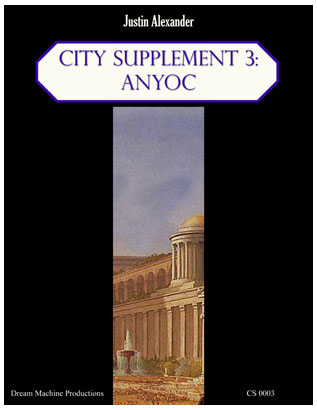
City Supplement 3: Anyoc

WALLS OF FAIRY STONE AND BLOOD…

Built of the seven fairy stones, the city of Anyoc stands proudly upon its hill. Pale purples mix with soft blues and faded greens; pinkish reds stand in contrast to burnished gold. And its white walls of essabas – the star stone – gleam in the bright light of the sun.

But long ago, in days dimmed by the thick mists of time, the site where Anyoc now stands was home to another great city: A black city which served dark and evil powers. It was said that the walls of that nameless city towered above its streets to a height of five hundred feet, and every inch of them was stained black with blood.

And beneath the streets of Anyoc, that ancient evil still waits for the time of its return…

City Supplement 3: Anyoc features full-color, black-and-white, and poster-size (21″ x 16″) maps of the city, a complete gazetteer featuring more than 30 unique locations, and bonus maps of the Westgate military complex and the Street of Trade!

Full-color maps only available in the Deluxe Color and PDF editions.

Each City Supplement provides a complete fantasy city. In addition to a full-page map of the city, each supplement includes a description of the city’s full history, an overview of the major characters and organizations, adventure seeds, and a complete gazetteer.

B&W Print Edition – Deluxe Color Edition
RPGNow PDF – Lulu PDF – Paizo PDF
36 pages – Sample City Map

Anyoc Sample Map

To read a spoiler-free review of Dune, click here.

For some spoiler-filled thoughts about the book, go ahead and read more…

Read more »

What I’m Reading #52 – Dune

October 17th, 2008

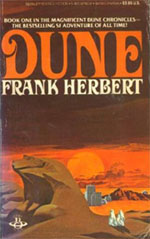
Dune - Frank HerbertIt’s interesting reading Dune immediately following a mass-reading of Vernor Vinge’s catalog, because both authors are essentially fascinated by post-humanity: Both see something essentially incomprehensible in the transhuman, but they approach it in different ways. Vinge chooses to approach it at oblique angles – from the POV of children; or on the rapid approach to it; or from a great distance; or through the lens of the primitive.

Herbert, on the other hand, tends to tackle the transhuman directly, but he does so from a fundamentally religious point of view.

To be clear on the distinction here: Vinge also equates transhumanity with godhood (the references to “Applied Theology” and “deicide”, for example, in A Fire Upon the Deep). But Herbert actually structures his narrative around a religious viewpoint – he couches his understanding of the transhuman through symbolism and prophecy; through divine mystery and ceremony.

Of course, the post-humanities of Vinge and Herbert are not exactly identical, either. But it would be interesting to see Vinge tackle Herbert’s thought (as expressed in an interview): “I had this theory that superheroes were disastrous for humans, that even if you postulated an infallible hero, the things this hero set in motion fell eventually into the hands of fallible mortals. What better way to destroy a civilization, society or a race than to set people into the wild oscillations which follow their turning over their critical judgment and decision-making faculties to a superhero?”

And it would be equally interesting to have seen Herbert tackle Vinge’s thesis: “Let an ultraintelligent machine be defined as a machine that can far surpass all the intellectual activities of any any man however clever. Since the design of machines is one of these intellectual activities, an ultraintelligent machine could design even better machines; there would then unquestionably be an “intelligence explosion,” and the intelligence of man would be left far behind. Thus the first ultraintelligent machine is the _last_ invention that man need ever make, provided that the machine is docile enough to tell us how to keep it under control. … It is more probable than not that, within the twentieth century, an ultraintelligent machine will be built and that it will be the last invention that man need make.”

But I digress.

For those of you completely unfamiliar with Dune, it may suffice to say that it is one of those works grouped with the Foundation Trilogy or The Lord of the Rings: A transformative and pivotal classic which cast a long shadow upon the entire genre from the moment it was published.

To understand how Dune achieved this stature, consider for the moment a seemingly simple question: What is the most impressive thing about Dune?

The trick is not in any particular answer. It is in the breadth of answers your question will provoke. Many people will point to the planet of Arrakis itself — painstakingly rendered and with a completely realized ecology. Others will point to the manipulation of prophecy. Or the action-packed battle sequences. Or the alien cultures. Or the evocative future history. Or the exploration of religious themes.

The story of Dune is a political thriller; it’s a character drama; it’s high tragedy; it’s mythological; it’s religious. And then Herbert tells it in the style of historical fiction within one of the most deeply realized science fiction settings ever realized on paper. It’s a gestalt creation.

And what do I, personally, find most impressive about Dune? The fact that Herbert successfully realized a story with the emotional depth and archetypal resonance of a Greek tragedy. I’ve probably read, watched, and listened to the Dune story more than two dozen times. And yet, every single time, there’s something fresh and new which can be gleaned from the experience.

GRADE: A+

For additional comments on Dune, which include SPOILERS, click here.

Frank Herbert
Published: 1965
Publisher: Ace
Cover Price: $7.99
ISBN: 0441172717
Buy Now!

Archives

Recent Posts

Recent Comments

Copyright © The Alexandrian. All rights reserved.