The Alexandrian

Thinking About Morale

January 27th, 2009

D&D Basic Set (1981)

James Maliszewski at Grognardia has spoken at various times about the Moldvay morale rules. (Tom Moldvay being the TSR designer responsible for the 1981 edition of the D&D Basic Set.) James even went so far as to say that “D&D combat only makes sense if you assume the use of morale”.

This is an interesting thought. It was one that I initially rebelled against when I first read it, but it’s been kind of churning around in my head for a few weeks now. It’s been one of those memes that just refuses to let go.

I think the reason I mentally rebel against it is that it impinges into my “zone of GM control”. When I GM, I make a point of roleplaying the monsters. Hurt a wild animal badly enough and it’ll give up… unless it’s rabid. Get a one-shot kill on the goblin chieftain and at least some of the goblins are likely to rout.

A morale mechanic has always seemed like a fairly crude way of modeling this behavior.

On the other hand, I understand James’ point: If you don’t take morale into consideration, D&D combat — particularly the classic D&D combat he’s talking about (when 0 hit points meant dead) — always ends in a slaughter. No quarter is ever given; no prisoners are ever taken. Once you start fighting, everyone keeps fighting until they’re dead.

For those who don’t have access to the 1981 Basic Set, these were Moldvay’s morale rules:

Any creature in battle may try to run away or surrender. Characters are never forced to do this; a character always reacts in the way the player wishes. NPCs and monsters, however, may decide to run away or surrender. To handle this situation, each monster is given a morale score. Good morale (a high morale score) indicates a willingness to fight on, regardless of the odds. Bad morale (a low morale score) means the monster will tend to panic and desire to withdraw from combat.

MORALE SCORES: A monster’s morale score is given in each monster description. The score is a number from 2-12. The higher the morale score, the better the morale. A score of 6-8 is average. A score of 2 means the monster will not fight. A score of 12 means the monster will fight to the death without checking morale. Creatures with a morale score between 2 and 12 will need to “check morale” at some time during a battle, as explained below.

HOW TO CHECK MORALE: During combat it is often necessary to check monsters’ morale to see if they will continue to fight. To check morale, roll 2d6. If the result is greater than the monsters’ morale score, the monsters will try to retreat or use a fighting withdrawal. If the result is less than or equal to the morale score, the monsters will continue to fight.

WHEN TO CHECK MORALE: In general, morale is checked in critical combat situations. Two recommended times for morale checks are:

1. After a side’s first death in combat (either monsters or characters).

2. When 1/2 the monsters have been incapacitated (killed, asleep due to magic, so forth).

Monsters that successfully check morale twice will fight to the death.

ADJUSTMENTS TO MORALE: Morale can be changed by situations (unless the morale score is 2 or 12). Adjustments to morale may be permanent or temporary. The exact adjustments are left to the DM. A maxmium of +2 or -2 is recommended; for example, if monsters are losing a battle, their morale score may be temporarily adjusted by -1. If they are winning, the monsters’ morale score may be temporarily adjusted by +1.

RETAINER MORALE: The morale score of a retainer is based on the Charisma score of the player hiring him (or her). Retainers must check morale after each adventure. If the morale check is failed, they will not adventure with their employer again. Retainers do not need to check morale in combat unless the danger is greater than might be reasonably expected. If a retainer is given a full share of treasure for several adventures, his or her morale score might permanently become 1 higher than the original morale score.

SURRENDER: A character or creature may offer to surrender at any time; however, the opponent need not accept the offer, nor even stop fighting long enough to listen! The DM will handle any talks about surrendering that occur between monsters and characters. Even non-intelligent creatures will usually act reasonably and try to run from hopeless battles. Surrender will usually occur when a morale check is failed, if the defender cannot safely escape. If an intelligent creature surrenders, it will usually offer treasure (from its lair or friends) as payment for its life.

(There’s one obvious error in these rules: A score of 2 actually means that a monster might continue to fight. Morale scores should be one a 1-12 scale if you actually want to design monsters that will automatically run at the first critical juncture in combat.)

There are a few things these rules make me think about:

(1) How simple they are. Part of my objection to morale systems is, as I mentioned before, the crudity of them. But in some ways, if I were to use a morale system, I would prefer this kind of streamlined approach: As a DM it gives me a dollop of information (are they staying or are they going?), but lets me figure out what the information means. (Are they fleeing madly? Making a fighting retreat? Dropping their swords? Staying on guard while trying to negotiate?)

Adding more complexity to this system probably won’t make it any more faithful to reality. In many ways, it might actually make it less faithful and believable.

(2) Retainer morale. I have always been fascinated at the use of retainers in classic D&D gameplay. Despite that, I’ve only played in a single (very short-lived) campaign in which hirelings were ever a significant part of gameplay. If I ever did end up with retainers in play, I think a morale system for them makes a lot of sense: They’re sort of the players’ purview and they’re sort of the DMs’ purview, so it makes sense to use the completely impartial arbiter of the dice determine their outlook.

(3) While I’m still loathe to turn over sentient NPCs to a morale system (because roleplaying them is one of the things I enjoy about DMing), I think it would be interesting to use a morale system for certain types of opponents: Animals for example. And even petty thugs and mooks.

I’ve mentioned in the past that one of things I really love about GMing is being surprised by the actions of my players. (I probably despise railroading more as a GM than I do as a player, actually.) I enjoy seeing events unfold in unexpected ways at the game table. It seems like morale rules would help make that happen.

(4) Is there any easy way to implement a morale system in 3rd Edition? Many efforts I’ve seen in the past start by looking at some sort of mechanic based around Will saves. This has the advantage of using an existing statistic (so that you don’t have to add a morale score to every stat block that you use), but has the disadvantage that the bonus to Will saves increases with level.

Because the Will save bonus increases, you’re left with two options: Either you can complicate the rules in order to vary the DC (which, as I’ve noted, make the rules seem far less appealing to me). Or you’ve effectively introduced another save-or-die effect into the game — one which is pervasive and constant (insofar as it happens every combat).

For example, Heroes of Battle introduced a morale check which was simply a DC 20 Will save. (It was specifically designed for mass combat, but also included an optional variant for “Morale in the Dungeon”.) It kind of split the difference: It had a handful of modifiers that could effectively vary the DC of the check from 15 to 32 (thus adding complexity to the check), but for the most part it was just a flat DC 20 check.

Moldvay sidesteps this issue by using a flat scale. To mix-and-match edition terminology, a CR 1 creature can have morales from 2 to 12 and so can CR 20 creatures.

But the interesting thing about Moldvay’s rules is that, although they look like a flat scale at first glance, they aren’t in practice. Why? Because the triggering conditions are based on the toughness of the monsters. A CR 1 creature with a morale score of 8 and a CR 20 creature with a morale score of 8 might appear to have the same morale… but it’s actually much more difficult to score a “first kill” against CR 20 opponents than against CR 1 opponents.

Moldvay’s system breaks down a bit when it comes to monsters keeping mixed company — does it really make sense for the ancient red dragon to panic because the heroes have killed one of the hundreds of goblin goons he keeps around? — but that type of issue can probably be glossed over through the use of DM discretion.

And maybe that’s the solution for morale mechanics: Use a Moldvay-style flat rating system, but don’t bother specifying the “critical combat conditions” that trigger a check. The DM simply makes a check whenever it seems appropriate. Ultimately, you’re giving the DM the final discretion in how and when… but then, at the crucial moment of decision, he gives up his control and lets the dice decide.

So that, in the end, even the DM can be surprised by the result.

(I’ve also noticed that Moldvay’s doesn’t seem to play well with solo monsters. This probably has a lot to do with the fact that encounters with solo monsters were comparatively rare in previous editions, but nonetheless it would definitely be something to look at if you were planning on using Moldvay’s rules.)

Whether you use a morale system or not, I think it’s important to remember that many (if not most) opponents won’t fight to the death unless they’re forced to.

But also remember that routed opponents can also regroup, go for help, or otherwise return to the field of battle… either during the same confrontation, or later after they’ve had a chance to recover.

Back to Reactions to OD&D

Fixing Munchkin Quest

January 26th, 2009

Munchkin QuestA lot of my contemporaries have fond memories of the boardgames Dungeon! and HeroQuest. I was never that enamored of them. I think this is largely because I came to the games via Dungeons & Dragons rather than vice versa — so it always seemed like the poor man’s version of a fuller and richer game. There are myriad limitations to the game, of course, but the largest lack I felt was that — although the contents of a room could change — the board was largely immutable. There was no true sense of exploration.

HeroQuest, in particular, was never a game I really warmed up to. The inclusion of a gamemaster allowed for dungeons with more flavor, but also emphasized the fact that — with the same play dynamic — I could be playing an actual RPG. (Perhaps Advanced HeroQuest or Warhammer Quest would have left a different impression on me, but I’ve never even seen a copy of those games.)

The completely randomized Dungeon!, on the other hand, at least served the niche of “I want to play D&D, but I don’t have a DM”. It just didn’t scratch it very well (at least for me).

Over the years I’ve occasionally dipped back into this particular sub-genre, usually to be met with disappointment. Most recently the Order of the Stick boardgame failed to be anything more than an unbalanced, colossal bore.

Which brings me to Munchkin Quest — which finally scratches the itch I first developed twenty years ago: DM-less dungeoncrawling. It has a variable board which you discover as you explore it,

Over the past few weeks, my little circle of friends have played Munchkin Quest almost a dozen times, more than any other game. That’s probably not a pattern of usage that will last forever, but it does speak to a dynamic and interesting game.

SLOW PACE

The only real complaint we had with the game was its slow pace. Allow me to explain…

Munchkin Quest is based on the popular Munchkin card game, which I played a lot 3-4 years ago before losing my regular playing group. In Munchkin, every turn stats by opening a Door — which generally means fighting a monster. And once that monster has been defeated, play proceeds to the next player.

In Munchkin Quest, in order to facilitate the exploration of the dungeon complex, players are instead given 3 movement points (which can be increased or decreased with various pieces of equipment or other abilities in the game). When players explore into a new room (generally by spending a single movement point), they encounter a monster and fight it.

Begin to see the problem?

In Munchkin a player’s turn usually consisted of a single combat. In Munchkin Quest, on the other hand, we were usually seeing 3 or 4 combats on every player’s turn.

The first time we played the game, it took 90 minutes before the fourth (and final) player finally got to take their first turn. Even with all the out-of-turn actions that can be taken in the game, this was still hugely problematic. The long breaks between turns not only tended to result in players disengaging from the game, it also had several knock-on effects that also degraded gameplay.

For example, because of the multiple combats per turn the players tend to level up faster in Munchkin Quest than they do in Munchkin (at least in terms of the number of turns — in actual playing time, Munchkin Quest is a little slower). In our experience, a game of Munchkin Quest was over in just 3-4 turns (which would take 3-5 hours). This had a direct impact on the flow of the game (unlike Munchkin it didn’t feel like you were in a race with other players — the pace was just too slow for that).

One of the more interesting elements of the game are the wandering monster mechanics — which allow undefeated monsters to move from one room to another. But the longer, slower turns significantly lessened this dynamic of the game. Monsters rarely moved and didn’t move very far.

The longer, slower turns also created poor gameplay in other ways. During our third game, for example, it took nearly two hours for the fourth player to get their first turn. At their beginning of that turn, the first three players were already levels 6th, 8th, and 7th. (The game is won at 10th level.) The fourth player was already 2nd level, but had ended up out of position as the others had all moved away from the entrance of the dungeon. She hadn’t been able to join in the combats or treasure hauls and was seriously disadvantaged.

HOUSE RULES

In order to fix this problem, we introduced a simple set of house rules:

(1) At the beginning of the game, all players roll a single d6. The player with the highest result becomes the Quest Master. (Re-roll ties.)

(2) At the beginning of a round of play, all players draw one (1) Deus ex Munchkin card.

(3) At the beginning of a round of play or at the end of any monster movement phase, the player with the most green feet (movement points) takes a turn. In the case of ties, start at the Quest Master and go clockwise.

(4) On their turn, in addition to all the other actions allow by the rules (playing cards, combat, etc.) a play can take any ONE action which requires the use of movement points.

(5) At the end of each player’s turn, there is a monster movement.

(6) If all of the movement points at the table have been spent at the end of a monster movement, then a new round begins. Flip all of the red feet back to green and continue play.

EFFECTS

These house rules have several effects:

(1) Play looks a little more like traditional Munchkin in that, on any given turn, a player will probably only fight a single combat (at most).

(2) Players don’t have such long lapses between their turns, which also means that there will be a more active churn of resources (which helps to keep the game fresh).

(3) Monsters become more active in their movement around the board, making the dungeon feel more dynamic.

(4) As far as we can tell, no meaningful strategies from the original game are eliminated. But we have discovered that all kinds of new strategies have been created. One major area of strategy became the manipulation of remaining movement tokens (allowing you to take more turns or affect the sequence of play). Another area of strategy rose up around how players traveled together. (In the original rules we all felt like we were basically soloing the game. But the house rules allowed people to either move off by themselves; move with small partnerships; or huddle up as one big group and stick together.)

Game balance appears to be completely unaffected by the modification.

I suspect that once we get the 6-player expansion for the game, the dynamics made possible with these house rules will become even more interesting. And, in my opinion, necessary: When it takes 45-75 minutes to get to the fourth player’s first turn in a four-player game, I can only imagine that it would take 90-120 minutes toget to the sixth player’s turn in a six-player game. And that would be outrageous.

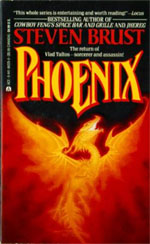
Jhereg - Steven BrustWhy didn’t anybody tell me about this?

Jhereg, the first in a series of books starring the character of Vlad Taltos, was originally published 25 years ago and I’m only finding out about it now?

Not fair.

Truth be told, though, I only have myself to blame. I’ve heard about the Dragaeran books a number of times over the last decade or so, mostly on the rec.arts.sf.written newsgroup, but also as far afield as Penny Arcade. I actually bought Jhereg about four years ago, started it, and bounced off the first chapter.

It should be noted that I didn’t bounce because it was bad. I just bounced because I wasn’t in the mood for that sort of book

Which is ironic, because the book is actually almost nothing like the first chapter.

The first chapter reads like the introduction to a grand saga of sorts — something along the lines of A Game of Thrones or the Malazan Empire books. The rest of the book reads pretty much nothing like that. In fact, if I was going to describe the rest of the book, it would be something like this:

A pulp detective novel by Raymond Chandler, except the main character is an assassin instead of a private detective and his seedy office is in a world of high fantasy instead of the 1940s.

And it really is as awesome as that sounds.

Actually, though, saying “high fantasy” is somewhat misleading because one of the things Steven Brust does very well is blending together high fantasy and low fantasy. Vlad Taltos runs a small-time criminal organization in a gritty fantasy city. But just a short teleport-hop away, Taltos will also find himself rubbing shoulders with powerful Dragonlords who have lived for thousands of years and wield powerful sorceries that can lay waste to mountains.

And it works.

As an example of making things work, Brust’s world is one of the rare instances in which I’ve seen anyone attempt to work with a society where easy, prolific, D&D-style revivification is possible. And he makes that world believable, largely by simply saying, “This is the way things works.” And then building the world logically around it. “Death” in the Dragaeran Empire doesn’t mean what “death” does in the real world, and everyone in the story just seamlessly accepts that reality.

What else can I say about Jhereg?

Perhaps the most notable thing about the book is Brust’s prose. It’s not the type of eloquent or beautiful language that lends itself to loving quotation, but it’s tight and it’s fun to read. It’s really easy to plow through a hundred pages and then find yourself wondering where the last hour disappeared to you. I literally lost myself in the story, which is a rare pleasure.

Long story short: If you haven’t already read it, I highly recommend Jhereg. You might be 25 years late to the party, but it’s a really great party and you won’t be the only one to have just arrived.

GRADE: B

Steven Brust
Published: 1983
Publisher: Ace
Cover Price: $7.99
ISBN: 0441006159
Buy Now!

THE RINGWORLD ENGINEERS

Louis Wu sleeps his way across the Ringworld… and then kills everybody he slept with.

THE RINGWORLD THRONE

The Ringworld Throne - Larry NivenWithin the first few chapters of The Ringworld Throne, I was struck repeatedly by two thoughts:

1. “This is incredibly turgid.”

2. “Oh lord, here we go again.”

To explain the first, let me offer an example: Early in the novel there is a sequence in which the main characters are waiting to meet with another group of characters. They have to wait three nights.

First, it must be understood that there is no particular reason why they have to wait three nights. Niven simply made an arbitrary choice. Second, it must be understood that essentially nothing of interest happens in those three nights. There is exactly one significant conversation and nothing else of consequence.

Despite that, Niven spends over twenty-five pages describing the events of those three nights. The characters mill about pointlessly; they sleep; they eat; they have meaningless sex. And it’s all described in mind-numbing detail. The one significant conversation meanders along through three different sequences stretched across half a day and six pages and is three times too long at that.

It’s boring. Achingly, painfully boring.

To explain the second, let me simply say this: It takes Niven less than a dozen pages before he has retconned the entire plot of the second novel and rendered it into a math error.

The Ringworld Engineers - Larry NivenSince the entire second novel was, in itself, a massive retcon of the first novel, one begins to wonder if there was ever any actual substance here or if it’s just retcons all the way down.

I also think that there’s a fairly good chance that the original title of this book was Ringworld: Home of the Pointless Orgy until Niven’s editors made him change it. I have never read about so much sex while simultaneously being bored out of my mind. Niven never lets a dozen pages pass without having somebody humping somebody else, nor does he ever let an opportunity pass to make sex sound as boring as he possibly can.

Also, let’s take a moment and talk about Protectors: I know it’s always been kind of tough to take them seriously if you’re a hard science fiction buff. But when the entire conclusion of the novel consists of Protectors running around willy-nilly and a plot lifted from a Benny Hill sketch with the words “sexy nurse” scratched out and replaced with the word “Protector”… well, it’s kinda hard to take them seriously at all.

GRADES:

RINGWORLD ENGINEERS: B-
RINGWORLD THRONE: F

Larry Niven
Published: 1980/1996
Publisher: Ballantine Books
Cover Price: $7.99
ISBN: 0345334302 / 0345412966
Buy Now!

Ptolus - In the Shadow of the Spire

IN THE SHADOW OF THE SPIRE

PRELUDE 2A: THE AWAKENING – RANTHIR

PBeM – March 5th thru 9th, 2007
The 15th Day of Amseyl  in the 790th Year of the Seyrunian Dynasty

Read more »

Archives

Recent Posts

Recent Comments

Copyright © The Alexandrian. All rights reserved.