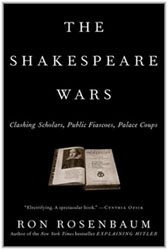
 I’ve recently been reading The Shakespeare Wars by Ron Rosenbaum. The book is far from perfect (Rosenbaum has a tendency to circle around a topic in endless repetitions and effusing instead of explaining), but it does offer a rather nice survey of several scholastic controversies currently swirling around Shakespeare’s works.
And thus, of course, it provides me with ample opportunities to brush up against the uniquely eruditic idiocies that only literary scholars seem capable of.
If you’re looking for the really interesting, fascinating material, then you should hunt down a copy of The Shakespeare Wars and dig in. For an explication on the stupid stuff, just buckle your seat belt and hang on for the ride.
I’m going to start by discussing a scholarly emendation of a line from Hamlet. The actual bit of dialogue being discussed is relatively minor in the grand scope of things, but I think it serves as a more-than-adequate example of the hubris and foolishness to be found in much of Shakespearean textual work. (In the bigger picture, this seems almost inevitable: Ask several thousand PhD candidates to masticate the well-worn corpse of Shakespeare’s work every single year and you’ll end up with all kinds of crazy shit being postulated by people desperate for a thesis statement.)
Before we begin, let me lay out some groundwork: All modern editions of Hamlet are based on three source texts — the Bad Quarto (Q1); the Good Quarto (Q2); and the First Folio (F1). The first two texts were published during Shakespeare’s lifetime (although not necessarily with Shakepeare’s direct involvement) and the last was the first complete collection of Shakespeare’s plays (published after his death in 1623). All of these editions differ from each other. (The Bad Quarto is significantly different and is theorized to be a text reconstructed from memory by an actor who performed in a touring production.) The exact reasons for these differences is under debate (something I’ll touch on in a later essay), but at least some of the differences are the result of the typesetters making mistakes. Thus, modern editors are faced with imperfect, conflicting texts and must figure out how to edit them in an effort ot produce a clean and accurate version of the play.
With that in mind, let’s take a look at an excerpt from Chapter Two of The Shakespeare Wars:
In 1997, when Harold Jenkins, former Regius Professor at the University of Edinburgh and editor of a leading scholarly edition of Shakespeare’s play, went to see Kenneth Brannagh’s film version of Hamlet, he was both excited and nervous. Sitting in his home two years later, the ninety-year-old scholar became animated as he described to me the anticipation he felt as the play reached the seventh scene, in the fourth act, when Laertes, huddling with Claudius, reacts to the news that Hamlet is back in Denmark.
It’s a moment in which Jenkins had made a crucial single-word change in his influential, encyclopedic Arden edition of Hamlet, and he wondered whether Branagh would adopt his emendation. “I listened to see what was coming,” Jenkins told me. “What would [Laertes] say?”
On screen the actor playing Laertes turned to the King and told him, apropos Hamlet (who had killed [Laertes’] father): “It warms the very sickness in my heart / That I shall live and tell him to his teeth / ‘Thus diest thou…'”
“Thus diest thou! Yes!” the dapper, mild-mannered Jenkins exclaimed with all the fervor of a soccer fan celebrating a goal. “He got it right. And of course it is so much more effective.”
Effective or not, Jenkins believes he is not “improving” Shakespeare but restoring to us Shakespeare’s own long-lost word choice. In the two most substantial early texts of Hamlet that have come down to us from his time — the 1604 Quarto and the 1623 Folio versions — Laertes doesn’t say, “Thus diest thou.” He says “Thus didst thou” in one and “Thus didest thou” in the other.
But Jenkins believes that what he has done is recover the word Shakespeare wrote with his own hand and quill — before it was corrupted through carelessness in the printing house or the playhouse.
Jenkins is wrong.
I say this for two reasons:
(1) You have only two sources of information. They are both telling you the exact same thing. The only possible reason to suspect that they’re both lying to you is if the resulting sentence were nonsensical. But it isn’t nonsense. It makes perfect sense. Ergo, there is no rational reason for making any sort of change.
(2) Within the context of the play, “Thus didst thou” is poignant and specific: Laertes is planning to kill Hamlet the same way that Hamlet killed his father, and in that moment of revenge he wants Hamlet to understand exactly why he’s being killed. “Thus diest thou”, on the other hand, is generic. So you’re not only changing the line for no particular reason, you are simplifying it and robbing it of its specific and dramatic content.
Now, here’s the important thing: You see #2 up there? I think it’s an interesting point. But it’s also completely irrelevant. Whether I think “didst” is more interesting than “diest” is meaningless when it comes to making reasonable corrections to the text of Hamlet. It’s just as irrelevant as Jenkins’ opinion that “diest” is “much more effective” than “didst”.
And let’s be clear: It’s certainly possible that Shakespeare wrote “Thus diest thou”. But by the same token it’s just as likely that he wrote “Why didst thou”. Once you go looking for words that could be different (without any indication that they should be different), you’ve turned all Shakespeare into a scholastic mad lib.
OF MOONS AND MURALS
I think there’s also something perverse about looking for problems where none exist when there are plenty of places in Shakespeare’s works where we have actual problems… some of them without any clear solution.
In Act 5, Scene 1 of A Midsummer Night’s Dream there is a play-within-a-play. During that play, the character of Wall exits the stage and one of the audience members says, “Now is the mural down between the two neighbors.”
Or, at least, that’s what it says in many modern editions of the play.
But we have only two primary sources for A Midsummer Night’s Dream: The First Folio (1623) and a quarto edition (1600).
The 1600 Quarto reads: “Now is the Moon used between the two neighbors.”
The 1623 First Folio reads: “Now is the morall downe between the two neighbors.”
These lines don’t make any sense. Clearly something is wrong. In 1725, Alexander Pope — the first English poet to make a living from sales of his published work — produced an authoritative edition of Shakespeare’s plays. In that edition, he created the emendation “mural down”.
But using the word “mural” to mean “wall” was something that Pope made up out of wholecloth. (In many dictionaries you will, in fact, find the origin of this definition cited to A Midsummer Night’s Dream.) But what are the odds that Shakespeare made up a word, the typesetters screwed it up, and then Alexander Pope reinvented it?
Many modern editions (including, for example, the Oxford edition) instead render this line as: “Now is the wall down between the two neighbors.” In doing so, they are imitating a line Bottom has later in the scene, when he says, “No, I assure you, the wall is down that parted their fathers.” Is that right? I dunno. It certainly sounds more plausible to me than “mural”. On the other hand, it has a significant influence on Bottom’s line — so if it isn’t right, the impact is felt beyond this single line.
SULLIED vs. SOLID
Here’s another fun one. Pretty much everyone is familiar with Hamlet’s famous soliloquy which begins, “O that this too, too solid flesh would melt…”
At the moment, however, there’s a significant debate about this line because Q2 reads: “O that this too too sallied flesh would melt…”
But here’s the weird part: The argument isn’t that “sallied” is the correct word (although the image it conjures forth of sallying forth to defend a besieged location is interesting, particularly since Hamlet immediately goes on to equate the situation to God turning a “cannon ‘gainst self-slaughter”… although you’ll also find the word “cannon” changed to “canon” in many modern editions). Instead, the argument is that the word should be “sullied”.
(You may find a few references online claiming that “sullied” comes from Q1. As far as I can tell, this is not true. Q1 also uses the word “sallied”, and you can see it online.)
What’s the truth here? Well, given a choice between either:
(a) Picking one version of the text and then using it exactly as it appears; or
(b) Picking one version of the text and then emending it to something else
I think (a) is the better bet if you’re looking to play the odds. On the other hand, given a choice between:
(a) Picking a word which appears in one good edition; or
(b) Emending a word found in one good edition and also used in a bad edition
I think the question becomes a bit hazier.
I’m sticking with “solid” for now… but I could be wrong.