The Alexandrian

Strip-Mining Adventure Modules

December 29th, 2009

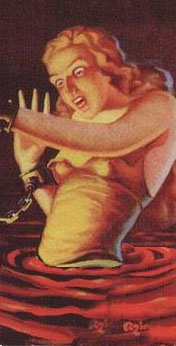
Serpent of the FoldA question I’m asked with surprising regularity is, “Why do you waste money on adventure modules?” It’s a question generally voiced with varying degrees of disdain, and the not-so-hidden subtext lying behind it is that published adventure modules are worthless. There are different reasons proffered for why they should be ignored, but they generally boil down to a couple of core variations:

(1) Published adventures are for people too stupid or uncreative to make up their own adventures.

(2) Published adventures are crap.

The former makes about as much sense to me as saying, “Published novels are for people too stupid or uncreative to write their own stories.” And the latter seems to be derived entirely from an ignorance of Sturgeon’s Law.

On the other hand, I look at my multiple bookcases of gaming material and I know with an absolute certainty that I own more adventure modules than I could ever hope to play in my entire lifetime. (And that’s assuming that I never use any of my own material.)

So why do I keep buying more?

There are a lot of answers to that. But a major one lies in the fact that I usually manage to find a lot of value even in the modules that I don’t use.

Take, for example, Serpent Amphora 1: Serpent in the Fold. While being far from the worst module I’ve ever read (having been forced to wade through some true dreck during my days as a freelance reviewer), Serpent in the Fold is a completely dysfunctional product. It’s virtually unsalvageable, since any legitimate attempt to run the module would necessitate completely replacing or drastically overhauling at least 90% of the content.

A QUICK REVIEW

The only thing worse than a railroaded adventure is a railroaded adventure with poorly constructed tracks.

For example, it’s virtually a truism that whenever a module says “the PCs are very likely to [do X]” that it’s code for “the GM is about to get screwed“. (Personally, I can’t predict what my PCs are “very likely to do” 9 times out of 10, and I’m sitting at the same table with them every other week. How likely is it that some guy in Georgia is going to puzzle it out?) But Serpent in the Fold keeps repeating this phrase over and over again. And to make matters worse, the co-authors seem to be in a competition with each other to find the most absurd use of the phrase.

(My personal winner would be the assumption that the PCs are likely to see a group of known enemies casting a spell and — instead of immediately attacking — they will wait for them to finish casting the spell so that they can spy on the results.)

Serpent in the Fold gets bonus points for including an explicit discussion telling the GM to avoid “the use of deus ex machina” because it “limits the PCs”… immediately before presenting a railroaded adventure in which the gods literally appear half a dozen times to interfere with the PCs and create pre-determined outcomes.

The module then raises the stakes by encouraging the DM to engage in punitive railroading: Ergo, when the PCs are instructed by the GM’s sock puppet to immediately go to location A it encourages the GM to have the PCs make a Diplomacy check to convince a ship captain to attempt dangerous night sailing in order to get to their destination 12 days faster than if the captain plays it safe. The outcome of the die roll, however, is irrelevant because the PCs will arrive only mere moments after the villains do whether they traveled quickly or not. On the other hand, if the PCs ignore the GM’s sock puppet and instead go to location B first for “even a few days” then “they will have failed” the entire module.

So, on the macro-level, the module is structurally unsound. But its failures extend to the specific utility of individual sequences, as well: The authors are apparently intent on padding their word count, so virtually all of the material is bloated and unfocused in a way that would make the module incredibly painful to use during actual play.

The authors are also apparently incapable of reading the rulebooks. For example, they have one of the villains use scrying to open a two-way conversation with one of their minions. (The spell doesn’t work like that.)  More troublesome is when the PCs get the MacGuffin of the adventure (a tome of lore) and the module confidently announced that it has been sealed with an arcane lock spell cast by a 20th level caster and, therefore, the PCs won’t be able to open it. The only problem is that arcane lock isn’t improved by caster level and the spell can be trivially countered by a simple casting of knock.

The all-too-easy-to-open “Unopenable” Tome is also an example of the authors engaging in another pet peeve of mine: Writing the module as if it were a mystery story to be enjoyed by the GM. Even the GM isn’t allowed to know what the tome contains, so when the PCs do manage to open it despite the inept “precautions” of the authors he’ll be totally screwed. And the tome isn’t the only example of this: The text is filled with “cliffhangers” that only serve to make the GM’s job more difficult. The authors actually seem to revel in serial-style “tune in next week to find out the shocking truth!” nonsense.

Maps that don’t match the text are another bit of garden-variety incompetence to be found in Serpent in the Fold, but the authors raise it to the next level by choosing to include a dungeon crawl in which only half the dungeon is mapped. The other half consists of semi-random encounters strewn around an unmapped area of wreckage which are too “haphazard” to map and key. Despite this, the encounters all feature very specific topographical detail that the authors are then forced to spend multiple paragraphs describing in minute detail. (Maps, like pictures, really are worth a thousand words.)

As if to balance out this odd negligence, the authors proceed to round out the final “chapter” of the adventure by providing an exhaustive key to a mansion/castle with 50+ rooms… which the GM is than advised to ignore. (And I mean this quite literally: “In order to [“get right to the action”] have them notice the bloodstains in the entry foyer, and thus, likely, find the bodies. Make the trail that leads to the infirmary a bit more obvious […] it should be easy to keep the PCs moving up the stairs and to the final confrontation with Amra.”) In this case, the advice is quite right: The pace of the adventure is better served if the PCs don’t go slogging through a bunch of inconsequential rooms. But why is a third of the module dedicated to providing a detailed key that will never be used?

Round out the package with a handful of key continuity errors and elaborate back-stories and side-dramas featuring NPCs that the PCs will never get to learn about (another pet peeve of mine) to complete the picture of abject failure.

THE STRIP MINE

I tracked down the Serpent Amphora trilogy of modules in the hope that I would be able to plug them into a potential gap in my Ptolus campaign. Unfortunately, it turned out that the material was conceptually unsuited for my needs and functionally unusable in its execution. So that was a complete waste of my money, right?

Not quite.

To invent a nomenclature, I generally think of adventure modules in terms of their utility:

Tier One modules are scenarios that I can use completely “out of the box”. There aren’t many of these, but a few examples would include: Caverns of ThraciaThree Days to KillIn the Belly of the BeastDeath in FreeportRappan Athuk, and The Masks of Nyarlathotep. Tier One modules might receive some minor customization to fit them into my personal campaign world or plugged into a larger structure, but their actual content is essentially untouched.

Tier Two modules are scenarios that I use 80-90% of. The core content and over-arcing structure of these scenarios remains completely recognizable, but they also require significant revision in order to make them workable according to my standards. High quality examples include The Night of Dissolution, Banewarrrens, Tomb of Horrors, The Paxton Gambit, Beyond the Mountains of Madness, and Darkness Revealed. (For a more extreme version of a Tier Two module, see my remix notes for Keep on the Shadowfell.)

Serpent in the Fold is a Tier Three module: These are the modules which are either too boring or too flawed for me to use, but in which specific elements can be stripped out and reused.

(Tier Four modules are the ones with interesting concepts rendered inoperable through poor execution. Virtually nothing of worth is to be found here, since you’re largely doing the equivalent of taking the back cover text from a book and writing a new novel around the same concept. Tier Five modules are those rare and complete failures in which absolutely nothing of value can be found; the less said of them, the better.)

For example, consider that mansion with high quality maps and a detailed key for 50+ rooms.

Serpent in the Fold - Manor House

That mansion is practically plug-‘n-play. Less than 5% of it is adventure specific. That’s an incredibly invaluable resource to have for an urban campaign (like the one I’m currently running).

But the usefulness of Serpent in the Fold doesn’t end there. I’ll be quite systematic in ripping out the useful bits of a Tier Three module (since I have little interest in revisiting the material again). Starting from the beginning of the module, I find:

Inside Cover: A usable map of a simple cave system.

Page 10: Three adventuring companies are detailed. (These are particularly useful to me because Ptolus feature a Delvers’ Guild full of wandering heroes responding to the dungeon-esque gold rush of the city. Ergo, there’s plenty of opportunities for the PCs to bump into competitors or hear about their exploits. Such groups are useful for stocking the common room of an inn or pub in any campaign.)

Page 25: An interesting mini-system for climbing a mountain. It features a base climbing time and a system for randomly generating the terrain to be climbed (prompting potential Climb checks which can add or subtract from the base climbing time). I’d probably look to modify the system to allow additional Survival or Knowledge (nature) checks to plot the course of ascent (to modify or contribute to the largely random system presented here).

Page 27: A very nice illustration that I can quickly Photoshop and re-purpose as a handout depicting a subterranean ruin.

Serpent in the Fold - Subterranean Ruin A

Serpent in the Fold - Subterranean Ruin B

(As a tangential note: I wish more modules would purpose their illustrations so that they could be used as visual aids at the gaming table. You can make your product visually appealing and useful at the same time, and you’re already spending the money to commission the illustration in any case.)

Page 33: Another useful illustration that can be quickly turned into a handout.

Serpent in the Fold - Giant Serpent A Serpent in the Fold - Giant Serpent B

Page 54-55: A new monster and the new spell required to create them.

The module also features countless stat blocks, random encounter tables, and similar generic resources that can be quickly ripped out and rapidly re-purposed.

So even in a module that I found largely useless and poorly constructed, I’ve still found resources that will save me hours of independent work.

When you’re dealing with a module like Serpent in the Fold that you have no intention of ever using, these strip-mining techniques can be used to suck out every last drop of useful information without any particular care for the husk of detritus you leave behind. But similar measures can also be employed to harvest useful material from any module, even those you’ve used before or plan to use in the future.

The Shakespeare Wars - Ron RosenbaumI’ve been reading The Shakespeare Wars by Ron Rosenbaum and writing short essays in response to some of the more dunder-headed bits of scholastic self-indulgence that Rosenbaum has been discussing. (Rosenbaum also discusses a lot of good stuff, and despite some reservations over the quality of Rosenbaum’s writing, I recommend checking his book out for a good review of current controversies in Shakespearean scholarship.)

Today I want to take a peek at one facet of the debate between the theories of the Lost Archetypes and the Revisions.

To offer a simplistic summary: All modern editions of Shakespeare are based on versions of the plays published during the late-16th and early-17th centuries. All of these texts feature various typo-like errors that must be corrected.

In the case of nineteen plays, however, things get a little more complicated because we have multiple versions of each play published during or near Shakespeare’s life. (For example, we have three extant versions of Hamlet.) In producing a modern edition, the differences between these versions must be resolved in order to produce a single text.

This is where the difference between the Lost Archetype theory and the Revision theory comes into play.

The Lost Archetype theory says that Shakespeare wrote one, authoritative version of each play. In other words, the original manuscript, written in Shakespeare’s own hand, is the Lost Archetype for each play. The differences between the primary sources for a play are the result of different editions making different errors in transcribing Shakespeare’s text, and our goal in rendering a modern edition is to remove these errors.

The Revision theory, on the other hand, says that Shakespeare continued revising his plays throughout his lifetime and that the differences between the various versions of each play are the result of Shakespeare’s rewrites.

For example, the 1604 Second Quarto of Hamlet contains an entire soliloquy which is missing from the 1623 First Folio. Under the Lost Archetype theory, this soliloquy was somehow lost: Perhaps the page was misplaced. Or the typesetter accidentally skipped it. Or the typesetter was working from a theater promptbook that had been cut for length. Basically, there are many different theories to explain how this soliloquy went missing, but the underlying theory is that Shakespeare intended the soliloquy to be part of the play and, therefore, it should be included in the modern text.

Under the Revision theory, on the other hand, the idea is that Shakespeare rewrote the play. At some point between 1604 and 1623, Shakespeare came back to Hamlet and decided to cut that soliloquy. Maybe he cut it for length or pace; or because it was repetitive; or because it cast an inaccurate light on Hamlet’s character. Again, there are many theories for why Shakespeare might have cut it, but the underlying theory is that Shakespeare changed the play and we should ask the question, “Why did he change it?”


TAYLOR’S FOLLY

With these two theories in mind, let’s take a closer look at a particular argument proffered by Gary Taylor (one of the primary advocates for the Revision theory), as shown by Rosenbaum in The Shakespeare Wars:

“There’s always someone standing between you and him. It’s like being at a cocktail party and there may be one person in the room that really interests you most, but there’s other people around, and so it’s like seeing Shakespeare across the room at a party. There’s always going to be parts of him you can’t see, and which parts you do see is partly accidently…”

And yet, he tells me, it was his communion with the inky traces of the compositors and typographers that led him to see, through an ink-smudged glass, darkly, a vision of Shakespeare as a reviser.

It was a reaction to what he calls the “demonization” of the compositors by the partisans of the Lost Archetype who try to blame the variations between the two Hamlets on the inattention, the “eye skip”, the carelessness, the willfulness and wandering eyes of an array of compositors. On the contrary, Taylor believes, “You need only one agent to account for all those variations and that’s the agent who’s present in all these cases: Shakespeare.”

And right there is the point where Taylor’s logic runs aground.

I can say this with a fair degree of confidence for three reasons:

(1) We know that compositors made errors because the publisher would frequently correct them during a print run. In other words, there are differences between the various copies of the 1604 Second Quarto of Hamlet that survive today. I suppose one might still imagine that Shakespeare was actually at the printers, looking over their shoulders and doing rewrites while the book was being published, but…

(2) Compositor errors are not limited to the work of Shakespeare. They can be found in every single book published in this era. The King James Bible is particularly noted by many scholars because it contains so few errors compared to other texts of the era, but it still contains hundreds of known errors. And maybe, like our hypothetical Shakespeare, every author of the era — including the translators of the King James Bible — made a habit of going down to the print shop to make rewrites on the fly, but…

(3) The errors continue long after Shakespeare is dead. For example, the First Folio was published in 1623 (seven years after Shakespeare was dead). Over the course of the 17th century it was followed by the Second Folio (1632), Third Folio (1663-1664), and the Fourth Folio (1685). These later editions are essentially never used in the creation of modern editions because

(a) We know that they were based on the text of the First Folio. (In other words, the typesetters of these later editions were looking at copies of the First Folio or other editions derived from the First Folio.)

(b) They introduce even more errors of the exact same type seen in the earlier texts. (They also attempt to fix some of the existing errors, but since they’re doing so without any reference to a primary text, we have no particular reason to invest trust or value in their decisions.)

This is what I refer to as Shakespeare Myopia. Shakespeare is such a towering figure in English literature that lots of people will study him exclusively. And this, in my experience, results in all kinds of half-assed theories that wouldn’t have any kind of traction if people would look outside of the Shakespeare Box once in awhile.

(Another example of Shakspeare Myopia can be found all over the so-called “Authorship Question”. For example, people looking to discredit Shakespeare’s authorship of his own plays will often declaim the lack of historical evidence we have for Shakespeare’s life. The only problem? We have more documented evidence of Shakespeare’s life than for any other Elizabethan playwright with the possible exception of the always self-promoting Ben Jonson. For those interested in a thorough debunking of the “Authorship Question”, I recommend Irvin Leigh Matus’ exceptional Shakespeare, In Fact.)

SHADES OF GREY

In any case, unless one is willing to believe that Shakespeare was still rewriting his plays as late as 1685, we know for an absolute certainty that at least some of the variances between the texts are the result of typesetting errors and not Shakespeare’s revisions.

And if we have concluded that some of them must be, then doesn’t it make sense to apply Ockham’s Razor and say that all of them are the result of typesetting errors?

Well… maybe.

But misplacing a whole soliloquy seems like quite the slip of the eye, doesn’t it? Maybe we could hypothesize that the soliloquy was on a page all by itself in the manuscript and either that page got misplaced or two pages got flipped over at the same time or… Well, any number of things. But it seems just as likely that the soliloquy was deliberately removed from whatever text the compositor of the 1623 First Folio was working from.

But here we run into two more problems with the Revision theory:

(1) We have no way of knowing who did the revising. It might have been Shakespeare who cut that soliloquy. But it could just as easily have been a theater manager who thought the play was too long. In other instances, of course, words have been added. But it was a well-documented practice for other playwrights to touch-up older works and it remains a common (if often frowned upon) practice in the theater for promptbooks to reflect improvisations from the actors of the current production.

(2) We have no way of knowing which text is the original and which text is the revision. It’s easy, for example, to assume that the 1623 First Folio text of Hamlet would be the revision of the 1604 Second Quarto text. But the 1623 text could just as easily be the copy that Shakespeare originally gave to the Globe Theater to perform in 1600, while the 1604 text is the result of Shakespeare revising the text before submitting it for publication.

Personally, I feel like attempts to apply a one-size-fits-all solution to the relationships between the various primary sources of Shakespeare’s plays is somewhat foolish. Among these theories:

(a) Bad Quartos. The result of pre-copyright publishers trying to surrepititously obtain a copy of a play to publish without paying for it, either by having someone in the theater trying to write down the lines as fast as they can or by hiring a former actor to reconstruct the text from memory.

(b) Revision. Shakespeare rewrote the plays to lesser or greater extents.

(c) Derived texts. Some texts in the First Folio appear to have been set from previously published quartos; some from manuscript (although whether it would be Shakespeare’s original or a scribed copy is often open for debate); some from theater promptbooks.

In my opinion, all of these have some merit. In fact, it makes sense that different texts would have different relationships (both to each other and to Shakespeare). It seems silly to argue that if King Lear was rewritten by Shakespeare, then it must also be true that Shakespeare rewrote Hamlet. (Or, vice versa, that if Shakespeare didn’t rewrite Hamlet, it must be true that he didn’t rewrite King Lear.)

But this is so often what happens: Somebody comes up with a nifty theory and then they try to apply it everywhere. They overreach.

For example, A Midsummer Night’s Dream exists in three primary sources: The 1600 First Quarto, 1619 Second Quarto, and 1623 First Folio. We are almost completely certain that the 1619 Second Quarto was set from a copy of the 1600 First Quarto (based on textual similarities in which the 1619 text duplicates the unusual spellings, incorrect speech attributions, typographic features, and various other errors of the 1600 text in a way that only makes sense if the compositor of the 1619 text were looking at the 1600 text).

In most cases, therefore, moden editor would largely ignore the 1619 text as a mere reprint. But here it gets weird because the 1623 First Folio was almost certainly set from a version of Q2 (once again we have similarities between the texts, but where the 1619 Second Quarto differs from the 1600 First Quarto, the 1623 First Folio always follows the 1619 Second Quarto). And, once again, we would normally ignore this text… except that information from the theater’s prompt-book has apparently been added to it.

(How do we know it was a prompt-book? Several bits suggest it, but the clincher is a stage direction in V.1: “Tawyer with a trumpet before them.” Tawyer was the name of a company member, not a character.)

Dover Wilson postulated that a copy of the 1619 Second Quarto must have been used as a prompt-book at the Globe and then that prompt-book was used to set the type for the 1623 First Folio. Some doubt has been cast on this theory due to errors in various entrances and exits (which would never be tolerated in a theater manager’s copy of the script), but it seems more likely that those errors were introduced by the compositor.

The result is that we have a very clear textual lineage for these scripts: The 1600 First Quarto was published from some unknown source. The 1619 Second Quarto was set from the 1600 edition and was accurate enough that the theater started using it as their promptbook, which was then used (in turn) for the 1623 First Folio.

But I think it would be foolish to draw any broad conclusions from this. (For example, by assuming that all First Folio texts were printed from theater promptbooks.) When it comes to the history of Shakespeare’s texts, there are no easy answers. No one-size-fits-all solutions that will remove all doubts. (In this, they are much like the plays themselves.)

Current Projects

November 16th, 2009

I know things have been pretty quiet around here of late. I’m afraid that’s because everything else in my life has been so ridiculously busy. So, on that note, here’s a quicky summary of upcoming projects I’m involved with:

Rabbit Hole - South High School

I directed David Lindsay-Abaire’s Pulitzer Prize-winning Rabbit Hole for South High School. Most high school theater can only be loved by the parents, but South High Theater sets a higher standard for itself and Rabbit Hole achieves it. (I may be biased, but if it didn’t, then I wouldn’t be promoting it here.)

Rabbit Hole has two performances left: November 19th and 20th (Thursday and Friday), both at 7:30 PM. Reserve your tickets and check it out.

Complete Readings of William Shakespeare

I’ve also founded the American Shakespeare Repertory, and we’re getting ready to kick-off our inaugural project: The Complete Readings of William Shakespeare will present every play, poem, and sonnet (along with a sampling of the apocrphya) from 2009-2011.  It represents the unique opportunity to experience in performance all of Shakespeare’s masterpieces, including those rarely or never seen, in a way that hasn’t been possible since the King’s Men originally performed them 400 years ago.

On November 23rd, the series premieres with MACBETH at the Gremlin Theater. Join us for a night of blood, murder, and mayhem as Shakespeare’s darkest tragedy is brought to vivid life.

STARRING
Macbeth – Justin Alexander
Lady Macbeth – Elizabeth Grullon
Macduff – Neal Beckman
Lady Macduff – Amanda Whisner
Malcolm – Jordon Johnson
Witch 1 – Gail Frazer
Witch 2 – Susannah Handley
Witch 3 – Hannah Steblay
Angus/Siward – Ann Gerstner
Donalbain – Kelly Bancroft
Fleance/Young Siward – Emma Mayer
Lennox – Sarah Martin
Ross – Gabe Heller
Seyton – Martha Heyl

Stage Manager: Sarah Holmberg

SPONSORED BY
Gremlin Theater’s Corleone: A Shakespearean Godfather

And coming soon…

Two Gentlemen of Verona – December 2nd – Pillsbury House Theater
Coriolanus – December 9th – Open Eye Figure Theater
Twelfth Night – December 16th – South High Skybox Theater

AND BEYOND…

In January I’ll be appearing in Starting Gate’s production of Moss Hart’s Light Up the Sky!

In May I’ll be assistant directing Walking Shadow Theater’s production of Trasndimensional Couriers Union.

… AND HERE AT THE ALEXANDRIAN

I’ll be doing my best to get back to regular updates and fresh content. Promise.

Gateway - Frederik PohlI often think of Gateway as being the last great hurrah of the Golden Age of Science Fiction. Although published in 1977, to me it has always felt like a Campbellian classic — as if it should be a contemporary of Childhood’s End or the Foundation Trilogy. A throwback to the 1950’s.

I probably wouldn’t have that impression if I had been reading science fiction when Gateway was published, but there it is.

And there’s really no denying, in my opinion, that Gateway‘s crowning achievement is the perfect melding of multiple branches of the science fiction tree.

On the one hand there is the Big Concept: The Gateway itself. A concept so breathtakingly original that people have been imitating it ever since. (Basically, it goes like this: Humans find a space station abandoned by aliens. Inside they find hundreds of ships. They don’t know how the ships work, but they can operate the auto-pilot. Brave prospectors board the ships, hit a button, and go God-knows-where in the search for Heechee technology.)

Hidden within that Big Concept are the hints of space opera: Small bands of adventurous heroes journeying into the unknown on missions of thrilling exploration.

But while Pohl teases us with the structure of space opera, he weds it to the best literary traditions of hard science fiction: His prospectors are exploring the cold, hard worlds and braving the impossible terrors laid bare by the cutting edge of science. And rather than proving indulgences, the carefully extrapolated detail of the milieu is instead used to provide dramatic sauce for the goose.

Meanwhile, wrapped around all of this, Pohl is tapping the alternative literary structures and deep, psychological characterizations of the New Wave to illuminate the personal struggles of Robin Broadhead, one of the richest and most rewarding characters in science fiction.

The plot of Gateway doesn’t merely happen; it is made painfully relevant by the effect it has on Broadhead. Indeed, the greatest triumph of the novel is the creation of Broadhead: A deeply sympathetic, flawed, and yet (on some very real level) noble human being. His transformation — revealed through complex and interwoven flashbacks and flashforwards — is the heart and soul of the book, lending true meaning to the amazing universe that Pohl has crafted.

In short, Gateway pushes all the buttons. It’s a true highlight of what the science fiction genre is capable of achieving.

GRADE: A+

Frederik Pohl
Published: 1977
Publisher: Del Rey
Cover Price: $14.95
ISBN: 0345475836
Buy Now!

The Shakespeare Wars - Ron RosenbaumI’ve recently been reading The Shakespeare Wars by Ron Rosenbaum. The book is far from perfect (Rosenbaum has a tendency to circle around a topic in endless repetitions and effusing instead of explaining), but it does offer a rather nice survey of several scholastic controversies currently swirling around Shakespeare’s works.

And thus, of course, it provides me with ample opportunities to brush up against the uniquely eruditic idiocies that only literary scholars seem capable of.

If you’re looking for the really interesting, fascinating material, then you should hunt down a copy of The Shakespeare Wars and dig in. For an explication on the stupid stuff, just buckle your seat belt and hang on for the ride.

I’m going to start by discussing a scholarly emendation of a line from Hamlet. The actual bit of dialogue being discussed is relatively minor in the grand scope of things, but I think it serves as a more-than-adequate example of the hubris and foolishness to be found in much of Shakespearean textual work. (In the bigger picture, this seems almost inevitable: Ask several thousand PhD candidates to masticate the well-worn corpse of Shakespeare’s work every single year and you’ll end up with all kinds of crazy shit being postulated by people desperate for a thesis statement.)

Before we begin, let me lay out some groundwork: All modern editions of Hamlet are based on three source texts — the Bad Quarto (Q1); the Good Quarto (Q2); and the First Folio (F1). The first two texts were published during Shakespeare’s lifetime (although not necessarily with Shakepeare’s direct involvement) and the last was the first complete collection of Shakespeare’s plays (published after his death in 1623). All of these editions differ from each other. (The Bad Quarto is significantly different and is theorized to be a text reconstructed from memory by an actor who performed in a touring production.) The exact reasons for these differences is under debate (something I’ll touch on in a later essay), but at least some of the differences are the result of the typesetters making mistakes. Thus, modern editors are faced with imperfect, conflicting texts and must figure out how to edit them in an effort ot produce a clean and accurate version of the play.

With that in mind, let’s take a look at an excerpt from Chapter Two of The Shakespeare Wars:

In 1997, when Harold Jenkins, former Regius Professor at the University of Edinburgh and editor of a leading scholarly edition of Shakespeare’s play, went to see Kenneth Brannagh’s film version of Hamlet, he was both excited and nervous. Sitting in his home two years later, the ninety-year-old scholar became animated as he described to me the anticipation he felt as the play reached the seventh scene, in the fourth act, when Laertes, huddling with Claudius, reacts to the news that Hamlet is back in Denmark.

It’s a moment in which Jenkins had made a crucial single-word change in his influential, encyclopedic Arden edition of Hamlet, and he wondered whether Branagh would adopt his emendation. “I listened to see what was coming,” Jenkins told me. “What would [Laertes] say?”

On screen the actor playing Laertes turned to the King and told him, apropos Hamlet (who had killed [Laertes’] father): “It warms the very sickness in my heart / That I shall live and tell him to his teeth / ‘Thus diest thou…'”

“Thus diest thou! Yes!” the dapper, mild-mannered Jenkins exclaimed with all the fervor of a soccer fan celebrating a goal. “He got it right. And of course it is so much more effective.”

Effective or not, Jenkins believes he is not “improving” Shakespeare but restoring to us Shakespeare’s own long-lost word choice. In the two most substantial early texts of Hamlet that have come down to us from his time — the 1604 Quarto and the 1623 Folio versions — Laertes doesn’t say, “Thus diest thou.”  He says “Thus didst thou” in one and “Thus didest thou” in the other.

But Jenkins believes that what he has done is recover the word Shakespeare wrote with his own hand and quill — before it was corrupted through carelessness in the printing house or the playhouse.

Jenkins is wrong.

I say this for two reasons:

(1) You have only two sources of information. They are both telling you the exact same thing. The only possible reason to suspect that they’re both lying to you is if the resulting sentence were nonsensical. But it isn’t nonsense. It makes perfect sense. Ergo, there is no rational reason for making any sort of change.

(2) Within the context of the play, “Thus didst thou” is poignant and specific: Laertes is planning to kill Hamlet the same way that Hamlet killed his father, and in that moment of revenge he wants Hamlet to understand exactly why he’s being killed. “Thus diest thou”, on the other hand, is generic. So you’re not only changing the line for no particular reason, you are simplifying it and robbing it of its specific and dramatic content.

Now, here’s the important thing: You see #2 up there? I think it’s an interesting point. But it’s also completely irrelevant. Whether I think “didst” is more interesting than “diest” is meaningless when it comes to making reasonable corrections to the text of Hamlet. It’s just as irrelevant as Jenkins’ opinion that “diest” is “much more effective” than “didst”.

And let’s be clear: It’s certainly possible that Shakespeare wrote “Thus diest thou”. But by the same token it’s just as likely that he wrote “Why didst thou”. Once you go looking for words that could be different (without any indication that they should be different), you’ve turned all Shakespeare into a scholastic mad lib.

OF MOONS AND MURALS

I think there’s also something perverse about looking for problems where none exist when there are plenty of places in Shakespeare’s works where we have actual problems… some of them without any clear solution.

In Act 5, Scene 1 of A Midsummer Night’s Dream there is a play-within-a-play. During that play, the character of Wall exits the stage and one of the audience members says, “Now is the mural down between the two neighbors.”

Or, at least, that’s what it says in many modern editions of the play.

But we have only two primary sources for A Midsummer Night’s Dream: The First Folio (1623) and a quarto edition (1600).

The 1600 Quarto reads: “Now is the Moon used between the two neighbors.”

The 1623 First Folio reads: “Now is the morall downe between the two neighbors.”

These lines don’t make any sense. Clearly something is wrong. In 1725, Alexander Pope — the first English poet to make a living from sales of his published work — produced an authoritative edition of Shakespeare’s plays. In that edition, he created the emendation “mural down”.

But using the word “mural” to mean “wall” was something that Pope made up out of wholecloth. (In many dictionaries you will, in fact, find the origin of this definition cited to A Midsummer Night’s Dream.) But what are the odds that Shakespeare made up a word, the typesetters screwed it up, and then Alexander Pope reinvented it?

Many modern editions (including, for example, the Oxford edition) instead render this line as: “Now is the wall down between the two neighbors.” In doing so, they are imitating a line Bottom has later in the scene, when he says, “No, I assure you, the wall is down that parted their fathers.”  Is that right? I dunno. It certainly sounds more plausible to me than “mural”. On the other hand, it has a significant influence on Bottom’s line — so if it isn’t right, the impact is felt beyond this single line.

SULLIED vs. SOLID

Here’s another fun one. Pretty much everyone is familiar with Hamlet’s famous soliloquy which begins, “O that this too, too solid flesh would melt…”

At the moment, however, there’s a significant debate about this line because Q2 reads: “O that this too too sallied flesh would melt…”

But here’s the weird part: The argument isn’t that “sallied” is the correct word (although the image it conjures forth of sallying forth to defend a besieged location is interesting, particularly since Hamlet immediately goes on to equate the situation to God turning a “cannon ‘gainst self-slaughter”… although you’ll also find the word “cannon” changed to “canon” in many modern editions). Instead, the argument is that the word should be “sullied”.

(You may find a few references online claiming that “sullied” comes from Q1. As far as I can tell, this is not true. Q1 also uses the word “sallied”, and you can see it online.)

What’s the truth here? Well, given a choice between either:

(a) Picking one version of the text and then using it exactly as it appears; or

(b) Picking one version of the text and then emending it to something else

I think (a) is the better bet if you’re looking to play the odds. On the other hand, given a choice between:

(a) Picking a word which appears in one good edition; or

(b) Emending a word found in one good edition and also used in a bad edition

I think the question becomes a bit hazier.

I’m sticking with “solid” for now… but I could be wrong.

Archives

Recent Posts

Recent Comments

Copyright © The Alexandrian. All rights reserved.