The Alexandrian

In “Revisiting Encounter Design“, I make the argument that 3rd Edition plays better if you use old school encounter design. To briefly sum up:

  1. Design most encounters around an EL 2 to 4 lower than the party’s level.
  2. Feel free to use large mobs (10+ creatures) with an EL equal to the party’s level.
  3. Sparingly use encounters with an EL equal to the party’s level.
  4. Occasionally throw in an EL+2 or EL+4 encounter.

Using this encounter design results in faster combats (which means you accomplish more in a typical game session) and drastically reduces the likelihood of the 15 minute adventuring day.

This advice is not radically different from that provided in the 3.5 DMG, which suggests that encounters should be 30% with ELs lower than the party’s level, 50% with ELs equal to the party’s level, 15% with ELs 1-4 higher than the party’s level, and 5% with ELs 5+ above the party’s level. (Let’s call this the 30/50/15/5 ratio for easy reference.)

THE ANALYSIS

The Forge of FuryThis 30/50/15/5 ratio was not atypical in early 3rd Edition modules. For example, here’s the EL breakdown of combat encounters in the first section of The Forge of Fury (designed for a group of 3rd to 5th level characters):

EL 1
EL 2 (x7)
EL 3 (x3)
EL 4 (x4)
EL 5 (x4)
EL 10

If we use an average party level of 4th, this ratio breaks down to: 55/20/20/5. Not an exact match, obviously, but definitely within the ballpark of having 80% of your encounters equal to your lower than the party’s level.

Curse of the Crimson ThroneBut as you look at modules published in the last 5-6 years, the misguided “common wisdom” of how to design encounters for 3rd Edition had taken hold. For example, here’s the encounter breakdown from part four of Paizo’s Curse of the Crimson Throne (designed for 10th level characters):

EL 8
EL 10
EL 11 (x2)
EL 12 (x2)
EL 13
EL 14 (x3)

That’s a ratio of 10/10/80/0. 80% of the encounters are now above the party’s average level instead of below it.

Fane of the DrowYou can see the same design principles in Wizard’s modules. For example, here’s Fane of the Drow (designed for 4th level characters):

EL 3
EL 4 (x4)
EL 5 (x5)
EL 6 (x5)
EL 7 (x2)

Which is roughly 5/25/70/0.

Similarly, here’s the breakdown from “The Demon Council”, the last section of Expedition to the Demonweb Pits (for 11th level characters):

EL 10 (x2)
EL 11 (x3)
EL 12 (x10)
EL 13 (x4)
EL 14 (x2)

Which gives us a ratio of 10/15/75/0. (This one looks a little better if you assume that the PCs are supposed to level up to 12th halfway through this sequence.)

THE TIP

A couple weeks ago, as I looked over my recent usage of published 3rd Edition scenarios, I realized that I’ve been instinctively using modules published in the last 5-6 years when the PCs are 2-3 levels higher than the recommended level.

For example, when you apply this guideline to the modules used above you end up with:

  • Curse of the Crimson Throne 4: 50/10/30/0
  • Fane of the Drow: 60/30/10/0
  • “The Demon Council”: 70/20/10

Which definitely slants them back into the ballpark of what we’re looking for.

Reflecting on this also taught me something new: The tips in “Revisiting Encounter Design” are designed to widen the dynamic range of your encounters. Shifting the recommended level for these published modules made me realize that we’re also widening the dynamic range of our adventure design.

Fane of the Drow, for example, isn’t unachievable for 4th level characters. But it is a tough slog. And if you use “tough slog” as your baseline for normalcy, then you have nowhere to go: If your 4th level characters face anything tougher than this, their odds of dying horribly begin to skyrocket. Which means that if your 4th level characters “skip ahead” or take an unexpected shortcut, they could easily run headlong into a deathtrap.

But if Fane of the Drow is, instead, your expected baseline for 5th or 6th level characters, suddenly you’ve got room to breathe.

And where would having room to breathe become particularly important? Node-Based Scenario Design.

Revising your approach to encounter design allows you to be more fluid and dynamic in how you run and combine your encounters; it also allows you be more fluid and dynamic in how you run and combine your scenarios.

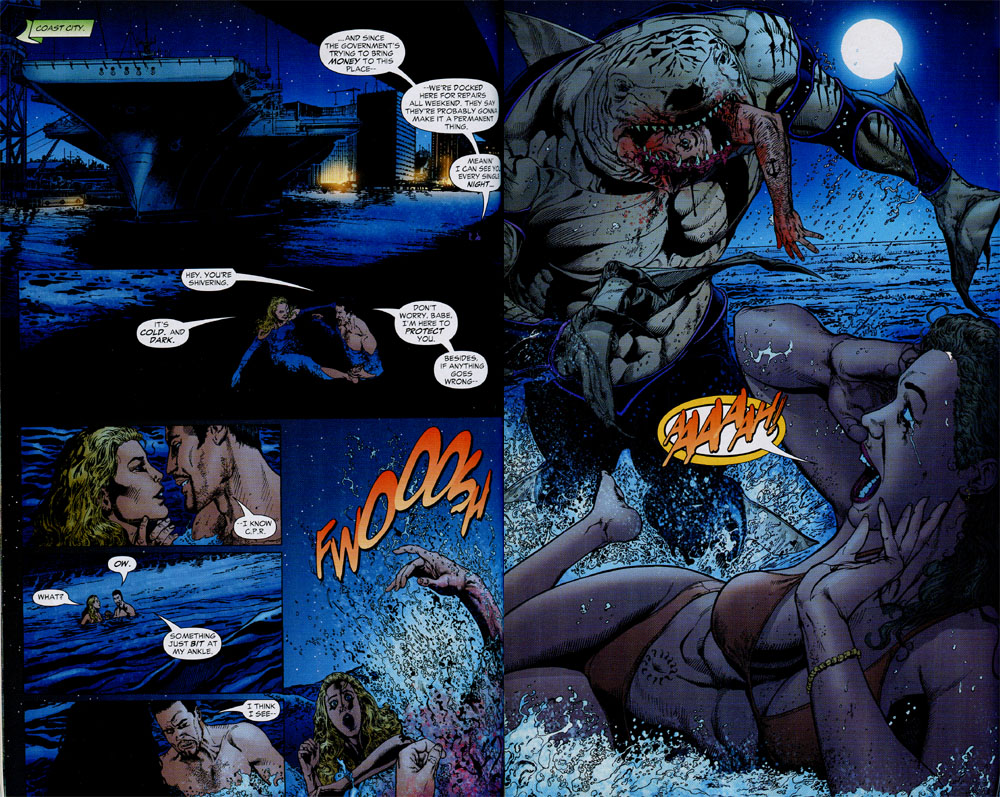
Battle for the Cowl - DC ComicsYou know the story I never need to read again? It’s the one where some vigilante comes to Gotham City and says, “I’m going to use guns and kill criminals. ‘Cause I’m a bad-ass and I’ve got the guts to do what Batman can’t.” And then, ya know, something goes wrong: A kid or a cop gets caught in the crossfire. It turns out the “criminal” was actually innocent. Commissioner Gordon won’t stand for it. Batman says, “Stop being a dick.” Whatever.

Throw in a quote about “staring into the abyss” if you want to get really “edgy” about it.

(And, no, changing it to a flaming sword doesn’t make it “fresh and exciting”. Cut it out.)

This story has been D.O.A. for awhile now, but the recent Battle for the Cowl mega-plot in the Batman comics uses this plot (I kid you not) three different times.

What really cements the creative bankruptcy involved here, however, is that Battle for the Cowl exists specifically because Batman is missing. And Batman is missing specifically because he broke his own rule and fired a gun. Which means that there was actually an opportunity here to take this tired, weary story and breathe a little fresh, legitimate life into it by using it to explore and comment on the decision that Batman had made.

Unfortunately, all three of the writers involved were too busy beating this dead horse to notice the opportunity that was passing them by.

Infinite Crisis - DC ComicsStep 1: I have just read some interesting things about recent DC continuity and would like to check it out.

Step 2: Let’s try Infinite Crisis.

Step 3: Ah, there’s a Countdown to Infinite Crisis. I should read that first.

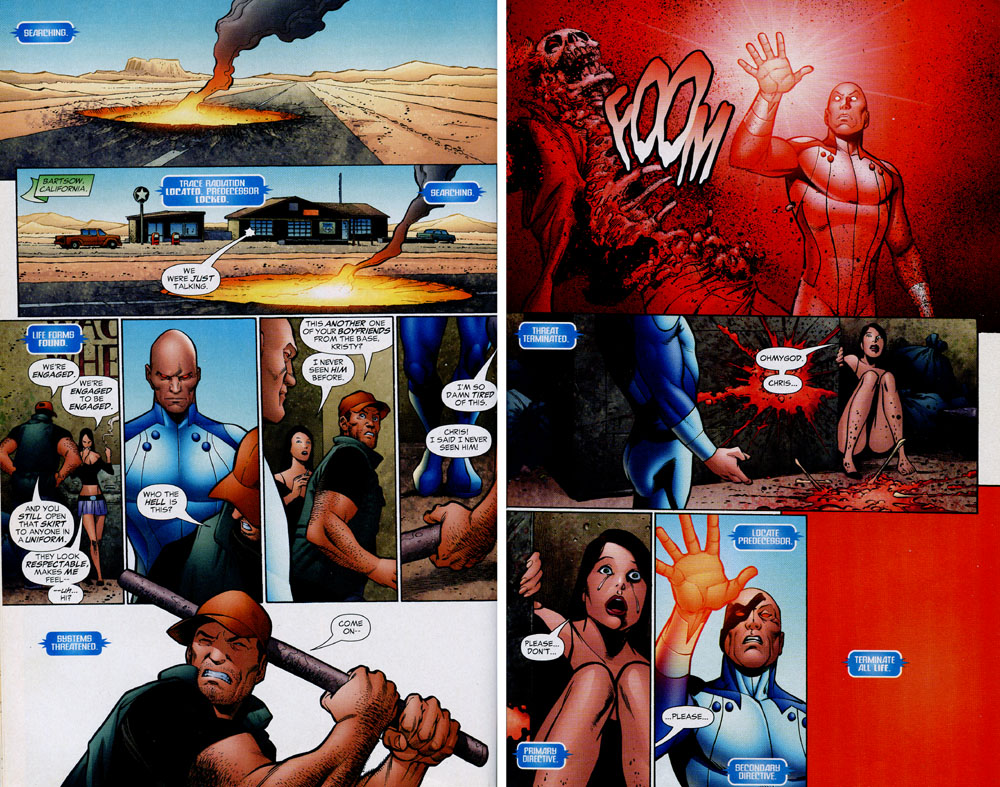
Step 4: Hmm… Apparently this ties into a bunch of mini-series leading up to Infinite Crisis. Some googling reveals The OMAC Project, Rann-Thanagar War, Days of Vengeance, Villains United, and The Return of Donna Troy.

Step 5: And some more googling tells me what order I should read them in. Also, I seem to have missed a Prelude to Infinite Crisis

Step 6: … and these mini-series wrap-up in several specials. When should I read those?

Step 7: Oh. Intermixed semi-randomly between the seven issues of Infinite Crisis.

Step 8: Okay, now I can start reading.

Step 9: Three issues into The OMAC Project and apparently the “story continues” with Superman: Sacrifice. Can I just skip that and keep reading this series? … Nope. Nothing makes sense. (In fact, it turns out that Superman: Sacrifice contains the event which arguably triggers the entire Infinite Crisis.)

Step 10: … and Superman: Sacrifice is split across three different Superman comics and a random issue of Wonder Woman.

Step 11: Okay. Tracked those down. I’ll continue reading…

Step 12: And then Infinite Crisis sucked.

(Some of the mini-series were pretty decent, though.)

Why is DC Comics asking me to do this much homework in order to simply read their books?

Admittedly, only some of this material was actually crucial for understanding and appreciating Infinite Crisis (insofar as that drek could appreciated on any level). But that doesn’t actually help, because I had absolutely no way of figuring out which bits weren’t essential until after I’d read them. (And it’s not as if I tried to seek out every issue of DC that crossed over with Infinite Crisis. These are just the major backbones of the event.)

If Marvel and DC really feel it’s important to create this kind of convoluted, multi-title, overlapping continuity, I say more power to them. But, if so, then it would really behoove them to put together reading lists so that readers who are interested in their comics can trivially figure out what they need to read.

Having cleared Infinite Crisis, I proceeded to 52 — which was delightfully straight-forward, except for the bit where you read issues #1 thru #50, then stop and read World War III #1-4, before finishing with 52 #51-52. (This problem, at least, is cleared up in the collections.)

But now I’m trying to figure out Countdown to Final Crisis and, as far as I can tell, it is literally impossible to put together a reading order for its penumbra of narrative. (In fact, all I can find online are people saying, “I dunno.”)

Below the “Read More” barrier, however, I have included my reading order for the first chunk of the modern crisis era at DC Comics (for anyone who might find it useful). I have included my personal grades for each story in parentheses after each title.

Read more »

While some ivory scraps can be scavenged from the tusks of beasts, most ivory is mined. In an age long lost, behemoths trampled the land beneath feet which could crush the metropoli of this modern era. Their cylcopean corpses, buried now in vast elephantine graveyards beneath the surface of the earth, have left behind vast deposits of ivory.

The mines themselves are fantastical, but so are the crafts which this mined ivory allows. In the real world, one cannot find slabs of ivory as tall as a man (or taller). One cannot pave royal throne rooms with it. One cannot carve life-size statues from it. Nor can one marvel at the Ivory Palaces of the Seven Island Caliphates.

Stat Blocking with the Barghest

February 21st, 2011

Jeffrey challenged me to a barghest stat block using the “3rd Edition rules; 4th Edition format” style I talked about yesterday.

As I mentioned to Jeffrey in the comments, the first thing I needed to do was fix the barghest: Designing a monster so that you need to apply new HD to it in the middle of combat is just bad design. Oddly, the designers of 3rd Edition knew this, which is why they included a negative level template (-1 on all checks, -5 hit points, -1 effective level, lose your highest level spell and your highest level spell slot). It seems pretty obvious to me that the way to fix the barghest is to reverse this template (as shown in the stat block below).

Jeffrey also made the point that 3rd Edition’s “laundry-list” of spell-like abilities can be difficult to make work with a 4th Edition-style stat block. I believe the trick of that is to simplify the spell descriptions down to “essential information”. (On the rare occasions when you need more detailed information on the spell, that’s when you crack open the reference manual.)

What really made me interested in rising to the challenge, though, were some thoughts I had on how the 4th Edition-style stat block could be used for shapechangers. Traditionally, I’ve simply gotten in the habit of prepping multiple stat blocks for shapechangers (so that when they change shape, I can just swap stat blocks). But I had some thoughts on color-coding that might make it possible to run them from a single stat block: The colors on the stat block below are coded to conditions described in the monster’s ability. (In this case, coded to different shapes.) The monster can only use colored abilities when the code is in effect (e.g., that shape has been assumed). Black text can always be used.

There are some formatting errors below, but the process I used to build these stat blocks is time-consuming to correct. (So I apologize for being too lazy to fix them.) I have concluded, in retrospect, that supernatural and spell-like abilities should be coded to icons to further clean-up the lay-out, but that hasn’t been executed.

Barghest - 4th Edition Style Stat Block

UPDATE: And since I’ve got too much time on my hands, here’s a balor:

Read more »

Archives

Recent Posts

Recent Comments

Copyright © The Alexandrian. All rights reserved.